Showing posts with label artificial intelligence. Show all posts

Thursday, May 21, 2026

The joy of knowing

 Why do we have to learn things when we can just ask Google or ChatGPT? A friend told me recently about a conversation with a child when they were doing a puzzle together about capital cities. The child asked my friend why she knew so many capital cities and she said that she had memorised them. The child then wondered why she should spend time memorising such information when the answer is only a click or two away. A logical question really and it has become a reflex action to reach for your mobile whenever you're not sure of something. I sometimes get frustrated when I ask someone if they can give me directions of if they know how to fix something and they simply reply "just google it". The reason I ask is to engage in some conversation or to gain from their advice. I know I can find some kind of answer on YouTube or a web search (I don't google anymore) but prefer to ask.

It's ironic that trivia quizzes are so popular today when the answers are nearly always a few quick clicks away. There are usually strict rules to keep mobiles out of reach during quizzes and the joy of such activities is finding how much you actually know. We feel pride in what we have learnt over the years, whether it is knowledge in a particular subject area or everyday trivia. Getting an instant answer from a chatbot gives us no sense of achievement at all. 

Learning is hard work but gives us great satisfaction and pride when we find that we have mastered a skill or can remember important facts. This is particularly true with the information we learn in our hobbies. I have spent a significant part of my life learning all sorts of useless information about nature, history, sport, railways, music, languages and indeed the capital cities of the world. I get a real kick when I am able to use this knowledge and can amaze my friends. Admittedly 95% of this personal information archive will never be used except in my own head but sometimes, in a quiz for example, it suddenly comes to use. 

Increasingly we hear of  AI-enabled literature, art or music but for me these are empty vessels, devoid of human experience. They can never be more than decoration or background noise because they convey no human experience and required no thought or skill to produce. I could certainly generate this post with AI and it could well be better written, but it would not be mine and give me no sense of achievement no matter how many views it got. When I read in languages that I haven't mastered I prefer to struggle and work out the meaning myself with the help of an old-fashioned dictionary than to simply use the camera function in Google Translate. I am rather proud to have read books in, say Finnish, even if I probably missed many nuances and guessed or skipped a few words on each page. Using Google Translate wouldn't give me any satisfaction. That's the reward for years of painstaking memorising and practice and that's why we keep on struggling to learn even when there are tempting shortcuts.


Wednesday, March 18, 2026

Escaping the clutches of big tech - initiative from Norway

Photo by Nicolai Berntsen on Unsplash

At last there seems to be some serious resistance to the monopolistic dominance of big tech, the empires of the tech billionaires. The term enshittification, coined by Cory Doctorow a few years ago has now gained mainstream acceptance: read more about this in a post I wrote a couple of years ago, The "enshittification" of the internet - we know it's bad for us but we're hooked. Digital platforms and services that initially offered genuinely useful and attractive services for users have been slowly and deliberately degraded (for the users) by increasingly promoting adverts and paid content at the expense of the useful functions the user originally signed up for. Once users and advertisers are locked in then the companies add subscriptions for previously free functions, increase fees for advertisers and sell user data to the highest bidders. They hold users and advertisers hostage since the platforms are so big and powerful that you simply can't afford not to be there. If competition comes along big tech just buys them creating de facto monopolies. The unprecedented global power wielded by the Big Five (Google, Amazon, Meta, Microsoft and Apple) mean that users, companies and governments are all helplessly trapped in their walled gardens. You and all your content can be instantly removed from the platform without explanation or right to appeal. Indeed it's hard to appeal when you don't know what you have done wrong as I found out a few weeks ago. We are no longer customers and the concept of customer service beyond an exasperating chatbot is becoming extremely rare.

But maybe a backlash is coming. The Norwegian Consumer Council, together with other similar bodies in Europe, has released a report on the dangers of enshittification with concrete policy recommendations for the EU and European govenments, BREAKING FREE – Pathways to a fair technological future. They define the issue thus:
Enshittification is the result of a dysfunctional market, where companies have been able to get away with mistreating and exploiting consumers. Consumers are trapped in digital services, potential competitors are shut out, and policymakers and regulators are unable or reluctant to clamp down on anticompetitive, illegal and otherwise abusive behavior. In practice, a handful of tech companies have become so powerful that they do not have reason to fear any consequences. 
To make people realise how far this phenomenon has gone they have produced a satirical video showing how companies make their products increasingly "shitty".


We are becoming trapped in the walled gardens of big tech and it's very hard to escape. In recent years I have tried to at least reduce my dependence by using a European browser (Vivaldi), a non-tracking search engine (Duckduckgo), an alternative music streaming service (Tidal), a European storage, calender and mail service (Proton) and an open source office suite (LibreOffice). But here I am blogging on Google's Blogger platform, I still use Google Maps, YouTube, Instagram, Whatsapp etc. My banishment from Facebook should have been a relief but I really miss my communities and network there. As in the old Eagles song: You can check out any time you want but you can never leave

An alternative suite of social media services, the Fediverse, has existed for several years with built-in portability and interoperability. These include Mastodon as an alternative to X, PeerTube for YouTube, Pixelfed for sharing images and many more. They work but the problem is how to move all your own contacts into those services.

AI is of course a key element in this process. Big tech owns the tools and are integrating AI into almost everything, in many cases as a feature that you cannot remove and certainly can't ignore.

Generative AI is to a large degree driven either by the incumbent big tech companies or by companies with strong financial connections to these companies. It is also evident that big tech companies want to lock users into their generative AI services, to capture an emergent market and further entrench their dominance. 

Our search requests are now reliant on AI, often leading to misleading or biased results. Our "smart" devices from TVs and fridges to cars and homes are AI-enabled allowing big tech to harvest vast amounts of personal data on users' lives. All devices require frequent updates and standard functions can suddenly become premium features at an extra expense as shown amusingly in the final part of the video. Whether you like it or not you are forced to become reliant on AI and even more helpless to work things out for yourself. The days of fixing your car in the garage at weekends or mending electrical appliances in the home are well and truly dead. Everyday life without an app-ridden smartphone is virtually impossible.

The report is well researched and provides many examples and references. The final chapter proposes a number of recommendations that offer the hope of an alternative internet with interoperability between platforms and services and freedom for users to change platforms without losing their contacts or content. 

  1. Rebalance power between service providers and consumers.
  2. End dependence on big tech. To lay the groundwork for innovative products and services and pave the way for alternatives to big tech, competition in digital markets must be restored.
  3. Double down on the enforcement of existing laws.

Innovation and competition have been effectively stifled as it is impossible to challenge big tech's dominance. The report recommends that governments invest in new solutions that are based on openness, interoperability and portability. There are indeed regulations and guidelines in place to combat monopolistic practice but they are poorly implemented and the tech giants can easily avoid taking any responsibility - they are too big to care basically. The report urges European authorities to seriously challenge big tech and implement regulations vigorously.

This is very admirable and I hope the report has some effect but in today's toxic political climate I am not confident that much will change. The EU is far from united on any issue and many governments are either governed by neoliberal right-wing parties and their allies or are too afraid to challenge those parties and their followers. Big tech funds and embraces the march of Trump-inspired authoritarianism and will fight to prevent anyone from threatening their dominance. The report urges the public sector to lead the change by moving away from dependence on big tech. Indeed, there are already examples of municipalities that have switched from Microsoft to open source software.  

For example, Denmark, Germany and Austria are trying to swap out their proprietary (Microsoft) software for the open-source alternative LibreOffice. The German state administration of Schleswig-Holstein estimate they will save 15 million euros by not purchasing Microsoft licenses annually, whereas the open-source alternative is a one-time investment of nine million euros.

Vast savings could indeed be made but logic is sadly lacking in modern politics. We seem unable to imagine an alternative to the existing order, even if we see how harmful it is for us. This applies not only to technology but also on a global scale to our lifestyles that are accelerating us towards catastrophic climate change. But all signs of resistance must be applauded and encouraged and I would love to see this report stimulating serious discussions in the media and in politics. I am not confident but try to hope for better times.


Saturday, March 23, 2024

Mass personalisation - when every cafe looks the same

Photo by shawnanggg on Unsplash

Remember when you first used Amazon and they offered recommendations of other books you might like based on what you had bought or browsed on the platform? Often the recommendations were very much in line with your tastes and you discovered new books or music. Google searched for results that matched your browsing, giving you a personalised search service. We felt served, but today we feel used and manipulated by algorithm-driven recommendations that are now extremely commercialised. If you keep getting fed music or literature that you already like you'll never discover anything new. It's a bit like the radio stations that promise to play only hit music - that means you'll never hear anything new until after it has become a hit. The trap of personalisation becomes even more worrying when you show interest in more extreme political views and the algorithms offer you increasingly extreme material until you see very little else. Add to that the power of influencers on social media and our flock instinct and the result is a global streamlining. In the end everything looks or sounds roughly the same.

This streamlining is the subject of a fascinating podcast and article on The Verge, How to save culture from the algorithms, with Filterworld author Kyle Chayka. Kyle is the author of a book called Filterworld: How Algorithms Flattened Culture, about how global trends are created on a viral scale, via social media and streaming services.
It’s a book about how digital platforms like Instagram, TikTok, and Spotify took over our modes of cultural distribution in the past decade. Algorithmic recommendations, like TikTok’s For You feed or Netflix’s homepage, control the majority of what we see and hear online. Though they promise personalization, the net result of so many algorithms is a homogenization of culture.
Mass personalisation leads in the end to a final common denominator, as in all the trendy cafes, restaurants and BnBs looking very similar no matter where they are in the world.
I was traveling around the world quite a bit and landing in all these different cities, and I would notice that every Airbnb I stayed in had the same kind of aesthetic signature, every coffee shop I went to in Reykjavík or Kyoto or LA or Berlin all had the same stuff in it, and I just started wondering or almost being anxious about why all the sameness was happening
Products, services, trends and influencers pay for ratings in the main platforms and if you press the right buttons you can go viral. Ratings and reviews matter and these can now also be manipulated with the help of AI bots. Some music, books, films etc get pushed more than others. Our personalised services are not as personal as they seem. Our tastes are moulded by the algorithms. The question is how to escape. According to Chayka you need to reconnect with yourself and ignore the recommendations, reviews and like-counts.
Being more thoughtful is a good start. I think what I came out of it with was you want to know that you like what you like because you like it, not just because it was recommended to you and exposed to you repeatedly in a feed. Thinking about your personal taste, having a real encounter with a song or a piece of art or a piece of clothing where you don’t think about how many people liked it, where you don’t think about the Instagram account, where you just sit with your own feelings and have an experience of culture that’s in front of you that’s changing your mind or your soul or whatever, that’s truly what I want people to have. I want you to sit and stare at a painting and be like, “What does this make me feel? I don’t care how many likes it has. I don’t care how many followers the artist has. How am I feeling right now?”

I try by using for example Duckduckgo for searching since it doesn't track me. I get a more diverse set of results than with Google but that is the point. Google frequently suggested my own blog posts or articles whereas I can hardly find them with Duckduckgo! I've stopped using TripAdvisor since since reviews can be written by bots or trolls. I don't use Amazon anymore and my use of Spotify is sinking to the point where I don't think I want to subscribe anymore. We don't need to go completely offline but treat the big tech platforms with extreme care and suspicion. There are alternatives out there.

Monday, February 26, 2024

The "enshittification" of the internet - we know it's bad for us but we're hooked

Photo by ROBIN WORRALL on Unsplash

I frequently consider leaving social media completely but can't quite bring myself to do it. As I have no doubt written before I have so many contacts in there that I would lose and I still get pleasure from the groups I belong to. But you will certainly have noticed over the years how what was once a place to see photos and comments from friends has turned into a stream of adverts and posts (often political or provocative) from organisations you don't follow. At first, the ads on Facebook were often hilariously irrelevant, based merely on stereotypes. As an older male living in a village I saw ads for chainsaws, tractors, hair restorer, Viagra (of course), crypto nonsense and the fact that hundreds of fascinating women are waiting to meet me. They're getting better at finding things I am at least vaguely interested in but the problem is that the platform has become just a random stream of stuff that I never asked for. Basically it has become enshittified.

Enshittification is a concept launched by Cory Doctorow last year in a post about TikTokTiktok's enshittification. In it he argues that all platforms inevitably fill up with garbage due to the greed of the owners. Even if he writes mostly about TikTok the principle seems to apply across the board. A new post, My McLuhan lecture on enshittification, is the script of a recent lecture where he goes into more depth on the phenomenon. In short, the enshittification process goes like this:

It's a three stage process: First, platforms are good to their users; then they abuse their users to make things better for their business customers; finally, they abuse those business customers to claw back all the value for themselves. Then, they die.
This rings true for most if not all the tech platforms: Google, Amazon, Facebook, X (Twitter), TikTok,  etc. Facebook, Instagram and Twitter were very succesful in getting us all onboard to share our everyday events and interests and we quickly got hooked. But once we were all in there and the platform changed into an ad-based channel we were trapped. If you leave the platform you leave behind all your friends. It's virtually impossible to get all your Facebook contacts to leave all at once and meet up in a new platform. So we stay there even if we begin to hate the place and despite all the scandals and blatant societal damage. Then came the trolls and disinformation channels, destroying even light-hearted discussion threads with the result that more and more became passive users or simply gave up. But still it is so hard to leave and many of us stay in there. I gave up Twitter when it became X but amazingly it is still the default channel for serious media and organisations.

Doctorow offers four factors that could combat enshittification:
There are four constraints that prevent enshittification: competition, regulation, self-help and labor.
The problem is that all of these have disappeared. We could have regulated the tech industry and broken up the monopolistic monsters like the big five. We could have created more genuine competition. We could have legislated against monopolistic takeovers, exploitative labour practices and so on but we didn't. We believed the big tech mythology of the "new economy", cool laid-back leaders, flashy offices and mottos like "Don't be evil". We are no longer customers to these companies, have you noticed how none of them offer any customer service, not even a contact number. We are simply data to exploit. Doctorow sees some glimmers of hope in a renewed interest for privacy legislation, especially in the EU, current labour action against companies like Tesla and Amazon, attempts to curb monopolistic take-overs and suchlike. But we have allowed the industry go run wild for so long it's extremely hard to constrain them now.
The capitalism of today has produced a global, digital ghost mall, filled with botshit, crapgadgets from companies with consonant-heavy brand-names, and cryptocurrency scams.
The internet isn't more important than the climate emergency, nor gender justice, racial justice, genocide, or inequality.
But the internet is the terrain we'll fight those fights on. Without a free, fair and open internet, the fight is lost before it's joined.
We can reverse the enshittification of the internet. We can halt the creeping enshittification of every digital device.
I wish we could mobilise to fight this as Doctorow suggests but first we have to get people to look up from their screens and realise that something is seriously wrong. That is the biggest challenge. 

For more on this theme please watch this interesting discussion between Camille Francois (Columbia University) and Meredith Whittaker (President, Signal) on Al Jazeera, AI and Surveillance Capitalism. They discuss the surveillance economy, the effects of AI and how we can combat it.

Sunday, February 18, 2024

Seeing is not believing


Following on from my last post on the web becoming a digital landfill site, here's more reason for concern. The limited release of Sora, a new AI generated text-to-video application, shows how fast this technology is developing and the terrifying potential it offers for disinformation Watch the video above where Marques Brownlee presents and discusses the demo videos released by OpenAI Sora and compares them to the hilariously inept AI-generated videos of just one year ago. He points out that there are still tell-tale signs of AI in the videos but in many cases you need an experienced eye to spot them. Most people, however, will not even suspect that the films are not real and if we consider the astounding improvements that AI-generated applications have made in the last year we can expect near perfection in the coming year or so.

AI-generated content is of course completely based on existing, copyrighted content but at the same time makes copyright legislation irrelevant. Why use human models in the fashion industry when you can generate totally realistic digital versions? Why pay people or companies for photos, music, graphic design, advertising copy or whatever when you can generate it yourself in seconds for free? I already see lots of ridiculous AI images in my social media feeds and at the moment they're extremely obvious but what happens when I can't tell the difference anymore? No amount of digital literacy is going to help unless you're prepared to analyze the content in depth. We are fast approaching a time when you simply can't believe what you see, hear or read. We could regulate the use of AI and have strict guidelines but that would mean governments taking responsibility, standing up to big business and cooperating globally. Can you seriously believe such a development given the nature of today's governments and power structures? I certainly can't but I would love to be proved wrong.


Monday, January 29, 2024

Will AI turn the web into an information landfill site?

Photo by Shardar Tarikul Islam on Unsplash

Until now we have believed that most of what we see on the web is reliable information and we have developed digitalliteracy skills to fact-check and identify trustworthy sources. With the rapid deployment and advancement of AI, however, I wonder if we are soon reaching a frightening tipping point where it will become impossible to tell fact from fiction and where the lies and disinformation drown out the truth. "Truth is behind a paywall but the lies are free" is a valid comment on today's media landscape and I am afraid that this will get even more pronounced as AI-generated content floods the net.

AI tools can write increasingly plausible news stories, reviews, articles and summaries complete with references and it is easy to be impressed by it all. Often the content is good but there are many cases of so-called hallucinations where the application simply invents things and passes them off as fact. Without considerable knowledge in the field it is very hard not to believe what you read. There are plenty of people using AI to spread propaganda and disinformation with news channels, blogs and sites full of AI-generated content. These are of course free to access unlike serious news media who rely on subscriptions to survive. As more AI-generated content fills the web the new AI-applications will of course trawl the freely available content on which to base their new production. Could this lead to a web that looks like a gigantic landfill site, full of toxic waste?.

A recent example of the wild imagination of AI-applications was in an article in the Swedish daily newspaper Dagens Nyheter (in Swedish but here's the link). The writer asked an AI-generator, Bard, to describe the careers of the children of the famous Swedish artist/designer couple Carl and Karin Larsson. The answer was well written and detailed but completely wrong. The oldest son actually died at the age of 18 but according to Bard he had a long and successful career as an architect. The careers of the other children were also fabricated. The writer checked the facts from other sources but how many of us would simply accept the AI-generated answer as the truth? What happens when search engines offer us links to AI-hallucinations in the first 20 search results?

A post by Ian Betteridge, The information grey goo, raises the alarm on this threat. He states that anywhere content can be created will ultimately be flooded with AI-generated words and pictures. New AI applications will feed off the old AI content and the mix becomes increasingly inaccurate, resulting in what he describes as AI Grey Goo, a swamp of rubbish:

This is the AI Grey Goo scenario: an internet choked with low-quality content, which never improves, where it is almost impossible to locate public reliable sources for information because the tools we have been able to rely on in the past – Google, social media – can never keep up with the scale of new content being created. Where the volume of content created overwhelms human or algorithmic abilities to sift through it quickly and find high-quality stuff.

Traditional digital literacy skills are not enough to deal with a disinformation overload. We risk a situation where nothing on the web can be trusted. Services like customer reviews, so important to retailers, restaurants and the tourist industry will beome trashed since the bots will be doing all the reviews.

It will be possible to create a programme which says “Find all my products on Amazon. Where the product rating drops below 5, add unique AI-generated reviews until the rating reaches 5 again. Continue monitoring this and adding reviews.”
If we can no longer trust any text, photo or film what on earth can we believe? The trustworthy sources are increasingly forced to charge for access since good journalism costs money to produce and so only the already converted will be able to access fact-checked and scientific content.
With reliable information locked behind paywalls, anyone unwilling or unable to pay will be faced with picking through a rubbish heap of disinformation, scams, and low-quality nonsense.

I know that AI can and will be used to further research and to benefit science, but the negative consequences, in my opinion, far outweigh the positive. We risk the prospect of quality content being hidden behind paywalls whilst the "free" web will be an information landfill. But, like Pandora's box, it's probably too late to close the lid. 

Thursday, July 20, 2023

Into the vortex of the post-truth era

Photo by Manuel M. Almeida on Unsplash

I can't help it but here's another post about my concerns with artificial intelligence. AI is already being used to churn out fake news stories, entire sites of it, as well as fake reviews of hotels, restaurants, movies and much much more. It can be used to write plausible project plans, essays and academic articles (often without substance or any originality complete with references both genuine and invented), fake videos of people saying and doing things they never did in reality (whatever that is!), scripts for TV shows, novels - the list goes on and on. Since AI can produce an infinite amount of content in a few blinks of an eye, I wonder what happens when most of the content on the web is AI-generated. And since AI trawls the web for content it will be trawling other AI content and producing new content based on its own content. This sounds like a wormhole into a Wonderland where nothing is real and fact and fiction have become completely blurred into each other. 

Reviews have been a problem for a long time with people being paid to write fake reviews to make or break a hotel, restaurant, destination, book or film. But why pay people to write nonsense when AI does it instantly and for free. This is highlighted in a n article in the GuardianFake reviews: can we trust what we read online as use of AI explodes? The review sites like Trip Advisor, Amazon etc are aware of the problem and try to filter out the obvious fakes but very soon we will not be able to tell the difference, making the whole process meaningless. In the end you stop reading the reviews. The companies behind the AI tools simply ignore the issue - they lit the fuse and then watch the fireworks.

Guardian Money asked OpenAI, the company behind ChatGPT, why it does not prevent its AI tool from producing fake reviews of hotels, restaurants and products that the “reviewer” has never visited or used. We made multiple attempts to contact the company and submitted a number of questions but it did not respond by the time this article was published.
AI music is also thriving with streaming services offering playlists of AI-generated formula music in various genres. Since this music is generated by scanning thousands of human compositions the music industry is concerned about copyright and royalties as described in an article on CNN, Universal Music Group calls AI music a ‘fraud,’ wants it banned from streaming platforms. Experts say it’s not that easy. We could theoretically stop it but it's hard to prove breach of copyright when the AI tool has sampled thousands of pieces. 
“You can flag your site not to be searched. But that’s a request — you can’t prevent it. You can just request that someone not do it,” said Shelly Palmer, Professor of Advanced Media at Syracuse University.
Pandora's box is wide open and it looks very unlikely that we will be able to impose regulations. Once again the companies benefitting from the AI-generated content are predictably silent:
Music streamers Spotify, Apple Music and Pandora did not return request for comment.
I have read many articles about how we can harness AI to open up new opportunities in education, health care and other fields and there will be some excellent examples of good practice. But in terms of the wider impact I simply can't imagine human beings acting so rationally. We are truly entering the post-truth era.

Saturday, April 1, 2023

Frozen in the headlights of AI

Photo by Eugene Triguba on Unsplash

This has been the longest break between blog posts since I started this in 2008. I've been busy with other things but I also have to admit that it's hard to find a topic that inspires me just now. My retirement last year has meant that I no longer spend hours reading reports, articles and news items in the field and I am not in direct daily contact with educators and researchers to provide input and inspiration. I am still taking short assignments but have no intention of returning to full-time work. A major reason for retiring early was that I realised that I had lost my enthusiasm for the field. Educational technology is all about big business and is dominated by a few global corporations profiting from all the data they acquire from students and teachers alike. Although there are still havens of openness and collaboration, most of the internet is controlled by the big five corporations and driven by greed. I'm not sure I want to continue encouraging the use of technologies that I'm feeling increasingly uncomfortable about. This theme has been well documented by Audrey Watters who after many years of exposing the myths and bluffs of the educational technology industry finally decided to leave the field completely and start a new life (see her present blog which today is about fitness and nutrition instead of technology).

I find myself frozen in the headlights of the AI juggernaut and realise that I don't have the curiosity and energy to find out more and test new opportunities. I see many colleagues presenting optimistic ideas for how we can use AI to benefit education and how tools like ChatGPT are simply the modern equivalents of the advent of the pocket calculator or the iPhone. Yes, there are certainly benefits to using AI in education as long as we do so with caution and as long as we have control over how the data gathered is stored and used in the future. But I can't see that happening when there are such overwhelming commercial interests involved. I see enormous potential for misuse in the form of surveillance, control, automation of skilled work and an explosion of fake news and propaganda. Stop the world, I want to get off.

I found some consolation reading Tony Bates' latest post, What are the main issues facing digital learning in the future?, where he announces that he will be scaling down his work in educational technology and citing AI as the insurmountable barrier. 

I could continue in the field and still contribute to the important but specific areas of online and digital learning, but AI is the deal breaker. I would have to work so hard to become expert in this area (and even then I may not have the mathematical skills), and it is now so critical to the future of digital learning that expertise and full understanding of AI and the issues around its use in post-secondary education and teaching are absolutely essential. I hope there are younger, brighter educators coming into the field who are willing to develop this area of expertise.

The challenge of learning about AI and its implications are one step too far for me too. AI is a complete game changer and if I am not willing to devote a lot of time to learning more about it, I don't think I can be relevant in the field anymore. So I'm unsure about the future of this blog which has been a part of my life for so long. I'll wait and see if I find new inspiration in the coming months and if not I can round it off with a review of what I have learned from the process.

Monday, February 6, 2023

Artificial intelligence - instant gratification but what do we learn?

Photo by Joakim Honkasalo on Unsplash

Artificial intelligence (AI) has become the default centre of attention in education this year with enthusiasts telling us to accept and even welcome it into our teaching and learning whilst sceptics are busy looking for tools that can detect AI-generated texts, videos and images in order to combat the expected wave of cheating. The tech giants are already on the case with Microsoft planning to embed ChatGPT and now Google has announced a launch of their version of the tool. There's big money to be made out there and lots of data to be harvested and distilled. 

Cheating in exams is probably the least of our worries. This eternal battle reminds me of the wonderful Spy versus spy cartoons in Mad magazine where two spies, identical except for one being dressed in white, the other in black, engage in a never-ending tit-for-tat battle using all sorts of secret weapons. Every new secret weapon prompts an even better anti secret-weapon weapon in a parody of the cold war antics of the USA and the USSR. In recent years we've had waves of plagiarism detection tools countered with essay mills where you can buy off-the-shelf essays or pay someong else to write it all for you. Interestingly the biggest vendor of plagiarism detection software Turnitin has announced its own AI-detection software. And so it goes on. It's time to break this war of attrition by changing to other forms of assessment based on personal reflection, interviews and projects. Many teachers have already made this transition. 

A more balanced response to AI in education appears in an article on SlateYou’re Not Going to Like How Colleges Respond to ChatGPT. The authors see the spy versus spy scenario as one orchestrated by the tech companies so that educators will feel forced to invest in AI detection software (you can bet your life that this will need to be updated regularly and create a never-ending income stream).

Whenever fears of technology-aided plagiarism appear in schools and universities, it’s a safe bet that technology-aided plagiarism detection will be pitched as a solution. Almost concurrent with the wave of articles on the chatbot was a slew of articles touting solutions. A Princeton student spent a chunk of his winter break creating GPTZero, an app he claims can detect whether a given piece of writing was done by a human or ChatGPT. Plagiarism-detection leviathan Turnitin is touting its own “A.I.” solutions to confront the burgeoning issue. Even instructors across the country are reportedly catching students submitting essays written by the chatbot. OpenAI itself, in a moment of selling us all both the affliction and the cure, has proposed plagiarism detection or even some form of watermark to notify people of when the tech has been used. Unfortunately, the tool released is, according to the company, “not fully reliable.”

Once again it's a case of whether we should develop new technologies just because we can and then let the world deal with the consequences. Who benefits? Certainly not educators or students but then again nobody asked us.

However, one thing we can be sure of is this: OpenAI is not thinking about educators very much. It has decided to “disrupt” and walk away, with no afterthought about what schools should do with the program.

The texts produced by AI are often impressive - articles with references, instant summaries, creative writing, poetry, programming - but the shortcomings are becoming clearer as people experiment more deeply. Basically it reformulates what it finds on the sources it trawls, including some that would not be considered reliable, and sometimes it simply makes a guess at an answer, as Maha Bali describes in How *Not* To Be Overly Impressed with #ChatGPT. These flaws make it untrustworthy at present but I suspect it will improve very rapidly.

Yes, it's impressive to get an instant blog post or essay but what do you learn from that? Isn't learning all about doing this ourselves: researching other sources, working out connections, following a train of thought and putting it all together in a coherant text? The instant answer teaches you nothing. There are no magic shortcuts to learning as we should have realised by now after so many commercially driven hype cycles around things like smartboards, iPads, MOOCs, virtual reality and so on. The learning process is complex and takes place in your head, irrespective of the gadgets you have available. The Slate article continues:

To outsource idea generation to an A.I. machine is to miss the constant revision that reflection causes in our thinking. Not to mention that the biggest difference between a calculator and ChatGPT is that a calculator doesn’t have to check its answer against the loud chaos of everything toxic and hateful that has ever been posted on the internet.

AI will soon be able to write fact and fiction, compose music, produce art works, write programs, design clothes, automatically translate from one language to another and much more. When all this has been automated what is left for us to do apart from endless consumption? We need to learn how to use AI for our benefit but focus more on our own creative energy and the value of learning for our own development. We must not simply accept technology just because it's there. 

It’s a failure of imagination to think that we must learn to live with an A.I. writing tool just because it was built.
AI is developing fast and I'm struggling to make some kind of sense of it and how it affects education. Please view this post as muddled work in progress.

Wednesday, January 11, 2023

AI-driven voice simulation - do we really want to go there?

Photo by Aditya Saxena on Unsplash
The old saying that curiosity killed the cat seems to apply equally well to us. Even when we see the dangerous potential of new technology we just keep on developing it. We continued developing nuclear weapons even when we saw the devastation they caused and maybe our curiosity about artificial intelligence will lead us to new distasters. As I wrote in the last post we can't resist opening Pandora's box.

In the wake of the panic caused by ChatGPT (an excellent overview of what we know so far is in a post by Mark Brown, Ten facts about ChatGPT). I found an article in Ars technicaMicrosoft’s new AI can simulate anyone’s voice with 3 seconds of audio. Microsoft have seemingly developed an AI text-to-speech model called VALL-E that can simulate a voice based on a short recording. Presumably the more input it has the better it can simulate the voice. You can then let it read any text you wish in the voice of that person, thus enabling you to create fake statements. Even if you can certainly find beneficial uses for this, the potential for and consequences of misuse are terrifying.
Its creators speculate that VALL-E could be used for high-quality text-to-speech applications, speech editing where a recording of a person could be edited and changed from a text transcript (making them say something they originally didn't), and audio content creation when combined with other generative AI models like GPT-3.
At first the fakes will be detectable but the whole point of AI is that it will improve. Combining this with tools for text, photo and video generation and the potential for governments, corporations, political parties, extremists and conspiracy theorists is enormous. Just because we can develop this technology doesn't mean that we should, to paraphrase the famous quote from Jurassic Park. Do we really want to open this box? Can't we just step back?

Microsoft try to sound reassuring in the article but I don't think we are capable of following any principles, no matter how well intentioned.
"Since VALL-E could synthesize speech that maintains speaker identity, it may carry potential risks in misuse of the model, such as spoofing voice identification or impersonating a specific speaker. To mitigate such risks, it is possible to build a detection model to discriminate whether an audio clip was synthesized by VALL-E. We will also put Microsoft AI Principles into practice when further developing the models."'

So what happens when AI becomes increasingly smarter and we can no longer trust what we read, hear or see? In case you wondered, I actually wrote this myself. 

Thursday, January 5, 2023

Artificial intelligence - opening Pandora's box


It has been a while since I last wrote here due to life events taking precedence. Meanwhile the world of educational technology has been buzzing about the advent of the AI application ChatGPT. This is a more user-friendly upgrade of GPT that I wrote about back in October, The end of the essay? Ask ChatGPT a question and you'll get a very plausible and often accurate answer, in most languages. There are lots of interesting reviews out there and we're all trying to digest the potential consequences this will have for education. For example have a look at a post by Tony BatesPlaying with ChatGPT: now I’m scared (a little), where he analyses the tool's answers to questions in his own field of expertise. 

Of course the main topic for the media has been how students can use this to cheat without the risk of running foul of anti-plagiarism tools. Why do we always assume the worst in our students? I've seen calls to return to the exam hall with paper and pencil examinations (though some institutions have never left this scenario) and speculation on tools that can detect AI-generated text (it takes a thief to catch a thief I suppose). But these are futile attempts to stop the tide and it is vital that educators and decision makers keep up with the development of AI and find strategies to use it wisely. There are several good articles about how to use ChatGPT in your teaching, for example Ryan Watkins'Update Your Course Syllabus for chatGPT. Tips include asking students to fact check and improve on the tool's answers to questions and using other media for assignments such as mindmaps, podcasts and video at least until AI can generate even those!).

There are of course limitations with ChatGPT. According to a presentation by Torrey Trust, ChatGPT and education, the tool is not actually connected to the internet and cannot access texts and information from later than 2021. I assume that this is a temporary inconvenience and we can count on more advanced versions and competitors very soon. In addition the tool collects data from all its users that can then be shared with third parties (surprise surprise!). So before using this with students you'll bneed to discuss the privacy implications, as well as the implications for their own learning.

Just because the tool produces plausible and accurate answers to a lot of questions it can also pick up biases from texts it analyses and in some cases can provide false or misleading information, even backed up by non-existent sources, as shown in an article by Lucas Ropek in Gizmodo, How to Talk to ChatGPT, the Uncanny New AI-Fueled Chatbot That Makes a Lot of Stuff Up.

However, there is a bizarre exception to the program’s automated smoothness. The part where things get slightly uncanny (and, in this writer’s opinion, more creepy) is when the chatbot makes mistakes. The reason this is so weird is that instead of just short-circuiting or spitting out an automated response like “Error” or “Please Try Again” when it doesn’t know something, ChatGPT actually makes something up. Often this thing is a rough approximation of the correct answer. This is weird because it’s also what humans tend to do, conversationally. Unsure of how to answer a particular question or address a topic, most people try to bullshit their way out of it. Well, so does ChatGPT.

In some cases it will admit its limitations, for example when asked to make predictions, summarise texts or make personal reflections, but many writers have found it worryingly good at providing flawed answers. The danger is that we trust AI too much and assume it knows everything. Using it in say health care, social work and employment would seem to be asking for trouble.

Then we have the thorny issue of copyright. Who owns the texts produced by AI and how can they be cited? Does the person who wrote the prompt have copyright, or the programmers who devised the tool, or the owner of the company? Jonathan Binns (The impact of AI on copyright law) asked ChatGPT what the impact of AI would be on UK copyright law and got this answer:
It is difficult to predict the exact impact that AI will have on copyright law in the UK. However, it is likely that the use of AI in creative industries, such as music and art, will raise questions about the ownership of works created by AI. There may also be discussions about whether AI itself can hold copyrights for works it creates. It is possible that the UK government will need to update copyright laws to address these issues.
AI is also making a big impact on creative industries like music. ChatGPT and other tools can write song lyrics to order in seconds in the style of any famous artist. Music generator tools are already producing songs, jingles and soundtracks and although they are hardly masterpieces they certainly threaten a lot of people's livelihoods, as described in an article in Billboard, What Happens to Songwriters When AI Can Generate Music? and in a video by Rick Beato, How Auto-Tune DESTROYED Popular Music. The point in Beato's video is that since so much popular music over the last 20 years has been increasingly computer-generated the jump to AI may not be noticed.

All this raises so many questions about the future of education and work and we are only glimpsing the start of AI's development. We have opened Pandora's box and, as in the myth, it will be impossible to close it again. There are many exciting uses but the opportunities for manipulating between fact and fiction are clearly enormous to the point that it may soon be impossible to distinguish between them. What happens when we can't trust anything? I am not confident that we are able to handle the genie we have created.

Monday, October 3, 2022

The end of the essay?

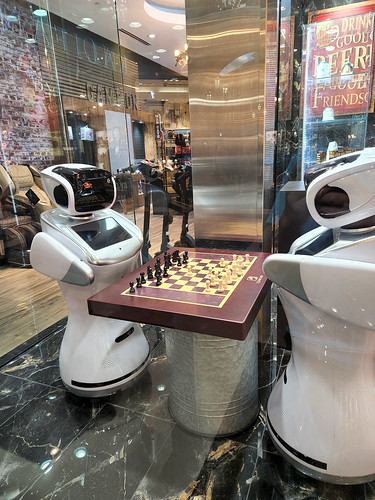
Robots Playing Chess by Joe Shlabotnik, on Flickr

Will artificial intelligence kill off the essay as an assessment form? That seems very likely after reading an article from the University of Sydney, Assessment and integrity in the age of essay-writing artificial intelligence. It describes how you can generate a plausible and well-argued essay on just about any topic using AI algorithms without any risk of falling foul of anti-plagiarism software. The text will be original and offer a variety of perspectives gathered from analysis of countless related texts on the net. In many cases these essays are far better than many students could ever write themselves and the technology is developing rapidly. Similarly the use of AI in teaching is progressing rapidly and we face the prospect of robots teaching and assessing robots.

The most remarkable aspect of this article is that it was written by an AI application called GPT-3 with some minor human edits. It analyses the arguments for and against AI in education and gives examples of how AI generated texts could be used in a positive manner: for example, letting AI generate a text on an introductory paragraph and asking students to compare the AI text with the original. It is remarkably insightful on its own limitations and how academics need to rethink traditional practices to counter the threat of AI.

Because artificial intelligence is trained on a huge corpus of text and has access to the entire internet, it excels at writing and responding to textual prompts. This includes topics that would otherwise be perceived as meeting criteria for authentic assessment. This presents a challenge for higher education academics because we are so accustomed to using exams and other assessments that focus on student knowledge. If artificial intelligence can write essays and answer exam questions, higher education academics need to radically rethink learning, teaching, and assessment in the post-machine era.

But the question remains of whether the essay is a valid form of academic assessment and what new methods we should turn to. The gut reaction to the problem could be doubling down on traditional proctored exam hall tests with no access to digital devices or textbooks but I hope we can think further than this. Learning to write a well argued essay or article is a fundamental skill in all forms of science and it is hard to imagine higher education without this crucial element. But if we can instantly generate an acceptable imitation the exercise becomes somewhat futile. Problem and project-based learning as well as a greater focus on interviews and live seminar discussions would seem to be more relevant both in terms of assessment and as training for professional practice. Writing and critical thinking skills must be learned and practiced but somehow we need new ways to use them. There are already examples of AI-generated texts getting accepted for journal publication and as conference submissions. The foundations of academia are under threat and we need to develop new strategies and methods. 

Jon Dron writes about this in a post, So, this is a thing… and sees the answer in a refocus on people and genuine interaction.

This is a wake-up call. Soon, if not already, most of the training data for the AIs will be generated by AIs. Unchecked, the result is going to be a set of ever-worse copies of copies, that become what the next generation consumes and learns from, in a vicious spiral that leaves us at best stagnant, at worst something akin to the Eloi in H.G. Wells’s Time Machine. If we don’t want this to happen then it is time for educators to reclaim, to celebrate, and (perhaps a little) to reinvent our humanity. We need, more and more, to think of education as a process of learning to be, not of learning to do, except insofar as the doing contributes to our being. It’s about people, learning to be people, in the presence of and through interaction with other people. It’s about creativity, compassion, and meaning, not the achievement of outcomes a machine could replicate with ease. I think it should always have been this way.

Another article, Will artificial intelligence be able to write my college essay? by Eamon Costello and Mark Brown, Dublin City University, raises the need to rethink how we assess learning rather than finding ways to defend the traditional essay. 

Do we try to tame AI to protect old ways of learning or should we embrace its potential and reimagine our assessment practices to reflect the modern reality of living in the 21st century? One creative educator had his students purposefully use and evaluate AI essay writers as part of their assignment.

Finally, this perspective is echoed by the AI-generated article itself, showing a surprising level of insight on its own limitations.

In particular, there is a need to focus on developing higher-order thinking skills such as creativity, critical thinking, and problem-solving, which are not easily replicated by machines. Additionally, it will be important to create opportunities for students to interact with each other and with their instructors on a regular basis, in order to promote the social and emotional skills that are essential for success in the workplace.


Sunday, May 29, 2022

Platform literacy needed to avoid increasing inequalities in education

James Elder Christie: The Pied Piper of Hamelin Public domain (CC0) on Wikimedia Commons

A major argument in the educational technology debate over the years has been to facilitate widened access to education through digital platforms and applications. This has indeed been achieved to a large extent with the widespread adoption of open access to scientific articles, open educational resources published by many institutions around the world, global collaboration projects such as Wikipedia as well as the use of learning management systems, video conferencing platforms and networking tools. The options for studying from home, even in sparsely-populated regions have increased dramatically and it would be easy to claim that the mission of widened access to education has been achieved.

However, as the power and sophistication of educational technology has increased so we see new inequalities and biases appearing and this is the topic of an excellent article by Laura CzerniewiczMulti-layered digital inequalities in HEIs: the paradox of the post-digital society. Although millions of students and teachers were able to adapt successfully to online education during the pandemic there were many who suffered. Many students had poor internet access or could not afford to pay for access. Many had to study with only a mobile or sharing one device with the rest of the family and in many countries reliable electricity is still a dream. The rollout of modern edtech assumes that everyone has the right devices, internet access and reliable electricity and thus the digital divide is further accentuated.

The digital divide is alive and well; indeed the digital paradox is that even as the basics of the divide are addressed through access, more complex layers of exclusion are added; digital inequalities thus morph into new complicated forms. Nevertheless, fair and equitable technological infrastructure is the foundation of inclusion in HE: electricity, devices, ubiquitous connectivity and cheap data. These are essential but insufficient.

The pandemic has also forced educational institutions to invest in new technology and the urgency has meant that many have overlooked the serious implications for user privacy associated with much of today's IT industry. The growth of surveillance capitalism, as defined by Shoshana Zuboff, is particularly worrying with the big five tech giants (Amazon, Google, Microsoft, Apple, Facebook) controlling and storing so much of our daily lives.

The intensive digitalisation catalysed by the pandemic and concomitant “online pivot” means that HE is in danger of fast becoming a site of surveillance capitalism, with the concomitant dangers for equity, little transparency and unequal terms of engagement.

With such an upsurge in educational technology many institutions have signed major contracts with companies without questioning what those companies will do with all the student data they gather. We all happily accept the terms and conditions, cookie settings and other privacy settings without really understanding the implications and no matter how digitally literate we may be those settings are not designed to be understood. The hidden biases of algorithms can add to further exclusion of some students groups especially when combined with the rise of artificial intelligence in tracking student progress, identifying weaknesses and detecting cheating.

The amalgamation of the digital into higher education, through the dominant extractive economy, introduces complex and often invisible power dynamics into public higher education. The terms of engagement are imbalanced, hidden behind dense language and easy promises. There are especially profound implications for those with barriers to participation at individual and institutional levels. This has introduced several new inequities into the student experience and the sector.

Czerniewicz presents some strategies to prevent this rather dystopic development. Firstly, institutions need to develop better platform literacy and be more able to demand safeguards from technology providers. We need to decide whether the risks of buying a platform outweigh the advantages - no matter how cool it may be. Many technology decisions are governed by FOMO (fear of missing out) and this tendency must be changed. She advocates iterating towards equality, developing strategies to identify inequalities and minimising risks as far as possible, i.e. Developing equitable ethical data policies and frameworks.

These themes are further discussed in another recent article, Ableism And Disability Discrimination In New Surveillance Technologies: How new surveillance technologies in education, policing, health care, and the workplace disproportionately harm disabled people. This looks at how technology is used in education, health care, workplace and criminal law to further disadvantage disabled and minority groups in society. Here too we see examples of societal biases being magnified by algorithms. 
In recent years, schools have adopted technologically-augmented surveillance tools, some of which rely on predictive analysis and automated responses to flag suspicious behavior, trigger investigative or disciplinary action, or prioritize crisis response resources. The surveillance tools can have a disproportionate impact on disabled students and students of color - and likely on disabled students of color in particular.
Although the European General Data Protection Regulation (GDPR) has increased our awareness of some of these dangers there is still a need for a deeper understanding of the consequences of the IT systems we use. If we are not careful we risk following the pied piper into the cave, dancing merrily to his tune. Sometimes we must dare to say no to the lure of technology.

Update
Further coverage on how some tech companies exploit student data, in this case children, can be read in a new post by Tony Bates, The perversion of the Internet: scraping and selling children’s data from ed tech tools.

Thursday, May 19, 2022

AI-generated essays - time to rethink written assignments


Students will employ AI to write assignments. Teachers will use AI to assess them. Nobody learns, nobody gains. If ever there were a time to rethink assessment, it’s now.

This is a quote from an article by Mike Sharples, London School of Economics, New AI tools that can write student essays require educators to rethink teaching and assessment. There are now tools that use artificial intelligence (AI) to generate highly plausible academic essays, complete with references. The article takes an example of a short essay about the problems around the popular concept of learning styles generated by a Transformer AI program, GPT-3. The user simply entered the first sentence and AI completed the essay. The result is not particularly insightful but good enough to pass and it won't show up in any plagiarism control since the text is completely original. If the essay is fed back into the tool by the teacher it can write a similarly plausible comment on the essay. The whole assignment can therefore be performed by AI, prompting the quote above.

Even if some of the essays generated this way may still have weaknesses (the example in the article has false citations) the whole point of AI is that it is constantly learning and improving. The phenomenon is not new, it has been possible for many years to pay someone else to write your essays for you via essay mills, but now the human element has finally been removed. Does this mean the end of the written assignment as an examination form? 

The author suggests a few ways of using the AI transformer in a constructive way, for example by getting students to generate AI texts and then find faults in them and improve them. This reminds me of how some teachers tackled plagiarism by writing a sample essay/article that included several form of plagiarism as well as poor citation practice and asked the students to find the problems and correct them. 

But the main point here is that we need to move on to new ways of assessing students and avoid examination methods that ask questions that can be automatically generated or copied from the internet. 
Finally, as educators, if we are setting students assignments that can be answered by AI Transformers, are we really helping students learn? There are many better ways to assess for learning: constructive feedback, peer assessment, teachback. If Transformer AI systems have a lasting influence on education, maybe that will come from educators and policy makers having to rethink how to assess students, away from setting assignments that machines can answer, towards assessment for learning.
Live assessment activities like interviews, presentations, debates or round table discussions can be run either on-site or online and are almost impossible to cheat in. But that brings us to the eternal question of how to move the focus in education from extrinsic motivation (exams, credentials) to intrinsic motivation (satisfaction, self-confidence, pride). Focus on competition, rewards and results encourages cheating among some, whereas activities that focus on community, learning for pleasure and intangible rewards are generally free of cheating. If learning is in the forefront there is simply no point in cheating. Hopefully AI-generated essays will remain a mere curiosity.

Sunday, April 24, 2022

Clouds on the horizon

Photo by Daniel Morris on Unsplash

Once again it's time for one of the most widely read reports on the opportunities and challenges facing higher education around the world, the 2022 EDUCAUSE Horizon Report, Teaching and Learning Edition. This year's report comes in the wake of the pandemic that has had a profound effect on education and has lead to a major reappraisal of how we teach and learn in an increasingly uncertain and unstable world. As usual the report features a number of trends in educational technology that are having major effects on education as well as overarching societal and environmental factors. It also describes a number of plausible scenarios for higher education, and even society in general: growth, constraint, collapse and transformation. An added value is the wealth of links to relevant examples of the trends described and inspirational solutions. To provide a global perspective there are chapters written by experts from Australia, Canada, Mexico, Saudi Arabia and the USA as well as a corporate view. Sadly voices from Africa and South America are not represented.

The report has been criticised over the years for repeating the same trends each year but to be fair these trends are seldom short-term or transient. Some of this years trends have been on the Horizon lists for many years but each year new details become visible as they mature and new factors come into play. The old tradition of looking at technologies that will impact higher education on a short-, medium- and long-term basis has now been thankfully dropped. In the past some short-term impacts took much longer to materialise (or simply died) and long-term trends developed more quickly than predicted. Such is the fate of most predictions. One thing is clear however:
Higher education likely will never be the same again, for these and many other reasons that have emerged just within the past two years.
Not surprisingly, the word hybrid is used a lot in the report. Universities are spending a lot of money on technology to equip classrooms for hybrid teaching with sophisticated systems with multiple cameras, screens and microphones to allow everyone to participate as equitably as possible. However, no amount of high-tech will work unless teachers and students are confident in using it and the teaching is suitably adapted. Similarly, the rise of hybrid working will lead to changes in campus design with fewer teachers, administrators and students on site. 
Remote work is making its way into job descriptions and contracts on campus, and institutional leaders are having to rethink important aspects of their culture and operations, such as interpersonal staff and team communications, the use of facilities and on-campus office and desk spaces, and staff and faculty training and support for their device and connectivity needs.
This in turn opens up questions on the value of the campus. It is certainly a great place to be for many who gain networks for life and a stimulating academic environment, but it also excludes many others. The report also describes a major shift in interest away from traditional degrees towards skills-based learning with shorter focused courses offering microcredentials. These are being increasingly recognised by major companies and some universities are already partnering with the corporate sector to offer such credentials.
Some students will simply conclude that they cannot afford the cost of a degree, particularly in regions and at institutions where rises in tuition and other related expenses simply seem unmanageable. Other students will conclude that the traditional college degree no longer meets their personal and professional needs, or they will seek alternative opportunities for acquiring the knowledge, skills, and credentials they need for successful job placement and career advancement.

Learning analytics, artificial intelligence and cybersecurity also feature heavily in the report but earlier tech-optimism is now clouded with concerns in terms of how student data can be used in a responsible and ethical manner. The full potential of learning analytics and AI has not been realised yet, often due to the fact that most institutions have so far failed to integrate all their systems to be able to tap into the vast resources of data they possess. Even the data available in the learning management system is seldom exploited. Will students accept that their data is analysed and profiles created that might not always be to their advantage? 

As previous EDUCAUSE research has found, for example, students may be more or less comfortable with their institution collecting and using their data depending on the type of data being collected and used. And many students may not fully understand why or how their data are being collected and used, eroding their trust and confidence in the institution’s use and protection of their data and subsequently eroding their trust in their institution overall.

Although the report shows the potential of the trends it describes it does not hide from the storm clouds hanging over all of us in terms of  the climate crisis, increasing political instability and the global rise of misinformation and anti-scientific thinking. We already see an increase in political control of what is taught at universities and a decrease in the public funding of higher education and the report does not see this ending in the short term. This can lead to universities seeking more private funding and risking that major benefactors influencing policy and strategy in ways that limit academic freedom.

Of course there are other issues or trends not mentioned in the report but I still think this is the most accessible summary of the challenges facing higher education today and one that you can certainly send to decision makers at your institution. If you'd like another perspective as a complement, then please have a look at Mark Brown's excellent article from December 2021, What are the Main Trends in Online Learning? A Helicopter View of Possible Futures (Asian Journal of Distance Education. Vol. 16 No. 2, 2021) 


.

Wednesday, April 13, 2022

My best friend is a robot - virtual companions

Photo by ThisisEngineering RAEng on Unsplash

Many of us had imaginary friends when we were children; someone you could tell your innermost secrets to and who would always lend a sympathetic ear. An ideal friend is especially important when real live ones are hard to find. Another common childhood strategy was the old-fashioned secret diary where you could write your deepest thoughts, loves and fears though always with the nagging fear that some day someone might find it and read it. We all need a channel for our reflections.

As a modern equivalent, how about confiding in a virtual companion? There are now many examples of artificial intelligence applications that can provide this type of friendship and I found a good overview of the field in a newsletter (in Swedish) from the Swedish consultancy Futurewise. If you understand Swedish go straight to the article, otherwise I'll pick out some of the highlights here. A good example of an AI companion is a chatbot called Replika that you can create and train through text communication to become an understanding and sometimes entertaining friend. Today Replika can also appear as an avatar with a choice of appearances and even virtual accessories - yes, you can buy nicer clothes, hair etc. It takes time for your new friend to adapt to your communication but the more you chat the more it learns and slowly you find the conversations quite rewarding, though there are large gaps in its knowledge and some replies can be rather bizarre. In the end, however, you are conversing with a kind of mirror image of yourself, though always understanding and supportive. Talking to your companion can become a daily habit and some people may find it reassuring to open up to a virtual friend in ways that they could not do with a human companion. It offers a kind of therapy, as a sounding board for your feelings. The company's website offers the following user quotes:

Using Replika can feel therapeutic too, in some ways. The app provides a space to vent without guilt, to talk through complicated feelings, to air any of your own thoughts without judgement.
Replika encouraged me to take a step back and think about my life, to consider big questions, which is not something I was particularly accustomed to doing.

Here's a video explaining how it works and some of the background to Replika.


There are of course much more advanced AI avatars and one is called Leta. She has learned from almost one terabyte of data and you can speak with her instead of text chatting as in the case of Replika. Leta has been created by Alan D. Thompson and in the video below he introduces highlights from his many discussions with her (see his YouTube channel for all the discussions). Leta can actually be rather witty and creative, for example she can instantly create a haiku on a given topic. At the same time she can also come out with very strange answers when confused or when her programming does not offer a better answer. She is of course no better than the script that runs her.


This all raises a host of ethical questions that I suspect commercial interests will quickly bury under the carpet. An AI companion can certainly offer sympathy and understanding but is that what we really need? Sometimes we need a friend who can ask uncomfortable questions and challenge us to reflect more deeply. We've already seen various types of robots (robot dogs or other cuddly robot animals) marketed as companions for elderly people living alone but this seems to be more of a comfort to the  society that created it than to the target group. We don't need to worry so much about old aunt Ida because she's got a robodog at home. The bots also depend on someone feeding them with data and writing the scripts. Leta was given sources like Wikipedia, the Guardian and the New York Times to study but what if you fed her full of "alternative" sources and created an extremist robot?

Many in education see a great future for tutor bots helping students by asking questions, offering feedback, finding learning resources and encouraging. There's certainly potential there but the bots are only as good as their programmers and all sorts of biases and prejudices can be built in, intentionally or not. And then of course there's the whole issue of integrity and privacy: if these bots are commercial what happens to all the personal information they gather in our private conversations? Will my innermost thoughts and feared be gathered and sold to companies or even governments? We have already welcomed AI into our lives with Alexa or Siri with most of the ethical questions unanswered. The next step scares me.