Showing posts with label collaboration. Show all posts

Tuesday, July 25, 2023

Farewell Twitter - breaking up is hard to do

Photo by Alexander Shatov on Unsplash

It looks like it is time to leave the sinking ship of the app formerly known as Twitter after almost 15 years of tweeting. Elon Musk, looking and behaving more and more like a classic James Bond villain, has succeeded in destroying a major social media channel in one year of chaotic ownership. His strategy seems to be to scare off all serious users and create a new platform, X, for right wing extremism, conspiracy theories and disinformation. In that case he has succeeded. 

However, I'm sad to leave because over the years I have made so many valuable connections on Twitter that have lead to collaboration and new friendships, as well as countless useful links, inspirational chats and moral support. I've met people on Twitter who I have then met at conferences, written articles with and formed projects with. It took me a few years of work to build up a network on Twitter. Many colleagues gave up with it because they had so few connections and didn't work out how to attract more. There was little or no interest in the platform here in Sweden back then so I reached out internationally, following educators I knew and admired and then checking who they followed. That way I built up a network of trusted sources. Then I had to find ways of getting people to follow me otherwise I'd be simply tweeting into a vacuum. I focused on sharing useful content (articles, news, threads) and using hashtags to reach as many as possible. Slowly people started following me and connections began to happen. I followed people and channels who offered useful content for my work and assumed that some of themwould find me a useful contact. I also started using Twitter to generate traffic to my blogs and that certainly helped them thrive. I remember the day one of my educational gurus retweeted one of my blog posts and I saw the sudden peak in page views - I really felt I'd made the big time! That has happened quite often since then but I still get a great feeling when a major name in my field notices what I've done. No names mentioned but I thank you all. 

I have made many exciting contacts and one in particular still makes me smile. I saw a tweet one day from a school teacher in Canada  who had seen a nice Swedish brochure about using Creative Commons licenses in school. She wondered if anyone could translate it to English. I happened to know the person who wrote the original and we very quickly created a new English version and sent it to the Canadian teacher. This then spread and was used in many schools. I then got an invitation from the teacher to meet her class on Skype one afternoon and talk about Creative Commons as well as answering the pupils' questions about life in Sweden. All that because I answered a tweet.

Then there have been all the tweetchats. I have taken part in many of these and organised many too. If you have never tried one before it goes like this. You announce a chat session in advance and a suitable hashtag. At the proposed time you send a tweet with the hashtag welcoming everyone to the tweetchat. Participants "tune in" by searching for the hashtag on Twitter or whatever app you use for it. The participants can then introduce themselves and you can make a few welcoming remarks and repeat the chat rules. The key is that the hashtag must appear on every post. Then you ask a question and wait for responses. As the answers come in you can comment on them and encourage participants to comment on each others' posts. You keep feeding the discussion until the time is up, usually after one hour. It's rather chaotic - some people find it stressful and confusing whilst others thrive. I love hosting but you end up typing almost non-stop for an hour. If you have experienced users the chat just flies along and participants share links, ideas and new perspectives. I will miss this and even if the same thing can be done on other platforms I don't really have the energy to start all over again.

As Twitter implodes into a platform called X it is time for the world's media, institutions, companies and leaders to leave and stop using it as a channel for serious dissemination and discussion. I hope that world politics will no longer be conducted on X. I'm not sure where they should move to though. Do we really trust Meta's new Threads? Is Mastodon able to become a default news source? Or is the new social media landscape too fragmented? Twitter has been an extremely powerful medium for 15 years and it is hard to understand how it could be destroyed so quickly.

Curiously, I have never really seen the dark side of Twitter. Maybe it's due to a combination of being careful who I follow and the algorithms being very effective at feeding me content that I want to see. Anyway, my feed has always been full of education content as well as increasing amounts of climate research and humanitarian posts with almost no trace of the toxic garbage that have made the platform so infamous, especially since Musk turned off all the safety controls. I'm still reluctant to completely switch off because I still get good useful content from both contacts and trusted news media. I've deleted Twitter from my mobile but haven't quite pressed the button to completely exit. Breaking up is hard to do.

PS. I have now deleted my account.

Thursday, July 13, 2023

Wave goodbye to the edtech cruisers and focus on real community building

Photo by Peter Hansen on Unsplash

One year after retirement and it's a strange feeling standing on the quay watching the edtech ship sail away from me and onwards towards the horizon. I've tried to maintain contact with the issues I used to find so important but if you're not onboard and involved it all feels more remote every day until the ship disappears over the horizon. There are new technologies and platforms on board now and my personal learning environment has become almost obsolete.I thrived on the social media boom of blogs, Twitter, Facebook, LinkedIn, Diigo and so on and the opportunities these fascinating channels offered for networking, collaboration, sharing and creativity. It was a great ride for about 12 years but it has all turned sour as the platforms have become polluted with algorithm-driven ads, propaganda and toxicity. Having spent so long urging teachers to use social media to widen their horizons, increase their impact and foster collaboration I realised that I might now be leading them into a trap. So now the edtech cruiser is sailing away loaded with new technologies and platforms that I simply can't relate to anymore. But maybe we have to reset our ambitions about networking and settle for less flashy but more sustainable solutions.

A post by Inger Mewburn in her excellent blog The thesis whispererThe enshittification of academic social media, really rang a lot of bells for me. She has also been a strong advocate of academics using social media to promote their work and build networks. But now she advises caution with using social media on the grounds that no matter how good the content you share may be you will not get exposure thanks to algorithms that prioritise content that will generate income. It's also hard to make contact with others when the algorithms continually push other stuff in front of you.

Maybe Threads is the next big platform and indeed the initial uptake is spectacular, though here in the EU it is blocked since it is full of major privacy issues that violate the GDPR regulations (well played EU!). But even if you can use Threads it's probably not a good idea. It looks good but it feeds off your privacy and is fully integrated with the rest of Meta's platforms.

Inger proposes a revised set of recommendations to academics wanting to use social media in their work. Think very carefully before you use mainstream social media in your teaching. Think especially about the privacy issues to which you may be exposing students and colleagues. Use these channels for social contacts if you want but don't share content there; own your content by having your own space for it. For building a network she suggests the good old-fashioned mailing lists. I certainly found e-mail newsletters a good way to reach out though there are issues with that, especially the problem that many organisations ' firewalls automatically block newsletters as suspected spam. But certainly you can reach out to known subscribers and build your community through that.

Email is still the best distribution medium of them all: cost free and free from algorithms. I just started a mailing list for people interested in my neurodiversity in the PhD research – I already have 160 or so people signed up, which is so incredible (thank you!). I plan to use this list to test out research ideas and get feedback on research in progress. Much more effective than shouting into the wind on Threads or something.

She also mentions a possible revival of blogging, something I would of course welcome. Use your blog as a space to share your ideas and offer advice. The best way to blog is to host the blog yourself and be in complete control. I made the mistake of opting for the convenience of Google's Blogger platform back in the days when I believed they were working for the common good and so all my writing is in their domain. 

Of course Mastodon and its family of open source social media in the Fediverse is the sustainable and uncommercial option to create communities, though it's always a good idea to check each platform first to see if it's right for you (don't assume that all are automatically trustworthy). If I was still active that's where I'd go. The Fediverse will not go mainstream and will remain a refuge for those who see through the glitter and flashy facade of the Big Five, but maybe we have to accept that meaningful collaboration is limited in scale. Leave the big platforms and connect with people rather than bots and trolls. It may not be as flashy and may not have all the bells and whistles but it works.

Saturday, April 22, 2023

Self-assessment of digitally enhanced learning and teaching - overcoming inertia

Photo by Ross Sneddon on Unsplash

The pandemic threw all educational institutions into the deep end of the educational technology pool. Adapting to what was for most institutions a relatively new form of teaching and learning was a traumatic but also transformative experience. In the wake of that experience the most obvious strategy was to take stock and make a thorough review of what worked, what didn't work and how to improve in terms of using digital technology. In an increasingly unstable and unpredictable world the likelihood of further crises is extremely high and therefore the need to ensure that education can quickly adapt.

There is no shortage of research, reports, guidelines, tools, webinars and conferences to help educational institutions improve their use of educational technology in teaching and learning. Organisations like the European Commission, EUA (European University Association), EDEN (European Distance and E-learning Network) and many others have run projects, produced reports and run dozens of webinars and conferences all based on extensive research but somehow they seldom result in major changes on the ground. It's not simply about the adotpion of technology, that is really not the main point, it is a change towards more inclusive and active forms of teaching and learning. It's about learning to learn by active involvement in meaningful collaborative work where technology is an enabling factor. But the main barrier is the reluctance to change from the traditional information transfer model that so many people feel comfortable with and which is perceived as effective and indeed symbolic of higher education.

An excellent way to move towards this is to look carefully at how technology is used in the institution today and how this contributes to a more holistic view of teaching and learning - a process of self-assessment. This has been the focus of a recent EUA project, DIGI-HE that I have been involved in (on the advisory board). The project has included numerous studies, consultations and thematic peer groups reaching a broad range of educational institutions and in various disciplines. One report in particular offers a comprehensive overview of the wide range of self-assessment tools available and advise on their use: Developing a high performance digital education ecosystem - Institutional self-assessment instruments.

Set against this prerogative and growing strategic interest, this report presents a review of 20 instruments from around the globe designed for self-assessment of digitally enhanced learning and teaching at higher education institutions. It offers a number of insightful observations concerning their use (or non-use) by institutions for promoting both quality enhancement and digital capacity development. It should be of immediate interest to higher education institutions, but also to policy makers, developers of instruments, and generally, to all those who seek information on such instruments.

The project also produced a MOOC on FutureLearnInside Digital Higher Education: Self-Assessment Guide for Educators. Here institutional leaders are taken through the process of reviewing the institution's current strategies and planning for a self-assessment, looking at both risks and opportunities. The course was run during the spring but is available as an asynchronous self-study course. This is a good springboard to kick-start a change process and the project's various reports provide further guidance and inspiration from institutions who have already started their transformation process. 

This is one example of the abundance of the guidance and support available for digital transformation and pedagogical development but as the saying goes: you can lead a horse to water but you can't make it drink. Despite the clear benefits of conducting a self-assessment there seems to be a great reluctance to do so, despite the lessons of the pandemic and the abundance of research into active collaborative learning. The first barrier is the abundance of tools that creates anxiety on which one to choose. Faced with too much choice we simply don't make a choice. I think we all experience feelings like this in our daily lives when faced with the myriad of choices available in everything between insurance to telecom providers. It seems that we all suffer from inertia when it comes to actions that threaten our comforable balance. 

Self-assesment also demands a lot of time and energy at a time when most people feel already stressed and overworked. It also risks exposing wasteful practices or inequalities in the present system and thus creating conflict. The pandemic was certainly disruptive (tragically so for millions around the world) and there were signs that we would need to rethink our structures and systems to adapt to new challenges. However, we seem to have simply reverted to old practices again without much reflection. Changing the way we live and work is too demanding so we return to the default. Thatä's why we can't expect too much of institutions to embark on such costly processes voluntarily (with a few exceptions). Governments and authorities need to help them find space and time for these processes and offer incentives for doing so. Then we can hopefully create some momentum that will generate interest and widen involvement.

Thursday, November 3, 2022

The end of social media?

Photo by Dasha Urvachova on Unsplash

Are the social media platforms that have dominated our lives for the past 15 years or so nearing the end of their useful lives? As Meta/Facebook transforms itself into the so-called metaverse and the Bond villain lookalike Elon Musk takes over Twitter, these platforms are likely to be completely transformed and millions of users, like me, will choose to leave. An article by Ben Werdmuller, The end of Twitter, mourns the demise of a networking platform that has been so important to many in education over the years but is now drowning in the vitriolic hatred and disinformation that has polluted today's society and is likely to get even worse as Musk makes massive staff cuts and reinstates banned accounts, thereby removing the present inadequate controls against hate and threats. Indeed, since Musk's takeover the levels of hate content has risen steeply, according to an article in The Guardian. Community and collaboration are being sacrificed for whatever gives the best financial returns and today that means scandals, insults, lies and conflict.

I have benefited greatly from social media over the years, allowing me to build a global network of educators and friends who have inspired and encouraged me and I hope I have returned the favours. I would be so much poorer without access to this network but sadly I see the end of this era rapidly approaching. Facebook and Twitter will not disappear overnight but will either fade into irrelevance or drown in trash and hatred. They will no longer offer the social interaction and and sense of community that they pioneered and that we have all enjoyed. 

I have a Mastodon account, the multi-server platform that offers a safer alternative to Twitter, but have not really discovered how to make it work for me. I haven't found many of my Twitter contacts in there yet and have no appetite for building up a network from scratch - it took several years to build my Twitter network. It's not so easy to start all over again but there are, however, some useful tips by for example Martin Fowler, Exploring Mastodon. The same applies to alternatives to Facebook like MeWe (I'm sure there are many others out there). Ideally I'd like a social platform that is safe and where I can continue to interact with the people and groups I have built up over the last 15 years. If that doesn't work then I will have to rediscover what life was like back in the nineties.

Werdmuller sees a shift to a multitude of new social media channels and a more complex landscape.  

As big tech silos diminish in stature, the all-in-one town squares we’ve enjoyed on the internet are going to start to fade from view. In some ways, it’s akin to the decline of the broadcast television networks: whereas there used to be a handful of channels that entire nations tuned into together, we now enjoy content that’s fragmented over hundreds. The same will be true of our community hangouts and conversations. In the same way that broadcast television didn’t really capture the needs of the breadth of its audience but instead enjoyed its popularity because that’s what was there at the time, we’ll find that fragmented communities better fit the needs of the breadth of diverse society. It’s a natural evolution.
The main benefit of the major platforms was that everyone was there. If we all scatter into a multitude of closed communities we lose that global connectivity that was so empowering and fun. The embryo to this inter-connectivity already exists in the Fediverse concept, gathering a number of open source social media platforms like Mastodon and PeerTube and allowing people to connect across the platforms. I haven't dared to investigate this much but it seems rather complicated and I wonder how many of my contacts are out there.  

I deeply dislike both Twitter and Facebook and how they profit from the spread of lies, hatred and horror but I still appreciate the human contacts I have made through them. But I sense that very soon I will have to move out. I can maybe find another platform that offers some consolation but I fear that many contacts and groups will be lost forever. Very sad.

Friday, September 23, 2022

Learning - from magic solutions to meaningful processes

Photo by Dollar Gill on Unsplash

Learning cannot be forced or planned. We can create the right conditions for learning and offer a variety of strategies but the learning comes from within. You have to want to learn and you have to learn how to learn. So in education we work on helping learners to work out how they learn best and then apply those principles to the things they want to learn. We can nudge, guide, support, motivate, challenge and applaud but in the end it is up to the learners. Learning is individual and subject to so many variables but still we search for ways to measure efficiency and upscale process that are simply not scaleable.  

These themes emerge in an interview article from the Centre for Public Impact, 5 Lessons from Olli-Pekka Heinonen and the Finnish National Agency for Education. Please watch the interview on the above link to hear the full details of his proposals. Olli-Pekka Heinonen is the Director General of the Finnish National Agency for Education and in a longer interview he discusses how the Finnish education system has tried to avoid falling into the trap of performance ratings, checkboxes and national solutions. He claims that scaling is failing because it assumes that what works for some will work for all - rather obvious it would seem but so often forgotten. There is no right answer, it all depends on the situation, circumstances and the learning context. Instead of national initiatives in terms of methods and structure we need to empower local initiatives and encourage teachers to compare and adapt from each other.

The alternative vision for scaling developed in EDUFI’s work moves from seeking to scale the innovation(s) that worked in one place, and implementing those in other places, to scaling the capacity for learning and innovation itself. “What works” is actually the capacity for learning and experimentation in each place, so that is what must be scaled.
We need to develop the preconditions for innovation and allow for collaborative communities to share and adapt new methods. As with the students, help teachers to learn how to innovate and experiment, offer spaces for collaboration and exchange of experience and support their processes. From magic solutions to meaningful processes. 

Another area that he discusses is the prevailing obsession with accountability with all the efficiency reviews and checklists that so many institutions and individuals feel trapped in. This box-ticking mentality leads to a fear of falling lower in the various rankings that seem to define today's education systems. Self assessment can easily lead to self deception as you become increasingly under pressure to tick the right boxes in your quality review.
The research evidence, together with vivid personal accounts, show that target-based performance management approaches undermine real-world performance by creating the conditions in which people systematically lie to one another. Olli-Pekka's experience is that “payment by results” and other forms of results based management undermine the capacity to do effective work and gets in the way of learning. “We should rebuild the performance management system entirely”, says Olli-Pekka.
Once again he advocates helping institutions to build capacity and focus on development than imposing criteria from above. It sounds so obvious but sadly so few governments seem to understand and instead treat education like an industry that can be planned and controlled. We can do so much better.

Saturday, April 2, 2022

Some students just want to learn alone - when community becomes an inconvenience

Photo by Suganth on Unsplash

Most people learn well in groups or communities where ideas are discussed and new insights emerge in a collaborative process. We get energy and inspiration from others and develop in a supportive environment where there are common goals and a shared interest. However, there are a lot of people who find such collaboration daunting and prefer to study alone. The same applies to the workplace where the ability to work from home during the pandemic has led to a divide between those who enjoy the social interaction of the office and those who prefer the peace and quiet of the home office. Many studies of student experience during the pandemic show that the hardest part was the lack of social contact and sense of community. This is probably the main reason students chose to study on campus - the friendships, contacts and social events that come from that common experience. Online students, however, have a different perspective on their studies. They already have their social contacts and networks established where they live and see little benefit from all but the most necessary interaction with fellow students. 

This discussion is put into perspective by David White in a fascinating post, Belonging is inconvenient. When discussing student needs universities often assume that all students behave as campus students, what he calls a residential assumption

As we develop, or expand, our fully online provision it’s important not to fall into the trap of designing with ‘residential assumptions’. What I mean by this is that we can assume that online students will want what our residential students demand (or what they missed when things moved online). Part of that is the need for community and belonging.

We need to accept that there are many students who do not need the sense of community and are happy to learn on their own. Those who are combining study and work do so to get qualifications for their professional development and therefore want to learn what they need, get the certificate and move on. For them all the process of forming a community and working in groups is extremely time-consuming and offers little practical reward, in short they see belonging as an inconvenience. White discusses three modes of learning shown in the diagram below: independent learning, communal learning and networked learning. Independent learners are those who prefer to go it alone and see group work as a burden and distraction though there are some who do enjoy the experience given time to adjust. At the other end of this spectrum are the networked learners who already have their own personal learning networks and use them rather than imposed groupings in a given course.


These modes are of course very fluid but show that we are dealing with a diverse group when we offer an online course, especially the hybrid mode so often discussed today. Mixing campus and online students sounds like a good idea but they have very diverse perceptions and preferences about the course and how they learn. White suggests that we need to focus more on inclusion rather and offering a variety of ways to engage with the course.

We need to design on the basis that there are multiple authentic modes of learning for multiple communities of students. Not all of these require belonging and community but where they do we need to acknowledge that it’s hard work, time consuming, and that access-to-a-building or being-in-a-cohort is not a proxy for membership-of-a-community.

Sunday, March 20, 2022

Hybrid classrooms - impressive solutions but are we asking the right questions?

Photo by Col·legi de Farmacèutics de Barcelona on Unsplash

Educational institutions all over the world are busy redesigning their classrooms and buying lots of hardware to facilitate hybrid teaching. The pandemic has revealed a need to offer more flexibility in how courses are run, offering students the choice of whether to attend classes on site or online. Many institutions have been doing this for many years but suddenly hybrid has become mainstream and there is a frenzy of ed tech investment. The challenge is to ensure that the online students are not simply passive observers but can participate as fully as their counterparts on site. This inevitably involves more advanced technology in the classroom with multiple screens, microphones and cameras so that everyone can be seen and heard clearly and that slideshows, whiteboards and collaborative tools can be easily shared. 

Some excellent examples of hybrid classrooms are described in a detailed post by Zac WoolfittThe future is bright - the future is hybrid. He describes how four European universities are redesigning their classrooms for a hybrid future: University of Amsterdam, KU Leuven, Imperial College London and Oulu University of Applied Sciences. All are very impressive and I urge you to read the article to get the details. Online students are visible on large screens, cameras automatically focus on the speaker in the classroom and high quality microphones ensure that everyone is heard. Not only have they upgraded their larger lecture theatres to cope with hundreds of students at a time but they have also equipped smaller classrooms and group rooms for hybrid sessions. Some solutions are like sophisticated TV studios and each lesson will require careful planning between teachers and production staff. Others are less complex but still demand that teachers rethink their teaching to adapt to the technical affordances.

However, all of them admit that they have still not found the best solution and that hybrid teaching still presents many challenges. Complex technical solutions demand qualified staff to assist the teacher, or require teachers to be well trained in using the equipment; resulting in an almost impossible juggling act trying to focus on both teaching and on managing the technology.

Finding ways to combine collaboration online and on campus remains a challenge. Those presenting here thought that there is more hybrid collaboration than every before. The solutions provided currently work, but it is expected the demands and context will change in a few years. Some have only been running Hybrid classrooms for less than a year. The feedback from students will provide lots of input. Creating really good hybrid breakout rooms has not yet been achieved yet and requires improvements in the technology. For some students, it is not easy to learn remotely, and they want to be in class, in contact with fellow students.

They are all impressive initiatives that aim at providing all students with a high quality experience no matter how they choose to participate. However, I wonder if we are asking the right questions here. These solutions are expensive and unrealistic for many institutions, especially in less developed countries. I also wonder if we place too much importance on synchronous events. No matter how much technology you have in the classroom, any gathering of more than 30 students means that the majority of them will not say a word during the session and that interaction will be limited. Large lecture theatres, no matter how much technology you buy, will always favour lecturing with the teacher in focus. Of course there is value in gathering all students in a synchronous event from time to time. It reinforces a sense of community and common purpose. But I would like to see a greater emphasis on group work, investigating, analysing and solving problems, and this is done in a combination of synchronous and asynchronous collaboration rather than in large class meetings. Maybe the hybrid classroom does not need to be so sophisticated. Shorter focused hybrid sessions to set up the task and then let the students work together in hybrid groups. This requires lots of flexible group rooms on campus but those require often only a screen, webcam and microphone. Learning to work in virtual teams to solve problems and find solutions are also vital skills to learn for most professions in a world where international travel is likely to become increasingly unfeasible.

Tuesday, February 8, 2022

Finding the sweet spot for learning

Photo by Maria Lupan on Unsplash

Learning is an extremely complex field and, in order to make sense of what is going on in the interaction between teachers and students, models and diagrams can help to make sense of the complexity. we will never capture the whole picture in one diagram but the interplay between models at least offer us guidelines for practice. 

One diagram caught my eye last week  in an article by Melissa EmlerFuture of Work Is Nothing Without Consideration For The Future of Learning (see below). The article looks at professional training but shows that learning takes place at the intersection of three elements: event, content and community. The gist of the model is that learning doesn't happen if one of these elements is missing.

If organizations want to get a return on their investment on learning, the components must be seen as interdependent parts of the whole. When making decisions about professional learning opportunities, people must understand the best experiences will contain all three components: community, content, and events. The ones that don’t contain all three components can be left unopened in your inbox.

Basically an event full of content but with no community element (ie. no discussion, interaction) has no lasting effect. Similarly a community with events but no content lacks a purpose - maybe lots of fun but what's it all about? Finally a community with content but with no events lacks urgency and the chance to get involved. Over the last couple of years we have certainly seen examples of all three with countless well-purposed webinars full of useful content but without forming a sense of involvement. many started a good discussion but offered no space for that to develop into a sense of community. I have certainly been part of quite a few such ventures.

In a pre-pandemic era, the components of training and development could stand alone. But if the goal is to embrace being a learning organization in the post-pandemic era, they can’t. During the pandemic, people in every industry were faced with a barrage of offers for free events and online courses. At first, many dove right in because they had a need to upskill fast. Now, heading into the third year of the pandemic, people are tired. Screen fatigue is real. Making sense of the one-off events is complicated. And, the logins for those online courses remain tucked safely away in the email inbox never to be seen again. And more than anything, people are craving connection and a sense of community. 
There are similarities here to the more complex community of inquiry model that shows the close and essential interplay between three presences: teaching presence, social presence and cognitive presence. These elements vary from course to course but the true educational experience takes place in the sweet spot where the three presences meet. So many solutions fail because they only focus on one or two factors. You can have lots of great well-designed content but without a wider context and sense of community it has only limited impact. We need to offer that magic space where several factors intersect.

Image: Melissa Emler Modern Learners 2022


Thursday, February 3, 2022

"It ain't what you do it's the way that you do it" - note taking skills

Photo by Dollar Gill on Unsplash
One rather sad reflection on the world today is that we tend to believe what we want to believe and often disregard scientific evidence that goes against these beliefs. Sometimes it gets absurd - it may be a myth but it's such a good story so we're sticking with it. Even in education we have many myths that are simply too good to discard, despite considerable scientific evidence against them. Digital natives, learning styles, the benefits of open-plan offices are still going strong after all these years. 

Another fondly held belief is that learning was somehow better before computers came along. This appears in different guises such as the benefits of print books over e-books, classroom teaching versus online teaching, video meetings versus online meetings and so on. Another in this series is about handwritten notes being more beneficial to learning than typed notes on a digital device. A post by Donald ClarkIs handwriting better than typing for note taking? Surprisingly, it's not!, debunks this myth very well, though I suspect that it will still continue to thrive. Clark points out that the claim is based on one article from 2014 that showed better learning from handwritten notes. Subsequent studies have shown no significant difference between the note-taking methods but have received much less coverage than the original study. The problem is that it is not a simple contest between two methods but we need to look deeper to see that note-taking is a valuable learning tool, no matter how you do it, but also that it is one of many learning strategies. Learning happens when you make a conscious effort.

It would seem that writing notes in your own words, and studying your notes, matter more than the methods used to write your notes. This makes sense, as the cognitive effort involved in studying are likely to outweigh the initial method of capture. It is not note taking that matters but effortful learning.

There are far too many discussions today trying to prove which method/tool/medium is "best" as if it was a contest. Taking notes is a skill that all students need to develop but they need to find the format that works for them whether it be traditional handwritten notes, Word documents, collaborative notes in Google Drive, a writing tablet, a collaborative mindmap or even reflections recorded as voice notes. The active process of summarising, rephrasing and sorting is part of the learning process. 

This debate focuses on one issue, the method of note talking but the more important issue is to move beyond note taking to actual learning. Here we know that underlining, highlighting and rereading are not efficient learning strategies. One needs to move towards effortful, generative learning, deliberate, retrieval and spaced practice. Note taking is not an end in itself, merely the start of a learning journey. It is an important bridge to more effortful learning.

Note taking can also be used as an alternative to recording online meetings. Simply hitting the record button is convenient for students but why not ask them to take notes instead and collaborate in producing collective notes? They may need some guidelines at first, but if two students take notes during the session and at the end allow the rest of the class to fill in gaps and post comments and links the collective notes can be much more valuable than a simple recording.


Sunday, January 9, 2022

MOOCs - so much more than course completion

I started this blog way back in 2008 and that happened to be the year when the term MOOC (Massive Open Online Course) was coined after the ground-breaking course at the University of Manitoba, Connectivism and Connective Knowledge, lead by George Siemens and Stephen Downes. Not surprisingly I have written a lot of posts on this topic and have tried to follow and reflect on the complexities of designing online courses at scale. The term MOOC is used today to cover a very diverse range of course models from very traditional content transfer to collaborative and flexible learning spaces that can be better defined as communities rather than courses. The old adage that every letter in the acronym MOOC is negotiable is more true than ever today, especially O for open. However, despite claims that the MOOC boom of the last decade is over, the form continues to thrive with a massive upswing in interest during the pandemic (see article in EdSurge). 

I have just read an interesting review of recent MOOC research in an article by Aras Bozkurt in Open PraxisSurfing on Three Waves of MOOCs: An Examination and Snapshot of Research in Massive Open Online Courses. It is described as a systematic review of the empirical MOOC publications from 2016 to 2018, a total of 633 articles. The article examines four themes and how these themes have been described in the research.: (I) MOOCs as a mainstreaming learning model in HE, (II) motivation and engagement issues in MOOCs, (III) assessment issues in MOOCs, and (IV) MOOCs for social learning

The author describes three waves of MOOC development: the first wave of connectivist MOOCs (cMOOCs) in the spirit of the pioneers (Siemens, Downes, Cormier, Alexander, Belshaw etc), the highly commercialised second wave based on global consortia and elite universities and the present third wave that is a kind of mix of the previous waves. These waves are given time spans that feel a bit too tidy for me. All three are still present. The so-called first wave did not simply stop in 2011 with the advent of  Coursera, EdX and Udacity. Connectivist inspired open courses (not necessarily massive) have continued to thrive but under the media (and research) radar, recruiting through networks and communities rather than through global consortia. Many have stopped labelling themselves as MOOCs and thus evade radar detection.

One overarching trend in the article is the focus shift from the early qualitative emphasis on openness and community-building to a quantitative focus on massiveness and course completion statistics. The author points out how the focus on completion rates and student numbers has missed one of the main objectives of the whole concept, as a contribution to lifelong learning.

Studies have therefore suggested that the success of MOOCs cannot be measured based on drop-out or completion rates, but rather, on the learning behaviors of the participants (Kahan et al., 2017). The advantage of MOOCs, in terms of social learning, is their ability to form social learning communities (Gallagher & Savage, 2016) that “would arise around the course, would remain over time, and involve participants contributing to with new proposals” (de Lima & Zorrilla, 2017).
Somehow, when MOOCs became mainstream in 2011, they were conveniently mapped into the known models of higher education with measurable learning outcomes and assessment criteria. The potential of the original connectivist model to promote collaborative inquiry and community-building became restricted in the confines of the traditional notion of a course where the course structure and objectives are decided by the course organisers and participants are assumed to embrace these and follow the course to its conclusion.
While the first wave MOOCs was a fertile territory for leisure learners, and learning was associated with perceived learning, the second and third wave MOOCs strived to keep the learners in the MOOC, and thus, motivation and engagement have become a trending hot topic.
MOOCs are constantly compared to regular for-credit university courses and have been marketed as alternative paths to higher education with MOOC-based degrees as well as new credential forms like nano-degrees, specialisations and micro-masters. However the motivation of many MOOC participants is not to gain credentials but to widen perspectives, learn something new or sheer curiosity. Each participant has their own motivation to learn and that will often not coincide with the course organiser's narrow view of a course. Research has so far not investigated learner motivation sufficiently.
One area of concern, however, is that the perceived learning in MOOCs has been neglected as a focus of research. This is important to note because learning goes beyond quantified learning objectives.
Then there is the learning that can occur after the MOOC is officially over. Many people study MOOCs asynchronously outside the timescale of the course and some MOOCs have developed into self-directed communities. I have taken several courses over the last couple of years and all of them were long after the dates of the actual course. Does my course activity count when studying the success or failure of the course? Many people learn a lot without making much of a footprint (if any) and their learning is extremely hard to detect even if it may be significant for them as individuals. 
However, it is noted that not all learners learn by visible interaction (e.g., lurkers or legitimate peripheral participants) or wish be a part of the entire MOOC (e.g., drop ins). Interestingly, some MOOCs help learners to form a learning community, and these communities provide more learning opportunities, even outside of the defined MOOC concept. The problematic view according to the studies in the research corpus is when social learning is framed around predefined MOOC dates alone, ignoring their contribution to lifelong learning. This perhaps stems from the influence of HE, which tends to resist change, and from interpreting MOOCs from a strictly structured HE view.
Finally the author recommends a renewed focus on the potential of open courses (can't we finally lose the acronym?) to promote lifelong learning, widened access to education and community-building rather than trapping a good concept into the narrow domain of traditional higher education.
Based on the research findings and the impressions gained from the examined publications, this study argues that the real potential of MOOCs cannot be quantitatively measured, but rather, this potential should be considered in terms of the qualitative contributions provided by MOOCs. To this end, it is suggested that MOOC providers focus more on the 
social justice and widening participation aspects of MOOCs.

When an institution offers a regular for-credit course the structure, outcomes and pedagogical model are decided and students sign up to follow those with credible credentials as a reward. When you offer an open course without preconditions the participants are under no obligation to accept the institution's success criteria. They participate in line with their own ambitions and learning objectives that may coincide with the institution's but generally don't. The "success" of the course lies in the eyes of the beholders. 

Reference

Bozkurt, A. (2021). Surfing on Three Waves of MOOCs: An Examination and Snapshot of Research in Massive Open Online Courses. Open Praxis, 13(3), 296–311. 

Sunday, November 28, 2021

Building connections in open online courses

Photo by Fabio Bracht on Unsplash
A vital motivator for most learners is the sense of being part of a community where your efforts are acknowledged and where you get support and encouragement both from teachers and peers. Ever since MOOCs came on the scene course designers have been searching for ways of building a sense of community even in large-scale courses of hundreds or even thousands of participants. Courses have discussion forums, volunteer facilitators/moderators, chatbots, options for self organising group work and so on, but the quest for that ideal solution to make these course more "sticky" continues. It is not enough to simply suggest groups and let the participants get on with it. The groups need to be guided and encouraged, rules of engagement need to be agreed on and a community of trust must be established and to do this usually requires a facilitator/moderator with experience in team-building. This is very hard to scale since it can be difficult to find enough people to act as facilitators and when it comes to courses with thousands of participants this becomes virtually impossible. Furthermore, good facilitation requires some degree of training. Thus, in a course where you aim at offering a consistent experience to all participants, facilitators should share a common idea of how to support the groups..

There is an excellent description of providing this kind of support on a relatively large scale in a post by Joitske HulseboschLarge-scale online course design? Use collaborative learning for high engagement. She describes the development of an open online course in food systems with an intake of around 500 participants. Learners are divided into groups though this is not compulsory and each group has a volunteer mentor to motivate and support them. The organisers put a lot of work into creating a course community with onboarding activities like interactive maps to show where everyone lives (enabling people to link with others in their region) and a gamification element rewarding contributions and active participation in activities. Groups are encouraged to create a name for their group thus forming a common identity and the establishment of group chats in Signal or Whatsapp is encouraged. They are also careful to make sure that those who start the course are sufficiently motivated.

In addition to social learning and good content, I think there were a number of other factors that helped to keep people engaged. First of all, a good intake and selection. People were asked if they had time (some answered no and were therefore not selected :)) and what their motivation was. The 500 fortunate participants were selected from more than 900 applications. In addition, there was continuous feedback from the experts and some mentors on the contributions. This was highly appreciated and even more feedback was requested. In addition, there was a clear structure with a final weekly assignment: the gateway to the next week. When all gates were completed, people could download a certificate. This was certainly an incentive for many participants.

In this way they achieved a 54% completion rate and high learner satisfaction, remarkable for this type of open course. This cannot compare to a regular campus course since the participants are doing the course in their spare time and it is not part of a degree programme that they are committed to with financial consequences for non-completion.  

It is clear that collaborative and social learning have contributed to keeping participants engaged in the food systems e-course. The organization and supervision takes time, but you can minimize it through clear instructions and the use of voluntary mentors. Online you have to look redefine participation differently compared to face-to-face. You will never get 100% of participants doing all learning activities. Someone who does not fully participate but does participate in two online sessions can also learn something from this what he / she wants to learn, self-management and making choices become more important. It seems that a percentage of 50% is a good achievement for a large-scale online course.

This approach is similar in many ways to our experience with a course called Open Networked Learning, aimed at university teachers who want to explore the opportunities and challenges of online teaching and learning. We are colleagues from four Swedish universities who organise the course and run it twice a year together with a network of up to 15 partner institutions from Sweden, Finland, Germany, Switzerland, South Africa and Singapore. It's on a smaller scale compared to the food systems course, with usually 100-130 participants from the 13-15 partner institutions plus about 30 open learners who are admitted each term on a first-come-first-served basis. We have a good completion rate, usually around 70-80% and this is largely due to the fact that group work is a central feature.

The focus of the course is problem-based learning (PBL) and we divide the participants into groups with 8 members per group. Each group has a facilitator from one of the partner institutions and a co-facilitator who is a former participant who volunteers to support a group as a study buddy; someone who knows how it feels to participate and can offer advice and understanding. We provide support for these facilitators in the form of a course guide and regular meetings to discuss the groups' progress and current issues. This way we hope to offer a consistent experience for all participants and all facilitators share a common approach to facilitation.

The institutional learners get local support and also receive a certificate (or in some cases credits) for their efforts whilst the open learners have no such foundation and this has sometimes led to lower motivation. To counter this we now we now offer online support sessions for them and the response has been extremely positive. We have also found that quite a few of our co-facilitators are former open learners who volunteer to return for another course where their only reward is a recognition certificate. They simply enjoy the course and want to continue to be a part of it. That in itself is a reward for us as organisers.

Theoretically anyone is free to follow the course since the activities (webinars, recordings and tweetchats) and the topic work are all available on the public course site. However we have found that those who try this option seldom stay for long since they do not have access to the course community and above all do not have the support and motivation of joining a group. So now before the course we contact all the open learners and inform them that participation in a group is a prerequisite for certification though they are welcome to follow informally on their own.

Our model is probably not very scaleable because recruiting and supporting the facilitators would be too time-consuming and increase the risk of groups not getting a consistent course experience. So we keep the numbers low by recruiting through the partner institutions and using word of mouth to attract open learners. The example of the food systems course described above does however show that maybe a certain upscaling is possible. It's a fine balance though to combine the intimacy of group work with a large scale course environment. 

Saturday, October 23, 2021

Inclusive online collaboration - from disability to extrability

Blind man sitting at desk with computer and paper on desk.
Photo by Mikhail Nilov from Pexels

Over the last couple of years I have been learning about how we can make webinars and online meetings more accessible for blind and deaf people. This has come through collaboration with a remarkable guy called Oleg Kolpashchikov, who is president of the Russian White Cane organisation. He is totally blind and when we first met at a conference in Kazan in Russia three years ago I was so impressed with how easily he was able to use his iPad, mobile and laptop with the help of all the accessibility tools available today. Since then I have learned how blind people in particular can participate in webinars and online conferences and how we can facilitate their involvement. I admit I have only scratched the surface of this issue but I can share a few insights here.

A central theme of Oleg's work is the concept of extrability. What we so often describe as disability is in fact an extra ability, an extrability. For instance the loss of one sense demands greater use of other senses. Blind people need to develop extremely good memories or their ability to listen effectively. They have a keen awareness of the soundscape around them and this gives them an awareness of space that abled people lack. His organisation works a lot with activities where the abilities of abled and disabled people complement each other and where the development of trust is crucial. In a physical setting this can mean blindfolded seeing people being guided around a town by a blind person or even making food together in a blacked out kitchen. Or even working as a team to sail a yacht where the extrabilities can become very useful (sensitivity to wind direction, sounds etc).

How does this link into online collaboration. It can work very well as long as we make necessary adjustments. Firstly we have to learn to describe ourselves. We usually introduce ourselves by saying our name, what we do and where we live but for blind people you just add a few phrases to describe what you look like - I'm a man in my 60s with short greying hair, glasses, clean shaven and wearing a blue open-necked shirt. For deaf people we need automatic captioning or a sign language interpreter. Blind people can learn from videos as long as they have an audio commentary that describes the visual features of the film as well as the commentary. Here's an example of this that describes the work of Oleg's organisation.


We can also help blind people by making simple adjustments to our PowerPoint presentations in webinars and meetings. These are summarised in an article by Holly TukeHow to make your PowerPoint presentations more accessible. In short it means using the accessibility templates in PowerPoint and being consistent with the use of headings, sub-headings and normal text. Each headline should be unique and describe the contents clearly. Bullet points should end with a full stop so that text-to-speech apps don't just read out all the points as one sentence. Indeed punctuation is extremely important to avoid misunderstanding. Links should not be written as URL but as the title of the web page and a hyperlink, otherwise the text reader will read the whole URL character by character. It's also important to remember to add alt-text to images in the slideshow - just a short description of what the image shows. If you can post your slides before the session they can listen to them in advance and follow you even better. For those with hearing disabilities the presence of sign language interpreters or automatic captioning make the session accessible. Manual captioning is also an option but requires a skilled typist who can listen and type simultaneously. 

We can't realistically make online events 100% accessible for everyone but a few adjustments in our practice can lower the barriers that exist today. Working in mixed breakout groups of sighted and blind people is an excellent lesson that makes us realise the limitations of our "normal" interaction. It can be very confusing at first but with curiosity and a willingness to learn and adapt, the collaboration can work surprisingly well. 

The key is shifting our perception from disability to extrability.

Friday, August 20, 2021

Instruction or inquiry-based learning - it's not a choice

Photo by Brendan Church on Unsplash

Why do we keep believing in simple solutions to complex problems or that there is one best way to do something? This is sadly true in education where we should really know better by now. What is the best method/platform/tool for learning? Is online better or worse than classroom? Is group work better than self study? The answer is nearly always "it depends" but the comparisons and competition go on anyway. 

One of these debates is about the value of collaborative learning compared to the more traditional individual approach. Genuine collaboration, where a group works together to solve a problem by sharing knowledge, peer reviewing and discussing issues, is a powerful learning experience. But at the same time there are many pitfalls with many groups failing to reach the required level of mutual trust and respect to collaborate effectively. Groups who lack the critical level of knowledge and experience will often fumble, argue and fail or arrive at completely false conclusions. Learning to collaborate effectively is a lengthy process and needs to be guided and scaffolded by examples and feedback. Far too much group work in education can be seen as ineffective "busy work" that may look creative and engaging but does not really foster learning. 

There's an interesting critique of collaborative learning in a post by Zach GroshellDo We Learn Best Collaboratively or Individually? He examines in particular a study from 2017, Can collaborative learning improve the effectiveness of worked examples in learning mathematics?, comparing students' performance in maths using traditional worked examples with individual study to collaborative problem-solving. Here the traditional approach was found to be more effective though collaborative work was sometimes effective for low complexity problems. 

Once again it's not a competition between two approaches; it's about when and how to use them. Collaboration requires experience and knowledge and is probably not going to work in an introductory course unless very clearly guided. Once the students have learned the basics and know how and where to search for more information as well as how to critically assess the quality of the search results, then collaborative learning can work very well. However they also need to be guided through the skills of team building and group dynamics so that they can establish the trust and common purpose that is necessary to collaborate.

Providing students with examples is effective, withholding examples from students when they could benefit from them is bizarre and irresponsible, and if teachers want students to have a shot at making sense of the examples they’re provided, it’s probably best that they study them individually, away from the attentional competition and extraneous noise that is the group dynamic.

Another problem with criticism of collaborative or inquiry-based learning is the idea that the students are simply left to their own devices and the teacher takes a more or less passive role (guide on the side). Collaborative work is described several times as unguided and this is surprising since most research into collaborative learning emphasizes the need for careful management, scaffolding and feedback from the teacher. Collaboration is a skill to be learned, not a spontaneous activity and this means careful guidance.

There's a good summary of the advantages and the pitfalls of inquiry-based learning in a couple of posts by Kath MurdochInquiry learning: Pitfalls and perspectives part 1 and part 2. She recognizes the arguments in favour of a traditional approach but also demonstrates the strengths of inquiry when it is well-supported and scaffolded by the teacher. 

When understood well, inquiry learning actually demands careful design of authentic learning experiences, attention to existing schema, deft questioning, ongoing assessment, the cultivation of curiosity and the ability to plan and teach through concepts. The teacher’s role is critical.
The key once again is that learning is a complex process with so many variables and there is never only one "best" method no matter how much we wish for one. Teaching involves being able to choose the right mix of methods and tools for each learning situation, often offering alternative paths. Traditional instruction might work very well in certain situations and with some students, but will certainly not work for everyone, neither will any other method. This is well expressed in an article by Alan Reid (University of South Australia) in The Conversation, Teachers use many teaching approaches to impart knowledge. Pitting one against another harms education.

There’s a variety of useful teaching models — and this includes explicit instruction — which have been designed for different purposes. It is the educator’s task to select the most appropriate given the context.

Creating simplistic binaries in a field as complex and nuanced as education impoverishes the debate.

We need more discussion about the art of designing courses using a broad template of methods and tools and less needless comparisons between A and B.

Wednesday, June 16, 2021

Digital resilience - navigating a myriad of tools and platforms

Photo by Matt Walsh on Unsplash
Digital resilience for me is the ability to adapt in a digital world: being able to use a variety of devices, tools and platforms and being able to carry out standard checks and routines when something doesn't work as expected. Vendors always claim their products to be intuitive and user-friendly but that only applies when you've learned how to use them. That resilience has been tested to the limit during the pandemic as we all work from home and are completely dependent on all our digital devices, tools and spaces.

Most organisations offer staff a limited but structured range of digital tools and platforms for everyday use. Those are maintained, regularly tested and updated and there is support, backup and security for all. Even within the organisation the range can be wide enough to cause confusion, but as soon as you start working with external partners the complexities increase. Most days I move relatively nimbly between the university's platforms to all sorts of external ones. Meetings are mostly in Zoom but also in Teams or Google Meet or even Skype. I have contacts spread over e-mail, Zoom chat, Whatsapp, Messenger, Twitter, Facebook groups, Slack as well as various discussion forums. I share documents in Microsoft 365, Box and Google Drive. The list goes on. Navigating all these takes time and energy and maybe our overflowing toolboxes are an energy drain rather than an advantage. 

The more tools we use the more inefficient we get and this is the gist of an article in TechRepublic, Remote working technology is creating a productivity nightmare. It describes results from a survey produced by Cornell University and QatalogWorkgeist Report ‘21, that investigated over 1,000 employees' attitudes to the plethora of digital tools used during the home working period of the last year. The price of this digital diversity has been high with 43% of those surveyed saying that they spend too much time switching between tools and using up to an hour every day checking for and answering messages on different platforms.

As a result, employees are wasting up to five hours every week switching between different digital tools, cycling through tabs and digging through messaging channels. It's also fuelling workplace slip-ups, with 48% of respondents admitting to making mistakes as a result of being unable to keep track of what's going on across different channels.

The report claims that productivity tools are killing productivity with information and communication distributed over a growing number of platforms, tools and apps. Information often gets lost in e-mail conversations or in Slack groups that are simply invisible to everyone else. Restricted communication is of course essential but these spaces can sometimes hide important enclosed documents that are not stored anywhere else.

People are losing time scouring messaging channels, navigating project management boards, and digging through cloud storage systems. They spend about of their typical workday doing this; it’s time that could be better spent doing focussed work like designing a new product or getting user feedback.

Some people take a dislike to their organisation's recommended tool and decide to use an alternative. This tool may well suit their purpose but using it means that the information shared there is invisible to the rest of the organisation. Important information risks being stored in silos that only a few people know about. According to Tariq Rauf, CEO and founder of Qatalog, in the TechRepublic article:
There's been an explosion in the number of apps we rely on to do our jobs, but the result isn't greater productivity – it's total chaos. ... No matter their individual merits, each tool is adding to a noisy digital environment that is, quite literally, driving workers to distraction. The more time that we waste on this mess, the less we have for deep thought and meaningful engagement with our colleagues.
The report offers recommendations to organisations on how to streamline their use of digital tools and find smarter solutions that facilitate transparency and ease of use. However, the problem for many of us remain - no matter how well-planned your internal communication channels are, whenever you step outside and work with external partners your collection of tools starts growing again. While we wait for the ultimate solution (Godot 2.0?) we will need to become even more resilient.

Thursday, June 3, 2021

MOOCs in study circles for teacher professional development

A return to an old theme this week of how we can use MOOCs to complement on-site training. Even if many MOOCs offer opportunities for forum discussions, many people would benefit from face-to-face discussions around the course material, especially in their own language. There are many examples around the world where groups of people decide to form a support community to help each other through a MOOC (MOOC meet-ups, learning hubs etc). This community can meet weekly either online or better still face-to-face. The community offers a safe space for asking question and discussing course topics and can be the difference between completing the course and dropping out in confusion.

The idea of self-organising study groups is firmly anchored in the Nordic tradition of study circles developed in the 19th century by pioneers like the Danish pastor N. F. S. Grundtvig. The principle here is also collaborative learning, a kind of community of interest. None of the group is necessarily an expert or teacher so the group decides together how to structure the course and one course can inspire a new one. Generally one of the circle acts as a facilitator but the study form is collaborative investigation and discussion. This form of study has spread internationally and can today be applied to studying a MOOC. The general principles and generic examples of the MOOC can be adapted by the study circle to local and specific cases thereby adding relevance and practical application.

One area where MOOCs can make an impact is in professional development. There are, for example, plenty of courses aimed at teachers and the study circle approach can work very well. To encourage this the European Commission’s Teacher Academy initiative on the School Education Gateway has published  a guide entitled Using Massive Open Online Courses in Schools. How to set up school-based learning communities to improve teacher learning on MOOCs. This is a step-by-step guide to organising a study group at a school or college to study a MOOC as professional development. Studying individually is challenging for many: finding time and maintaining motivation as well as the challenges of adapting to the course technology and learning in a foreign language. The moral support of colleagues adds a dimension that is not available in many MOOCs and the group can discuss how to apply the lessons learned in their own practice.

The study groups therefore offered a framework to support colleagues with low levels of digital and self-regulated learning competence to help them benefit from a MOOC, while at the same time contextualising and localising what was learned on the MOOC and facilitating a transfer to practice. Feedback from study group participants and the eight pilot teachers suggests that the study groups successfully addressed all of these areas. 
Here's a short film that gives a clear overview of the project and its outcomes.

Sunday, May 9, 2021

The power of grades - student resistance to collaborative learning


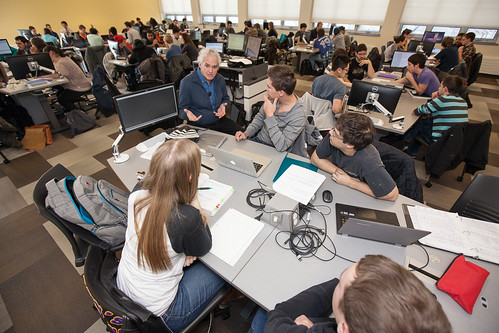
The concept of the flipped classroom, where lecture input is recorded and classroom meetings focus on discussion and problem-solving, has become extremely popular, not least during the pandemic as a way of making online classes more participatory. However, like all attempts to diverge from traditional practices, there is often opposition, especially from the students who may see new methods as a threat. The key issue seems to be the perceived withdrawal of the teacher from the centre stage as the students are given the freedom to take control of their learning and learn through collaboration. This can be seen as an unwelcome imposition by many students and leads to insecurity since traditional roles and models have been disturbed.

This sense of threat is clearly described in an article in the journal Teaching in Higher EducationWhat does it mean to do teaching? A qualitative study of resistance to Flipped Learning in a higher education context (sadly not open access). It describes the implementation of a flipped learning approach in a teacher training programme at Macquarie University in Australia. The main benefit of flipped learning is that by switching the delivery of content to recorded lectures and demonstrations this will enable teachers to devote contact time to providing timely feedback, guiding, challenging and encouraging. The problem is that students have high expectations of the teacher as performer and see the flipped model as an abdication of responsibility. The stand-up lecture is seen as the definition of teaching - that's what teachers do. When that is withdrawn, the students feel cheated.

As indicated in the title of this paper, the Flipped Learning trial was met with resistance – in fact vociferous resistance. As I analysed data from the study and also reflected on my engagement with students during the delivery of the flipped course, a ubiquitous refrain emerged. Students drew persistent attention to an absence. In absenting from the traditional stand and deliver tutorial presence, I had denied my student’s access to the sage on the stage. My student’s indicated fear of missing out on critical information, discomfort of engaging in core content in asynchronous environments and resentment of what they understood as my absence in the tutorial (i.e. I was no longer sage on the stage but a guide to the side).

The students saw the method as at best interesting, but most commonly useless, time-consuming and confusing. The traditional lecture-based approach is seen as a way of guaranteeing that the necessary course material has been "covered" and that the students know what they have to learn for the exam.

The need to get the best exam grades to enhance future job prospects is the hard currency of higher education and pedagogic innovation sometimes clashes with these very pragmatic needs. This clash is demonstrated in another interesting article: Mediating Students’ Fixation with Grades in an Inquiry-Based Undergraduate Biology Course. Here students on a year one course in biology at Borealis University were studied as they worked through a redesigned course based on inquiry-based learning. Instead of the traditional lecture-based format, the students were expected to collaborate to investigate the main topics and reflect on the process.

... the curriculum required students to work cooperatively in groups to design and execute experiments that are authentically novel, gather and analyze data, and present their findings orally and in writing. Evaluative criteria included rubrics for transferred skills, and summative assessments for acquisition and application. Scientific concepts of uncertainty, peer review, and self-reflection were explicit parts of the design.
This approach has been shown to lead to deeper learning as well as learning vital skills of search skills, source criticism, collaboration and self-reflection, but the results show a serious mismatch between the teachers' well planned approach and the students' perception of teaching. As in the first example, the students were vociferous in their criticism of the course methods and were especially critical that the experiment seriously threatened their chances of getting the top grades they need to progress in their career path. The teacher expected them to work things out for themselves and that was seen as an abdication of responsibility - the teacher is expected to go through the syllabus and make it clear to students exactly what they need to know to get a top grade.

Instructors who did not give explicit directions or answer questions directly were perceived as obstructionist. One student framed her professor’s response to her repeated requests for directions as adversarial, saying, “[The instructor] said, ‘You’re not gonna have a step by step. You need to figure it out.’ And I said, ‘Well, I’m sorry, but I’m not paying tuition to figure it out myself.’”

The article concludes that the extrinsic motivation of grades has a negative effect on the intrinsic motivation needed for an inquiry-based approach to succeed. The inquiry-based approach was designed to enhance student autonomy but the effect was the opposite - students felt cast adrift and powerless whereas in the traditional setting they felt more autonomous because it was clear what they had to do to achieve desired results. It's hard to be creative in a world governed by grades.

The key takeaway here is that any changes in course design have to be clearly communicated to the students and they need to know why the changes have been made and how it will benefit them. In this case the student expectations were completely at odds with the teachers' methodology. Maybe if you want to implement more collaborative methods you should introduce them in stages though the first year, slowly working towards collaborative learning rather than throwing the students in at the deep end. This means that all teachers in a programme have agreed on this progress and that each course is part of a progression towards greater autonomy and active learning.

References

Wilson, K. (2020) What does it mean to do teaching? A qualitative study of resistance to Flipped Learning in a higher education context, Teaching in Higher Education, DOI: 10.1080/13562517.2020.1822312

DeFeo, D.J., Tran, T.C. & Gerken, S. Mediating Students’ Fixation with Grades in an Inquiry-Based Undergraduate Biology Course. Sci & Educ 30, 81–102 (2021). https://doi.org/10.1007/s11191-020-00161-3