Showing posts with label sustainable. Show all posts

Sunday, April 7, 2024

Climate crisis - why are universities so silent?

Photo by Markus Spiske on Unsplash

We are in the midst of the greatest environmental collapse since long before human beings emerged onto this planet but the vast majority of governments and obedient citizens have decided that the best strategy is to pretend that there is no threat and continue with business as usual, focusing on short-term profit above future survival. Science denial is now becoming mainstream and the United Nations' reports coming from the world's experts on climate and environmental science are flippantly dismissed as alarmist and governments pay at best lip service with greenwashed statments of fantasy and wishful thinking. Climate activists are ridiculed and often branded as extremists and a "threat to democracy" whilst the governments and corporations that are profiting from actively destroying the world we live in are portrayed as rational and responsible. 

Since the science behind these reports come from the world's universities and research institutes these organisations are worryingly silent in national debates. Instead of fully and vocally standing up for their own researchers and offering a united front against the deluge of disinformation and greenwashing, they seldom if ever make their voices heard. There are some positive signs, such as the EUA's (European Universities Association) A Green deal roadmap for European universities published in October last year..

EUA’s Green Deal roadmap outlines processes and interventions which can boost universities’ impact and visibility in pursuing a climate-neutral, environmentally sustainable, and socially equitable Europe. The roadmap should serve as an inspiration and template for how universities can face the climate and environmental challenge over an extensive timeframe, enabling them to make both an effective contribution and serve as exemplars of sustainable communities.

Certainly almost every university has some kind of environmental/sustainability policy but on the ground there are often only cosmetic changes. Despite the lessons learned during the pandemic about the affordances of digital meetings and conferences we have largely flocked back to on-site conferences and academics, like other professions, are flying far and wide again. This despite all relevant research pointing to the fact that business as usual will have catastrophic societal consequences in the next 20-30 years. If that wasn't bad enough we have the terrifying trend that just when we need global cooperation to solve global crises the world is filled with toxic xenophobic nationalism leading to more conflict and destruction.

These thoughts were given greater perspective last week in an article in Frontiers in Education, “No research on a dead planet”: preserving the socio-ecological conditions for academia, by Aaron Thierry, Laura Horn, Pauline von Hellermann and Charlie J. Gardner. Universities' passivity in this issue will threaten their future existence.

Despite thousands of higher education institutions (HEIs) having issued Climate Emergency declarations, most academics continue to operate according to ‘business-as-usual’. However, such passivity increases the risk of climate impacts so severe as to threaten the persistence of organized society, and thus HEIs themselves.

Universities are of course simply following the societal indifference to our impending crisis, often with a warped pride in being as climate unfriendly as possible, refusing to even contemplate flying and driving less often, eating less meat, consuming less and living more sustainably. Our governments confirm these prejudices as here in Sweden where we are being encouraged to fly and drive more with increasing subsidies to fossil industries. Climate change and environmental protection are guaranteed conversation killers - I have tried! But universities should at least support their own scientists and offer a research-based response to the disinformation.

This dissonance extends to the individual behavior of many academics. For example, the normalization of aviation-based hyper-mobility in academic work (Bjørkdahl and Franco Duharte, 2022). It is even the case that professors in climate science fly more than other researchers, despite the tremendous carbon emissions associated with such activities (Whitmarsh et al., 2020). On a day-to-day basis, most academic staff seem to be maintaining the semblance of normalcy and unconcern. So great is our apparent collective indifference that an onlooker could be forgiven for thinking that we do not believe our own institutions’ official warnings that an emergency is unfolding around us.

It's time to speak out, but not as individuals (vulnerable to the hate and threats that speaking out provokes) but rather as institutions or even alliances of institutions. Universities still carry a lot of weight in society even if it is being eroded by authoritarian politicians. If they do not speak loudly and clearly in support of their own science then they risk becoming irrelevant. It is that serious. I will give the last word here to the authors of the article.

For too long we have allowed a culture of climate silence to dominate in our universities, leading to a misalignment of our priorities from our core purpose and values, thereby perpetuating a maladaptive response to the unfolding planetary emergency and undermining the very future of the higher education sector. Universities have in effect become ‘fraud bubbles’ (Weintrobe, 2021) in which staff and students must construct a ‘double reality’, in order to pursue a narrow social role, trapped in maladaptive incentive structures of increasingly neoliberal institutions. This ultimately serves to reproduce the hegemonic practices, norms and conventions driving socio-ecological collapse. As an academic community we must urgently learn to grapple with the role that universities can play as leaders in the necessary social transformation to come. Our dearest notions of progress, rooted in our desire for the beneficial accumulation and application of knowledge (Collini, 2012), are now both directly and indirectly threatened by the climate crisis.

Maybe I have missed good examples of university action. Please send examples in that case. Happy for all signs of resistance!

Sunday, April 30, 2023

To fail is human - let's share and learn from it

Photo by Michael Dziedzic on Unsplash

Behind every success there are lots of failures. Papers that never got published, projects that didn't get funded, courses that flopped, examinations failed, opportunities missed and so on. It happens to everyone but is seldom talked about or analysed. The success cult promoted on sites like LinkedIn shows a steady stream of successful people doing great things (more often than not "awesome"). Rather than being inspired I have often been a bit depressed when scrolling through all the success stories. It's a similar feeling at conferences which are also celebrations of success. I don't mean that we shouldn't celebrate success, but there are also lessons to be learned from less successful activities, since we can all relate to them. We may not feel we have ever reached the successful heights of the best practice cases but we can all identify with schemes that didn't win any silverware. But it's so hard to get people to share those experiences - it takes courage to admit your failures. But we could learn a lot by sharing these examples and discussing how we could improve. Most importantly hearing that even the most respected educators have failed many times in the careers.

This is the gist of a nice article by Tracy Nevatte in Times Higher Education, Lead by example and share your failures. She calls on senior academics to share their failures and how they contributed to later success. Many young researchers and teachers despair at repeated rejections and wonder if they are really cut out for a career in education and an opportunity to be rassured that everyone has felt like that at some point can be more inspiring than listening to stories of constant success.

We rarely see senior academics share their failures, either with each other or with those at the start of their careers, but their career trajectory is undoubtedly full of them. Do they not share these stories because they’re ashamed or, rather, do they not see them as failures in the first place? The latter seems more likely. Only when we normalise failure, and take the isolating power of it away, can failures equal success. But it’s going to take effort from early career researchers, research leaders, institutions and funders to get there.
There are indeed failure conferences, sharing experience and discussing how to improve. See Failcon for example. I've never managed to attend one but wish I had been able to. It's not easy, however, to attract speakers who are willing to talk about their less successful ventures and you certainly don't get any career points for doing so. Being a keynote speaker at a failure conference would not be something to post on LinkedIn. But we need to remove the shame and stigma and dare to share. Realising the even the top practitioners have a long string of flops behind them can reassure many who feel like giving up. By opening up like this and discussing our shortcomings we can also move away from the toxic overworking culture that has so often been spread on social media with people bragging about the unfeasibly long hours they spend working on their projects, papers, course design and project applications.

This post was written without any contribution from AI. I wonder if AI can discuss its own vulnerability ...

Sunday, April 24, 2022

Clouds on the horizon

Photo by Daniel Morris on Unsplash

Once again it's time for one of the most widely read reports on the opportunities and challenges facing higher education around the world, the 2022 EDUCAUSE Horizon Report, Teaching and Learning Edition. This year's report comes in the wake of the pandemic that has had a profound effect on education and has lead to a major reappraisal of how we teach and learn in an increasingly uncertain and unstable world. As usual the report features a number of trends in educational technology that are having major effects on education as well as overarching societal and environmental factors. It also describes a number of plausible scenarios for higher education, and even society in general: growth, constraint, collapse and transformation. An added value is the wealth of links to relevant examples of the trends described and inspirational solutions. To provide a global perspective there are chapters written by experts from Australia, Canada, Mexico, Saudi Arabia and the USA as well as a corporate view. Sadly voices from Africa and South America are not represented.

The report has been criticised over the years for repeating the same trends each year but to be fair these trends are seldom short-term or transient. Some of this years trends have been on the Horizon lists for many years but each year new details become visible as they mature and new factors come into play. The old tradition of looking at technologies that will impact higher education on a short-, medium- and long-term basis has now been thankfully dropped. In the past some short-term impacts took much longer to materialise (or simply died) and long-term trends developed more quickly than predicted. Such is the fate of most predictions. One thing is clear however:
Higher education likely will never be the same again, for these and many other reasons that have emerged just within the past two years.
Not surprisingly, the word hybrid is used a lot in the report. Universities are spending a lot of money on technology to equip classrooms for hybrid teaching with sophisticated systems with multiple cameras, screens and microphones to allow everyone to participate as equitably as possible. However, no amount of high-tech will work unless teachers and students are confident in using it and the teaching is suitably adapted. Similarly, the rise of hybrid working will lead to changes in campus design with fewer teachers, administrators and students on site. 
Remote work is making its way into job descriptions and contracts on campus, and institutional leaders are having to rethink important aspects of their culture and operations, such as interpersonal staff and team communications, the use of facilities and on-campus office and desk spaces, and staff and faculty training and support for their device and connectivity needs.
This in turn opens up questions on the value of the campus. It is certainly a great place to be for many who gain networks for life and a stimulating academic environment, but it also excludes many others. The report also describes a major shift in interest away from traditional degrees towards skills-based learning with shorter focused courses offering microcredentials. These are being increasingly recognised by major companies and some universities are already partnering with the corporate sector to offer such credentials.
Some students will simply conclude that they cannot afford the cost of a degree, particularly in regions and at institutions where rises in tuition and other related expenses simply seem unmanageable. Other students will conclude that the traditional college degree no longer meets their personal and professional needs, or they will seek alternative opportunities for acquiring the knowledge, skills, and credentials they need for successful job placement and career advancement.

Learning analytics, artificial intelligence and cybersecurity also feature heavily in the report but earlier tech-optimism is now clouded with concerns in terms of how student data can be used in a responsible and ethical manner. The full potential of learning analytics and AI has not been realised yet, often due to the fact that most institutions have so far failed to integrate all their systems to be able to tap into the vast resources of data they possess. Even the data available in the learning management system is seldom exploited. Will students accept that their data is analysed and profiles created that might not always be to their advantage? 

As previous EDUCAUSE research has found, for example, students may be more or less comfortable with their institution collecting and using their data depending on the type of data being collected and used. And many students may not fully understand why or how their data are being collected and used, eroding their trust and confidence in the institution’s use and protection of their data and subsequently eroding their trust in their institution overall.

Although the report shows the potential of the trends it describes it does not hide from the storm clouds hanging over all of us in terms of  the climate crisis, increasing political instability and the global rise of misinformation and anti-scientific thinking. We already see an increase in political control of what is taught at universities and a decrease in the public funding of higher education and the report does not see this ending in the short term. This can lead to universities seeking more private funding and risking that major benefactors influencing policy and strategy in ways that limit academic freedom.

Of course there are other issues or trends not mentioned in the report but I still think this is the most accessible summary of the challenges facing higher education today and one that you can certainly send to decision makers at your institution. If you'd like another perspective as a complement, then please have a look at Mark Brown's excellent article from December 2021, What are the Main Trends in Online Learning? A Helicopter View of Possible Futures (Asian Journal of Distance Education. Vol. 16 No. 2, 2021) 


.

Saturday, January 15, 2022

Waiting for the storm to pass is not a solution - dealing with uncertainty

Photo by Zoltan Tasi on Unsplash

We used to believe that we could plan for a relatively predictable future, a clear linear pathway for our medium and even long-term strategies. Today however the future is wildly unpredictable and just about anything can happen, as the pandemic has clearly shown. We continue to plan for the day when the pandemic disappears and we can get back to normal, but how realistic is this, especially given the increasingly serious effects of the climate crisis and the growth of political instability around the world? This pandemic could continue for years, returning in new variants and, if that is not enough, climate and political instability will lead to further crises. The only way forward is to plan for dealing with constant uncertainty. We cannot put changes on hold until the pandemic dies down. 

This theme turned up in two articles I read this week. The first is by Debbie McVitty in the journal Wonkhe, Making peace with uncertainty in 2022. Many people in education leadership are trying to revert to normality and restore order in the disorder of the last two years. Universities look to the government to lead the way back to normality and unpredictability but what if that state never returns? One positive side to the present crisis is that it has forced us to rethink processes and practices that we have always taken for granted.

When things are uncertain, it becomes necessary to ask more searching questions about the various things that might happen – and in doing so gain an insight into the way things work and how they might work differently or better – like the many teaching and learning innovations that arose from the uncertain environment of online and hybrid learning. Uncertainty also means learning to deal with unexpected consequences – like student over-recruitment – a nice problem to have certainly, but also one that requires serious creative thinking to ensure students get what they’ve been offered in an acceptable way.

In fact there is a great danger in pretending that we can manage and control the future, ... the illusion of certainty may be more dangerous than confronting the reality of ambiguity. When the virus died down last year many universities joyfully reverted to the old order as soon as possible. For example, experiments with online examination were put aside as we reopened the examination halls again. We need to continue developing alternative methods rather than putting them back on the shelf because we simply don't know when we will have to handle the next crisis.

One area that needs to be developed is that of risk analysis and contingency planning and it's time to employ people to lead this work. This is highlighted in an article by Javeria Salman in The Hechinger Report, How to plan for a future of education where disruption is the norm, describing the work of one such person, Andrew Smith, chief administrative and strategic planning officer for the Rowan-Salisbury School District in North Carolina. He gets management to develop plans for a variety of scenarios so that the organisation develops a certain crisis resilience. 

The leaders asked: What is the worst that could happen? What is the risk to schools, teachers and students? Then they asked whether the district was prepared to handle each scenario. Smith said they considered questions like: “What happens if kids never come back? Or if staff aren’t allowed in the buildings?” They even asked seniors for ideas in planning for socially distant graduation ceremonies.

We have been able to test many alternative solutions for teaching and learning over the last two years and we need to continue with this rather than waiting for the storm to pass.

Schools can’t keep waiting for an end to the pandemic for problems to go away, the solution “has to be now, not later,” Smith said. “Because every time you keep waiting for the end … how many hours kids are waiting for you?”

Saturday, May 30, 2020

Online conferences should be different


Online conferences have become mainstream in just a few months and many organisers have had to hastily adapt their original on-site schedule to an online format. I have written many times about how we could find new models for academic conferences and we now have the chance to review the whole concept. At present most organisers are simply switching the classic conference format to an online set-up, using Zoom or similar platforms to run plenary and parallel sessions as well as providing spaces for a certain amount of social interaction. The social interaction aspect is particularly interesting since that is the feature of regular conferences that most people appreciate most. Curiously it's not the high profile keynote speakers that attract people to attend a conference, it is the opportunity to meet colleagues and expand your network.

There are many tools that can to some extent simulate social interaction. One that I have just discovered is called Online Town. This is extremely simple but rather ingenious. You log into a room where you are represented by a simple photo that you can move around the space. As you approach a group of faces they appear as video feeds, as in a Zoom or Skype meeting. If you all stand close together you can have a video meeting but if you move away the other speakers' video feed gets weaker and then disappears. In this way you can mingle as you might at a reception, the main difference being that you don't have to balance a drink and a plate of nibbles whilst chatting with colleagues. It's a rather basic tool but the idea is perfect for conference settings.

But maybe we shouldn't simply translate the on-site conference to an online setting. Why should we sit in front of a screen intensively for two or three days? It doesn't work, so why not rethink the conference to exploit the strengths of online spaces for asynchronous collaboration. This is voiced by Matt Webb in a short post, A month long conference is a neat concept. Why not spread the conference over several weeks with short and intensive synchronous sessions interspersed with asynchronous collaboration and group work over several days or even weeks? The impact of such a conference would be greater and the asynchronous discussions and collaboration would certainly lead to more networking and lasting relationships than many regular conferences.
There was something about the weekly rhythm which meant that there was time for me to digest each download of new thoughts. The session stayed with me for the week. … A week is time to discuss with friends, contemplate, see the deeper patterns.
One platform that embraces this concept is Qiqo chat. This integrates Zoom with collaborative documents in Google Drive or teamwork tools like Slack and allows participants to form their own breakout groups and change groups at will.
QiqoChat (Qiqo) provides a wrapper around Zoom meetings so that participants can move themselves into different breakout rooms. For example, Qiqo is good for when you want participants to have more freedom (such as an online conference or workshop where you want people to be able to move freely in and out between sessions).
For a conference you can create a large group space for synchronous meetings or keynotes and then let the participants move to working groups where they can then spend hours or even days working on a position paper, brainstorming solutions to a problem or editing a website. In the groups they can mix video meetings with collaborative writing before reporting back to the main event at a given time. The solution is already used for intensive collaborative events like hackathons. This short demonstration video gives you a good overview of the solution.


I haven't participated in a Qiqo session yet but I can see that this type of solution widens the potential of conferences. I'm sure there are also many other exciting solutions out there that I simply haven't discovered yet. Even when on-site conferences are again possible we could gather people for a shorter time and then continue the conference discussions for several weeks before final conclusions are reached. More hybrid conferences will be available where online participation can be as active as on-site. There are already many problems with the traditional on-site academic conference: one-way communication, passive consumption, exclusive access, extremely expensive. There is no better time than the presence to try new models and see if we can create a better experience for all.

Saturday, March 7, 2020

Why tech - the dangers of digital over-dependency


In our rush to adopt all things digital we seldom pause to consider what we are discarding from our lives. Handwriting, navigating by map, calculating in your head, remembering facts, deep reading, dealing with silence and so on. Obsolete skills you may think but extremely useful if the digital alternative breaks down. For example, here in Sweden we have virtually achieved a cashless society and although cash still exists it is becoming extremely difficult to spend it. Public transport is almost completely cashless, many shops and restaurants refuse cash and even the banks don't want to touch the stuff. Many old and vulnerable people (asylum seekers and homeless people without bank accounts) are therefore completely marginalised, but that seems to be regarded as collateral damage in the rush towards a digital future. As a result, every step your take and every move you make are being stored and exploited. At the same time we are building an extremely dangerous vulnerability into our society. If there's a power or network connectivity failure, nothing works. You can't buy anything and there's no back-up.

I have been thinking about this for a long time and have consciously reverted to some old-school habits in an attempt to keep myself in touch with both worlds, trying to become functionally ambidextrous; able to handle both the digital and the analogue. This week I stumbled across a short interview with Kris De Decker, founder of Low-tech Magazine, ”Reconsider the thinking that everything should become digital”. He's a former tech journalist who has discovered the joys of low-tech. The magazine's slogan is "doubts on progress and technology" and questions the belief that technology can solve all our problems. It contains low-tech solutions to everyday problems and the website itself runs on a solar-powered server showing that you can be low-tech and still benefit from some aspects of the digital world. It also questions many technologies that we consider green such as electric cars, wind turbines and solar cells; they all rely on batteries and manufacturing processes that have a considerable footprint. But it's not about retreating into a cave and living off-grid, but reassessing our over-reliance on a technology that is becoming frighteningly vulnerable.

In the interview, De Decker explains why we shouldn't discard our old skills.
We also lose a lot of skills. As someone who doesn’t have a smartphone, I have noticed that I have become one of the few people who still knows how to navigate a city without staring at a screen. This makes us also very vulnerable. If our complex infrastructures falter, we are helpless. Just think about the infrastructure we need to do digital payments. Cash, on the other hand, is very resilient.
Maybe we should all challenge ourselves now and again to go retro for a while. Try visiting a city and see how well you can survive without TripAdvisor, Google Maps, Uber etc. See the sights with a map and find restaurants by asking people. It works, but just in a different way. If we lose that ability we lose our resilience.

Then there's the issue of the environmental impact of technology. I have been working enthusiastically with webinars and digital conferences as an answer to the need to reduce the carbon footprint of frequent flying but we also need to realise that technology has en enormous impact too. All our devices and gigantic server halls that store our data are extremely damaging to the environment, not to mention the ever-growing mountain of electronic waste that is all too seldom recycled.
But of course digital technology is just as physical as any other technology. There is an enormous infrastructure behind the internet. The production of computer chips requires complex factories and lots of energy and other resources.
I'm not going low-tech (yet) but I am attracted to the idea that we embrace digitalisation with more caution than before and dare to maintain contact with the skills that digitalisation is trying to make obsolete. We need to be able to work on both sides of the digital divide and develop a functional resilience. You never know when you may need to work out something for yourself again.

Monday, January 13, 2020

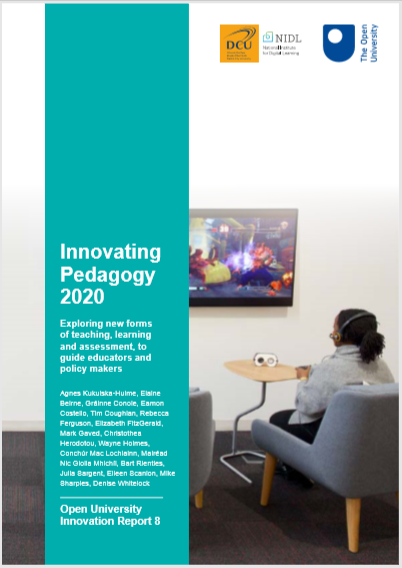
Innovating pedagogy 2020 - time for sustainable education?

CC BY-NC Some rights reserved by The Open University
The UK's Open University, in collaboration with the National Institute for Digital Learning (NIDL), Dublin City University, Ireland, has published its annual review of innovations in teaching and learning in higher education, Innovating pedagogy 2020. This the eighth report in a row and has common features with the much hyped NMC Horizon reports, such as predictions about the potential impact and timescales of each innovative practice described. These criteria are notoriously inaccurate (especially in the Horizon reports) and should not be taken too seriously but the descriptions, conclusions and references are interesting as indications on the present wind directions in the use of technology in higher education.

The ten areas examined by the report are:
  • Artificial intelligence in education. This means learning for, about and with AI. It is also vital that educators are involved in the implementation of AI and make sure it is used to benefit teaching and learning.
    ... what is clear is that the topic of AI in education is too important to be left to engineers and entrepreneurs. Instead, it is critical that educators, learning scientists and other stakeholders engage, to ensure that the AI applied in educational contexts best supports the learners, the teachers and the learning.
  • Posthumanist perspectives. This concerns the blurring of boundaries between humans and machines and the potential of this interaction for the benefit of education.
  • Learning through open data. Public organisations all over the world produce enormous amounts of open data that should be used in universities to enable students to use authentic data for research purposes.
  • Engaging with ethics. The (un)ethical use of personal data has been in the headlines for the last couple of years with the rise of what is often termed as surveillance capitalism. It is vital that students learn to learn how their data is used and misused and to gain a mature and informed attitude to the platforms and tools they use.
    Teachers and other education practitioners can actively engage their students with ethics by presenting authentic case-studies and giving opportunities for active discussion, ideally with people from different cultural settings and backgrounds. Only by engaging with ethics can we learn that our own mindset might not necessarily be shared by others.
  • Social justice pedagogy. Developing the ability to see issues from different perspectives, especially in terms of power structures, prejudice, roles, accessibility issues etc.
    For individuals, the process of thinking about how they came to know what they know, and what they think about what they know, can be very challenging. Specific teacher education may be required, to encourage and prepare teachers to adopt a social justice pedagogy and to deal with how the approach may play out in class.
  • Esports. The world of online gaming shows the power of learning and problem-solving in a community. These lessons are now being applied to create immersive learning communities.
  • Learning from animations. Animations are being increasingly used to show processes, procedures and movement.
  • Multisensory learning. Smell,taste and touch can be used more in learning activities.
  • Offline networked learning. Millions of people have limited or no internet access but can still benefit from digital resources in local networks run on battery or solar powered servers.
  • Online laboratories. Access to realistic virtual online labs give authentic laboratory experience to students who would otherwise never have access to such physical facilities.
The report is in general positive about the future as long as we can learn to harness the dangers of big data and artificial intelligence. Our attitudes to technology have changed and we need to be much more critical and cautious of the global tech giants.

The theme that interests me most is that of offline networked learning. Using battery powered mini servers and a wireless network, students in remote areas can work together with digital resources in a closed offline network (see also my post, Online learning - unplugged). This solution is also being used for education in prisons where internet access is not appropriate. However it is not only a solution for remote regions, there are arguments for closed networks even in developed regions. The report mentions the concept of  slow learning:

Networked offline learning brings people together in meaningful collaboration and sharing activities that can create opportunities for a slower, more deliberate learning experience than is typical on the Internet. 

Maybe we need to experiment with working in such distraction-free digital spaces to relearn how to focus. I don't mean that we go completely offline but a future skill will be learning to go offline in order to focus without losing the advantages of digital collaboration.

However, the biggest issue of all today is how education intends to face the greatest challenge of all today - the climate crisis. This is mentioned only briefly in the report but none of the innovations discussed will be of any relevance if the climate issue is not addressed immediately. Unless radical and uncomfortable changes take place on a global scale in the next ten years the future looks extremely dark. The educational sector must push harder for these changes, through further research but more importantly by integrating the message of United Nations sustainable development goals 2030 in every course and classroom. As I have previously written, we must develop sustainable ways to meet and collaborate, primarily through digital meetings and conferences. The carbon footprint of the higher education sector is extremely high through countless international projects and conferences (read more in this article in University World News, Time to cut international education’s carbon footprint). We cannot stop this completely but we could surely half the level if we develop better digital arenas for collaboration and learn how to use them effectively. As with all other aspects of the climate crisis, we know the dangers and we have solutions but entrenched attitudes and habits are the hardest things to change. My top trend for 2020 would be rethinking academic culture and focusing on sustainable education.

Reference
Kukulska-Hulme, A., Beirne, E., Conole, G., Costello, E., Coughlan, T., Ferguson, R., FitzGerald, E., Gaved, M., Herodotou, C., Holmes, W., Mac Lochlainn, C., Nic Giolla Mhichíl, M., Rienties, B., Sargent, J., Scanlon, E., Sharples, M. and Whitelock, D. (2020). Innovating Pedagogy 2020: Open University Innovation Report 8. Milton Keynes: The Open University.

Saturday, November 2, 2019

Attention seekers - taking innovation from project to mainstream


There is no shortage of innovative and exciting projects in education full of enthusiasts investigating new ways to enhance learning or widen the horizons of current educational practice. However the challenge of moving from project to mainstream often proves too great and few innovations get a chance to make a real impact on the institution's core activities.This is a source of frustration for all of us who have been working with educational technology but it's worthwhile stepping back a bit and looking at all the other important issues that are competing for the attention of policy makers and management: internationalisation, accessibility, diversity, sustainability, pedagogical development, quality assurance etc. Educational institutions must deliver what is asked of them by their government authorities or owners and if these requirements do not include specific objectives for the issues mentioned above, then those issues will naturally be of secondary importance to the management. If your cause is not on that priority list then your chances of getting noticed are low.

In recent years in Sweden there has been little coherent strategy from the top on the use of educational technology and as a result development has largely been fragmented and responsibility delegated to each institution. Things are changing now with the issue once again on the agenda of the government authorities but for many years it was hard to see real progress. There have been many projects and initiatives but almost always bottom-up and dependent on short-term financing. If bottom-up is not met half way by top-down strategies, commitment and incentives then all that energy just evaporates into thin air.

The struggle to catch the eye of the decision makers was nicely captured in a lecture I attended the other week by Melissa de Wilde from Gent University in Belgium. She is a researcher in educational innovation and described her efforts to promote virtual exchange at her university. Her story was familiar to everyone who has tried to introduce new concepts and perspectives. The challenge of simply getting people's attention is probably the greatest and demands resilience and stubborn persistence to make any kind of headway. Decision makers are the hardest to influence unless your issue can help them tick at least one of the boxes on their to-do list. Teachers can often be interested in your cause, but simply don't have the time or energy to get involved, especially since your cause is just one of many admirable but non-essential ones vying for the attention. Key success factors according to Melissa are simply getting your foot in the door and not withdrawing, getting help from a high status staff member or an external expert (deus ex machina), providing support to those who do engage, making sure to document, measure and analyse the process, creating  opportunities to share experiences and success stories and simply making yourself and your colleagues hard to ignore (creating a buzz).

However, no matter how hard you try, nothing helps your cause more than it becoming national policy and part of the institution's mission, so you need to address the policy makers as well as the grassroots. If we can join forces with other causes vying for attention and show that you can tick several boxes in one go then the chances of mainstream adoption must be high. Digitalisation can for example help to build sustainability (reduced air travel, paper use), promote internationalisation (virtual exchange, online collaboration), widen access to education (online courses), enhance inclusion (digital tools for text-speech-text, translation, sub-titles) and pedagogical development (open pedagogy, online courses, collaborative learning, best practice dissemination). If we have to compete for attention we will not get very far. Joining forces must be the answer.

Sunday, October 27, 2019

The future of student mobility is digital - whether we like it or not

I have spent the past week contributing to an international staff training week on virtual exchange at the Silesian University of Technology in Gliwice, southern Poland. I was responsible for several workshops and presentation sessions on subjects like tools for digital collaboration, webinars and the open online course for teachers that I help to run, Open Networked Learning. It was a truly global gathering and our common interest was widening international collaboration between students and teachers by using digital platforms and tools. Integrating internationalisation in the curriculum has been common in language teaching for many years but today’s online collaboration goes far beyond the level of simply linking up with colleagues abroad using Skype. Using synchronous and especially asynchronous platforms students can collaborate on common projects in practically any field, teachers can develop common online courses and students can even work for international companies through virtual internships. The participants were all enthusiastic about the opportunities offered by virtual exchange and many different projects and approaches were presented and discussed.

This part of Poland, Upper Silesia, and surrounding cities like Katowice, Chorzów and Zabrze are synonymous to many people with heavy industry such as coal, iron and steel and the resultant pollution. In recent years, however, most of the mines and factories have closed and this has led to a massive restructuring of the economy, moving from industry to services. The cities are changing as the old industrial landscape is replaced by modern housing, offices shopping malls and motorways. In many cases industrial buildings are converted and repurposed and many of the impressive new public buildings have elements of the past heritage, such as the use of local bricks. Some industrial areas have been converted into parks or wetlands and slowly the region is emerging from the polluted industrial past. During the week, we were taken on a tour down an old coal mine, a visit that made me ashamed to ever complain about my own work having seen the conditions that the miners have had to work in. This process of totally overhauling the regional economy is painful and far from complete but the change has been essential. Our conference in some way reflected this in that we are facing a radical shift in how we work with internationalisation.

With the background of the urgency to reduce carbon emissions, especially through air travel, it would seem logical that virtual exchange/mobility is clearly the way forward in terms of international cooperation in higher education. However, this week made me realise that the field is still in its infancy compared to the efforts universities put into physical mobility programmes. Even if my colleagues this week were all enthusiastic about the potential of online collaboration and were trying hard to influence colleagues at their respective institutions, it seemed to me that physical mobility is still the default option, even if an average of around 5% of all students ever get the opportunity to study abroad. Even without the climate crisis, the arguments for investing in virtual exchange activities would seem to be convincing. Online collaboration enables all students to learn how to work in international and multi-cultural teams, a skill that is highly valued in the labour market. It also promotes accessibility since students with restricted mobility are able to participate in international activities on equal terms. If we genuinely believe that students benefit from meeting and working with students from other countries and with other perspectives then the only way to enable this for all of them is by using online platforms and tools.

The elephant in the room however is the realistic prospect that we may soon have to drastically cut or even stop our use of air travel and physical meetings and conferences will become rare or unfeasible. Even those who are working with virtual exchange are still flying to meetings and conferences and the desired outcome of many projects is a physical exchange at some point. This is a very hard pill to swallow and although I have been trying hard to avoid air travel for the past few months it still hurts; especially those extremely long train trips through Europe with hectic platform changes and bags to carry. However, I suspect that the pressure to reduce the carbon footprint of higher education will increase rapidly in the coming year and no matter how exciting it is to travel and meet each other in person, we will simply have to find other ways. I am very glad, however, that I was able to attend this event and meet other enthusiasts who see great potential in virtual exchange.

Sunday, September 29, 2019

How dare you! What future do we offer our children?


This short speech by Greta Thunberg at the United Nations climate summit this week has shaken me. I've been increasingly depressed by how the world's leaders and decision makers continue to pay no more than lip service (at best) to the urgent demands from scientists and experts for concrete action to prevent the disastrous effects of massive climate change. But this short speech spells out the message better than any scientific report. We're in danger of triggering a disastrous and irreversible process and those who can actually do something about the situation continue with a message of business as usual, in some cases denying that the problem even exists. At the same time, the scientific facts were made even clearer as the IPCC published its Special Report on the Ocean and Cryosphere in a Changing Climate, outlining the potentially disastrous effects of global warming to the marine environment with severe flooding, collapse of fishing and increase in severe weather phenomena. The message couldn't be clearer.

Greta points the finger not only at world leaders but also at all of us. We have all contributed to the mess and it's our responsibility to do everything we can to avert disaster. We talk so often about our children's future but now when the children are begging us to offer them a future the world seems suddenly paralysed. The solutions are there, the science and technology are available but the will to change is absent. Yes, there are millions protesting and many are trying to adjust our lifestyles, but the majority are simply continuing as normal, assuming that it will somehow work out well in the end. In all disaster movies, no-one listens to the lone scientist who warns of the impending danger. The mayor insists that the show must go on and scoffs at the idea of a giant shark/mutant piranhas/monsters/aliens coming to spoil the festivities. Sounds familiar today doesn't it? In the movies the lone scientist manages to save the day at the last minute, but I'm not sure this is a realistic scenario.

I have made some changes to my lifestyle in the last couple of years but admit that they are mostly cosmetic. Like most people, I'm still leading a comfortable lifestyle and following ingrained habits. I have often questioned whether not flying or eating less meat will make the slightest difference to the situation. The airports and planes are still packed, new massive shopping malls are opened every day, the annual consumer feeding frenzy of Christmas is already under way and the world's forests are disappearing rapidly. We seem to be consuming ourselves to extinction.

The role of education is absolutely vital to make people aware of climate issues and many educators are already making valuable contributions. But this is a global issue and needs international coordination. A major obstacle is the countries who actively discourage discussion of environmental issues even in schools or suppress any movement that may question or threaten the government's control. Even in the richest nations science and education are under threat since the solutions to the climate crisis threaten the profits and even existence of massive multinational corporations. The backlash we are seeing just now is savage and therefore it is essential that everyone in the education field is conspicuous and active in the public debate (where such action is allowed). Educators and scientists must react publicly to provide facts to debunk the conspiracy theorists and deniers. But we can't do this alone, we need political support. The saddest part of all this is that I see very few political leaders who are willing to step forward seriously and this is the core of Greta's message. She has power to influence but we need bold politicians who can do the real work. I can't see anyone willing to take the lead at the moment.

Wednesday, June 26, 2019

Trans Europe express - flightless conference travel

Hamburg Hbf, one of many stops on my travels
Having been responsible for a considerably large carbon footprint due to frequent flights to conferences and project meetings I decided this year to try and cut unnecessary flights from my work schedule. I have travelled by train to two activities in Norway and last week I tried a more ambitious project. I attended both the EDEN 2019 (European Distance and E-learning Network) conference in Bruges, Belgium and a project event and meeting in The Hague, Netherlands and did it all by train. I felt doubly motivated for this since I and a colleague planned to run a workshop at the conference on the challenge of organising engaging, interactive online conferences to minimise the need for air travel. I simply couldn't fly to the conference to run a workshop on that theme! Sadly the workshop did not attract much interest this time but we will try again elsewhere later in the year. You can read the abstract for our workshop in the EDEN 2019 Book of abstracts (p 72).

Changing train in Amersfoort, Netherlands
Some reflections then on my feelings after my first Interrail journey for almost 40 years. The whole journey consisted of 15 trains, two ferries and two rail replacement buses and took a total of three days and two extra overnight stays. Only one train was seriously late and although I missed my planned connection there was a later train I could take. I had planned to get some work done on the journey but to my surprise almost none of the trains had any wifi to offer and several did not even have electricity sockets so once the rather weak battery of my iPhone ran out of juice that was the end of the little connectivity I had. Many hours of just sitting on trains takes its toll and I was very tired after a long day on rails. Changing trains was always quite exciting working out which platform to get to and carrying my bags from one platform to another. I did however make short excursions outside many stations dragging my case on a bit of fast sightseeing, something you certainly can't do at airports. I read a lot, gazed at some beautiful German, Belgian and Dutch countryside and made brief contact with many cities I knew about but had never visited. It was a generally pleasant experience and gave me a sense of distance that you lose completely when flying. It just takes so much time.

My Interrail pass - valid all over Europe
There is no doubt that the explosive increase in international air travel over the last 20 years has had a major effect on global CO2 levels and that we need to reduce this as quickly as possible. Of course this is only one of many factors that are contributing to our environmental crisis but it's one that we can directly change if we only put our minds to it. However, if even a fraction of today's air travellers changed to rail transport then today's railways simply could not cope with the increased demand. Long-distance trains are already full and in most countries there are major capacity issues that need to be fixed immediately. It will take billions of euros to upgrade Europe's railways to meet the massive demand of the future and this investment must happen now, not in ten years or later.

At the same time we need to continue meeting each other to find global solutions to global problems. The need for effective digital meeting spaces is therefore the key to international development and we can certainly replace many physical events with online meetings, as long as we are prepared to test new methods and change our traditional approach. It may not be the same as meeting physically but in today's climate crisis, we simply don't have that alternative, at least not as the default form of meeting.

Monday, June 24, 2019

Educational projects in rural areas - a Nordic perspective

Klaksvik, Faroe Islands (own photo)
Rural areas all over the world are suffering from depopulation as young people leave for the cities to get education and employment. This means that local companies are unable to find qualified staff and in many cases choose to move their operations elsewhere. The public sector has to deliver services on shrinking budgets due to the loss of tax income as the population decreases. It’s a vicious circle but one of the keys to reversing this trend is to provide opportunities for the local population to access education and training without having to move away from home. Those who do leave to go to college or university tend to find work in urban areas and seldom return home. Reversing this trend is a key to economic and community development in rural areas and an obvious enabler for this is the use of technology to offer education to all. Today there is a wealth of online education available, as well as blended courses that allow learners in rural areas to study mostly from home apart from a few campus meetings. Despite this, the brain drain continues apart from a few notable exceptions. These exceptions are extremely interesting of course and the question is why some places have found a sustainable solution for offering higher and further education whilst other places have failed?

This was the question behind a Nordic project (Nordplus project Presence at a Distance) I have been involved in over the past two years and we are now working on our final report (the project group are all members of the NVL Distans network). The project's focus was the question: what are the success factors behind educational initiatives in rural and sparsely populated areas in the Nordic region? We looked at a lot of good practice throughout the region but also investigated cases where local initiatives had disappeared. The key factor behind all the success stories was stable and long-term funding but also a common vision of a sustainable and diverse local economy. The establishment of learning centres was a catalyst for development in many rural areas; acting as a broker to match the needs of local companies and public sector with suitable education from colleges and universities. These centres also act as a hub and meeting place for students, teachers and organisations, offering guidance and support as well as access to technology and learning spaces. Having someone to talk to about the mysteries of online education can make the difference between a student succeeding in their studies or dropping out. Many learners have negative experience of education, especially from school, and so they feel apprehensive about going back to education. It is therefore essential that they feel included and valued in this new educational setting and a combination of support both online from the university and on-site from staff at a learning centre or local library.

In our study, we interviewed representatives from successful distance learning initiatives in all the countries and self-governing areas of the Nordic region with the exception of Greenland.  We saw that many initiatives to set up learning centres in rural areas have failed over the last 15 years and this was nearly always due to a lack of long-term vision on the part of the local authority. Many centres were started with the help of EU funding but once that funding dried up the venture suffocated and died because it was not part of any long-term strategy. Many centres also relied too heavily on the initiatives of a few dedicated enthusiasts with little help from the mainstream organisation and if any of those enthusiasts left there was noone willing or able to take over.

The successful educational initiatives we studied had the following factors in common:
  • Commitment and engagement from all interested parties to a shared vision. A vital element in all successful initiatives was close co-operation between the educational institutions, local authorities and local businesses as well as sustainable long-term financing. Many successful initiatives grew from the needs of local industry for qualified staff and this spurred the local authorities to find a solution. It is also essential that the local or regional authority include access to lifelong learning as a key element in their development strategy. Access to relevant higher and further education is not only an educational priority, it is also integrated with employment and economic development.
  • Local meeting places (learning centres) as hubs for educational activities. This must also be a long-term strategic initiative with qualified staff who work closely with all stakeholders to provide relevant courses and programmes that can be studied with a minimum of travel. Even if most people have internet access at home there is still a need for physical spaces for meetings, support and coordination.
  • Efficient and flexible systems for supporting learners wherever they are and building inclusive learning communities. This is largely the responsibility of the educational institutions and involves course design that is focused on building a supportive learning community for distance students. Too many online courses today are largely self-study and only those with great resilience in terms of digital and study skills can hope to succeed.
  • Incentives for universities to offer decentralised/distance education. We saw many good examples where universities responded to the needs of major companies or regional authorities but it is very difficult for the needs of more sparsely populated areas to result in action. While there are many distance/online courses and programmes available they are lack the scaffolding and course design features that are needed to prevent isolation and drop-out. No Nordic country has an open university whose focus is on lifelong learning and with distance as default. As a result the campus is still core business for our universities and this is unlikely to change unless government funding is provided.
Of course, even if all of these conditions are fulfilled it will not stop young people from wanting to spread their wings and move to the cities in search of education and new horizons. That is only natural. However, there is an urgent need to address the needs of those who already live and work there and want to stay. If the established higher education system is not able to develop lifelong learning then we need to create an institution that focuses on this field.

Sunday, June 18, 2017

Building the e-learning quality chain

Chain by robpatrick, on Flickr
"Chain" (CC BY-NC-SA 2.0) by robpatrick

At this week's EDEN 2017 conference here in Sweden there were several discussions about quality in technology enhanced education. There was a consensus that although we have sound quality assurance systems, certifications, strategies, policies and research we have still not reached mainstream integration and acceptance of educational technology. Even if some institutions have succeeded, they are prevented from full integration due to pressure from both government authorities and politicians who demand increased accountability and base their budget decisions on league tables and shallow evaluations. There are lots of success stories at faculty, institutional or even regional levels but to move forward we need a chain reaction involving all levels.

How can we enhance existing quality structures? This requires more than simply checking learner satisfaction at the end of each course or module. Quality is often mistaken for this checklist approach where each link in the chain tries to give answers that will satisfy the criteria of the next level. We ask learners to evaluate both the teachers and their own performance on each course module but the questions is whether learners recognise good teaching when they see it? Often students give the most positive evaluations to teachers who provide them with the material they need to pass the test rather than recognising the value of teachers who help them work things out for themselves.

So how can we develop learning literacy at all levels in the educational chain?
  • Learners need to develop the meta-cognitive skills to become conscious learners. To put it simply, they need to learn how to learn, becoming aware of the learning process and learning to monitor their learning through reflection and self-assessment. They need to develop their collaborative learning skills and realise how learning is a social process rather than simply cramming facts. These skills will be vital in their professional life where their development will depend on being able to learn new skills without waiting for someone to organise a course to help them.
  • The next link in the chain are the teachers who need to become more aware of their own teaching and how they themselves learn. They need to develop new skills, work in teams, learn to become facilitators rather than content providers and so on. This involves a greater emphasis on pedagogical development and how educational technology can complement and enhance traditional practice. At the teacher level this means learning to enable.
  • For this to happen we need institutional leaders who are aware of their leadership, have learnt how to empower, motivate and reward and can create a culture of sharing, support and common purpose among all staff and learners. This means learning to empower.
  • However none of this will happen without the next link in the chain. Government authorities and international bodies must lead the way by providing frameworks, strategies and policies that inspire and guide. Learning to inspire.
Today there are good examples of all the above but in order to create a true culture of learning each level must work as a chain and be clearly linked to each other. If any link in the chain is weak or missing it will never be sustainable and for me the reason why we have not achieved mainstream integration of educational technology is because one or more links in this chain are missing.

Sunday, February 12, 2017

Change is a shared responsibility


I read a short article on the news site eLearning industry, Why There Is Lack Of Enthusiasm Some Employees Have For Social And Collaboration Tools? about why digital collaboration has not really become mainstream, despite so many compelling arguments. The article deals with the difficulties of convincing employees of the benefits of online collaboration in the corporate sector.

... while many organizations have been full-heartedly adopting social or collaborative tools, these solutions work best when all members of a team use them. In most organizations, there is an evident struggle to get all employees interested in utilizing these tools to their fullest capabilities.

The article goes on to list barriers to the adoption of collaborative tools: lack of value, poor user interface and too many features. All of these are familiar issues, both in the corporate sector and in public education, but I would like to add what I think is the most crucial barrier to technology adoption - our instinctive aversion to unnecessary effort when we are faced with change.

Those who are curious about new solutions and embrace change are generally not satisfied with the status quo. Some are naturally inquisitive and are constantly looking for new ways to solve daily problems and are willing to put in extra hours to test and refine them. Change comes at a cost; long hours of trial, failure and frustration. However, if the potential reward seems great enough we'll make that effort.

On the other hand the vast majority of us are wary of change, primarily, I believe, because change comes at a price. If we're relatively content with the way we work today, there is little motivation to adopt new technology. Even if we suspect that the technology may make some aspect of our work more effective, that improvement is not worth the time we fear it will take to master the innovation. There's also the fear of failure - what if it doesn't work, what if I make a mess of it? The longer you avoid addressing this change the greater the effort required and this creates a vicious circle that I suspect many teachers are caught up in today. Many realise that they should have adopted technology many years ago but now it feels like the gap is so great that trying to catch up at this late stage is futile.

So what is the answer to the question posed by the article? A lot of responsibility lies at management level, leading by example and using digital tools in an exemplary way. Fostering an inclusive sense of community in the organisation where innovation is encouraged and most importantly recognised and rewarded. Providing support to staff, both in terms of educational technologists and online support, is essential so that no-one feels alone and that innovation is a shared process. Increased use of online collaboration tools can also be a feature of a sustainability programme, helping to reduce paper consumption or travel. If the change is a community effort and you know you are part of a planned and shared development with support and clear rewards great things can happen. Most importantly, we need to find ways of sharing and thus reducing the extra effort and risk involved in daring to change.

Thursday, December 8, 2016

Recycling webinars 2

A couple of weeks ago I wrote a post about how we could recycle webinar recordings and use them for other purposes (Recycling webinars). Not long after that post was published I got an e-mail from a colleague at Karolinska Institute, one of Sweden's leading medical universities, with a film they had made to help teachers think about webinar methodology. The film reuses a webinar I had helped to produce as part of their EdX MOOC, Introduction to urology, in the autumn of 2015. The cooperation was part of a Nordic project on making more effective webinars (see the project site Effective webinars for lots of articles, toolkit and ideas) and the idea of running a webinar as part of a MOOC was one of our most challenging activities.

Karolinska Institute have now used excerpts from the webinar to demonstrate how you can make your webinars more interactive, using different layouts, polls, chat and presenters-only area as well as tips on methodology. The original recording is probably of little interest today but parts of it will now live on in the form of a new product. An excellent example to recycling educational material


Thursday, November 24, 2016

Recycling webinars


I’ve been working with webinars for several years now and recordings of all of them are out there somewhere. Some of them have been watched by several hundred people whilst others sleep peacefully in digital obscurity. I think almost all webinars are recorded and made available for future reference but I wonder how much they are really used and whether we could do something to make them more useful, especially to those who did not attend the live event. The simplest form of reuse is to watch the recording with a colleague or small group, pausing to discuss the questions raised and making the webinar a springboard to further investigation. However large chunks of the webinar will be of little interest to those who didn’t participate in the actual event.

A webinar should be an interactive and engaging live event and therefore a straight recording will not capture that sense of participation. The audience for the recording will have different priorities to the live audience and will not be prepared to devote 45-60 minutes of their time to it. They are likely to be more interested in the most important content, preferably in a digested format. If we can invest time in editing and repackaging the webinar recording I believe that a snappy 10 minute summary with the most important issues, good ideas, quotes and links to more information provides a much more useful product than the standard one hour recording. The material could be enhanced with extra material such as a context-setting introduction, extra slides and maybe even background music (when there is only text on screen). In addition the new video can be tagged, subtitled (original language or translated or both) and indexed making the film more accessible and helping users to go straight to the point they’re most interested in. The new version should also allow educators to easily add subtitles in other languages and you could even consider adding a text manuscript for students with hearing difficulties.

Edited and repurposed webinars could also be used as input to new discussions as part of a flipped classroom approach. Let students watch the video as preparation for a classroom or online discussion. The new video could provide the basis of a short learning module using a tool like TEDEd that allows you to add quizzes, provide further information and links to more depth and even access to a discussion forum.

Sustainable webinars!

Thanks to my colleagues Francisca and David for extra inspiration here.


Wednesday, May 6, 2015

The year of the ROOC?

Rook 2 by scyrene, on Flickr
Creative Commons Creative Commons Attribution-Noncommercial-No Derivative Works 2.0 Generic License  Rook by scyrene on Flickr

At the risk of introducing yet another silly acronym into a world drowning in such things, maybe this can be the year of the ROOC - Really Open Online Courses. The problem with most MOOCs is that they are very seldom really open. The structure, templates and material are usually copyright and are not open for reuse and adaptation. While it's understandable that the owners want to protect their material it could benefit so many more people if it could be translated and adapted to other languages and cultures. The word open can be interpreted in so many different ways and this leads to a lot of confusion. The key to ROOCs is open licenses that allow others to use and adapt the course and its constituent parts to be more relevant to local culture and context.

One of the often repeated benefits of the MOOC movement was to make quality higher education available to all and the rather colonial vision of students in developing countries avidly following classes from the top professors at Harvard, Stanford, MIT etc. The problem here is that although the glossy high-end MOOCs are well produced and academically sound they are very much rooted in a western perspective and have little relevance to students in many other parts of the world. This one-size-fits-all approach has been widely criticized and if we genuinely want to use online learning to widen participation in higher education the present proprietary model of most MOOCs must be changed.

So what are the ingredients of a really open online course (massive or not)?
  • All course material has an open Creative Commons license permitting reuse and adaptation so that institutions and educators in other countries can make the course more relevant to local issues and culture.
  • Design sustainable resources - not context-specific, easy to add subtitles, avoid locked proprietary software, standard templates, compatible formats etc.
  • Build the course on a platform that is freely available to others.
  • Create a community around the course to open up the development process from the beginning and then provide support in the future.
If designed in this way even a very small course could grow into a massive one. The initial iteration may not have a massive target group but maybe an institution in, say, India sees the potential to adapt it and serve a massive target group there. Alternatively a small course could be adapted into hundreds of equally small but locally important courses on a global scale. The true power of open education lies in sharing and developing resources together but today's proprietary models simply reinforce traditional structures rather than democratising education. 

If you are still wondering about the photograph above, the bird is a rook!


Friday, November 8, 2013

How much does free cost?


Free is the norm on the net. You expect to access just about everything for free and if someone tries to put up a paywall around their content most of us simply don't visit that site any more. At the same time we are acutely aware of the bombardment of advertising that accompanies most websites and some are so full it's hard to actually read the content. There's a lot of quality content out there that costs time money and professional expertise to produce and neither of the present models (free with ads or paywall) work very well. I'd be happy to pay for quality content if there was a flexible and painless way to do so. I'm not interested in paying a subscription to a newspaper when I only read a handful of its articles each month but I recognize that good journalism costs money.

A BBC article, Are the days of free content on the net numbered? questions whether the present advertising-driven free content model is sustainable. Signs are that revenues are falling and that news sites in particular will be unable to continue unless they can find a new revenue model. The answer would seem to be some kind of micropayment system where you are charged a tiny sum every time you read an article or watch a film on certain sites. Web content produced by individuals without commercial interest (blogs, wikis, hobby sites, clubs etc) will of course remain free but newspapers, TV sites and so on will get paid per click in a similar system to paying artists whose music is streamed via Spotify. If this means that serious journalism is available without paywalls or irritating advertising then I'm all for it. Otherwise we risk losing such media and our view of the world will be controlled by blatantly commercial media channels.

The article quotes web pioneer Robert Cailliau:

Mr Cailliau thinks that monthly subscriptions are too expensive and restrictive. He says the pay-as-you-go mobile phone model is a great one for online content.
"When you send an SMS, you pay a small amount of money. Each individual action should be billed individually," he says.
"My browser should pay you automatically a cent or two cents per page without me feeling it. I should not have to prepay a large amount of money."
"Why re-invent? The telephone already does that. We already have a worldwide system that's capable of billing the customer for every move he makes."


It isn't easy getting people to pay for something that has been free but maybe the model will be to pay a small flat rate to help pay for quality content but also for the right to avoid drowning in ads. If this helps to pay for serious journalism then it's worth trying.