Showing posts with label silence. Show all posts

Sunday, December 5, 2021

Attention literacy and the value of slow learning

Photo by Johannes Plenio on Unsplash

The paradox of today's society is that we are both more connected than ever before and at the same time becoming increasingly disconnected from each other and even ourselves as we drown in a flood of information, advertising, entertainment and chatter. The torrent never stops and prevents us from stopping to reflect or question what is going on and there is growing interest in finding strategies to counter this threat. These strategies are an integral part of the so-called 21st century literacies including source criticism, information literacy, media literacy, data literacy and network literacy. 

The concept attention literacy caught my attention in an article by Howard Rheingold, Attention, and Other 21st-Century Social Media Literacies (Educause Review, vol. 45, no. 5), back in 2010. He described five key social media literacies: attention, participation, collaboration, network awareness and critical consumption. The issue of attention was mostly about the digital distractions that his students were subjected to in class and he proposed establishing oases of offline interaction when all focus would be on class discussion or deeper reading. The ability to switch between online and offline was the core of attention literacy.

Since then attention literacy has expanded and is discussed in a new article by Mark Pegrum and Agnieszka Palalas in the Canadian Journal of Learning and Technology, Attentional literacy as a new literacy: Helping students deal with digital disarray. They outline the challenge presented by the concept of digital disarray: the effects of today's information overload and the algorithm-controlled digital landscape that dominates our lives. They describe three components of digital disarray:

  • digital distraction is the overwhelming volume of news, updates, entertainment and social interaction that compete for our attention every day and often prevent us from focusing on any specific task.
  • digital disorder represents the abundance of misleading information, alternatives realities and conspiracy theories and how they have divided society on increasingly polarised tribal lines.
  • digital disconnection represents a growing disconnection between people with a growing trust in dangerous stereotypes and a lack of curiosity. People can have a strong online presence but lack interpersonal skills and an ability to connect with others outside their own sphere. The result perhaps of people being trapped in their own filter bubbles.

Many "new" literacies have been described in recent years (evidently an Irish review of the field identified 100 different models of digital literacies, see Brown 2017) but the authors suggest that attention literacy is an overarching literacy and a strategy to combat this notion of digital disarray. Attention is therefore a macroliteracy.

Arguing that today’s growing focus on digital literacies in education already serves as a partial response to digital disarray, this evidence-based position paper proposes the concept of attentional literacy as a macroliteracy which interweaves elements of now established literacies with the emerging educational discourse of mindfulness.Through attentional literacy, students may gain awareness of how to focus their attention intentionally on the self, relationships with others, and the informational environment, resulting in a more considered approach to learning coupled with an appreciation of multiple shifting perspectives.

Learning to focus and filter out the digital distractions involves not simply switching off your digital devices but learning to concentrate your mind on one task and being able to approach a topic without preconceptions and biases. The authors see mindfulness as a key to developing this skill and suggest integrating elements of this in education. Their working definition of mindfulness is given as the mental capacity to pay attention intentionally and non-judgmentally to an object of choice while remaining aware of changing experiences and contexts. Whether or not the concept of mindfulness is the answer here, there is a case for more focus on rediscovering the benefits of silence, quiet reflection, deep reading and simply switching off the distractions. 

The problem is that most university courses today focus on efficiency and demands to fulfill learning outcomes as quickly as possible. Students want to earn their credits and get their qualifications and this leaves little time for a new kind of slow learning. True lifelong learning is a slow process and insights often take years to develop. We need to create more space for reflection and develop strategies for fostering deeper learning. Whether you call this mindfulness or something else we need to learn to step away from the torrent of distractions and think more about where we want to go.

Thursday, January 21, 2021

Turn down the volume - Silence as a vital element in online teaching


How silent are your online classes and meetings? Probably not at all. We fill our synchronous meetings with talk and noise and feel awkward when no one wants to speak. But silence can help communication and stimulate reflection and has an important role to play both in the physical and digital classroom. In classroom teaching we often ask the students to work silently for a while but somehow in online sessions we feel the need to fill every moment with activity. After all the hectic online meetings and classes of the past year it's time to think more about how we can refine our online meeting skills and learn to embrace the power of silence. I've written about this theme several times in the past but it's always worth revisiting.

The simplest use of silence is to ask the class to switch off their microphones and cameras and spend a few minutes writing ideas on paper before starting a discussion. In this way all participants must try to formulate their ideas and everyone has something to say in the following discussion. For example, after such a silence they can be put into pairs in breakout groups where each person reads or explains what they have written in silence. Then they can form larger groups for a more structured task. In this way, everyone has contributed to the activity, not just those who raise their hands and are not afraid of speaking.

The concept of silent meetings has been around for some time in the business world, as explained in an article in The startup by David Gasca, The Silent Meeting Manifesto v1: Making meeting suck a little less. This was designed for on-site meetings but can apply equally well to online meetings and even in education. The idea is to start a meeting by letting the participants read a short document (3-4 pages) outlining the topic for the main discussion and spending the first half of the meeting silently reading and commenting on the document using a collaborative tool such as Google Drive or Office 365 etc. Everyone can comment and reply to comments and there is often a very high level of activity even if the room is silent except for the pitter-patter of keyboards. The moderator or teacher monitors these comments and identifies the main points to be discussed when the "noisy" part of the meeting commences. In this way everyone has actively contributed to the discussion instead of only the most vocal members. The moderator's job is not easy especially if there are lots of comments and discussion in the document so you have to follow the comments very closely and try to narrow down the points of discussion. This could of course be achieved before the meeting as part of a flipped classroom approach but as we all know it is very rare that everyone gets involved in this way and there will always be participants who turn up without having had time to prepare. This way everyone is on the same page from the start.

I have tried this in some classes asking the students to write ideas and reflections on a shared document during an online lesson and it is always a fascinating experience. No cameras or microphones but lots of writing and you see the discussion in real time as the page gets quickly covered in comments in different colours. As a teacher this gives you time to identify themes for discussion later on or misunderstandings that require explanation. Most importantly you can see that everyone is contributing, in contrast to a regular speech-based discussion. A similar approach to silent meetings in education is described in an article in the Chronicle of Higher Education, To Spark Discussion in a Zoom Class, Try a ‘Silent Meeting’. An added value of the method is that the collaborative document becomes a useful resource for the students and teacher after the class is over and the discussions and comments on the document can continue for days afterwards.

The students’ notes in the silent-meeting documents offer a transcript we could return to for guidance and inspiration as we prepared for exams, developed paper ideas, and guided future discussions. Threads in the margins of the main discussion often invited further exploration, as students noted areas of the course material that they found interesting and wanted to explore further. This record from the silent meetings was at once a set of discussion notes for students and a built-in survey for me as I sought to understand what excited students about the course.

Of course this method is not always appropriate but there are surely many other ways of using silence in online meetings. It's really about creating balance in our meetings, reducing stress and giving people space to think. 

Thursday, October 29, 2020

Hiding behind our mobiles

Photo by Ant Rozetsky on Unsplash

I read a short thoughtful post by Anne-Marie Körling (in Swedish, I skydd av mobilen – något om de ensamma i skolan, Protected by the mobile - about the lonely pupils in school) about how some school pupils use their mobile devices as a refuge when they feel threatened or excluded. There's a touching quote from a pupil who pretends to be checking important messages when classmates ignore her or to avoid getting into a confrontation. This also adds a seldom discussed element to the eternal discussion of whether or not to ban mobiles in schools. The option of hiding behind your mobile was only possible before the start of the school day. After that the pupils had to hand in their devices until the end of the school day and this meant that vulnerable and lonely pupils had no hiding place during break time.

This applies to all of us. We hide behind our mobiles to avoid contact, to protect our space and above all to look busy. I have been in many situations where I feel alone and awkward (conference mingle parties for example) and, as camouflage for my insecurity, I take out my mobile and pretend to be busy since it's much more acceptable than standing there looking lonely and bored. We live in a society where being busy gives you status and doing nothing is seen as weakness or laziness. So we fill our empty spaces with pretend activity, like checking our mobiles. In the past we hid behind newspapers or books, again giving the impression of doing something valuable. I remember commuting by train in a sea of newspapers every morning just as today's commuters are all immersed in their mobiles. It doesn't matter what you do there, a game, cat photos, scrolling down your Twitter feed, but the point is that you could be doing something important. I'm not bored or lonely, I'm answering important mails or reading brushing up my project management skills. 

We search our mobiles for some kind of contact, recognition or reassurance that we can't find in the physical space. Of course we can see them as distractions and substitutes for real life interaction but they also have a therapeutic value and offer us shelter from an often harsh reality. Simply banning them is schools can have unexpected side effects.

Saturday, March 7, 2020

Why tech - the dangers of digital over-dependency


In our rush to adopt all things digital we seldom pause to consider what we are discarding from our lives. Handwriting, navigating by map, calculating in your head, remembering facts, deep reading, dealing with silence and so on. Obsolete skills you may think but extremely useful if the digital alternative breaks down. For example, here in Sweden we have virtually achieved a cashless society and although cash still exists it is becoming extremely difficult to spend it. Public transport is almost completely cashless, many shops and restaurants refuse cash and even the banks don't want to touch the stuff. Many old and vulnerable people (asylum seekers and homeless people without bank accounts) are therefore completely marginalised, but that seems to be regarded as collateral damage in the rush towards a digital future. As a result, every step your take and every move you make are being stored and exploited. At the same time we are building an extremely dangerous vulnerability into our society. If there's a power or network connectivity failure, nothing works. You can't buy anything and there's no back-up.

I have been thinking about this for a long time and have consciously reverted to some old-school habits in an attempt to keep myself in touch with both worlds, trying to become functionally ambidextrous; able to handle both the digital and the analogue. This week I stumbled across a short interview with Kris De Decker, founder of Low-tech Magazine, ”Reconsider the thinking that everything should become digital”. He's a former tech journalist who has discovered the joys of low-tech. The magazine's slogan is "doubts on progress and technology" and questions the belief that technology can solve all our problems. It contains low-tech solutions to everyday problems and the website itself runs on a solar-powered server showing that you can be low-tech and still benefit from some aspects of the digital world. It also questions many technologies that we consider green such as electric cars, wind turbines and solar cells; they all rely on batteries and manufacturing processes that have a considerable footprint. But it's not about retreating into a cave and living off-grid, but reassessing our over-reliance on a technology that is becoming frighteningly vulnerable.

In the interview, De Decker explains why we shouldn't discard our old skills.
We also lose a lot of skills. As someone who doesn’t have a smartphone, I have noticed that I have become one of the few people who still knows how to navigate a city without staring at a screen. This makes us also very vulnerable. If our complex infrastructures falter, we are helpless. Just think about the infrastructure we need to do digital payments. Cash, on the other hand, is very resilient.
Maybe we should all challenge ourselves now and again to go retro for a while. Try visiting a city and see how well you can survive without TripAdvisor, Google Maps, Uber etc. See the sights with a map and find restaurants by asking people. It works, but just in a different way. If we lose that ability we lose our resilience.

Then there's the issue of the environmental impact of technology. I have been working enthusiastically with webinars and digital conferences as an answer to the need to reduce the carbon footprint of frequent flying but we also need to realise that technology has en enormous impact too. All our devices and gigantic server halls that store our data are extremely damaging to the environment, not to mention the ever-growing mountain of electronic waste that is all too seldom recycled.
But of course digital technology is just as physical as any other technology. There is an enormous infrastructure behind the internet. The production of computer chips requires complex factories and lots of energy and other resources.
I'm not going low-tech (yet) but I am attracted to the idea that we embrace digitalisation with more caution than before and dare to maintain contact with the skills that digitalisation is trying to make obsolete. We need to be able to work on both sides of the digital divide and develop a functional resilience. You never know when you may need to work out something for yourself again.

Sunday, May 12, 2019

Communicative noise - a barrier to creativity?


For many people e-mail has become a communication black hole with an inbox that is out of control. As we drown in e-mail we hope to find salvation in exciting new communication platforms like Slack, Teams and Workplace that promise to streamline your messaging and help teams work more efficiently. The problem is that even if we start using new platforms we can't escape the gravitational pull of e-mail which is still the default communication tool in most organisations. As a result we end up having several communication channels open all day and each of them overflowing. Most days I have e-mail, Skype, Zoom, Messenger, Twitter and Whatsapp all open and although I can't say my own feeds are overwhelming, I can imagine that some people have moved from having only one overloaded communication tool to now having several. The trouble is that easy-to-use communication tools lead to us communicating even more and thus adding to the communicative noise.

This is the topic of an article by Rani Molla in Vox, The productivity pit: how Slack is ruining work. The problem with team platforms like Slack is that they are so easy to use that they facilitate endless discussions that eat up valuable working and thinking time. E-mail "discussions" can be very irritating especially if everyone uses the "reply all" button every time they write something. However in platforms like Slack, these chatty discussions go viral and the channel becomes extremely noisy and hard to switch off due to fear of missing out or being seen as anti-social. We often confuse communication with productivity. People or groups who are "noisy", in speech or in writing, are generally considered more active and therefore more productive/effective than those who are quiet. We get worried about students who are silent or groups who don't seem to be discussing as actively as others. If you don't contribute to the discussion you aren't doing your job, though in reality the reverse may be truer.

Remote workers are under particular strain to prove that they are working. For people not in an office, messaging colleagues or posting information becomes a way of demonstrating that they are doing their jobs.

There's also a link to our physical work spaces that are increasingly open and flexible to facilitate teamwork and spontaneous brainstorming. The problem here is that it's very hard to concentrate when there are dynamic discussions going on nearby. You can't help overhearing or wanting to join in the fun. Once again we reward and encourage noise rather than silence. Combine the noise in the physical environment to all the digital noise and we have a major problem.

Keeping up with these conversations can seem like a full-time job. After a while, the software goes from helping you work to making it impossible to get work done ... Also, workplace software doesn’t seem to have supplanted the very thing it was supposed to fix: email. Most people use both.

The success of workplace software is because they offer similar rewards to the social media platforms we use outside the workplace. They are extremely sticky, stimulating our need for recognition and belonging through likes, emojis and small talk. Of course they can also be used very creatively and can indeed enhance collaboration but on the other hand they can easily eat up lots of valuable time. Their stickiness also leads to them invading your private life.

There’s a reason you’re checking your work app at night and it’s not because you love your job. It’s because the communications and digital affirmations from your coworkers feel good.

The outcome of all this for me is that we need to reassess the value of "noisy" communication and stop equating it with productivity, efficiency or creativity. Truly creative ideas often come through silent reflection, free from distraction, but we have somehow forgotten this as we create increasingly noisy environments (the ubiquitous use of non-stop background music in public spaces is a further plague). Noisy communication is good in certain contexts like brainstorming, socialising and meetings but we need to reclaim the right to silence (both verbal and digital) for the really creative work.

Monday, February 18, 2019

Is digital life without the big five possible?

Photo by rawpixel on Unsplash
Over the last year I have made a few attempts to limit my exposure to some of the tech giants services and make it harder for them to track everything I do. I have stopped using Chrome as a browser, stopped searching with Google, deleted Google maps from my mobile, reviewed all the privacy settings in my mobile and deleted a lot of apps. However this all seems rather futile after reading and watching a fascinating series of reports by Kashmir Hill, Goodbye big five. She decided to try to live without the big five tech giants one week at a time: Amazon, Google, Facebook, Apple and Microsoft. My attempts are simply superficial because between them these five companies control virtually everything on the internet. Services that we use every day and never even associate with the big five use their cloud hosting services, map functions and other tracking and ad-based services.

Hill took on one giant at a time and with the help of an expert colleague blocked all traffic from known IP addresses connected to Amazon, Google etc. Amazon alone controls over 23 million addresses which means that living without them is extremely difficult. So just stopping using the companies main site is not going to get them out of your life. Virtually everything we do online is dependent on five gigantic companies.

It’s not just logging off of Facebook; it’s logging off the countless websites that use Facebook to log in. It’s not just using DuckDuckGo instead of Google search; it’s abandoning my email, switching browsers, giving up a smartphone, and living life without mapping apps. It’s not just refusing to buy toilet paper on Amazon.com; it’s being blocked from reading giant swaths of the internet that are hosted on Amazon servers, giving up websites and apps that I didn’t previously know were connected to the biggest internet giant of them all.

The most interesting week of her experiment was when she blocked all five and tried to live with a non-connected digital camera, a no-frills Nokia mobile and a PC running open source OS Linux (watch the video about this week below). Suddenly she had almost nothing to listen to or watch since services like Spotify and Netflix are dependent on the big five. All streaming services were off limits as were most communication channels. Sending messages and files became extremely difficult because even if there are open alternatives they tend to be harder to use, less attractive in design and the people you need to communicate with are not on them. Hill calls the final stage of her detox as digital veganism and in the film below she interviews a tech expert who lives that way.

Basically we have allowed these companies to expand without any regulation and now when they control most of the internet it seems a bit late to try to fix things. Attempts are being made, most notably in the EU with, among other things, the recent GDPR legislation but there are few signs that the present US administration is considering any moves. The moral of the story from Kashmir Hill's experience is that we need to at least to become more aware of how dependent we are on the big five and try to limit that exposure to some extent. A certain amount of digital detox is recommended for all but at the moment it seems virtually impossible to escape completely.

Some final words from Hill's article series:

I went through the digital equivalent of a juice cleanse. I hope I’m better than most dieters at staying healthy afterward, but I don’t want to be a digital vegan. I want to embrace a lifestyle of “slow Internet,” to be more discriminating about the technology I let into my life and think about the motives of the companies behind it. The tech giants are reshaping the world in good and bad ways; we can take the good and reject the bad.

Tuesday, January 9, 2018

Silent learners guide

For the past couple of years I've been involved in a Nordic project looking at how to be more responsive to the needs of silent learners, especially in online education. We started out with the notion of lurkers, a rather pejorative term that assumes some kind of suspicious behaviour, but quickly realised that being silent does not mean that learning is not taking place. Many are working, not lurking.

Education today focuses so much on active student involvement and collaboration and it's easy to forget that a great deal of learning takes place in silence and alone. Have we actually neglected this aspect of learning in our enthusiasm for activity and engagement? Furthermore, there are many learners who learn best that way and avoid group work and collaboration as much as possible. This can be due to shyness, insecurity or simply because group activities take up so much valuable time, sometimes involving conflicts and compromise. Collaboration is an extremely important skill to learn but there are different ways to collaborate. We need to give space to the silent learners or introverts and let them contribute in their own way. They may not be so vocally active in the brainstorming or creative activities but they may be excellent at note-taking, summarising and analysis. We need to empower the silent learners and let their skills enrich the collaborative process but we also need to help more vocal and active learners to develop their own silent learning skills. In order to let the quiet learners participate in group work the vocal members must develop their listening skills, deep reading skills and their ability to observe and summarise.

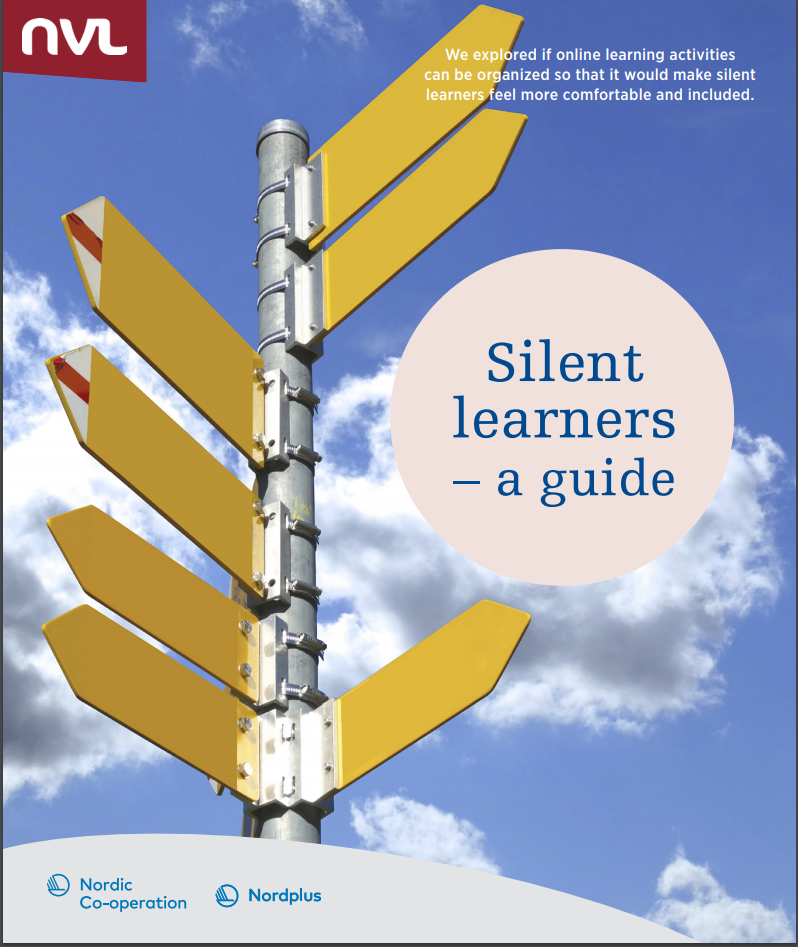
One tangible product from our project is a short and concise guide, Silent learners - a guide, with lots of practical ideas for both teachers and students. The guide also describes our own journey from seeing these learners as a problem to seeing the issue as one of inclusion and accessibility and that we need to take all learners into consideration when designing courses, not just the vocal and active ones.

The issue behind this guide is making education more inclusive and so we need to offer alternative pathways for learners and ensure that different competences and learning strategies are recognized. Collaboration does not always demand noisy synchronous meetings but can also involve more silent asynchronous activities where everyone can contribute using a variety of media. Introverts are often invisible in synchronous group work, but if that discussion is continued in an online asynchronous learning space then the more reflective learners are more likely to contribute effectively. Developing better asynchronous collaboration also empowers learners with special needs by allowing them more time to make a response and thereby making a valuable contribution to the group work. Another group of learners that would benefit from a more flexible and inclusive approach are non-native speakers who generally need more time to understand the subject matter and formulate their ideas and are therefore disadvantaged in synchronous discussions.

You can read more about the project activities with links to several webinars and other resources on the project site, Silent learners.

Saturday, October 29, 2016

Silence at last!

I've written several times about how hard it is today to experience silence, especially in public places. We're constantly bombarded by music, advertising, traffic and all the bleeps and assorted sound effects from our mobile devices. Now I've discovered a possible refuge from all this noise, a potentially revolutionary gadget called Muzo.

Muzo is a small device that you place on a table or window and incredibly it tones down all the background noise, creating an oasis of peace for you to work, relax or sleep in. I find it hard to believe that your oasis will be completely silent but if they can relegate that irritating music playing in the cafe you are sitting in then I'll be buying one very soon. Another feature is that you can select your own ambient background music or sound effects to create a more peaceful environment for sleep or meditation. So if you want to sleep you just select the sounds of a summer's evening beside a river with the optional crackling of a campfire. In addition Muzo can create a sound bubble so that you can have an intimate conversation in a restaurant without anyone else being able to overhear. The product certainly seems to have struck a chord with many people since the crowdfunding campaign to finance the product raised more than four times the money asked for.

I suspect that Muzo will be able to tone down a lot of background noise but there will of course be some leakage. I hope it will be at least possible to hear a fire alarm. But the ability to create a quiet oasis around me when I want to concentrate is a dream come true. The irony in all this is that almost noone actually wants the background noise that Muzo will help us escape from. If more cafes and public places would simply turn off the pointless background music (in some cases foreground music) we could have natural peace and quiet.

Wednesday, November 26, 2014

From awareness to participation

Lecture Hall by ahyang, on Flickr
Creative Commons Creative Commons Attribution-Noncommercial-No Derivative Works 2.0 Generic License  by ahyang on Flickr

Can we please stop using the word "lurker" to describe people who follow online courses but make little or no active contributions? The word has rather negative connotations that have little or no relevance to online learning, but for some reason taking a back seat is seen as a lazy or less honest approach. Active participation is seen as evidence of engagement and passive reception is viewed with suspicion.

At the same time isn't this the way most of us learn at first, by watching and listening to others and reflecting on that? It's hard to actively participate when you don't feel comfortable with the terminology, the environment and the other participants. Many people are more introverted learners who dislike the irritating complexities of group work and enjoy being able to get on with the process in their own way. Some like to reflect on what they read and hear and don't feel the need to ask questions or make spontaneous comments. They may not be posting comments on Twitter or in forums but that doesn't mean that there is no learning taking place. Learning doesn't have to be out loud. This phenomenon is of course nothing new. We've always had quiet students who sit in the back row and never say a word in class and the same is true online. Some of these back row students go on to get top grades and some of their more vocal colleagues drop out. But we need to respect both groups and encourage them to "cross over" now and again. The silent learners can benefit from some active participation and the "noisy" learners can benefit from quiet reflection too.

There's an interesting article by Donna Smith and Katy Smith on this theme in the latest edition of EURODL (European Journal of open, distance and e-learning), The Case for ‘Passive’ Learning – The ‘Silent’ Community of Online Learners. This describes studies made at the UK's Open University on non-active students in online courses and shows that silence and learning can go hand in hand and that this has implications for course design and teachers' strategies. There is such a strong focus today on getting students to be actively engaged in their courses that we may be forgetting the need to step back and silently reflect. Therefore we need to cater for participation as well as quiet absorption.

There may therefore be a tension: between institutions that expect students to ‘actively engage’ for all sorts of reasons, and learners who may not want to (at all, or some of the time). Institutions therefore need to explain the benefits of ‘actively engaging’, design modules where this is seen as useful by learners, make sure that those teaching the modules understand what is expected of students and know how to encourage participation and have undergone relevant staff development (something which also applies to those writing and designing online modules). Institutions also need to understand that some learners will simply resist engaging as much as possible (making the above strategies even more important, if activity is deemed essential by the institution).

"Passive" learning is maybe not a good term either since learning is an active process even if no noise is made. Maybe "silent learners" is better. We need to make the learning environment supportive and empowering to slowly nudge them towards more active involvement. Learning is at first all about watching, listening, absorbing, imitating and reflecting. As you do that you develop awareness of the issues and for many people that is enough. Awareness leads to reflection and can change the way you view the world. Not everyone wants or needs to take that any further, the internal learning has taken place. The step from awareness to participation is important but we can't force it. Let's give a nod of recognition to the back row. They may be working harder than the ones in front.

Thursday, December 12, 2013

Reading on paper or screen - what's the difference?

IMG_4227 by Jemimus, on Flickr
Creative Commons Attribution 2.0 Generic License by Jemimus

I often get into discussions about the pros and cons of reading print or screen texts. It's an emotional issue as many book lovers feel threatened by a digital takeover and the possible demise of books and newspapers. Many find screen reading a strain and prefer to print longer texts they find on the net. Many find digital formats lack the feel and soul of the print version and enjoy the tactile appeal of a book. I read both varieties and although I still prefer print I realize that it's largely a matter of what you are accustomed to. I can't see printed media disappearing in the near future though just take a look at the music industry to see an equally radical change that took place without many people really noticing - our music collections have moved from the shelves of our living rooms to our mobiles and record stores have almost disappeared from most high streets. Certainly there is discussion about how the sound quality of digital mp3 files is far inferior to that of vinyl records but for the vast majority that doesn't seem to matter. So what about the differences between print and screen reading?

I found an article from last year by Cindy Orr called Paper Vs. Screen—Does It Matter Anymore? She reviews research evidence for a significant difference between screen and print reading and finds that previously perceived differences are slowly disappearing.
  • We're reading much faster on the screen today than a few years ago and studies indicate that the gap is narrowing into insignificance.
  • Comprehension levels are about the same even if many people think they understand a print text better.
  • We feel much more comfortable with screen reading especially with the advent of tablets.
  • Our reading behaviour, in terms of eye movements, is very similar between print and screen.
A BBC article, Young people 'prefer to read on screen', describes the rapid shift to screens among children, with over 50% preferring screen to print, and how this affects reading ability.

"Younger children who read printed books as well as used computers were more likely to have higher reading levels than those who only read on screen, the study said. Although this gap did not apply to those children who used tablet computers or e-readers."

If the differences are melting away our perceptions are not changing as fast. Maybe there are other factors that affect our attitude to screen reading. A good summary of such factors is presented in an article by Ferris Jabr in Scientific American, The Reading Brain in the Digital Age: The Science of Paper versus Screens. One important aspect is the tactile aspects of a print book or magazine. We can feel the weight of the book, easily see how far we have progressed and can quickly flick the pages to see where the present chapter ends. We also have spatial aspects of print reading, remembering where we were in the book when something happened or remembering the layout of a particular page. Screen reading is often seen as putting a strain on the eyes and affecting concentration but new studies suggest that these problems occur when using a computer where scrolling and mouse clicks are necessary. The latest tablets reproduce the feeling of a print book much more realistically and few find reading a strain on such screens.

Another interesting factor is that maybe we treat screen content as somehow less "serious" than print and are not prepared to concentrate as hard. Digital content has lots of tempting links to check and your are likely to have other applications open at the same time leading to all the tempting distractions of social media and e-mail that I wrote about in last week's post.

"An emerging collection of studies emphasizes that in addition to screens possibly taxing people's attention more than paper, people do not always bring as much mental effort to screens in the first place. Subconsciously, many people may think of reading on a computer or tablet as a less serious affair than reading on paper. Based on a detailed 2005 survey of 113 people in northern California, Ziming Liu of San Jose State University concluded that people reading on screens take a lot of shortcuts—they spend more time browsing, scanning and hunting for keywords compared with people reading on paper, and are more likely to read a document once, and only once."

Despite all this I still feel that reading is reading whatever the delivery medium. I'm sure you can read as deeply on a screen as you do in a print book but you have to make a conscious decision to concentrate. Digital reading can be distracting if you choose to keep the distractions active but the same is true with print. If you try to read a complex print book with the TV on, music in your headset or with friends or family in the same room your concentration will be equally impaired. Once again it's about focus.

Thursday, March 28, 2013

Boredom is good for you

My dog being bored by joshme17, on Flickr
Creative Commons Attribution 2.0 Generic License  by joshme17

Is boredom is becoming an endangered state of mind? We have almost abolished boredom from our lives today because the second we feel the slightest hint of it we check our mobile for a game, an app, some music, a film or at least check Facebook or Twitter for updates. We used to get very bored waiting for buses or trains but not any more. Everyone is absorbed in their own private soundtrack. We all demand entertainment and contact 24-7-365.

Boredom and its colleague silence are not a popular couple these days and we try to eliminate them wherever they might appear. When was the last time you sat in a cafe, pub or restaurant that didn't have background music (often foreground music)? Runners and walkers are cocooned in their playlists. Do we ever allow ourselves to be alone, in silence and without any particular plan of what to do next?

An article from BBC News, Children should be allowed to get bored, describes research carried out by Dr Teresa Belton (University of East Anglia) on children and boredom. She has interviewed people about how boredom affected their creativity as children. She found many who were inspired to creative activities through boredom and silence:

"Enforced solitude alone with a blank page is a wonderful spur."
"As I get older, I appreciate reflection and boredom. Boredom is a very creative state."
"She happily entertained herself with making up stories, drawing pictures of her stories and going to the library."


Many people today are willing to pay for retreat weekends free from noise and distractions, hoping for inspiration and balance. Silence and a lack of stimulation are becoming exclusive commodities. Maybe it's time to reassess boredom and see its positive side.

Wednesday, February 13, 2013

Space to think

We learn through collaboration, discussion and sharing. However we also learn by quiet contemplation and by the often solitary processes of reading and writing. Most levels of education today, both classroom and online, stress the importance of group work and our ability to function in groups is highly valued. However there's a risk that we are forgetting the importance of working alone and thereby losing the opportunity to think deeply.

This is the theme of an excellent TED talk by Susan Cain called The power of introverts where she argues the case of all introverts who aren't comfortable with group work and seldom contribute to class discussions. This is not because they have nothing to contribute - often quite the contrary - but that they need time to think before expressing themselves. Classroom discussions are generally dominated by a few confident students and group work is also dominated by those who enjoy speaking and being the centre of attention. Crowds are not always as wise as we think and are sometimes easily lead to the wrong conclusions by dominant or manipulative members, both in class and online. She argues that society puts too much emphasis on groups and social interaction and sees solitary activities as negative. Offices are now mostly open landscapes and few people have the luxury of a quiet space to work. Open spaces can be creative but creativity also needs peace and quiet.

A teacher's perspective on this issue is presented in a blog post by Monica Edinger, In the Classroom: A Few Classroom Teaching Suggestions from an Introverted Teacher. She presents a selection of strategies to enable the less vocal students have a say in class discussions. This involves waiting for answers in silence rather than always feeling obliged to say more. It also involves not giving the dominant speakers so much space to dominate, doing much less group work and giving students more time and space to think. Written communication, often as an online private dialogue between student and teacher, gives more introvert students a more appropriate channel to reflect and discuss their learning.

The main idea behind the concepts of flexible or blended learning is that we have the tools and methods to let students learn the way that suits them best. There is a need for dynamic group work and that must be available but we shouldn't forget that many people learn best on their own and need more space to learn. The secret is in the mix.

Thursday, March 10, 2011

Do not disturb

Information overload and multitasking are fairly frequent subjects on this blog and it's time to revisit this theme. There has been a glut of articles on this theme recently, thus inducing stress at the overload of articles on information overload! Interestingly enough there is a summary of all these articles, for those who don't have time to read about information overload, 8 Must- Reads About Digital Distraction and Information Overload on Fast Company.


The gist of it all is that we are allowing ourselves to be interrupted at an ever-increasing frequency. We can multitask up to a point but then we become incapable of making decisions since we're taking in too much information. I'm guilty as charged I admit. It is increasingly hard to shut down the distractors and concentrate on one thing at a time. Even if most e-mails are relatively dull we can't help checking to see what's new - up to 40 times an hour according to a survey of office workers. The same goes for Facebook, Twitter and many other apps and it's easy for many to immediately jump to the conclusion that all this is a waste of company time.

An article in Newsweek, I can't think, describes recent research into our ability to make decisions when faced with too much information. A reasonable information flow can certainly stimulate our creativity and lead to good decisions but once you reach a certain level we face info-paralysis. If the volume of information is too great our brains just can't cope. According to psychologist Joanne Cantor:
“If you let things come at you all the time, you can’t use additional information to make a creative leap or a wise judgment. You need to pull back from the constant influx and take a break.”

So do we need to switch off and step back? Of course we do and we need to learn when to switch on and when to switch off. We need to relearn the art of attention. It's not just the teenagers who don't know when to switch off, we adults are equally guilty. Just look around at any conference or meeting at what people are really doing on their laptops and mobiles. Schools and universities must make more use of mobiles and laptops in the classroom but it is vital that some activities are tech-free. If the aim of a session is group reflection and discussion it is perfectly justifiable to ask for all devices to be switched off. It's a vital lesson for all to learn; we're here in this room and we're going to discuss but in one hour from now you can switch on again and search for further references. All age groups can benefit from structured non-tech time.

The art is to become multi-modal. Sometimes it's good to "go with the flow" and let all the social media stream in. I really enjoy seeing all the comments, tips, links and discussion and to be a part of it is stimulating. The tricky bit is to turn it off to focus on one important task and spend quality time with it. Sometimes we skim our way around various websites gathering notes and impressions for further use and sometimes we need to deep read an article or report. Some tasks go well with background music, chat sessions, Twitter feed and so on all at once and other tasks go best in silence.

Monday, December 21, 2009

Being bored

How often do you simply just sit staring into space, unable to think of anything to do? Or maybe you don't have an iPhone yet. The fact is that we are seldom in such situations nowadays since you can always watch, listen to or read something on some kind of mobile device. Failing that you're never far from a TV screen or piped muzak. Waiting for a bus or train used to be dull but now I can listen to music or podcasts, update Facebook or Twitter (eg I'm waiting for a bus), check the latest news or sport results and even watch highlights from a match. Now you barely notice that the bus went swishing past you ten minutes ago. The soundtrack of our lives keeps playing wherever we are.

In our always-on society we simply haven't any excuse for being bored. But boredom can be beneficial. Those quiet moments give us time to think and that may even lead to creative thinking. A blog post by Mattias Klang (in Swedish) lists a number of things he will miss in the future: bookshops selling more than just bestsellers, newspapers, notebooks and pens, letter writing and of course non-productive time. That non-productive, quiet time is under threat. It's becoming impossible to resist the temptation to connect.

Those of us brought up in the days of one or two TV channels and not many more options on the radio had plenty of media-free time to contemplate. Are we therefore better at handling silence and inactivity than today's youngsters? Is quiet time an essential part of our lives that is now under threat from media bombardment. I feel it may be and that we all need to be confronted with boredom now and again but it's not something we willingly volunteer to do. It's easy to say "just switch off" but much harder to do.

Monday, June 1, 2009

Music for supermarkets

We seem to have a fear of silence in public places and try to fill those awkward spaces with background music or muzak as it's often known. Muzak is meant to be gentle and soothing but often has the opposite effect, as anyone who has wandered round a supermarket to the strains of instrumental cover versions of Una paloma blanca or I just called to say I love you will know only too well. The ultimate horror is working in a place that plays a limited selection of easy listening favourites in a never-ending tape loop.

Even if the muzak versions of such hits are very pale copies of the originals they still are copyrighted to somebody and the shops have to pay for the privilege of playing it. However the answer to this problem is on the way in the form of computer generated muzak. According to an article in Techradar.com (Death to muzak!) researchers at the Spanish University of Granada have developed a program that will generate muzak on the fly, in a variety of genres. Since the muzak is composed and played immediately there is no copyright and so we can enjoy our supermarket melodies free of charge and with infinite variation.

This is of course bad news for synthesizer players who live off recording instrumental versions of old Barry Manilow hits but a giant leap for the rest of civilisation as we know it.

Not all muzak is like this however. Back in the late seventies musician and composer Brian Eno experimented with various forms of background music (ambient music) that were not meant to be listened to but would create an atmosphere conducive to, say, studying or writing. Indeed one of his albums of this period is called Music for airports. Music can be used positively in public places; the trick is to make it as unobtrusive as possible.

Saturday, April 25, 2009

Attention please

I enjoyed reading an article (Attention literacy) by a guy called Howard Rheingold about his efforts to grab the attention of his students. It's a recurring theme in many edublogs and it's not clear whether everyone in class who are busy checking Facebook, MSN, eBay etc are skillful multi-taskers or are simply not paying attention to the class.

Howard teaches a course in social media and communication at Berkeley and his tactics were to film his students and show them what the class looked like from the front; "... I realized that none of the students knew what it feels like to stand up in front of a room full of people who are not watching me or each other, but appear to be hypnotized by something on their computer screens."

The interesting point here is that Howard has spent time with his class teaching the important skill of attention; something that is not instinctive and must be learnt. It's important sometimes to create space to be able to think without all the distractions available all around us. Insights and ideas often come to us in moments of silence or even boredom but if we constantly fill the spaces with noise we'll never be able to reflect.

Have a look at Howard's video on the subject:

Thursday, February 5, 2009

Cold turkey for web addicts

Do you find it hard to concentrate on your work and can't stop surfing the net when you should be doing something more constructive? Well now there's a solution.

According to an article in The Wired Campus, Apple users can download a shareware application called Freedom that blocks your net access for as long as you want. So if you need to concentrate on writing that research paper or report and do not want to be tempted to check the latest sports results or what your friends are doing on Facebook, then you just activate this and you're on your own. Once you've enabled the net-blocker you can't disable it until the blockage time is out (unless you completely reboot of course, but that takes time).

I don't think this will be a massive success but the mere idea that someone has produced a tool like this must say something about homo zapiens. The distractions of the net are rather compulsive.

Thursday, May 1, 2008

The sound of silence

I can remember when there was literally nothing on television. Weekdays were largely TV free till the late afternoon when the children’s programmes started. They showed the testcard so that TV repair people could check that the set actually worked. At around 11 pm a presenter would tell us that the evening’s programmes were over and wished us all a very good night. Sometimes they even played the national anthem as a subtle hint that it really was time to go to bed. Even radio stations were silent at night.

Today there is still very little to watch on television but it goes on round the clock. 57 channels and nothing on. When they can’t think of anything to broadcast they switch over to TV-Shop with hours of hysterical ads about miracle fitness devices and anti-wrinkle cream. Or they show 5 back-to-back episodes of some instantly forgettable Dallas lookalike soap from the eighties. Who watches this stuff in the middle of the night? Anything to avoid silence.

Some channels show a very special type of phone-in quiz show. A young aspiring TV presenter gets the daunting task of filling an hour or two of non-prime time TV by trying to persuade the sparse audience to phone in and answer questions. The cash prizes are quite tempting and the questions are often along the lines of “What colour is the White House?” But no one phones and the presenter has to fill the time by commenting on the weather, what she/he had for breakfast etc. They can go on for 20 minutes without anyone phoning and you can sense the creeping desperation in the presenter’s voice as the nagging suspicion grows that there may not be anyone watching at all. I must say I admire their courage. If you survive a few months fronting one of these shows you deserve to go on to more rewarding roles. It takes guts to talk and smile non-stop for 2 hours in front of a camera knowing that your nationwide audience may be in single figures, including several who are unconscious.

We fill our lives with noise. People of all ages have their iPods almost permanently plugged in; when walking, jogging, gardening or travelling. Comfortable, handy, fun but again a sort of padding to block out the world, the avoidance of silence. When do we have time to rest, to think, to just be? Silence is awkward, it demands reflection. Sunday as a day of rest was an excellent idea and just as relevant today as it was for the Israelites of the Old Testament. Imagine a day when the shopping centres are closed and people just rest. A day when it’s OK to switch off. Hardly likely in our 24-7 globalised individualistic society but a nice dream.