Showing posts with label #langoer. Show all posts

Sunday, October 11, 2015

Can openness empower smaller languages?


How can open learning and open educational practices empower smaller, regional and minority languages? That was the question behind the seminar arranged 7-8 October in Leeuwarden, Friesland, by the EU-financed project LangOER that I am involved in. The title of the seminar was Open Learning in Minority Languages: Chances and Perspectives (see programme) and you can see all the slideshows, discussion notes, recorded webinar and interviews with speakers and participants on our conference Padlet page.

Padlet page with conference highlights
One refreshing point for me was the fact that the conference was not simply a meeting of open learning advocates but a meeting with another field, that of regional and minority languages, where issues of open learning were not familiar. The scope of the project is broad and we include many national languages that have millions of speakers but whose access to open educational resources pale in comparison to those available in English, Spanish, French etc.

We got insights into impressive national repositories for open educational resources such as the Greek Photodentro, Dutch Wikiwijs and Norwegian NDLA and Welsh OER Wales Cymru. These have had considerable impact in their respective countries with NDLA reporting around 60,000 visits per day and 60% of teachers in Norway using the repository regularly. They offer a wide selection of Creative Commons licensed resources (video, audio, text, photos, animations) all of which are tagged and related to the national curriculum. Considerable support and coordination is also provided; in the Greek case there are almost 300 experts and technicians who maintain the system, add metadata and provide quality control. All three have worked a lot building trust and support among teachers. The key is creating a culture of sharing – daring to share - and this involves recognising innovative teachers and providing time and resources for development. One interesting concept was gathering teachers together for intensive workshops to produce resources together, for example a group of teachers could work over two days to write a short course book together.

The growth of such repositories where teachers share materials obviously meets with opposition from publishers who see public money subsidising the production of free resources. There are often options for publishers to include commercial content in such repositories but I'm not sure if this has really worked anywhere and how users pay for access. Another difficulty has been including higher education in a national repository. OER Wales Cymru is a strategic cooperation between all Welsh universities whereas the Dutch, Greek and Norwegian examples are mostly resources for schools. It seems difficult to create a sharing environment that offers a bridge between schools and higher education.

These solutions are certainly impressive but they have been built with government and EU financing and have thereby gained legitimacy among teachers. In the case of regional and minority languages the situation is very different as we also learned at the conference. Being in the province of Friesland the example of Frisian was prominent. The language has grown in status in recent years and now has an established academic and cultural community, including Fryske Akademy, researching, supporting teachers and promoting the language. However integration into schools is not easy since there is always a mix of pupils who use Frisian as a native language, those who only use it at home, those who only have a passive knowledge and those who have moved to the area who do not speak it at all. There is also a lack of qualified teachers who speak fluent Frisian. A Frisian OER repository, EduFrysk, is being developed and there is even a prototype MOOC to teach basic Frisian.

But what about minority languages which have previously been marginalised and whose voices are only now returning to the education system? We heard about the status of Manx on the Isle of Man which is now taught again in some schools but whose speakers have to produce learning resources from scratch since there are very few publications in the language. A small number of educators and other enthusiasts are busy producing digital resources such as the site Learn Manx so there are encouraging signs. The case of the ArbĂ«resh language in southern Italy brought home the challenges facing many minority languages. With almost no written tradition apart from religious texts, all educational material has to be written from the start and awareness of the opportunities of open educational resources and digital tools is still very low. The creation of an OER repository in these languages would seem to be a distant vision but far from an impossible one.

Some ideas for using open educational resources and practices to empower smaller, regional and minority languages:
  • Open resources in English and other major languages should always include functions that facilitate translation, dubbing and the overlay of subtitles.
  • Provision of free and open course platforms such as Commonwealth of Knowledge's MOOC for development project to enable smaller language communities to offer open online courses on a low budget.
  • Communities of translators can create projects to translate at least some of the resources available on TED, Khan Academy and open courseware repositories, for example TED Open Translation project. See also the conference presentation Open Educational Practices in small languages: the role of community engagement.
  • Networks of teachers, students and experts can work on building the language's Wikipedia footprint, focusing initially on areas most relevant to their culture and development. there are several good examples of this but the process can be a catalyst for empowerment.
  • These networks would probably need funding to get up and running but initially it would be mostly in the hands of volunteer enthusiasts. Some kind of national or European funding should be made available to enable networks to get started.
  • Developing communities of practice between different language communities for mutual support and inspiration. Far too many work in isolation and would benefit from benchmarking with other communities in similar positions, even if the languages have little in common linguistically. Smaller languages can thereby support each others' development.
Some seeds were sown during this meeting and the project intends to hold a larger conference in Brussels next autumn aimed both at policymakers and practitioners.

Friday, August 21, 2015

MOOCs for development

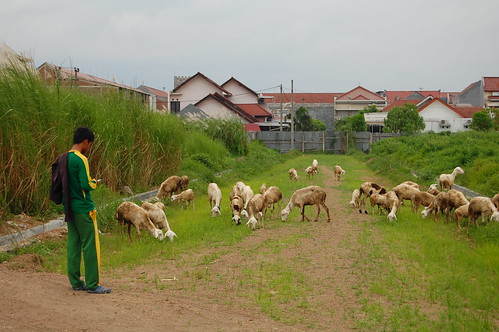
Keeping Goats and also Texting by Ikhlasul Amal, on Flickr
Creative Commons Creative Commons Attribution-Noncommercial 2.0 Generic License  by Ikhlasul Amal on Flickr

The original idea of a MOOC back in 2008 was that anyone can start a course and create a learning community around a subject of common interest. Open tools and platforms should be used so that there are no technical barriers to participation. Basically if you and some colleagues would like to investigate a particular subject or test some ideas you can invite the world to join in. There are still plenty of truly open grassroots MOOCs, more or less massive, but the vast majority today are highly polished professional productions from major universities and often extremely expensive to produce. As a result many smaller institutions, especially in developing countries, are discouraged from even considering open education. If the role model is a slick multimedia course from a high status university with over 100,000 participants it's easy to fell overwhelmed.

But a MOOC doesn't have to be so massive and the production costs can be kept low without compromising pedagogical quality. The promise of MOOCs was to widen participation and access to higher education especially for those who cannot afford a regular campus course. The problem with the high profile MOOCs is that all the video content, animations and other bandwidth heavy content puts them out of the reach of millions in developing countries.

Commonwealth of Learning (CoL) has now launched a free and open MOOC platform to enable smaller organisations in developing countries to run MOOCs without needing to invest so much money. The concept is called MOOC4D (MOOCs for development) and is built on the platform mooKIT offering a low bandwidth solution that is free to use for courses of up to 10,000 participants. The concept is that running a MOOC should be as easy as taking one. The platform offers participants the chance to download text and audio content for offline use and none of the content should use much bandwidth. At present there is only a limited range of courses available (Mobiles for development, ICT Basics, Climate change in the Pacific, Teacher training in the Seychelles and a MOOC on MOOCs) but the potential for this kind of platform is immense. The first course, appropriately a MOOC on MOOCs, has now been evaluated and a report is now available with analysis and conclusions, Massive Open Online Course (MOOC) on MOOCs: Course Evaluation. Here's an introduction video to the mooKIT platform.


Another fine example of low-tech online learning is a MOOC on horticulture taught in Hindi and run by the Indian Institute of Technology in Kanpur with support from CoL. This MOOC uses only mobile phones for distribution with regular short audio lessons being stored on voice mail and always accessible. Tests in the form of quizzes are also carried out by phone. The prototype course with over 1000 participants has been evaluated and a report has been published about the results with recommendations for future development, MobiMOOC - a massive open online course on horticulture - an effectiveness study, Uttar Pradesh State, INDIA.

The exciting thing with this type of initiative is providing a simple, open platform that enables institutions in developing countries to offer open courses that are adapted to the technical limitations of the areas they serve. It can also mean that more MOOCs are produced in smaller languages and thus offer a tool to empower local language and culture. Surely the real benefit of the MOOC movement is enabling everyone to participate in online learning.

Wednesday, May 6, 2015

The year of the ROOC?

Rook 2 by scyrene, on Flickr
Creative Commons Creative Commons Attribution-Noncommercial-No Derivative Works 2.0 Generic License  Rook by scyrene on Flickr

At the risk of introducing yet another silly acronym into a world drowning in such things, maybe this can be the year of the ROOC - Really Open Online Courses. The problem with most MOOCs is that they are very seldom really open. The structure, templates and material are usually copyright and are not open for reuse and adaptation. While it's understandable that the owners want to protect their material it could benefit so many more people if it could be translated and adapted to other languages and cultures. The word open can be interpreted in so many different ways and this leads to a lot of confusion. The key to ROOCs is open licenses that allow others to use and adapt the course and its constituent parts to be more relevant to local culture and context.

One of the often repeated benefits of the MOOC movement was to make quality higher education available to all and the rather colonial vision of students in developing countries avidly following classes from the top professors at Harvard, Stanford, MIT etc. The problem here is that although the glossy high-end MOOCs are well produced and academically sound they are very much rooted in a western perspective and have little relevance to students in many other parts of the world. This one-size-fits-all approach has been widely criticized and if we genuinely want to use online learning to widen participation in higher education the present proprietary model of most MOOCs must be changed.

So what are the ingredients of a really open online course (massive or not)?
  • All course material has an open Creative Commons license permitting reuse and adaptation so that institutions and educators in other countries can make the course more relevant to local issues and culture.
  • Design sustainable resources - not context-specific, easy to add subtitles, avoid locked proprietary software, standard templates, compatible formats etc.
  • Build the course on a platform that is freely available to others.
  • Create a community around the course to open up the development process from the beginning and then provide support in the future.
If designed in this way even a very small course could grow into a massive one. The initial iteration may not have a massive target group but maybe an institution in, say, India sees the potential to adapt it and serve a massive target group there. Alternatively a small course could be adapted into hundreds of equally small but locally important courses on a global scale. The true power of open education lies in sharing and developing resources together but today's proprietary models simply reinforce traditional structures rather than democratising education. 

If you are still wondering about the photograph above, the bird is a rook!


Sunday, September 21, 2014

Open educational practice stimulates less used languages

Click on image to go to the webinar recording
How can open educational practices empower less used and minority languages? This was the question behind a webinar I had the pleasure of moderating a couple of days ago - watch the webinar recording. The webinar was part of the European project LangOER that aims at enhancing the teaching and learning of less used languages through open educational resources and practices. About 70 participants (193 registered) took part in the live event which featured presentations from Sylvi Vigmo (University of Gothenburg, Sweden), Kate Borthwick (University of Southampton, UK) and Anna-Comas Quinn (Open University, UK).

I was particularly interested in the ideas of how openness can empower smaller languages and that we need to think more carefully about reuse and adaptation when we create new resources. Anna described the growth in open translation communities, often centered around educational content providers like TED (Open translation project), Khan Academy and Coursera (Global translator community). Course material, mostly lectures, are translated into hundreds of languages by networks of enthusiasts making the material accessible to local communities who would otherwise never benefit from such services. Translation of Wikipedia material into hundreds of languages has been going on for several years and the existence of an online encyclopedia in a less used language can become a source of pride for the community and a catalyst for further activities to strengthen the language and culture. School classes, student groups, academics and other experts can all help to create educational resources in smaller languages that would never be viable projects for commercial publishers.

But simply translating English language resources is only the tip of an iceberg of opportunities for smaller languages and cultures. Open education gets really relevant when resources are designed with reuse and adaption in mind, allowing other users to modify the material to be more relevant to local culture and practice. The majority of open resources today are not easily adapted and were developed for one particular context without considering who else might use it in the future. I would like to see a set of simple guidelines for OER sustainability that all educators could easily check when creating new resources. How to ensure that your material can easily be translated, edited, supplemented to fit other contexts. Maybe such a checklist already exists but it needs to be more widely distributed and used.

This applies not only to resources in English but equally to resources created in other languages. Resources created in a country's dominant language should be created with reusability in mind so that minority languages in the same country can benefit. If common guidelines are followed it will be easy for minority language teachers to adapt each resource to their language and culture and at the same time following for example the national curriculum. Resources created in one smaller language can then easily be spread to related languages, thus saving many people from reinventing the wheel.

I look forward to following this discussion in the future.

Have a listen to this short interview I made with the project leader of LangOER, Katerina Zourou, for a general background to the project.


Tuesday, April 29, 2014

OER and linguistic diversity

Atypical welcome by quinn.anya, on Flickr
Creative Commons Attribution-Share Alike 2.0 Generic License by quinn.anya on Flickr

The spread of English as the language of the world has certainly been accelerated thanks to digital media and it could be argued that this threatens to wipe out many smaller languages, some teetering on the brink of extinction. András Kornai describes this danger in an article, Digital Language Death, showing how many languages have a very low digital presence. Even if enthusiasts have accomplished much to create for example a Wikipedia presence for many smaller languages  Kornai argues that this will not be enough to create a community strong enough to help push the language truly into the digital space:

Of the approximately 7,000 languages spoken today, some 2,500 are generally considered endangered. Here we argue that this consensus figure vastly underestimates the danger of digital language death, in that less than 5% of all languages can still ascend to the digital realm. We present evidence of a massive die-off caused by the digital divide.”

At the same time technology could also empower many of these threatened languages and cultures that have been marginalised in the past. Could the development of open educational resources (OER) be a key to empowerment for smaller languages? This was the theme of a workshop, International workshop on policy for OER and less used languages, run by ICDE (International Council for Open and Distance Education) along with two projects I'm associated with, NordicOER and LangOER. This gathered an impressive cast of OER experts, stakeholders and policy makers to discuss how the development of quality OER and open educational practices can strengthen the position of such languages. For a full programme of the speakers and further details, have a look at the ICDE article on the workshop.

Workshop in progress (Photo CC-BY Tore Hoel)
UNESCO is one of the main driving forces behind the global uptake of OER, emphasizing the right for free and open access to knowledge to all people in all languages. Their representative in this workshop, Abel Caine, gave several examples of recent initiatives, especially the 2012 UNESCO OER Paris declaration calling on all member governments to make all educational materials produced with public funds freely available to all. This has resulted in many national and regional initiatives such as Indonesia (national OER policy) and West Africa. See more in the UNESCO OER Programme.

The development of OER as well as open courses (not necessarily MOOCs) has opened new opportunities to offer extremely narrow courses in places where they would previously never have existed. An open online course in, say, Welsh for beginners can attract students from all over the world, something that no traditional university course could ever do. I once read about a guy in the midwest of the USA who wanted to play the Scottish bagpipes. The chance of a local college running that sort of course was less than zero but on the net it was no problem and soon he was getting tuition via Skype from a teacher in Scotland. Many languages have rallied round the creation of their own Wikipedia and involved a large section of the community to develop the entries. There are countless sunshine stories like this showing how local languages and culture can become glocal. Alan Tait talked of OER as the long tail of education whereby resources of extremely limited interest can still be always available in a similar way to the global scale and reach of Amazon can store book titles that no single bookstore could afford to keep on the shelves.

Some takeaways from the workshop:

  • It’s not what you share, it’s how you share it. Share for reuse, include source code, provide a declaration of contents and purpose and systematic tagging and other metadata.
  • See OER more as data to be adapted than as finished learning objects.
  • Open standards, collaboration and search skills allow anyone to study anything from anywhere.
  • Infrastructure must support process, not just output.

But can open education contribute to strengthening smaller languages and cultures? Despite the overwhelming advance of English I believe there are opportunities for less used languages (however you define that vague concept) to gain much more legitimacy and impact than was possible before. It requires concerted effort but this can become a community building process galvinising all generations to contribute to preserving and developing the language and culture. Simply translating existing English resources is not enough, new resources that are relevant to the community must be developed and this is a creative rather than simply a reproductive process. Successful models from the English-speaking world can be adapted to local requirements. Teachers and students can collaborate to produce open textbooks and other educational resources that few if any traditional publishers would see as commercially viable. Open courses can be offered to a worldwide audience including speakers who have long since emigrated from their homeland. Smaller languages can help each other by sharing development costs, collaborating in cross-cultural projects to develop multilingual solutions and suchlike.

ICDE will soon publish the full results of the workshop and the LangOER project will be investigating the area of language and OER in more detail in the next three years. Stay tuned.

Have a look at my colleague, Tore Hoel's blog post on the topic:
Adopting OER for less used languages: We need hard talk on tools and infrastructure!

Saturday, April 12, 2014

Turning point in Estonia

This week I was invited to Tallinn, Estonia, speak at the annual conference of HITSA (Information Technology Foundation for Education), a national organization for the development of educational technology: initiating, coordinating and facilitating activities and developments in the field of ICT-supported learning in Estonian higher and vocational education. It was held in the impressive Mektory innovation centre of the Tallinn University of Technology and attracted over 200 delegates from schools and universities. My contribution consisted of a keynote speech on the future of MOOCs (see video at MOOCs - from hype to opportunity) and an overview of the development of OER in the Nordic region (Nordic OER) focusing on three projects I am involved in: NordicOER, OER Sverige and LangOER. Here is a short summary of my impressions from two intensive days.

Estonia is well known as a country that has invested in the use of educational technology, it is of course the home of Skype. They have also made some wise choices in the development of educational technology, for example establishing a consortium offering all educational institutions access to a national installation of the learning management system Moodle and thereby saving institutions enormous amounts of time and money running their own installations. In recent years two national repositories for open learning resources have been set up: one for higher education and one for schools, Kooleilu. Now a new education strategy has just been published by the government (only in Estonian just now), written in broad consultation with all stakeholders. The implementation of digital technologies is one of the key issues in the new strategy. The motto of the strategy is "Learning is a way of life" (Ă–ppimme on eluviis) and it stresses that it is not just about buying new technology but about changing the way we work, study and learn (see article 2014 Estonian lifelong learning strategy is called smart people. A partnership with Finland has recently been announced (see press release) to create a common cloud for storing OER at all educational levels and giving access to other global repositories. The aim is to offer a mix of open and commercial resources with quality assurance criteria. Government will also sponsor the development of quality resources with the cooperation of publishers. Heli Mattisen (EKKA Quality Assessment Council) presented the main aims of the new strategy and stressed the importance of raising the skill sets of teachers, increasing the professionalism of school leadership and implementing new rating systems for schools based on skills criteria rather than simply test results.

The sessions were full of examples of how educational technology is being integrated into Estonian education as well as highlighting international perspectives and trends. Here are a few highlights I'll take away with me:
  • Sixth grade pupils from Gustav Adolf Grammar School in Tallinn presented their perspective on learning and teaching. Their key factors for effective learning were attention, collaboration, respect and active learning. Not to mention a lot of creativity and fun. 
  • There is too much spent on technology for teaching content and nothing spent on helping learning. We need to use technology for learning. Technology can be used in four stages: to exchange, to enrich, to enhance and to empower. Most attention is still on exchanging; using technology to reproduce traditional processes. (Bob Harrison, Education adviser, Toshiba Information Systems UK)
  • We need new spaces for learning to cater for self-regulated learners and flexible teachers. The learners set the objectives and select strategies for learning. The teacher has to become a researcher in the widest sense of the term. (Margus Pedaste, University of Tartu) 
  • ICT use in schools is still dominated by presentation tools like PowerPoint and interactive social tools are very seldom used. We need innovative teachers, innovative schools and innovative education systems. We have to empower teachers to develop, nurture innovation and strengthen the evidence base of new practices. (Marc Durando, European Schoolnet)
  • If it's not digital it has no value. (Tiit Paananen, Association of IT and telecommunications)
  • Kids aren’t all the cool digital natives that the media portray them as. There are digital divides there and many are vulnerable and need guidance. (John Carr, European NGO Alliance for child safety online www.enacso.eu)
  • Hans Pöldoja, Tallinn University, presented his work with open badges on an open course, Preparation for digital learning, and the value of such badges as motivators on open courses without formal credits as rewards.
  • Most classroom time is on the bottom two layers of Bloom’s taxonomy and then we send them home to deal with the upper levels without access to the teacher. Flipping the classroom involves doing the demanding work in class and the lower levels at home. (John Bergmann, Flipped classroom
  • Innovations happen outside established institutions. (Steve Taylor, From Start-Up to Stay-Up)
Finally a very positive feature of the conference was the availability of simultaneous translation so that I and other foreign visitors could follow sessions in Estonian and the Estonians could follow our contributions. This wasn't available in the practical workshops that took place away from the main hall so I wasn't able to participate in them. They certainly looked like fun!