Showing posts with label wiki. Show all posts

Wednesday, May 15, 2019

Offline digital resources - connecting the unconnected


In many parts of the world the idea of online education is still only a dream. Rural communities lack internet connectivity and even if mobiles are used, the networks can only offer basic services like voice and text. Refugee camps around the world are full of children who need to learn but lack books and educational resources. There are plenty of initiatives that offer education based on low bandwidth text and voice services but how can people learn basic internet skills that may be so vital for the future?

One inspiring solution to this is a non-profit initiative called KIWIX that allows you to download Wikipedia, Wiktionary, Wikimed, WikiVoyage, Project Gutenberg, and Stack Exchange as compressed content packages and then be able to browse and read them offline on virtually any device. The teacher first needs to be able to download the packages but once that is done the material can be distributed to, say, pupils in a school, using a specially designed wifi hotspot. All the software and content are all free to download and use.

KIWIX provides free software to bring free knowledge even to remote places. This may be a school on the countryside in a developing country. This may be you on a plane or in the wilderness. Wherever you go: KIWIX gives you access to Wikipedia, WikiVoyage, Project Gutenberg, and a lot more free content from the Internet – even if you don’t have an Internet connection.

Since Wikipedia is available in so many languages this solution offers schools in rural areas or refugee camps access to valuable educational resources when printed school books are either unavailable or too costly. Access to this type of online material can be vital for speakers of "smaller" languages and there are many cases of educators collaborating on developing their language's Wikipedia content. School books may be impossible to afford or even non-existent but by developing Wikipedia and using solutions like KIWIX teachers can give children access to educational resources and help them gain basic internet skills without even internet access.

The website describes successful applications of KIWIX in places like Ghana and Cuba where internet access is limited. Another option suggested is to provide access to sites that are blocked and censored in some countries, such as North Korea, though the risks of doing that may outweigh the benefits.

Sunday, September 23, 2018

Open learning - back to basics

CC0 Photo by chuttersnap on Unsplash
The term open in education can mean almost anything today and should always be taken with at least a pinch of salt. Some MOOCs are now disappearing behind paywalls as described for example in Class Central's post First Look at edX’s Paywall Experiments. Many commercial platforms thrive on selling our data to advertisers and most online tools depend on the freemium model and if they cannot convert enough free users into paying customers they may go bust or ditch the free option completely. Many resources and courses have become dependent on commercial platforms that can quickly change their business model with very little advance warning or use the data they collect to earn money. I wonder therefore if it is time for a renaissance for the open non-commercial platforms and communities run by educators that have fallen by the wayside in recent years.

Stephen Downes wrote an excellent defense of the principles of open education a few months ago:  The Fabrication that is OER. The post is an answer to critics who claim that the OER movement has not been able to find a viable platform or business model and has not become mainstream. The counter claim is that it's all about educators who want to share their work, form communities and create a culture of sharing using whatever tools and platforms that best serve their purpose. It's not about creating an all-embracing platform for the world or to trying to institutionalise openness.

I'm not interested in collecting, institutionalizing, and marketing educational content as a product. Maybe there are some people in OER who are really interested in this aspect of it (and they tend to collect together, write manifestos, work with institutions, and collect all the funding). But I'm not, nor are, I think, the vast majority of people who actually produce and share free and open learning content.

I'm rather comforted by this since I have spent many years arguing for government initiatives, open education strategies including the creation of national and international repositories. This is happening in some places but is mostly a painfully slow process. Should we be trying to change the world or simply focus on building reliable and non-commercial arenas for those who want to share and collaborate?

In recent years the spotlight has been on high-profile and increasingly commercial platforms such as Coursera, EdX, FutureLearn, Khan Academy, iTunes U and so on. However many of the open communities and platforms that we used to use are still running, though very much under the radar of the media and most educators. I mean spaces like Wikiversity and WikiEducator as well as more focused platforms like the World Health Organisation's OpenWHO or the open courses hosted by the Commonwealth of Learning, to name but a few. I admit that I have not paid much attention to these spaces in recent years but I wonder if it's time to return to platforms that we have more control over and are run by open educators for open educators. They may not have the attractive features and intuitive feel of the commercial platforms but they are ideal places for collaborative projects and are not driven by advertising. 

I wonder if we really should be aiming at converting the skeptics and trying to win government approval and instead focus on helping those who do want to share, developing truly open platforms and communities. It's not a battle against traditional practices; it's about open educators "doing what they do" (to paraphrase Downes again). 

Sunday, October 22, 2017

Redefining "failure"


Success is the exception, not the rule. This idea struck me when reading an article on Wikimedia's blog, The crowdsourcing fallacy, which examines the pitfalls of building a service on the so-called "wisdom of the crowd". The clearest success story in this field is, of course, Wikipedia. If it had been pitched as a commercial project it would never have got off the ground, but the fact that it is the result of an unprecedented level of voluntary public collaboration has built up by far the largest reference work in human history. On paper, the venture was a non-starter, as the article states, "it only works in practice; in theory it could never work”. Its success could never have been planned, as is the case with most success stories. The success narrative of crowdsourcing is very attractive and has lead to many brave ventures, but the post provides a vital reality check: Your crowdsourcing effort will fail, most of the time, because most things fail. And because important things are hard.

We all love success stories. They can inspire us to study, work hard and persevere. At conferences we are fed a diet of best practice, projects that exceed expectations or innovative companies that have hit the headlines. We idolise business leaders who made it big and circulate their words of wisdom in the hope that some of the stardust will touch us. Our increasingly competitive culture is reinforced by countless reality TV shows where the winner takes it all and failure is not an option. To be branded a loser is the worst humiliation you can receive. The problem is that for every winner there must be millions of "losers" and success is the exception rather than the rule.

Of course we can admire and congratulate the successes but we need to look more realistically at failure. The word itself is loaded with prejudice. If success is so rare, then partial success or a lack of success are the norm. Success often comes unexpectedly and cannot always be rationalised. Often it's simply about having the right idea at the right time and getting the right breaks. Equally good or better ideas with equally sound business plans and strategies can sink without trace. Many failures, however, can then form the embryo of future success, so we need to question the use of the word failure; failure on what time scale?

What I wonder about here is that we need to move away from this simplistic categorisation of success/failure or win/lose. Most things we try to do have limited effects and don't usually meet our high expectations. Instead of seeing this as failure we need to see what we can learn from each venture and move on to try a different approach or a new angle. Success stories can give us a vision to aim towards but not getting there should be seen as perfectly normal and acceptable. Too many people today are hooked on the lure of making it big that they cannot be satisfied with anything less. All our efforts are part of a learning process and although each step may not seem to make any kind of impact they add experience and ideas to an iterative process. Even a total failure offers lessons to be learned if we can accept them on that level and not fall into the success/failure trap.

Too much of our education system (and of course society in general) is based on competition and the inhuman belief in the survival of the fittest. We should instead be developing collaboration and problem-solving and this requires that we stop branding activities and people as successes or failures. If learning is the focus of education then failure becomes a lesson learned and success an occasional happy outcome. A new vocabulary and mindset is needed.

Saturday, March 24, 2012

Towards an open educational culture

One of the main barriers to creating a culture of sharing in education is a lack of official approval. Here in Sweden teachers are often concerned about the perceived threats of sharing their materials; uncertainty about digital rights, fear of digital theft, lack of guidelines from above. Many teachers do share resources and make excellent use of the free material already available but the majority will not be convinced without clear approval from the top. It is impossible to make any significant progress in open education without leadership and a national strategy.

An impressive example of a national initiative to encourage sharing and collaboration is the Dutch Wikiwijs (English introduction, see the Dutch version). This is a site for sharing and finding educational resources and developing collaboration in Dutch education:

"Wikiwijs literally translates as Wikiwise. In a nutshell: Wikiwijs is an open, internet-based platform, where teachers can find, download, (further) develop and share educational resources. The whole project is based on open source software, open content and open standards."

Here you can create, share and adapt resources with guides and tips for new users. What is best about Wikiwijs is that it is aimed at all levels of education and not just for schools or university. The whole site has a Creative Commons attribution license giving maximum freedom for sharing.  Here's the introduction video.


A similar initiative, though limited to schools, is the Norwegian NDLA (National Digital Learning Initiative) that has become highly successful and is used by most teachers in the country.

Once you have established an arena for sharing that is clearly sanctioned by the responsible authorities teachers will be much more likely to use them. Credibility and quality are vital factors to encourage teachers to adopt OER. Without them it will continue to be a fringe movement for enthusiasts only.

Thursday, March 22, 2012

Wikipedia in the classroom

The net is awash with infographics these days and virtually all of them are very blog friendly - indeed the main aim of most is to be embedded in as many blogs as possible. So here's my contribution for this week to the relentless spread of infographics.

There are plenty of impressive statistics about Wikipedia and many appear below. Despite the success Wikipedia is still far from accepted in the classroom and is generally banned or at least frowned upon. It is undoubtedly the best place to get a quick overall introduction to a subject and often has a long list of external sources to continue your studies. If you want to work on source criticism Wikipedia is a goldmine. No other reference work is so transparent, showing the full history of every article with all revisions and corrections, often revealing conflicting views and interpretations. Reading the controversies behind many Wikipedia articles gives students a feeling for how subjective the "truth" can be and comparing different language versions on the same subject reveals sometimes highly conflicting national interpretations of the sam event.

I often wonder why teachers who are most critical and suspicious of Wikipedia don't try to improve the articles they find so inaccurate. That, after all, is the whole point of the whole work; to be constantly improved and revised. Wikipedia is always going to be a work in progress, a perpetual beta. Just like human knowledge.

Wikipedia
Via: Open-Site.org

Sunday, September 18, 2011

Process more important than result

There was a  pre-conference day before the EFQUEL Innovation Forum devoted to user generated content (known to its friends as UGC). UGC is defined as free educational resources that have not gone through process of peer review. Often it is a web site, wiki or group blog that has been created by learners and freely shared. Generating content is an important part of the learning process by providing involvement, motivation and performance. This is the focus of an important European project called CONCEDE which aims to:

"... improve the effectiveness of teaching and learning by enhancing the quantity and quality of user generated content that can be incorporated into higher education learning provision."

The project aims at creating a quality framework for user generated content using a mix of users' comments, reviews and ratings as well as institutional quality procedure and find a way of creating a system of trust for UGC. If we can easily see that a learning resource has been endorsed by many and fulfills clear criteria we are more likely to use it.

Here's a film from Swinburne University in Australia describing the process of creating UGC, in this case a student wiki (see film on original site)


This type of quality control is essential work if UGC is going to be used in mainstream education. However, I wonder if the value of this type of content lies more in the process of creation than in the finished product? Creating a quality resource involves a wide range of skills: collaborating, defining, researching, categorizing, creating, adapting, editing and reviewing. The end product is a source of pride for all involved but the journey was the most valuable part. This was described by Steve Wheeler in his presentation as an example of paragogy – peers helping each other to learn in a collaborative process (push) instead of being “pulled” by the teacher.

However, once completed, it is often not as valuable as it was during the process of creation. Other learners may well use the material in their studies and some may even build on it but anyone wishing to investigate the same subject would probably try to start from scratch and build their own site. I have several abandoned wikis as a case in point. It was great fun while I was working on them but once I'd reached the end I just left them to their own devices. I don't think anyone has taken them over but their value to me was in the process not the result.

Maybe by having quality markers and reviews in place these resources will not fade and die but may find new curators. Anyone wanting to take care of my mothballed wikis is welcome to do a makeover!

Friday, April 8, 2011

Locked away

It is a strange paradox in the academic world that research that is often funded by public money and that should be of interest to many is then only accessible to a privileged few. The main objective of most researchers is publication in one of the major scientific journals and, of course, this is what really counts in your CV when you're aiming for higher positions. However these journals command hefty subscription fees and university libraries devote a large part of their budgets to journal subscriptions. So students and staff can read the research papers but they are essentially out of the reach of the general public. This immediately places a barrier between the researcher and the general public. Shouldn't research results be freely accessible for all?

This is the subject of an editorial article in The Guardian entitled In praise of ... academic wikipedians which examines the reluctance of academics to seriously get involved in more open publication. The scientific journals have a long established business model and one that clearly works and it is not surprising that they have not been so interested in open access. As the articles states:

"While the stated aim of academic journals is disseminating ideas, they throw barbed wire around themselves and keep the interested public out."


The principle of Open Access (research being freely accessible on the net in fulltext) has become relatively widespread but many journals have been reluctant to allow parallell publishig on open sites. The vital factor here is status. Publication in open access journals doesn't quite have the same impact as publication in the top journals and it's going to take time to change this entrenched pecking order.

But what about Wikipedia, the most comprehensive reference work ever compiled and the default source for millions every day? The article wonders why so few academics are intrested in contributing. Wikipedia is still generally frowned upon as an academic source but the challenge from Wikipedia is that if you don't trust what you read why not help us improve the information? Right now the Wikipedia Foundation Research Committee are carrying out a survey, Expert barriers to Wikipedia, to find out why there is so little academic involvement (read more in another article Wikipedia wants more contributions from academics). Since Wikipedia is often the first reference point for so many people (students, journalists, general public) it would make sense for the universitiesto get involved and make sure the information is comprehensive and trustworthy.

Once again the problem is status. Contributing to Wikipedia gives almost zero status on an academic CV and as a result there is no reason that faculty should devote hours to that rather than concentrating on work that gives results. Of course there are plenty of pioneers who believe in the principles of open publication and collaborative work but they are still a tiny minority and the mainstream faculty is still highly skeptical. Who can tip the balance?

Wednesday, January 19, 2011

Whose truth?

Everything is subjective. You write from your own unique perspective and even if you try to present an objective argument you find that true objectivity is like the fruit dangling above Tantalus in Greek mythology (whenever he reached for the fruit it moved just out of reach). We would like to believe that our most revered reference works give a balanced and objective view of the world but even the most academic entry in an encyclopedia has been written from someone's point of view (and reviewed by other learned people often with very similar viewpoints and frames of reference).

This is why Wikipedia is so fascinating. On its 10th birthday it's in the media focus and there are plenty of articles and blog posts on this theme just now. The idea of a collaborative encyclopedia that everyone can edit is inspiring but there are huge problems. Whose "truth" is most valid on Wikipedia? That's the topic of a fascinating article on Slate called Jesus of Wikipedia . The wikipedia entry for Jesus Christ is one of the encyclopedia's most troublesome since just about everything written about him has been contested by somebody. As soon as one version was published new edits were made. Sometimes finer theological issues were disputed, sometimes the whole question if his existence was challenged and sometimes there were simple acts of digital vandalism.

In the end the entry has been "locked" and only a few trusted experts can now edit. This keeps the digital vandals at bay for a while but somehow defeats the original vision of Wikipedia as an encyclopedia that everyone can edit. Similar problems have afflicted other religious figures in Wikipedia as well as controversial political movements. The discussion tab on a Wikipedia page presents a history of the changes made to the entry and an insight into the problems of presenting a "balanced" view of any topic. If you want to get a flavour of the controversial issues the discussion tab is the place to go.

Somewhere along the line, however, you have to decide whose truth is most valid or at least present the most important interpretations. Letting everyone edit freely is probably just not practical.

For a general summary of the state of Wikipedia on its 10th birthday, here's the official video.

Friday, December 3, 2010

Meet the MOOC

New and mysterious acronyms appear every day. Most of them we instantly forget but a few get established and even make it into everyday speech. I don't think the acronym featured in this post will get into the Oxford English Dictionary any time soon but the phenomenon it represents is highly relevant in today's education debate.

Meet the MOOC - Massive Open Online Course. It's what happens when formal university education meets informal online learning. A free university level course that uses only online open educational resources where the course content and direction is negotiated continuously by the participants and there is no clear teacher role or predetermined syllabus. The most prominent example of this type of course has been this term's Personal Learning Environments Networks and Knowledge course (known to friends as PLENK2010) run by Stephen Downes, George Siemens, Rita Kop and Dave Cormier, all leading figures in the open education movement.

The course had over 2,000 participants when it started and although there were considerably fewer there at the end it's important to realize that all concerned had learned different things in different ways. The goal is not to get good grades or even complete a syllabus but to participate and learn. All material on the course is open and it's perfectly possible to go through all the material in retrospect and learn a lot though the key is participating in the discussion and negotiation during the course. Participants' own blogs are woven together with the course wiki as well as synchronous discussion meetings (recordings of these are available).

Here's a short film by Dave Cormier that explains the principle behind a MOOC.


If you want to try out other MOOCs have a look at the collection of courses at Massive Open Online Course. Then there is of course Peer 2 Peer University which runs courses with the same principles of openness but which opts for small enrolled groups instead of being open to all.

You can learn almost everything on the net. The material is there, you can link up with others with similar interests and you can even participate in free courses. The question is whether all this can be incorporated into the structures of formal education and there are ways of getting recognition of what you have studied.

Friday, May 28, 2010

Justifying Wikipedia

Here are some new resources that can help to explain Wikipedia to skeptical colleagues. As I have written in earlier posts (Wikipedia goes undercover, Wikipedia again), there is considerable resistance to Wikipedia amongst teachers both in schools and universities. Students are advised not to use Wikipedia as a source in their work on the grounds that it is not academically reliable.

There is now a very useful page on WikiMedia Outreach, FAQ for librarians, that answers many common complaints about Wikipedia. For example:

How common are mistakes on Wikipedia?
Because Wikipedia is editable by anyone, we can't guarantee you won't stumble across a mistake; you may. But mistakes are fairly rare: external studies have suggested they occur at about the same rate they do in traditional encyclopedias. One thing that's great about Wikipedia is that it allows anyone to correct  a mistake. So where a printed encyclopedia will need to wait for its next edition, for a mistake to be fixed - on Wikipedia a mistake can be fixed instantly, and often is.

Another useful source of ideas is Wikipedia in the classroom: Tips for effective use on Faculty Focus which, for example, recommends students writing new Wikipedia articles as written assignments.

Finally a new video from those wonderful people at Common Craft called Wikipedia: Verifiability and Neutral Point of View.

Tuesday, May 11, 2010

Wikipedia again

As a follow-up to previous posts on Wikipedia I'd like to recommend an article by Matthew Shapiro on Education Week called Embracing Wikipedia. He is also concerned about teachers banning the use of Wikipedia as a reference and refers to a recent study (Internet encyclopedias go head to head, Nature) showing that for every four errors found on Wikipedia you can find three errors in Encyclopedia Britannica.

That will no doubt come as a shock to many Wikipedia opponents but it's worth thinking about how reliable the traditional reference works actually are. Another point is that the Wikipedia errors get corrected, often very quickly, whereas the errors in the print encyclopedia don't get corrected till the next edition. This doesn't mean that Wikipedia is completely trustworthy, just that it should simply be brushed aside. It is one of many sources and since it is the sixth most accessed resource on the web it should not be ignored.

Friday, April 16, 2010

Knowledge management

Freedom of choice has been a favourite phrase of politicians all over the world in recent years. The problem today is that too much choice causes increasing stress as we try to decide which brands of margarine, pension funds or internet service providers to choose. Most of us resort to just picking one and hoping for the best or sometimes not even choosing.

It's much the same with knowledge. In the past we had a limited number of books to read on a certain subject and they had all been approved by publishers. At school we usually had one book which we read our way through each year. Since that book was part of a national curriculum we all assumed that it contained the truth and nothing but the truth.We seldom had access to books which presented alternative interpretations. History was always presented with a strong national bias and our own country was seldom if ever presented as being "on the wrong side" in a war. If you read school history books from different countries describing the same conflict you wonder if you're reading about the same events. Take a look at encyclopedia entries from different countries and you'll see how villians become heroes depending on the nationality of the authors. Yet in the absence of any alternatives we all accepted our textbooks as the truth.

Today it's much more complicated. On the net we have access to an almost infinite variety of sources when researching; from all countries and from all political viewpoints. Who's telling the truth? Who's biased? Is anyone, even the most eminent professor, objective? When we had a limited choice of sources it all seemed so easy. Today we can see the complexity of most issues and reach the conclusion that there are many truths and no one solution to a problem.

The vast range of information on the net is of course bewildering and the fact that everyone and anyone can contribute is disturbing for many. Clearly there is no real "truth" and that only by reading a variety of accounts can we reach some kind of balanced interpretation. We should treat everything as one writer's contribution to a discussion. Everything is a blog post and you always have the write to comment. Instead of consuming knowledge by accepting what we read we should be entering the discussion and contributing to the development of knowledge. Maybe that is one of the key 21st century skills for schools to focus on.

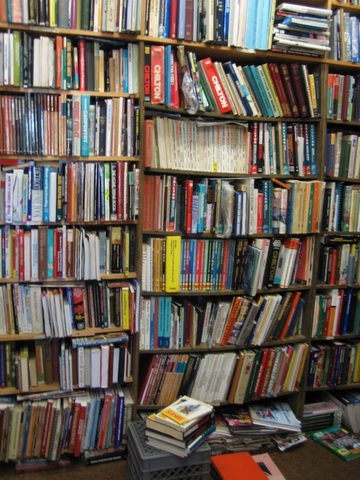
Photo: Used books by babblingdweeb on Flickr, Creative Commons BY-ND-NC

Tuesday, March 30, 2010

Embracing Wikipedia

I wrote last week (Wikipedia goes undercover) about the increasing clandestine use of Wikipedia by students in spite of teachers' warnings that it isn't always academically reliable. The moral of the story for me is that if faculty don't completely trust sites like Wikipedia why not get involved to improve the shortcomings.

This is what is happening already at some universities and in particular the University of Denver according to an article in eCampus News, Journalism students turn to Wikipedia to publish stories. Journalism students there are given assignments to write new entries in Wikipedia that have to be thoroughly researched and referenced. As one student says about the assignment:

“I never considered how much research and knowledge actually has to go into a Wikipedia article to make them good sources. It was actually very tough researching the subject and turning it into a coherent entry for Wikipedia.”

Indeed if you are writing for a site that gets around 68 million visitors per month you can be sure that if you make a mistake someone out there will comment. One of the Denver teachers involved in this initiative comments on faculty suspicion of Wikipedia:

“One of the reasons I wanted to assign [writing Wikipedia entries] is to combat that view. I tell students to use it as an information portal … and you can see what information has been sourced and see that they’re reliable sources. Wikipedia can be a great resource.”

I don't think anyone is suggesting that Wikipedia can replace academic journals and reference works but it is definitely a great place to start if you want a good overview of a subject and links to further study.

Wednesday, March 24, 2010

Wikipedia goes undercover

There's a new study just out from the University of Washington by Alison J. Head and Michael B. Eisenberg called How today's college students use Wikipedia for course-related research. The study covered students on six campuses across the USA. They have found that 80% of the students in the survey use Wikipedia in their initial research even if not encouraged by faculty to do so. I suspect that results would be similar at many other universities and schools in different countries. The big question of course is why they do so.

The number one attraction I think must be Wikipedia's sheer volume of information and even more important its ease of use. It is often quite simply the best place to start to get an overview of a field. Some students in the study state that they do not cite Wikipedia as a source since they know that the teacher will not approve. They all seem well aware of the potential limitations of Wikipedia but choose to use it anyway. However few claimed to use Wikipedia later on in their research where they cite more established sources.

"Overall, college students use Wikipedia. But, they do so knowing its limitation. They use Wikipedia just as most of us do — because it is a quick way to get started and it has some, but not deep, credibility."

Why this clandestine use of the world's biggest ever reference work? Using Wikipedia is an excellent way of demonstrating source criticism and you can gain a deeper insight into the complexity of many concepts by looking under the discussion tab. Why don't more teachers get involved in making Wikipedia more credible or accept it for what it is and let students use it as a springboard to more knowledge? Despite its size it is still suffering from growing pains as many committed contributors debate just how free and open the work should be in the future. Those debates are however not apparent to the average user and it seems to be the default starting point for investigating a subject area.

I found no reference to the alternative wiki-based encyclopedia Citizendium which operates somewhat in Wikipedia's shadow but has ambitions to be more accurate and peer-reviewed as I understand it. Forbidding the use of these sources just moves the issue under the radar. Using social reference works responsibly should be a topic for class discussions. Wikipedia won't just go away if we ignore it.

Read a summary of the above report in an article in Campus Technology.
Also another blog post on the use of Wikipedia by medical students on Dundee e-MedEd blog.

Friday, October 9, 2009

Taking the geek out of tech

One of the best things about using Blogger is that, on the whole, what you write is what you get. You don't need to learn any codes to write your blog and as a result it's highly popular. There are now so many similarly user friendly applications that we have grown to expect full transparency. But things are not always so easy.

I enjoyed reading a post on Lisa's Teaching Blog, Four web technologies that shouldn't be geeky anymore, where she lists RSS, wikis, tagging and embedding as four technologies that should be much easier. They are all extremely useful but in most cases remain relatively inaccessible due to what she sees as unneccessary complexities.

RSS, for instance, is probably my most important tool at work. I use Netvibes to gather hundreds of feeds. I find it easy to use but it still involves the process of finding the RSS button on an interesting website (not so easy even on popular sites), copying the link and then pasting it into Netvibes. One click should do it. RSS is one of the most useful web services around, especially for teachers and researchers, but very few that I know use it. It just hasn't been adequately hyped I suppose. The name doesn't help either. "Really Simple Syndication" - yes, quite.

Wikis are widely used but I also wonder if they couldn't just design them so we could dispense with the few codes and symbols they use. One teacher I know tried to get students to use MediaWiki but they found it too complicated, lost interest and solved the task using other tools. It's not that complicated but for many people the mere sight of coding turns them off instantly. The easiest wiki tool I've used is PBworks which hasn't so far required me to write any code at all.

Of course I admit that these problems could simply be down to my own reluctance to learn the finer points but the four technologies mentioned here might be much more widespread if they were just a bit more straightforward.

Saturday, September 12, 2009

Fotopedia

Sharing photos is one of the most popular social activities on the net and you might wonder if there is a need for another photo sharing site, but I can't help recommending a relatively recent arrival on the scene; Fotopedia. The idea is to create a photo equivalent of Wikipedia allowing photographers to share, tag and collaborate. Superb layout and some breathtaking photos.

The principle is that youcan upload photos and create your own albums or you can add your photos to existing albums on a particular subject. Photos can even be uploaded from Flickr or Picasa and then be linked to Wikipedia articles and Google Maps. The crowdsourcing principle rules here by allowing users to vote on the best and most relevant photos. The more votes a photo collects the further up the hierarchy it climbs.

“After traveling the world, I wanted to share my photos with others. Flickr and other photo sites give you exposure for only a brief window in time, and adding photos to wikipedia proved too complicated for the average user. This sparked the idea for a ‘wikipedia of photos’ – that combines the permanence and community collaboration of wikipedia with the ease of use of consumer desktop applications.” Jean-Marie Hullot, one of the founders of Fotopedia.

Saturday, August 22, 2009

Coming to a cinema near you ...

I love old movies and couldn't resist passing on this wonderful pastiche film trailer for an open access course Social media and Open Education. The course is free to join!

Thursday, March 26, 2009

Wikipedia as it happens

Ever wondered how often Wikipedia is updated? You're not the first because there's now a site that shows you updates as they happen and where in the world the update has been made.
Wikipediavision is the brainchild of a guy called László Kozma from the Helsinki University of Technology. It is a mashup with a world map (Google maps) and a feed from Wikipedia and you can simply sit and watch the world add to Wikipedia. When a new entry appears you just click on it and you see it on Wikipedia. Something for those long winter evenings maybe.

Monday, March 9, 2009

You've seen the wiki now read the book!

I'm not sure what to make of the interesting service offered by PediaPress. You choose a selection of entries from Wikipedia and PediaPress will make a book out of them and send it to you. The cost of this hard copy starts at $8.99 depending, of course, on how much of Wikipedia you want to print (take a look at a sample book). So theoretically you can aim to have a "fine set of modern encyclopedias on your bookshelf" as the door-to-door salesmen of yesteryear used to say.

It certainly enables you to compile your own book on whatever obscure topic you like and be the owner of a one-off publication. I doubt if there's a mass market here but in these days of customisation in everything, why not customise books?

Friday, December 5, 2008

Online Information part 2

Libraries around the world are doing their own 2.0 upgrade, using blogs to tell about new publications and services, allowing customers to review books or contribute to wikis and providing instant messaging for contact with library staff. The library building with its collection of books is merely the tip of the iceberg where the main arena for the library is on the net. Social software gives libraries the chance of bringing people together to discuss and collaborate and helping people to use the tools involved.

One particular library project caught my imagination. In Denmark there is a popular library service for children called Ask Olivia (Spørg Olivia - only in Danish of course) which has been produced by Danish TV (DR) together with today around 50 local libraries. Olivia is an animated teenager on the web site who answers all sorts of questions from children between 8 and 14. Instead of having a service like ”ask the librarian” they decided to create a character that the kids could identify with, Olivia. She has her own identity and personality and has succeeded in creating a genuine dialogue with the children who use the service. It is vital that she behaves and responds in keeping with her identity; a 14 year old girl who is smart and fun to be with.

Behind the character are a select group of librarians who take turns at ”being” Olivia and answer the questions that come in and take part in the discussion forum on the site. They found that the children soon began contributing to the service and wanting to add content where they knew more than Olivia or could add details. As a result Olivia has to deal with questions that would never be asked in a physical library. The service has expanded and today has a large following of children who enjoy sharing knowledge without ever really realizing that they are participating in a library service. That for me was the best part of the story; that a traditional library service has been turned into something much bigger simply by communicating on the children’s terms and by letting them contribute and communicate.