Showing posts with label personalization. Show all posts

Saturday, March 23, 2024

Mass personalisation - when every cafe looks the same

Photo by shawnanggg on Unsplash

Remember when you first used Amazon and they offered recommendations of other books you might like based on what you had bought or browsed on the platform? Often the recommendations were very much in line with your tastes and you discovered new books or music. Google searched for results that matched your browsing, giving you a personalised search service. We felt served, but today we feel used and manipulated by algorithm-driven recommendations that are now extremely commercialised. If you keep getting fed music or literature that you already like you'll never discover anything new. It's a bit like the radio stations that promise to play only hit music - that means you'll never hear anything new until after it has become a hit. The trap of personalisation becomes even more worrying when you show interest in more extreme political views and the algorithms offer you increasingly extreme material until you see very little else. Add to that the power of influencers on social media and our flock instinct and the result is a global streamlining. In the end everything looks or sounds roughly the same.

This streamlining is the subject of a fascinating podcast and article on The Verge, How to save culture from the algorithms, with Filterworld author Kyle Chayka. Kyle is the author of a book called Filterworld: How Algorithms Flattened Culture, about how global trends are created on a viral scale, via social media and streaming services.
It’s a book about how digital platforms like Instagram, TikTok, and Spotify took over our modes of cultural distribution in the past decade. Algorithmic recommendations, like TikTok’s For You feed or Netflix’s homepage, control the majority of what we see and hear online. Though they promise personalization, the net result of so many algorithms is a homogenization of culture.
Mass personalisation leads in the end to a final common denominator, as in all the trendy cafes, restaurants and BnBs looking very similar no matter where they are in the world.
I was traveling around the world quite a bit and landing in all these different cities, and I would notice that every Airbnb I stayed in had the same kind of aesthetic signature, every coffee shop I went to in Reykjavík or Kyoto or LA or Berlin all had the same stuff in it, and I just started wondering or almost being anxious about why all the sameness was happening
Products, services, trends and influencers pay for ratings in the main platforms and if you press the right buttons you can go viral. Ratings and reviews matter and these can now also be manipulated with the help of AI bots. Some music, books, films etc get pushed more than others. Our personalised services are not as personal as they seem. Our tastes are moulded by the algorithms. The question is how to escape. According to Chayka you need to reconnect with yourself and ignore the recommendations, reviews and like-counts.
Being more thoughtful is a good start. I think what I came out of it with was you want to know that you like what you like because you like it, not just because it was recommended to you and exposed to you repeatedly in a feed. Thinking about your personal taste, having a real encounter with a song or a piece of art or a piece of clothing where you don’t think about how many people liked it, where you don’t think about the Instagram account, where you just sit with your own feelings and have an experience of culture that’s in front of you that’s changing your mind or your soul or whatever, that’s truly what I want people to have. I want you to sit and stare at a painting and be like, “What does this make me feel? I don’t care how many likes it has. I don’t care how many followers the artist has. How am I feeling right now?”

I try by using for example Duckduckgo for searching since it doesn't track me. I get a more diverse set of results than with Google but that is the point. Google frequently suggested my own blog posts or articles whereas I can hardly find them with Duckduckgo! I've stopped using TripAdvisor since since reviews can be written by bots or trolls. I don't use Amazon anymore and my use of Spotify is sinking to the point where I don't think I want to subscribe anymore. We don't need to go completely offline but treat the big tech platforms with extreme care and suspicion. There are alternatives out there.

Tuesday, March 27, 2018

Terms and conditions apply - what went wrong?

Terms and Conditions by Nick Youngson CC BY-SA 3.0 Alpha Stock Images
"If it's free then you are the product". Yes, we've heard that many times over the years but somehow chose not to take it so seriously. We merrily approved all the terms and conditions that popped up when we signed up for all of our social media networks and tools and kept on clicking. We basically gave Google, Facebook, Twitter and the rest of them the freedom to gather enormous amounts of personal data and sell it to anyone willing to pay for it, whatever their motives. Now with Facebook in the eye of a storm of outrage and Google in similar trouble, we can see what the cost of "free" actually is. Basically most commercial online media that are "free" are also in the business of tracking and selling data to advertisers (read more in Doc Searls Weblog, Facebook’s Cambridge Analytica problems are nothing compared to what’s coming for all of online publishing). At the same time we are so hooked on "free" that it's hard to break away. Try to imagine your digital life without all these commercial giants, especially Google. I'm trying to limit the damage at present by switching platforms (e.g. moving from Chrome to Vivaldi and searching with DuckDuckGo), going through all the security settings and so on, but it feels like I'm hopelessly enmeshed.

So what about education in an age where free has been compromised? So many communities of educators and students are built around Facebook, Google, Twitter etc. Do we close them down and move elsewhere and if so where to go? Some institutions offer safe platforms for staff and student blogs and wikis, as Tony Bates describes in his post Our responsibility in protecting institutional, student and personal data in online learning. There are also still plenty of open source wiki sites and other non-profit services but they lack the glitter and stickiness of the commercial solutions. Many users will no doubt set up new alternative networks and platforms but they involve considerable administration and development and will cost time and resources. Some will try to limit the damage and continue to use the old favourites but being more aware of their limitations (e.g. Siva Vaidhyanathan's article in the New York Times, Don’t Delete Facebook. Do Something About It). Whatever happens we need to revise our practices and attitudes.

One interesting aspect of this mess is raised in an excellent post by Autumn CainesPlatform Literacy in a Time of Mass Gaslighting – Or – That Time I Asked Cambridge Analytica for My Data. She proposes platform literacy as a key skill for the future; the awareness of the power that platforms have and the ability to limit the amount of data that platforms can acquire from you. Personalisation it seems has been the pied piper leading the children to their doom.

Personalization in learning and advertising is enabled by platforms. Just as there are deep problems with personalization of advertising, we will find it is multiplied by tens of thousands when we apply it to learning. Utopian views that ignore the problems of platforms and personalization are only going to end up looking like what we are seeing now with Facebook and CA. The thing that I can’t shake is this feeling that the platform itself is the thing that we need more people to understand.

Platforms gather data and data is the new oil. That crude data can now be distilled and some of the applications are proving to be deadly, threatening democracy itself. Maybe we are now beginning to realise what that often misused term "disruption" really means? Even our learning management systems are powerful platforms that gather data on students' interactions, access to material and performance. This can be used to enhance learning as many experts in learning analytics have demonstrated, but what if the data escapes into the wrong hands? We need to become more aware of the power of platforms and what we can and cannot share on them. 

What if we were really transparent with the data that learning systems have about students and focused on making the student aware of the existence of their data and emphasised their ownership over their data? What if we taught data literacy to the student with their own data?


Thursday, January 29, 2015

Making feedback more personal

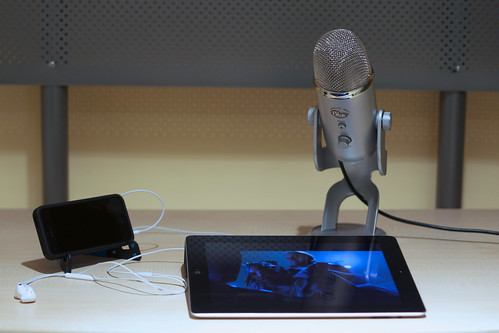
My New Podcasting Workspace by Brad.K, on Flickr
Creative Commons Creative Commons Attribution 2.0 Generic License  by Brad.K

Online education is often accused of being impersonal self-study with predominantly text-based communication that lacks the intimacy of meeting teachers and fellow students face-to-face. The discussion forums of many courses are indeed rather impersonal with many students and teachers opting not to show photos of themselves. The teacher may provide recorded lectures but generally there is very little personal contact in such environments; face-to-face contact is missing and students seldom hear the teacher addressing them directly. As a result it is extremely difficult to foster a sense of community and when interaction is limited and relatively impersonal it is no surprise that many learners simply give up or slowly fade from view. As low bandwidth has become less of an issue in recent years online learning should have been first to reap the benefits of synchronous and asynchronous audio and video communication to provide a more media-rich learning environment and enable more personal contact between students and teachers.

It is surprising therefore that we are only now beginning to exploit the use of audio and video in education. This is highlighted in an article by Steve Kolowich in the Chronicle of Higher Education, Could Video Feedback Replace the Red Pen? It describes how teachers are providing feedback on student assessments by posting short videos instead of commenting in text. The advantages of video feedback are many but above all it makes the teacher-student contact suddenly more personal, offering contact and empathy in a way that text can never convey. The article quotes student reactions to video feedback as overwhelmingly positive, claiming that the communication was real, honest and authentic in comparison with text feedback. The teacher addresses the student directly giving a few minutes of specific feedback and this can make the difference between the student opting out or staying the course. In addition teachers found it quicker and easier to make a video commentary with a mobile and any hesitations or repetition was seen by students as adding to the personal touch of the message.

Instructor feedback seems like a natural fit for video, especially because short videos have become easy for anyone to make and distribute. The Monash instructors, for example, recorded theirs with webcams and iPhones. And yet they found few documented cases of similar experiments in the research literature. Most studies have focused on videos directed at an entire class, they said, rather than ones tailored to individual students.

We should not simply focus on video either. Audio has many advantages and also offers a more personal contact than text. Recording an audio message is simple on any device and audio files can be easily embedded into a Word document or a PowerPoint slide enabling the teacher to give specific feedback on the student's work. Although it's good to see the teacher's face now and again it's often better to hear the voice while looking at the work being commented on. For students with bandwidth limitations audio feedback is not demanding and provides that direct contact between teacher and student that text fails to provide. The British organisation JISC's guide, Using Audio Feedback for Assessment, provides good advice on using audio feedback with students. They have also produced a specific guide to adding audio comments to a Word document.

Some research into the effects of student feedback on their development has brought up themes of staff effort gone to waste and students not digesting feedback, therefore hindering their development (Hartley and Skelton, 2002). As a result numerous case studies have investigated the potential for successful audio feedback to be an improvement on written feedback in the perception of students and assessors.

Audio and video can also transform the discussion forum offering students a choice in how they contribute. It also increases accessibility for students with impaired sight or dyslexia many of whom will feel much more comfortable making an audio comment than writing text. I know several teachers who use the tool VoiceThread to create discussion threads with a combination of video, audio and text communication and this gives a real voice and face to all participants who, on a more traditional online course, would never see of hear each other at all. Basically a variety of media makes a richer learning environment for all. Imaginative use of media for asynchronous communication can help to narrow the distance in online education. Soon the concept of face-to-face will not necessarily mean being in the same room. It can even be applied to asynchronous communication.

Thursday, January 16, 2014

Don't fence me in


I have quite a number of friends on Facebook but only a few of them ever show up in my news feed. I used to think that maybe they weren't so active but now I suspect that they are simply filtered out. A video (see below) by Derek Muller of Veritasium, an educational science channel on YouTube, featured in an article on the Huffington Post, Nobody 'Likes' Your Status Updates Any More? Blame Facebook, explains how Facebook is increasingly filtering what we see. Muller explains how we only see a fraction of what our friends post and that some friends never show up at all. Basically each one of us is an advertiser on Facebook and we are marketing ourselves. As a result we might be interested in paying for increased exposure. You can already pay to boost the impact of particular posts and although this applies mostly to companies and organisations a likely development, according to Muller, is that we too may have to pay extra to make sure our updates reach most of our friends out there. As Facebook, like all social media, tries to find new ways of monetizing their service it's not surprising that you may have to pay for maximum impact, even if Muller is highly critical of this tactic in the film. So we live in a kind of bubble in Facebook with a select band of faithful friends selected not so much by us but by an algorithm at Facebook. Read a reaction to Muller's film in Business InsiderBlogger Nails A Major Problem With Facebook's Newsfeed.

There has been similar criticism of Google cocooning us in a comfort bubble due to personalised search results. As Google learns your preferences it searches for sites that you have previously used and as time goes on you will get results that are customised to your preferences. That explains why my own blog posts always feature prominently when I search for something via Google (I bet they don't show up in your searches!). This creates a false bubble that could lead me to believe that my opinions are shared by the world and means that I am seldom exposed to ideas that are radically different from mine.

Personalisation sounds great but when it leads to a bubble culture it becomes rather dangerous. We develop tools that help us distill the vast reserves of raw data there will be increasingly sophisticated levels of personalisation. Learning analytics appears in most predictions of the next big thing in education and undoubtedly our devices will be able to lead us to learning resources that match our preferences and interests. The problem with all this is that it lacks serendipity and often real learning occurs when you meet the unexpected and have to deal with answers that question your thinking.

I don't want to be herded into personalised bubbles, no matter how convenient and comfy they may be. I want to have the option to switch off the bubble and see all my Facebook friends' updates now and again (well, minus the Farmville updates!). Let me choose if I want appropriate learning resources chosen for me or whether I want to take pot luck out there in the wild west of the web.

Will my plea be heard? No chance, I fear, but at least I've asked.

Thursday, August 15, 2013

Too much cake


I wrote recently about self-service learning and how MOOCs offer a convenient complement to formal education. The analogy of the self-service cafeteria where learners can compose their own blend of short courses is very attractive and I believe that we are seeing the emergence of a much more varied and flexible ecosystem for learning combining the benefits of short, just-in-time online courses with longer formal courses and programmes. You choose the option that best fits your current lifestyle and needs.

However there is a danger of letting everyone compose their own education by piecing together dishes from a gigantic buffet. What happens if you only choose the cakes and miss out the vegetables? This is the theme of an article in the Washington Post by Robert F Bruner: Commentary: Without structure, learning crumbles. He's worried that the new educational buffet will mean that people will only learn what they want to learn and thus will miss the less attractive but essential details that put everything into context. It's a bit like the problem of personalization on the web. If we can tweak our preferences so that we are only exposed to news and information that we agree with we will simply live in a bubble, unaware of other points of view or sheltered from unpleasant information. Our own preferences are not enough. Someone has to ensure that we have a balanced diet.

"Too much dessert and not enough broccoli. Students who simply follow their appetites will eventually find some educational candy: courses that may gratify an immediate interest, but don’t really build one’s capabilities. Like a healthy diet, a great education consists of a balance of intellectual nutrition. Eat your vegetables. They are good for you."

How do we make sure students "eat their greens" as well as benefitting from the flexibility and diversity of today's learning environment?

Friday, March 4, 2011

In the bubble

We live in the age of personalization. Products and services can be tailor-made to our individual requirements and we can choose from a bewildering number of alternatives, all to make us feel unique and special. On the net we have Google,  Facebook and all the others checking our on-line behaviour, remembering our preferences and then customising and adapting the information we receive according to our preferences. Several online newspapers, like the New York Times, now feature news items that your Facebook and Twitter friends have recommended so that you get the news you are interested in.

bubble by zzub nik, on Flickr
Creative Commons Attribution-Noncommercial-No Derivative Works 2.0 Generic License  by  zzub nik 

But there's a darker side to all this. At this week's TED2011 conference Eli Pariser spoke on the theme of his forthcoming book, The filter bubble; that personalisation is actually making us more uninformed. It sounds so positive that filters on the net help us to find the information we really want and that our friends' recommendations influence our search results. However the tendency that Pariser sees is that we end up only seeing information that confirms our present views, what he calls our "filter bubble". Information that conflicts with the preferences of my friends and myself are simply filtered out of the search without our being aware of the process. This unconscious filtering is worrying.

If all my friends share my political views I risk only seeing search results that we all approve of. Conflicting views are quietly discarded and we can be lulled into thinking that our views are correct. We can easily filter our news preferences on the net so we need never be disturbed by uncomfortable information. We risk being trapped in our own information bubbles.

Shouldn't we be able to switch off this well-meaning filter or at least be more aware that it is there? Is the wisdom of the crowd so wise if the crowd all agree with each other?

Read more in a Mashable article Is the personalization of the web making us dumber?