Showing posts with label learning environment. Show all posts

Tuesday, December 6, 2022

Back to campus - the intangible assets matter

Photo by Loïc Fürhoff on Unsplash

The pandemic revealed cracks in the value of the campus and physical work spaces that are now being hastily papered over as most institutions revert to business as usual. But we have shown that courses can be successfully run online and staff are able to do most if not all of their work from home. Many staff and students are keen to continue working online, at least a few days a week. Some institutions are offering hybrid/hyflex teaching with students able to choose between online or on-site participation. They also allow staff to choose whether they wish to work from home or from the office, in agreement with their boss and colleagues. However, other institutions have reverted to campus-only teaching and insist on staff (usually administrative staff) being physically on campus.

This creates tensions. If a significant number of staff and students choose not to go to campus so often the sense of community offered by the campus is diminished. Management naturally want to make optimal use of their expensive and often recently built or refurbished campus facilities. They are caught in a difficult position where offering flexibility is clearly positive but will result in a sparsely populated campus that will become increasingly unattractive. At the same time forcing everyone back to campus will sow dissatisfaction and create negative publicity. 

So what is the value of the physical campus and what is missing in the digital campus? This is discussed in an article by Jasmine Price, Donna Lanclos and Lawrie Phipps, COVID, Campus, Cameras, Communication, and Connection, in the Irish Journal of Technology Enhanced Learning. They interviewed students (undergraduates and post-graduates) about their learning experience during the pandemic and how they feel about returning to campus. The difficulties that arose during the terms of enforced home study are familiar from many other studies but the core of the article is about how the online experience has affected student attitudes to the physical campus. Online lectures work well, as do most administrative routines, but somehow the online environment lacks soul, presence, ambiance, a sense of fun, being part of something. These intangible factors are central to being able to identify as a student.
We found that, for the students we spoke to, a return to campus implied access to fun, spontaneity and interaction with peers, lecturers, and other staff members. Even as students did talk about the flexibility that online places and platforms afforded them around attending lectures, and taking exams, they also highlighted their need for the physical spaces of the university campus to facilitate their focus, as key locations for group work (particularly important in undergraduate second years), and for socializing.
The digital spaces work well for some things. Chat groups on Whatsapp and suchlike offer instant interaction and a sense of group identity, course material is always accessible and online meetings became valuable after an initial period of trial and error. However, the digital campus still lacks a sense of place and social interaction. The digital spaces are somehow fragmented and support services that are visible on campus are hidden online. 
The digital campus, as yet still feels difficult and obscured for some students, lacking the well-established paths and cues that are familiar on a physical campus.For the digital campus to realize the potential and possibilities exhibited on the physical campus, universities need to find ways of enabling greater transparency so that students can tell where the pathways are to meet and engage with their peers, and with staff who can teach and otherwise support them. If we are going to continue to cycle through times when we are only in digital places for university education --and it looks like that is likely--we must find ways to make visible and accessible the entirety of the potential support network.

The students did not really miss the lecture halls and classrooms during the pandemic. That part worked well online. What they missed were the intangible assets of the campus - a sense of belonging.

Monday, November 28, 2022

From lecture to story-telling

Photo by Dom Fou on Unsplash

During my schooldays and even at university I believed that I would be assessed on how well I remembered what the teachers told us in class. We were lead to believe that anything the teacher "went through" in class could come up in the exam. What we read in our textbooks was supplementary knowledge. The teacher probably also felt obliged to cover all possible questions to avoid accusations after the exam that "you never mentioned that in class". I taught for many years using this model and tried to cram in as much useful information as possible into my lessons in the belief that this was how the students learned best. So we were all locked in this information transfer illusion of learning that is still very common in education all over the world. Even if active learning and flipped classroom have become accepted and widely used, the default is still the traditional lecture.

This is discussed in an article by Harald Liebich in the Norwegian higher education news site Khrono (just use a translation tool), Er forelesningen et ritual eller en læringsarena? (Is the lecture a ritual or a learning arena?). Whenever the media or popular culture want an image to represent higher education it is nearly always the lecture hall with the professor on stage. He describes how lectures simply repeat what is much better described in a textbook and that students remember very little of value. A method with such limited impact on students' learning must be questioned. 

The time invested by lecturers and students does not correspond to the intended outcome; the enhancement of learning. The limited impact of initiatives to implement innovative teaching methods can be linked to the lack of incentives for pedagogical development in the whole university sector. [My translation]

Forelesers og studentens tidsbruk står ikke i forhold til hovedintensjonen; læringsutbytte. Manglende drivkraft til å fornye undervisningsformene, kan ha sammenheng med at undervisningsarbeid gir begrenset merittering innen universitetsfeltet.

The lecture is indeed a ritual and should in most cases be transformed into an arena for group work and discussion. At the same time, I wonder if the ritual element still has relevance in terms of creating and cementing a sense of belonging. Attending a lecture every week reminds students that they are part of the university as an institution and reinforces a sense of pride and tradition that should not be underestimated. You may not learn so much but simply being there gives you a sense of identity just as walking about the campus or chatting in the cafeteria. I know that many people prefer to study in the library even if you could easily do so more comfortably at home. Somehow the library feels more academic, more inspiring, more serious. Also you can see lots of other people studying and you want to blend into the studious ambiance. This was transformed into an online setting during the pandemic with sites like StudyStream where you could join a silent video meeting, watching other students studying at their desks. 

Lectures have a role to play but only is used sparingly. Liebich quotes an article in the journal Health Professions Education, On the Use and Misuse of Lectures in Higher Education, that reviews research in the value of the lecture and describes the methods limitations. However, there are times when a lecture can be valuable, especially as inspiration. The lecturer's role is not to provide content but to offer different perspectives and insights into their own research process. The vital element is to offer reflection, experience and inspiration - basically to tell an engaging story. 

Articles describe only the end product of a scientific endeavor and do so in a static and formal way. Students however deserve to hear the whole story; the story of how the researcher developed a particular hypothesis, the story of the difficulties the researcher encountered, and his or her emotions when a cherished hypothesis turned out to be false. Who can tell these stories better than the researcher him- or herself? These narratives should be told and the lecture is a good place to do just that, in particular if the lecturer knows how to tell a good story.

The lecture may be an academic ritual but if the speaker can offer this story-telling element and convey enthusiasm and commitment to the subject matter it can also play an important role in the students' development.

Tuesday, June 28, 2022

Conference conclusions part 2

Photo by John-Mark Smith on Unsplash

Following my previous post I would like to summarise some takeaways from the two conferences I attended recently, NU2022 i Stockholm and EDEN2022 in Tallinn, Estonia. I didn't make detailed notes this time so here is a list of themes that made an impact for me. There were of course many sessions about the perils of hybrid teaching but generally the focus was on improving teaching and learning rather than about using tools and platforms. I don't think that the pandemic has fundamentaly changed education but I do believe that we have finally realised that technology is now fully integrated into all pedagogical discussions. Here are a few themes I noted, in no particular order.

The changing role of the campus.

If we can deliver content, discuss, collaborate and network very well online and in some cases better than on-site the awkward question of the future role of the campus emerges. We need to offer sound reasons for being there and identify the unmissable elements of the campus experience. This is clear for the traditional target group of young students but the benefits are much less clear for the growing ranks of older online students. An interesting perspective on this came from the head of the Stockholm School of Economics who talked about the importance of appealing to all the senses - not just what your campus looks like but also trying to capture the feel, smell, sound and taste. We had an evening event at that institution and saw how they had cooperated with artists to have thought-provoking paintings, photos and sculptures in the corridors and learning spaces.They also ran very popular book circles to emphasize the importance of the humanities even in an economics degree. 

In Tallinn a presentation by a student raised the need for us to develop a coherent digital campus that allows students and teachers to interact, form groups, network and socialise. Today's digital campus consists of closed and often incompatible silos and the presentation showed that during the pandemic lockdown students at Tallinn University had to negotiate 11 different platforms as part of their everyday course work.

Students as partners

Nobel Prize winner Carl Weiman of Stanford University made an interesting online presentation at the Stockholm conference. Not about his research in physics that won him the prize but about the theme of the conference - pedagogical development. What struck me most was the fact that he presented in such down-to-earth terms and stressed the need to have students as partners in the learning process and in course design. Admittedly he was preaching to the converted but he reinforced the advantages of active learning and of peer feedback.

Discussing with a fellow student is more effective than listening to an expert instructor.

Pia Lappalainen, Aalto University in Finland, reinforced this theme by showing evidence for how regular small-scale feedback promoted learning more than detailed summative feedback.

New initiatives for promoting digital literacies

A representative from the European Commission presented news of further initiatives to promote digital literacies in education and in society in general through the updated version of the European Digital Competence Framework for Citizens, version 2.2. There was also enthusiasm about the launch of the Digital education hub. The hub is an ambitious venture to offer professional development for teachers as well as a store of learning resources and lesson plans.
The open online collaborative community for digital education stakeholders in Europe and beyond.
Even if there are excellent guidelines and criteria for assessing and developing teachers' digital literacies there are unexpected issues in trying to gain an objective assessment within an institution. Linda Helene Sillat and Mart Laanpere of Tallinn University showed the dangers of self-assessment where some teachers over-estimated their competence levels whilst other did the opposite. Objective tests at the university failed since teachers simply refused to take the tests, seeing it possibly as an affront to their professional abilities and suspecting that poor test results would negatively affect their career opportunities. 

Quality perspectives

Quality in the field of online education is a complex issue. Despite a plethora of quality frameworks (over 100 different frameworks according to Mark Brown of Dublin City University, there is still a reluctance to address the issue in higher education. Maybe this is due to universities being daunted by both the bewildering variety of frameworks and the diversity of overlapping terminology in the field. The question remains of whether quality in the use of technology in education should be assessed as part of the regular educational quality framework or as a separate feature.

My final takeaway was a presentation by Lesley Gourlay of University College London, questioning the use of the word virtual in an educational perspective. This opened up a wider theme that deserves a longer post to itself. I will break new ground on this blog by creating a cliff-hanger. 

To be continued ...


Sunday, March 13, 2022

Challenging assumptions about learning

Photo by Dom Fou on Unsplash

Do you have a clear idea of how you learn and what teaching methods help you most? I certainly don't and I'm close to retirement. However we continually ask students to evaluate their courses and draw conclusions from their feedback. Student course evaluations form the basis for future course design and administration but I wonder if we are asking the right questions. 

This is a topic discussed in a post by Zach Groshell, Do Students Have a Good Idea of What Helps Them Learn? We are asking them to evaluate a complex process that they have limited insight into and often the benefits of good teaching become clear months or even years later. He refers to a recent study, On students’ (mis)judgments of learning and teaching effectiveness. Journal of Applied Research in Memory and Cognition (Journal of Applied Research in Memory and Cognition, 9(2), 137–151), that investigates the hidden biases and subjective impressions behind student course evaluations. They found for example a mismatch between what the students thought they had learned and their test results. They preferred traditional content-rich lectures to more active sessions despite studies showing that active participation leads to deeper learning. They were also highly influenced by subjective perceptions of the teacher's status, enthusiasm, gender, ethnic background and accent (as we all are). I hasten to add that we are all subject to these biases.

As we have seen, empirical research has provided a wealth of results showing that students are poor evaluators of their own learning, and that their subjective impressions of teaching effectiveness are vulnerable to many biases that are unrelated to teaching and learning… Does this make it risky for instructors to use effective learning techniques? Particularly early in their careers and in teaching-focused positions, instructors may find themselves faced with the difficult decision of whether to incorporate teaching practices that gain them recognition as effective instructors, even if such practices do not positively impact students’ learning.
This poses a tricky question to teachers - do you teach for student satisfaction or teach for learning, even if it may lead to dissatisfaction and poor evaluations? An ambitious teacher who decides to promote active learning and student collaboration runs the risk of students misunderstanding their pedagogy and even a reprimand from the head of department when the poor evaluations emerge. Most of us can remember a teacher we hated at the time but with hindsight realise had pushed and challenged us to a higher level of understanding. What we think we want is not always what we need.

On a similar theme of assumptions and biases is an article by Perry Samson in Educause Review, Students Often Prefer In-Person Classes . . . Until They Don’t. We often assume that students prefer classroom teaching and student surveys show a clear preference for this. However, in this study the students were offered three levels of participation, the hyflex model of on-site, online or asynchronous interaction. Although they at first preferred to be in class, physical attendance declined as the course went on.
Given reasonable options, students in my class did not prefer the in-person mode of course delivery. In fact, the number of students who physically attended class dropped precipitously to an average of around 20% by mid-semester (see figure 1). At the same time, about one-third of students opted to participate synchronously during class time (see figure 2), with a growing number, reaching about 30%, participating asynchronously. The number of students who didn't participate any given day was relatively consistent throughout the semester at about 15%.
The test results showed that the on-site students performed no better than the others, in fact the first-year students who studied asynchronously (recorded lectures, forum discussion etc) had better results than those who attended classes in person. The study is of course limited and offers no exploration of the students' preferences but it does show that students appreciate the choice of participation modes more than we might assume.

My conclusion here is that we need greater dialogue with students about teaching and learning, explaining in advance why we are using a particular approach and getting them to buy into the method through together discussing rules of engagement and building a framework for feedback and reflection. Expectation management is so important and so pre-course information is so much more than just presenting a syllabus. It's setting an agenda and helping students understand how to succeed.

Monday, April 5, 2021

Teaching without video meetings

Photo by Joyce McCown on Unsplash

Synchronous meetings in Zoom/Teams/Google Meet have become the default teaching method over the past year but fatigue is setting in and many wonder if we really need to meet this way so often. Lecture sessions can be pre-recorded and discussions can often become more reflective in asynchronous forums or other discussion tools where everyone has time to consider their opinion and not simply react spontaneously as in a synchronous meeting. Could the frequency of video meetings be due to the feeling that that is what we are expected to do? Lots of meetings make everyone feel like they are working hard, but could learning take place just as well, if not better, without them?  

Some answers to these questions are discussed in an interesting article by Lucy Biederman in Inside Higher Ed, Goodbye, Zoom Fatigue. She teaches several classes very successfully without the use of video meetings and gives the following examples:

  • An advanced poetry seminar where students work together during the scheduled course times each week, communicating on Google chat as they do, to create a website that features a deep dive into one significant American poem each week. They collaborated to provide background, context, close readings, writing prompts based on the poem and more.
  • A business and professional writing course taught entirely on Slack, providing students experience with a new-to-them workplace application. Students communicated with me and one another on channels devoted to course topics and through direct messages.
  • An introductory creative writing course where students maintain individual blogs in which they explore course texts and their own writing processes throughout the semester. A page on the learning management system shares every students' blog address. Students create a community of writers by reading and commenting on each other's blogs.
In these examples the students are very active, learning together and interacting. These methods are also more inclusive in that they do not make high demands on bandwidth, devices or time constraints. The process is visible to all and the teacher is able to offer feedback at all stages. It also mirrors how virtual teamwork is conducted in professional life. This approach may not be valid for all subjects and levels but it raises questions around why we are so dependent on synchronous meetings even when many people feel that they are repetitive and uninspiring.

This does not mean that we should stop having video meetings but that we should always consider if they are essential and whether other methods would be more effective. Video lessons, like classroom time, can sometimes give us a sense of activity without really contributing to learning. We need to match each learning outcome to an appropriate method and space and be ready to challenge comfortable traditions.


Sunday, March 28, 2021

Drowning in content but what we need is community

CC0 Image created by Catherine Cordasco by @unitednations on Unsplash

Over the past year teachers all over the world have recorded and stored millions of videos, from short instructions to long lectures. Most of them can only be used once but are seldom deleted and as a result many institutions' servers are bursting with terabytes of video content. Storage is not as cheap as many think and as servers fill up we need to think of ways to free up space for more valuable content. Many institutions including my own compress and save seldom used content in archives but as production levels continue to mushroom we need to start asking why we need to produce all this. Why do teachers put so much time and effort into content production? 

One obvious solution is sharing such material as OER (open educational resources) and allowing others to reuse and adapt the material. Why record a lecture when there are hundreds of similar lectures already freely available? I'm sure you can be a good teacher without ever recording a lecture of your own and spending time focusing on facilitation, tutorials and feedback. But sadly OER has still not become mainstream despite greater awareness, according to a American recent survey reported by Campus technology, Faculty Awareness of OER Has Increased for 5 Years Straight, Yet Adoption Is Flat.

While OER awareness went up, for the first time in the past decade, adoption of OER as required course materials did not increase. Why? The researchers hypothesized that with last year's pandemic-induced shift from face-to-face to online instruction, faculty time was monopolized by pedagogical concerns. "[Flat OER adoption rates] may have been the result of the considerable amounts of time faculty had to put into converting their courses, leaving them no time to invest in the exploration and evaluation of new materials,"

Teachers feel bound by tradition to deliver content and the students expect the teacher to deliver content and it's very hard to escape from this mindset. Even if we know there is open content available we feel that we are not doing our job if we use other's material. If it's fine to recommend other people's books and articles it should be okay to recommend their recorded lectures.

This is reinforced in a recent article by David Kellermann in Times Higher Education, Academics aren’t content creators, and it’s regressive to make them so. The pandemic has forced everyone to become video editors and generally not very good ones.

Suddenly academics became video editors – mostly bad ones – and our students turned to YouTube, because on YouTube you can get a better explanation of the same thing (for free I might add). Universities turned from communities of learning and collaboration into B-grade content providers. This is the death march of higher education. Universities are not content providers. Somewhere along this unplanned journey we lost our way.

The main point of this article is that instead of producing vast volumes of content that already exist the university should focus on creating communities, providing context rather than content. The campus itself creates a sense of belonging with spaces that facilitate meetings, discussions and networking as well as having a strong identity in its architecture and setting. The article quotes Eli Noam: the strength of the future physical university lies less in pure information and more in college as a community. 

Today's online spaces lack these advantages and tend to be a collection of closed silos. The lessons of the pandemic must include the need to develop more social, interactive and engaging digital spaces that can complement the campus spaces. The endless production of video content is a distraction from this crucial challenge.

Sunday, March 21, 2021

Hybrid teaching - the new normal or yet another stress factor?

As universities prepare for a post-pandemic future, there is a lot of discussion about hybrid or even hyflex teaching where classes are held both on campus and online and students are able to choose how they wish to access the class. Hyflex even includes the option of being able to participate completely asynchronously but with exactly the same learning outcomes and examination requirements. It sounds great but doing this well will demand considerable effort and there are many pitfalls to beware of. Few classrooms are equipped for hybrid teaching for a start. Many institutions have already started converting classrooms for greater flexibility, generally involving the purchase of multiple screens, microphones, cameras and other hardware, much to the delight of the tech industry.

The idea of offering greater flexibility to students is fine but there are also dangers of taking a simplistic approach to a complex issue. Hybrid teaching is nothing new and many institutions have been doing it for years. It works relatively well for traditional large-scale lecturing since the students are largely passive regardless of location. The problems emerge when you add more interactivity. The classroom students then tend to dominate the discussion sessions and online students are often reduced to passive spectators since they are not as visible and it is hard to get the teacher's attention. Managing group work both in class and online is quite demanding on the teacher, especially if you want to have mixed campus and online groups. 

This all adds to the stress levels of already overstretched teachers after the past year's intensive pivot to online education, discussed in an article by teacher Amanda White in Times Higher Education, Upskill fatigue: will hybrid and hyflex tip academics over the edge? Despite her experience in online education, she admits that the past year has been very tiring and is worried that poorly implemented hybrid solutions will put even greater burdens on teachers. New teaching methods and skills will be required to ensure pedagogical quality and avoid falling into the trap of simply offering dual mode lecturing. Some institutions will be able to install expensive technology and provide essential support for their use but most will not, leaving teachers to rely on their multitasking skills, or lack of them.

While hybrid may seem like a panacea for the educational limbo we find ourselves in, implementing it poorly as a stopgap measure is likely to cause our educators more harm than good. Having educators without adequate training, learning design assistance, facilities and workload support is likely to pave the way for activities that do not engage the class, leaving online students cut adrift as observers.

Large lecture-based classes, often for first year students, are a tempting area for hybrid adaptation and Tony Bates warns against this in a new post, Teaching large lecture classes online in the fall? He advises universities to take the chance to change the model of teaching first year students and simply drop the large-scale lecture format except for a few exceptional occasions. Instead of lecturing, teachers need to help students find the information themselves and assess it.

When an instructor prepares a lecture, at least in first year, they are often doing work that the students could be doing: searching for information, raising issues, making a strong case or argument, coming to conclusions. These are skills that students increasingly need to develop themselves.
He also suggests that many first year classes could be smaller allowing for more collaborative group work and a teacher role more focused on facilitation and tutoring. If that is not possible then a more interactive and collaborative approach can be applied by a better use of prerecorded shorter lectures and a focus on asynchronous collaboration in the learning management system. In all cases we need to redesign our courses and review what technology we need. 
Without substantial re-design, moving large lectures online will increase the workload and stress on instructors, and/or will lead to poorer results for students. So now is the time for administrators and Deans to start asking whether we should be moving the large lecture classes online, or instead, finding better ways to deal with first year courses.
So should campus teaching become hybrid by default and if so, how do we deal with practical workshops, lab sessions and so on? I think we need to look carefully at which spaces to use for different types of activity. Sometimes we will have to insist on students coming to campus for essential hands-on training in fields like medicine, engineering, visual arts, music etc. Flexibility is fine but in some cases it can be dangerous and students need to be aware that although they can study online for some of the course there will be obligatory on-site training. At the same time we will definitely move to more hybrid solutions but they will demand course redesign and professional development for teachers if they are going to succeed.

Sunday, January 19, 2020

What happens on campus when everyone's online?


Most universities and colleges see online education as a supplement to the core business of the traditional campus. The institution's soul lies in the campus with its buildings, parks and meeting spaces and the everyday interaction between staff and students. But what happens when the online sector outgrows the campus? When most of the staff and students are working from home the campus loses its function as a meeting place. The physical campus has enormous symbolic value and if a visitor sees very few people milling around it is easy to draw the conclusion that the place is ready to close down, even if the online courses are full and very active.

These thoughts are discussed in a short post by Matt Reed in Inside Higher Ed, Online Enrollment and Campus Culture. His college has a rapidly rising number of online students and this is also affecting staff presence on campus as more and more prefer to teach from home. Empty corridors and quiet staff rooms can negatively affect staff morale and the feeling of community is eroded.

... it’s hard to convey a welcoming campus culture when fewer faculty are around at any given time. The feel of a department starts to change. If people who used to be on campus four days a week are suddenly here only two days a week, areas that used to bustle with activity start to feel like ghost towns. The culture starts to fray.

This in turn influences the students' sense of belonging to a living institution.

Students can tell the difference between a bustling area and a dead one. They draw a message from an entire hallway of closed doors and empty offices.

There are no clear answers but one guiding principal is to make the campus experience as valuable and unmissable as possible. Of course many distance students live too far away to attend campus meetings on a regular basis but all should be encouraged to spend some time there. Most of them are happy to travel if they can but there needs to be a very good reason for doing so; not just to get information that could have been delivered in a recorded video. Even established institutions need to rethink the physical campus, what it offers and why students and staff can benefit from being there. That added value should never be taken for granted.

Many institutions have succeeded in creating stimulating collaborative learning spaces where academic and social events can take place. At the same time we need to extend the college community into the digital spaces and find ways to blend the two environments. How can online students participate easily in campus events and be visible in doing so? How can we make campus students more aware of their online counterparts and create a common culture and community? These questions were partly addressed in the British JISC project, Sticky campus, where they experimented with setting up learning spaces where campus and online students could interact, even outside regular class activities. If we can use technology to make bridges between campus and online we can create a greater sense of community for all. The online students can become more visible and  feel part of campus activities and this will hopefully motivate them to some day make the trip to see it for real.


Monday, January 13, 2020

Innovating pedagogy 2020 - time for sustainable education?

CC BY-NC Some rights reserved by The Open University
The UK's Open University, in collaboration with the National Institute for Digital Learning (NIDL), Dublin City University, Ireland, has published its annual review of innovations in teaching and learning in higher education, Innovating pedagogy 2020. This the eighth report in a row and has common features with the much hyped NMC Horizon reports, such as predictions about the potential impact and timescales of each innovative practice described. These criteria are notoriously inaccurate (especially in the Horizon reports) and should not be taken too seriously but the descriptions, conclusions and references are interesting as indications on the present wind directions in the use of technology in higher education.

The ten areas examined by the report are:
  • Artificial intelligence in education. This means learning for, about and with AI. It is also vital that educators are involved in the implementation of AI and make sure it is used to benefit teaching and learning.
    ... what is clear is that the topic of AI in education is too important to be left to engineers and entrepreneurs. Instead, it is critical that educators, learning scientists and other stakeholders engage, to ensure that the AI applied in educational contexts best supports the learners, the teachers and the learning.
  • Posthumanist perspectives. This concerns the blurring of boundaries between humans and machines and the potential of this interaction for the benefit of education.
  • Learning through open data. Public organisations all over the world produce enormous amounts of open data that should be used in universities to enable students to use authentic data for research purposes.
  • Engaging with ethics. The (un)ethical use of personal data has been in the headlines for the last couple of years with the rise of what is often termed as surveillance capitalism. It is vital that students learn to learn how their data is used and misused and to gain a mature and informed attitude to the platforms and tools they use.
    Teachers and other education practitioners can actively engage their students with ethics by presenting authentic case-studies and giving opportunities for active discussion, ideally with people from different cultural settings and backgrounds. Only by engaging with ethics can we learn that our own mindset might not necessarily be shared by others.
  • Social justice pedagogy. Developing the ability to see issues from different perspectives, especially in terms of power structures, prejudice, roles, accessibility issues etc.
    For individuals, the process of thinking about how they came to know what they know, and what they think about what they know, can be very challenging. Specific teacher education may be required, to encourage and prepare teachers to adopt a social justice pedagogy and to deal with how the approach may play out in class.
  • Esports. The world of online gaming shows the power of learning and problem-solving in a community. These lessons are now being applied to create immersive learning communities.
  • Learning from animations. Animations are being increasingly used to show processes, procedures and movement.
  • Multisensory learning. Smell,taste and touch can be used more in learning activities.
  • Offline networked learning. Millions of people have limited or no internet access but can still benefit from digital resources in local networks run on battery or solar powered servers.
  • Online laboratories. Access to realistic virtual online labs give authentic laboratory experience to students who would otherwise never have access to such physical facilities.
The report is in general positive about the future as long as we can learn to harness the dangers of big data and artificial intelligence. Our attitudes to technology have changed and we need to be much more critical and cautious of the global tech giants.

The theme that interests me most is that of offline networked learning. Using battery powered mini servers and a wireless network, students in remote areas can work together with digital resources in a closed offline network (see also my post, Online learning - unplugged). This solution is also being used for education in prisons where internet access is not appropriate. However it is not only a solution for remote regions, there are arguments for closed networks even in developed regions. The report mentions the concept of  slow learning:

Networked offline learning brings people together in meaningful collaboration and sharing activities that can create opportunities for a slower, more deliberate learning experience than is typical on the Internet. 

Maybe we need to experiment with working in such distraction-free digital spaces to relearn how to focus. I don't mean that we go completely offline but a future skill will be learning to go offline in order to focus without losing the advantages of digital collaboration.

However, the biggest issue of all today is how education intends to face the greatest challenge of all today - the climate crisis. This is mentioned only briefly in the report but none of the innovations discussed will be of any relevance if the climate issue is not addressed immediately. Unless radical and uncomfortable changes take place on a global scale in the next ten years the future looks extremely dark. The educational sector must push harder for these changes, through further research but more importantly by integrating the message of United Nations sustainable development goals 2030 in every course and classroom. As I have previously written, we must develop sustainable ways to meet and collaborate, primarily through digital meetings and conferences. The carbon footprint of the higher education sector is extremely high through countless international projects and conferences (read more in this article in University World News, Time to cut international education’s carbon footprint). We cannot stop this completely but we could surely half the level if we develop better digital arenas for collaboration and learn how to use them effectively. As with all other aspects of the climate crisis, we know the dangers and we have solutions but entrenched attitudes and habits are the hardest things to change. My top trend for 2020 would be rethinking academic culture and focusing on sustainable education.

Reference
Kukulska-Hulme, A., Beirne, E., Conole, G., Costello, E., Coughlan, T., Ferguson, R., FitzGerald, E., Gaved, M., Herodotou, C., Holmes, W., Mac Lochlainn, C., Nic Giolla Mhichíl, M., Rienties, B., Sargent, J., Scanlon, E., Sharples, M. and Whitelock, D. (2020). Innovating Pedagogy 2020: Open University Innovation Report 8. Milton Keynes: The Open University.

Saturday, December 14, 2019

Smart campus, but who owns the smartness?


Learning analytics allows sophisticated analysis of students' activity in the university's various platforms and tools, allowing teachers and administrators to see who is falling behind, what they are having problems with and what types of activities give the best results. At the same time the campus is becoming smarter with the use of IoT (internet of things) technology and facial recognition, allowing automatic attendance registration, smart monitoring of room occupancy, car parks, heating control and even rubbish bins. Add artificial intelligence into this mix and we have the smart campus of tomorrow.

An example of the smart campus movement is Arizona State University, described in an article in EdTech magazine, How Arizona State University Built a Smart Campus. They have developed a campus app that has become almost default for students and staff allowing them to check schedules, grades, exam times, services, cafeteria menus, parking options, room availability and so on. Buildings and other spaces are constantly monitored and data collected about occupation and movement. This enables more efficient use of energy and provides vital data for planning new facilities and changes to existing ones. Major IT companies are pitching sophisticated solutions for campus management as seen in this film.


It's all extremely impressive but I have a couple of reservations.

Firstly, although the smart campus is very convenient and gives students and staff personalised and attractive services at their fingertips, you get the feeling that your every move is registered and stored. If all the data is aggregated all my movements, activities, purchases, studies, test results, hours spent in different spaces and travel will be available for possible analysis. Examples of facial recognition and ubiquitous CCTV monitoring seen in some Chinese schools and colleges in recent months can mean that there is simply nowhere to hide on campus. Your mobile is both the key to all campus facilities and a tracking device. The university therefore has extremely detailed data on everyone on campus and it is virtually impossible to opt out or even switch off. If that data is in the hands of a third party what guarantees are there that they will not sell that data or find ways of profiting from it? There are of course enormous advantages in smart campus solutions but questions about the use of personal data and informed consent must be foremost.

My second reservation is the focus on the physical campus and what sort of smart services all the off-campus online students will be able to access. These students are seldom mentioned in the smart campus narrative and I would like to see new learning spaces that bridge the gap between traditional campus students and online students. There seem to be few limits on the level of investment in the physical campus whilst the online spaces are in comparison extremely low-budget operations.

Tuesday, September 3, 2019

Online learning - unplugged


How can digital educational resources benefit those without internet access (about 3.2 billion people according to Internet World Stats) or even without electricity? Open educational resources (OER) are available in hundreds of languages but they don't help those who cannot access that material. The real potential of online education is making it accessible for all - even offline.

There are many examples of this around the world where online material is downloaded where bandwidth is available and then used offline in remote regions, but one particularly interesting example I found is described in an article in Campus Technology, Distance Learning Without Computers, It describes a project called Education for Humanity run by Arizona State University in collaboration with a number of humanitarian agencies where online higher education is offered to students in refugee camps in Uganda. These camps often lack both electricity and internet access so the solution involves a device called a Solar Powered Educational Learning Library (SolarSPELL - see film below). This device stores downloaded educational resources from the university (or any other source) and uses the open source learning management system, Moodle, for course delivery. It is powered by solar energy and can support up to 17 mobile devices on its local wifi network. The device is cheap and portable and has been used in many projects around the world including this one in Uganda. The solution allows students to access material, interact and navigate an online course in the same way as they would with internet access. Where possible, online interaction can take place using mobile devices and Whatsapp.


There are some interesting conclusions to this project. Firstly, students who studied ASU's course on agribusiness performed much better than average with some getting extremely high grades. Motivation was of course extremely high since the students all depended on agricultural business and had immediate practical use for what they learned. Being able to immediately test what you have learned in real life situations contributes enormously to completion rates.

Another valuable result of the project was that they developed their digital literacy skills, despite being unplugged. The offline environment was as close to the online version as possible and this gave them confidence for the future.The students clearly saw the benefits and motivation rose accordingly.

Besides the improvements in students' marketing and financial analysis skills, an unexpected outcome was a boost in digital literacy, Bauer noted. "Although the facilitators were actually in charge of powering up the boxes and being in charge of the technology, they really gave students the option to learn how it works, why it works that way and how the WiFi [in SolarSPELL] was different from the one that they may use to access the internet. We saw their confidence in their digital literacy levels improve, in terms of feeling comfortable in working with technology. And the facilitators were telling us about how excited students were to come in every day.

Because of the limited number of devices that can share the local wifi capacity, many students had to share a laptop or tablet. This proved to be beneficial because it added an element of collaboration that would have been lost if there had been one device per student.

One area of particular interest is the way people who were forced to share a computing device in the pilot project were also forced to work together. "We'll see what the data says, but it will be interesting to [find out] exactly how that collaboration might have improved grades and helped people's understanding.

In developed countries we often fail to discover the benefits that can arise from relative scarcity of resources. Sharing devices forces students to share their ideas and negotiate a solution to the problems they are trying to solve. This could easily be implemented in more connected classrooms to foster better collaboration skills and mutual support.

The course literature had to be revised and adapted to the local situation and OER was the solution. The publisher of the textbook used for the regular course at ASU did not allow the book to be distributed digitally, so the teachers replaced it with OER which they adapted to match more closely the target group's needs. This is another good example of the vital role that OER can play in widening the reach of education, especially through adaptation.

Maybe another success factor for offline digital education is the absence of distractions, allowing students to concentrate on the task in hand rather than be tempted into checking the latest messages. Even in our always connected world we need to learn how to focus and this can be done by temporarily disconnecting or limiting connectivity. Sharing devices with limited or no internet access could have some benefits. Less is more as they say.

Sunday, August 25, 2019

Transitional learning spaces


Most learning takes place outside the classroom. Of course, the opportunity to meet, discuss and practice in a structured setting is extremely important but the real battle to understand and implement new knowledge takes place in informal settings: at home, in the library, discussing in a cafe or during a long walk or run in the park. But a relatively unexploited learning space is the area outside the classroom and the corridors linking the formal learning spaces.

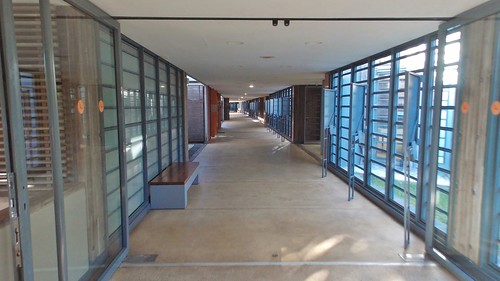
These spaces in between are discussed in an article by Luke McCrone in Wonkhe, Learning in the spaces in between. Valuable interaction often takes places before and after a class between students and between students and teachers, but only if the space provides a comfortable environment for this. The furnishings can invite groups to sit and discuss, use their digital devices or even discuss with an absent colleague by video. Previously dead areas such as corridors can become collaborative spaces if there are comfortable seats, power sockets, tables etc.

Frankly, the availability of this sort of transitional space should be prioritised. It is a relatively low-cost intervention that could be the difference between student interaction and disconnectedness. Kitted out with comfortable furniture and other amenities at the fringe of a lecture theatre, it has proven transformational. A student clarifying misunderstandings with the lecturer, or a chance encounter between two friends reflecting on an exam are examples of some of the active learning behaviours I have observed.

There is no doubt great potential here but no mention is made in the article about digital spaces. In most universities the digital campus is the learning management system, divided into class or course silos, offering very little interaction between students from different courses to meet and discuss. The discussion forums are seldom attractive spaces for more informal discussions since students often feel that anything written there is likely to be observed and assessed. Where are the digital spaces in between? How can we create them? Can we set up bookable digital group rooms so that students can meet with full video, audio, chat and screen-sharing functionality. How about social spaces that can lead to meetings with students from other disciplines but without the risk of meeting spammers and trolls?

Way back in the heyday of Second Life there were universities experimenting with virtual campuses where such chance meetings and group work were possible. Those spaces were generally restricted with only password access. The technology wasn't quite mature enough then, nor were most users, but the next generation of virtual worlds and virtual meeting spaces could lead to a much more interactive and social virtual campus. McCrone's research will be interesting to follow, but we mustn't forget the digital spaces. The campus spaces are used by many students but the digital space is the only one that unites the whole university. We need to build it for the future. 

Sunday, May 26, 2019

New models for higher education in rural areas

UHI Inverness campus. CC BY-SA Alastair Creelman
I am currently working in a Swedish project (Nya vägar - information in Swedish) that is investigating new paths to higher education for all who live in rural and sparsely populated areas. The problem today is that people move away from rural areas to study and very seldom return. This means that local businesses find it increasingly hard to find qualified staff and the local authorities also have difficulties finding teachers and health care staff. Even if there are many online courses and degree programmes available from Swedish universities, the range is nowhere near as wide as that offered on campus and so the brain drain continues. Some larger local authorities have set up local campuses or learning centres that try to match the needs of the local private and public sector with the courses and programmes offered by the higher education institutions. They also offer a meeting place as well as support and guidance to students and this has proved crucial to the completion rates of degree programmes. For many small local authorities the ability to access higher education without having to move from home is a simple matter of survival. Without this the population will dwindle and it will be difficult to maintain services. Our project aims to answer the following questions:
  • How can we provide higher education to all, wherever they live? 
  • How can we collaborate to optimize and assure the quality of the individual’s study situation? 
  • What can municipalities and other key actors do to create a local context that favors access to higher education? 
  • What is the role of industry and the public sector (employers)? 
  • What is required from the HE sector to increase access to HE for individuals and groups far from university sites? 
  • How can all actors collaborate to strengthen skills supply and life-long learning throughout the country?
UHI Inverness campus
One university that seems to have come a long way to answering these questions is the University of the Highlands and Islands (UHI) in Scotland and this week we paid them a visit to learn more about their unique approach to offering higher and further education to students spread over a large and sparsely populated region. Their development has been impressive and rapid; established in 1992, becoming a higher education institution in 2001 and a full university in 2011. Previously all universities in Scotland were concentrated in a central corridor between Glasgow and Aberdeen with nothing to the north and west; well over half of the country's area. UHI identifies strongly with its region aiming to be “locally based, regional in structure and have national and international reach.” They do this in an original way since the university's physical presence is in the form of a network of 13 colleges and 70 learning centres spread all over a region considerably larger than Belgium. Each college is an autonomous organisation with bilateral agreements with UHI, what they call a collegiate federal model. The teachers and researchers are based at the colleges, each of which has its own specialities and local focus, but the students can study most programmes from their nearest college or even learning centre and all have a personal academic tutor. The university faculties and support units operate horizontally in a matrix organisation. Then there are over 70 learning centres in villages, community centres, supported directly by UHI but fully rooted in the local communities. UHI is also a bilingual university with all information and support available in both English and Gaelic though this does not cover the education provided and although there are many courses in Gaelic, the vast majority of the education provided is in English.

What is particularly interesting about UHI is the fact that so many of its courses are accessible whether you study at college, a learning centre or from home and this enables people to access higher education wherever they live and don't need to leave their community. They proudly claim that students have access to about 30 degree programmes within a 30 mile radius of home (distance to nearest learning centre or partner college). Not all courses are available everywhere but as many as possible. Students work from home and come to their learning centre and local college when necessary. All students have a personal academic tutor, usually based at their nearest college. Most courses have students who study from different locations and the boundaries between campus and distance (whatever that means) seem to have been erased.

The same applies for the teachers who can be based at a college or run their courses from small remote learning centres. We met one such teacher who teaches music and even runs week-long virtual music residencies from her base on the tiny island of Benbecula. The use of digital media is of course central to everything that UHI does. A Cisco video-conferencing system links all nodes in the network and UHI is biggest user of video conferencing in Europe. It is therefore essential for all staff to be proficient in using digital media.

Inverness
For me the most interesting aspect of the university's work is its Learning and Teaching Academy (LTA) that supports the professional development of all teaching staff with a particular emphasis on the effective use of digital media. An integral part of their strategy is ALPINE (Accredited Learning, Professional development and Innovation in Education), a framework that offers professional development leading to official recognition in terms of fellowships of the UK Higher Education Academy (HEA). Staff are expected to first become associate fellows and then progress to full fellowships with the option of later becoming senior fellows. Qualification involves compiling a portfolio of learning resources, course plans and digital courseware with the amount and nature of evidence depending on the level of fellowship. Teachers are encouraged to create digital portfolios of their teaching material for recognition. The development of digital skills is integrated into all professional development but comes into focus in activities such as an annual Digital Education Week, mentorships and regular lunchtime webinars. In addition, there are seminar days involving student representatives and teaching staff to discuss for example implementation of learning analytics, course design, curriculum development etc.

Effective use of the learning management system (at present moving from Blackboard to Brightspace) is supported by their benchmarks for the use of technology in learning and teaching that maps teaching and learning criteria with functions in the LMS and offers best practice examples. This is done in terms of their 3E framework: enhance, extend and empower.

The benchmarks and associated guidance and exemplars defined and provided here are aligned with the university’s Learning and Teaching Enhancement Strategy, and will enable the embedding of the Learning and Teaching Enhancement Values in how we use the learning environment and other technologies to support learning, teaching and assessment.

Digital scholarship in terms of sharing scholarly practice and increasing research visibility is encouraged through schemes such as an annual fund to encourage research or study that must result in a paper submission to a journal as well as arranging a workshop or webinar. Three day writing retreats are arranged to help staff write their first scientific papers and this includes adjuncts and educational technologists.

Finally there is a clear strategy for openness, working towards a policy of open as default. A lot of course material is already open and they are planning to develop open textbooks and have joined the OERu partnership where they will offer open courses and validation of other partners' open courses.

I see a clear need for a model like this in Sweden, either by existing institutions in partnership or by a new institution. The key is that there is a university that focuses on providing inclusive and flexible higher education for all, no matter where they live, and sees "distance" as no object and the pedagogical use of digital media as default. The technology and methods already exist, what is often lacking is the will to change.

Finally my thanks to everyone at UHI for their hospitality and excellent discussions.

Sunday, April 28, 2019

Creating informal online meetings


A few weeks ago I wrote a post about the missing link in online conferences; the opportunity to network and discuss during mingle parties, coffee breaks and sightseeing tours. This week my Austrian colleague, David Röthler, and I arranged an experimental webinar to show a variety of tools and methods for creating such informal meeting spaces. The recorded webinar can be seen above. The idea was to showcase a few of the many platforms and tools for more effective virtual meetings and collaboration and discuss the opportunities they offer for more informal interaction.

We ran most of the session in the web-meeting platform Zoom, including a virtual coffee break where we randomly created groups of 4-5 participants who had all grabbed a cup of tea or coffee before the start of the meeting. This strategy could be used at many online events as an option before, during of after the session to let participants socialise and reflect together. Many new opportunities could arise from such chance meetings.

One of the platforms we highlighted was a virtual office solution called Remo. We were lucky to have the founder of the platform, Ho Yin Cheung, in our group and he invited our participants into Remo to continue discussing in a new environment. As a result our session ended in a slightly messy overlap where some of the group was already discussing in Remo, some were still in Zoom and some were in both spaces. The advantage of Remo (and similar solutions such as Sococo and Walkabout) is that participants can choose to sit in an office, a meeting room, a lobby or even an auditorium depending on what they want to do. When two or more sit in the same room they are able to have a video meeting with screensharing and chat. In this way people can easily change rooms, join different discussions and invite others to join. Or you can simply work alone in a room but indicate that your are available for consultation if needed. Maybe a good way to have a virtual mingle party for an online conference.

Our guided city tour had to be rather brief to fit in with our short time slot but David was able to go out on the roof and show us a fine view of Salzburg castle and the monastery where some scenes of the famous movie, Sound of Music, was filmed. A tour guide can be filmed with a mobile device mounted on a gimbal for stability and show participants around a city, allowing remote participants the chance to ask questions either by audio or in a chat. One of our participants made the exciting suggestion of offering a variety of city tours with conference participants offering to lead a tour around their own city for a small group. The evening programme could then include a number of optional tours around several famous cities. An alternative could be a series of short virtual study visits to different universities (interesting new buildings and facilities), places of natural beauty (virtual bird watching perhaps?) and so on.

The technology is already in place and is developing rapidly and the only thing missing is the willingness of educators to start experimenting with new forms of online meetings. Of course it's not the same as meeting people in a physical space but considering the present climate crisis it may soon be the only option for international collaboration.

Monday, April 8, 2019

Destination Indonesia

I have just returned from an extremely interesting exchange visit to one of my university's partner institutions, State University of Malang (Universitas Negeri Malang), in eastern Java, Indonesia. My job there was to lecture and run workshops for staff and students on digital skills development and online collaboration as well as discussing aspects of technology in education with management, teachers and administrators. I must complement my hosts for excellent hospitality and a very warm welcome. It's always fascinating to discuss with colleagues in different countries and finding that although we have different cultures, history, languages and educational context we have so much in common. Higher education all over the world is in the midst of a digitalisation process that is forcing us all to revise our concepts of teaching and learning. This process is never simple nor straightforward, with frequent barriers and backlashes to overcome. Once we start talking, we recognise each other's difficulties and hopefully can learn from each other.

Malang State University (MU) was founded in 1954 and has today over 33,000 students based on three campuses around the city of Malang. The city itself, with a population of over 3.5 million in the urban area, is known as a city of education and is home to four public universities and 13 private institutions. The main campus is modern, tidy and very green with tree-lined avenues and parks. The most striking feature of campus life is that virtually all students have a motorbike (indeed the whole country is swarming with motorbikes) and all the parking areas are packed with bikes. There is no real distance education so all students live on campus and are all in the age group 18-23 since it is extremely difficult to apply for the state universities once you get older due to government regulations. The private universities accept older students but many of them are rather expensive. So here university is still seen in its traditional role as as something you do when you are young in order to get a good job. Professional development for alumni seems to be rather rare and when offered students are expected to attend campus classes.

The lifelong learning sector is covered by the Indonesian open university, Universitas Terbuka, with about 460,000 students. Like many other open universities around the world it offers a variety of study options with digital and printed course literature, broadcast TV and radio and a network of support centres in major cities around the country, often in association with other universities. I had no contact with any representatives of this university but in the world's fourth most populous nation (population over 260 million) there is surely room for more institutions in the lifelong learning sector.

MU is in the midst of the familiar transition from a fragmented digital learning environment run mostly by enthusiasts to an integrated part of the university's infrastructure.
The learning management system (LMS) is an adapted version of Moodle run by the IT department but still only optional for teachers and as a result the uptake is only partial. Those teachers who do use the LMS need more training to use the more interactive features and the next challenge is to build a structure for offering support and professional development. This in turn requires management commitment and a digitalisation strategy covering all of the university's activites. We discussed many options for development including the introduction of educational technologists to support faculty, digitally skilled teachers acting as mentors for colleagues and ways of rewarding those who use digital tools in their teaching. Recognition of those who promote digitalisation, support colleagues and are innovative in their course design is a crucial driver. These issues are under discussion and it will be interesting to follow developments there in the future.

Another topic of interest was how to use technology to build bridges between the university's three campuses which, although they are all in the same region, are far enough from each other to limit contacts. Video conferencing is of course an interesting option to build bridges and there was interest in developing this in the near future. Transport between locations (up to 80 km) is not so easy with heavy congestion meaning that journeys of even a few kilometres take up to an hour. As a result the three campuses are largely self-contained.

Finally I must add that these are simply my impressions from a one week visit and not an attempt to provide a any overview of Indonesian higher education.

Saturday, March 23, 2019

Social media in education - it's complicated

CC0 Public domain on Pexels
The use of commercial social media in education has brought many benefits and taken online collaboration to new levels. I cannot even imagine my work without access to these platforms and tools (including the Blogger platform this blog uses). The tools we use every day are overwhelmingly commercial and our data is being stored and even sold to third parties. However these platforms and tools are today so firmly embedded into all sectors of education and in most cases there are few credible alternatives. The commercial social media are slick, well-designed, user-friendly and in many cases integrate nicely with each other whilst the non-commercial alternatives tend to be more complicated to set up and a bit clunkier in design. We have many reasons to review our use of these platforms and tools but are they simply too addictive and attractive to consider giving up?

This dilemma is very well discussed in a new article by Terry Anderson (one of the people who first inspired me to get interested in social media about 15 years ago) in the latest issue of the Journal of Learning for Development, Challenges and Opportunities for use of Social Media in Higher Education. He lists the benefits of social media in education along with references to research in the field as well as all the reservations and misgivings that have emerged in recent years and states that "The biggest reason that persons stay active users of social media is not because they feel secure and comfortable but, rather, they appreciate the value or service that the media provides." The value and convenience still outweigh the privacy concerns and the question is whether we continue to tolerate this or look for alternative solutions.

We see that the large potential benefit to social media use is coupled with deep threats to our privacy and control over our own activity and thought. Obviously, using these commercial products, with their questionable ethical practices, are not the type of learning product or environment that public higher education institutions have traditionally used. Is the pedagogical and motivational value sufficient to allow institutions to hold their collective noses and use the product anyway?

At the same time, informal learning thrives on social media and offers us instant access to educational material. If you want to fix something then a quick search on YouTube will almost always provide you with a solution. Google's product range enables simple and effective collaboration and networking opportunities. There are countless Facebook groups offering a forum for discussion and advice on practically every topic under the sun. Similarly there are hashtags on Twitter providing professionals with a convenient space for dissemination and discussion. The crossover from informal to the formal education is unavoidable. However it is hard to do research on how social media are used in education since the data is strictly protected by the companies that offer the platforms.

If we should somehow wean ourselves off commercial social media in education couldn't we build our own alternatives that institutions can control? Anderson describes in the article how a social networking platform was developed at Athabasca University and but even if it offered a secure environment for discussion, sharing and creation it simply couldn't match the rapid development and attractiveness of the commercial players. It never managed to build the critical mass so essential for a social network.

Our system, like other social media, only becomes useful when it is used and is only used when it becomes useful.

The conclusion is that if we are going to continue to use social media in education, institutions need to become much more platform literate and be able to make informed choices about which tools to use and which to avoid. The GDPR legislation in Europe for example is an important step in the right direction of protecting personal data.

Education has unparalleled opportunity to monitor and improve its own practices. Teachers have new ways to connect with students and, as importantly, means to monitor and intervene in student learning so as to increase the efficacy of both teaching and learning. Students have new ways to find, retrieve and share their learning products and opportunities. However, the cost of these benefits currently is reduction in privacy and user control. Continuous monitoring, research and surveillance of the is of critical importance to the development of educational quality and opportunity.