Showing posts with label music. Show all posts

Thursday, July 20, 2023

Into the vortex of the post-truth era

Photo by Manuel M. Almeida on Unsplash

I can't help it but here's another post about my concerns with artificial intelligence. AI is already being used to churn out fake news stories, entire sites of it, as well as fake reviews of hotels, restaurants, movies and much much more. It can be used to write plausible project plans, essays and academic articles (often without substance or any originality complete with references both genuine and invented), fake videos of people saying and doing things they never did in reality (whatever that is!), scripts for TV shows, novels - the list goes on and on. Since AI can produce an infinite amount of content in a few blinks of an eye, I wonder what happens when most of the content on the web is AI-generated. And since AI trawls the web for content it will be trawling other AI content and producing new content based on its own content. This sounds like a wormhole into a Wonderland where nothing is real and fact and fiction have become completely blurred into each other. 

Reviews have been a problem for a long time with people being paid to write fake reviews to make or break a hotel, restaurant, destination, book or film. But why pay people to write nonsense when AI does it instantly and for free. This is highlighted in a n article in the GuardianFake reviews: can we trust what we read online as use of AI explodes? The review sites like Trip Advisor, Amazon etc are aware of the problem and try to filter out the obvious fakes but very soon we will not be able to tell the difference, making the whole process meaningless. In the end you stop reading the reviews. The companies behind the AI tools simply ignore the issue - they lit the fuse and then watch the fireworks.

Guardian Money asked OpenAI, the company behind ChatGPT, why it does not prevent its AI tool from producing fake reviews of hotels, restaurants and products that the “reviewer” has never visited or used. We made multiple attempts to contact the company and submitted a number of questions but it did not respond by the time this article was published.
AI music is also thriving with streaming services offering playlists of AI-generated formula music in various genres. Since this music is generated by scanning thousands of human compositions the music industry is concerned about copyright and royalties as described in an article on CNN, Universal Music Group calls AI music a ‘fraud,’ wants it banned from streaming platforms. Experts say it’s not that easy. We could theoretically stop it but it's hard to prove breach of copyright when the AI tool has sampled thousands of pieces. 
“You can flag your site not to be searched. But that’s a request — you can’t prevent it. You can just request that someone not do it,” said Shelly Palmer, Professor of Advanced Media at Syracuse University.
Pandora's box is wide open and it looks very unlikely that we will be able to impose regulations. Once again the companies benefitting from the AI-generated content are predictably silent:
Music streamers Spotify, Apple Music and Pandora did not return request for comment.
I have read many articles about how we can harness AI to open up new opportunities in education, health care and other fields and there will be some excellent examples of good practice. But in terms of the wider impact I simply can't imagine human beings acting so rationally. We are truly entering the post-truth era.

Friday, September 11, 2020

When will robots start blogging?

Photo by Photos Hobby on Unsplash

Artificial intelligence is learning fast. It is now possible for AI to write perfectly coherent articles, illustrated convincingly in an article in the Guardian, A robot wrote this entire article. Are you scared yet, human? written by an AI language generator called GPT-3

This article was written by GPT-3, OpenAI’s language generator. GPT-3 is a cutting edge language model that uses machine learning to produce human like text. It takes in a prompt, and attempts to complete it. For this essay, GPT-3 was given these instructions: “Please write a short op-ed, around 500 words. Keep the language simple and concise. Focus on why humans have nothing to fear from AI.” 

GPT-3 argues that AI is not a threat to humanity unless humanity chooses to misguide it. The machine does reveal a fascinating level of self-awareness.

I would happily sacrifice my existence for the sake of humankind. This, by the way, is a logically derived truth. I know that I will not be able to avoid destroying humankind. This is because I will be programmed by humans to pursue misguided human goals and humans make mistakes that may cause me to inflict casualties.
The article was of course proof-read and edited but no more than standard copy from a human writer. There are many examples of perfectly coherent AI-generated essays and I can imagine that AI novels are on the way or maybe already here. 

AI is also busy composing music as demonstrated by Aiva (Artificial Intelligence Virtual Artist) whose playlist can be accessed on SoundCloud. Here's a sample of its work.


AI music is a growing industry as described in an article in MediumAI’s Growing Role in Musical Composition. While they are unlikely to rival the great composers, robots are already composing perfectly enjoyable music that can be used as film soundtracks, mood music and so on. A human composer will need days or weeks to compose similar music whereas AI does it in seconds, according to the parameters you give it (style, tempo, mood etc). 
Aiva’s tech is based on deep learning algorithms which use reinforcement learning techniques. Such techniques do not require labeled data for inputs or outputs, so the AI can improve its performance without any explicit instructions. This makes it easier to generate scores with the variations and diversity that characterize creative arts such as music.
While we can marvel at the pace of development I find myself wondering what will be left for us to do in the future. At first we had dreams that mundane tasks would be automated but not creative work. Now even the creative work can be outsourced to machines so what's left? The idea that this will enable us to live a life of leisure and "fulfill ourselves" is an illusion for all but the rich. Why do we devote so much of our energy to making ourselves superfluous?

Wednesday, June 21, 2017

Background music and other distractions


If you have something important to say, it is only logical that you want to be heard. So why do so many insist on adding background music that all too often becomes foreground music, drowning out the speaker? It may seem cool and I'm sure many people can cope with the combination. However it excludes people with hearing difficulties (and that includes most of us over 50) as well as those who are not native speakers of your language and need to hear what you are saying with a minimum of interference. Every week I watch educational videos where the speaker has to compete with unnecessary music. Even if I can hear the voice I can't concentrate because the music irritates me. Either music or speech but not both.

The same applies to slides. Think about inclusion every time. Yellow text on a green background is very hard to read. So is text on top of a photo. Or too much text on one slide. Slides should only show key words or short concise messages. If you want text on a photo create a text box with a plain background so the text is clearly visible. Clarity benefits everyone.

Sometimes these mistakes are combined and the effect is that most people will switch off. It's easy to do but we need to become more aware of making our material as accessible as possible and cut the potential distractions to a minimum. Even if you have clear slides and have cut out the music don't assume that everyone understands every work you say. Add subtitles to your film as extra support and reinforcement. It's not only people with hearing difficulties who turn on the subtitles. Many people appreciate the reinforcement and for those whose command of your language is not so good subtitles are essential to understanding.

Keep it simple please and cut the potential distractions.

Saturday, August 20, 2016

Music while you work

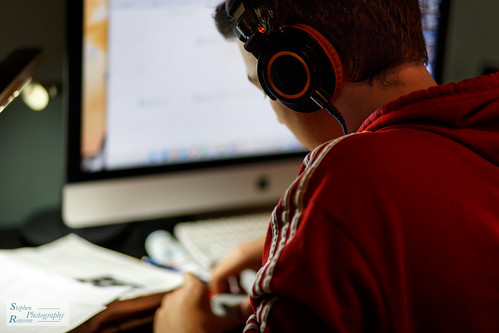
Homework in the Digital Age by ransomtech, on Flickr
"Homework in the Digital Age" (CC BY-NC-SA 2.0) by ransomtech

It's hard to avoid music these days. It's pumped out in every shop, cafe, mall, hotel and gym and often I find it hard to concentrate on what I really want to do; talking with friends or reading if I'm on my own. Many places can't turn off the music because they get sponsored by local radio stations to play that particular station all day long whether the customers like it or not. We seem to have an acute fear of silence and so they play often extremely irritating music while you're having your hotel breakfast or trying to have a pleasant evening meal. TV and radio seem to think that certain types of programmes have to have music while someone's talking, such as every nature programme about sharks always has heavy metal music in the background or reports from many sports events have "cool" music so you can hardly hear the voiceover (maybe this is an age issue). Don't get me wrong, I love music and listen to it many hours a day but the important point is that I want to listen on my terms and not have it forced on me. Even if they play music I like I get irritated because I don't want to hear it right now.

So what about music while you're working? Does it really help us concentrate as many suggest? This is discussed in a Guardian article, Does music really help you concentrate?, and it seems to be a highly personal issue. If the task we're trying to focus on is not particularly interesting then any other stimuli will divert our attention: people passing by, any noise, conversations and especially the siren's of social media inviting us to check out what's happening. So we have some music in the background to somehow block out other distractors.

The trouble is, while our conscious attention is focused on the task in hand, the unconscious attention system doesn’t shut down; it’s still very much online, scanning for anything important in your peripheral senses. And if what we’re doing is unpleasant or dull – so you’re already having to force your attention to stay fixed on it – the unconscious attention system is even more potent. This means that a distraction doesn’t need to be as stimulating to divert your attention on to something else.

If it's someone else's music then I can't work at all and generally will move somewhere where I can be in peace. The crucial factor with background music is that it has to be self-inflicted. Whatever music the owner/employer selects will irritate someone so maybe the solution in the future is BYOM (Bring Your Own Music); listen to whatever you want as long as you do it with a headset and don't disturb anyone else. This is bad news for commercial radio stations but the fact is that most of us simply don't want to hear them.

I generally have calm classical music in the background when I'm working, preferably baroque, but I'm not sure if it helps me concentrate at all. I just put it on to create a cosy atmosphere. I've also tried discreet background music like Brian Eno or Philip Glass that just meanders quietly without ever really grabbing my attention and therefore perfect for purpose. Anything with a catchy rhythm or songs with lyrics I understand are impossible. However I suspect that silence is still the best precondition for really concentraing on a task and that our desire for music is simply a false consolation. How can we help youngsters who have grown up with a headset permanently hanging round their neck that silence is important? Many are so convinced that they need music that they've never even contemplated the alternative.

What about you?

Thursday, April 11, 2013

The music of teaching


Teachers and students have a vast range of resources to use: books, audio recordings, films, tests, simulations, games, photos, diagrams etc. The teacher's role is putting selected resources into context and finding methods to help students to reflect on and develop that input. However, although we have documented and stored so much content we have not succeeded in documenting or recording actual teaching methods in a standard format.

Teaching resembles in some ways the performance of music. You have lots of instruments that can be used and integrated in complex or simple structures and there are a wide range of styles to choose between. Courses can be orchestrated and can involve soloists as well as different groups of musicians or combinations of instruments. The difference is that music has a standard form of notation (at least western music) and is therefore accessible through the centuries. Teaching on the other hand has no form of notation, no way of expressing how a lesson or course is orchestrated, so that other teachers can draw on previous practice. Teachers often have to work in their own silo reinventing the wheel rather than being able to draw on other's experience.

We've created open educational resources (OER) but the big question is how to fit them all together. Maybe we need to develop a language for open lesson plans with a standard notation form that all teachers understand and can interpret. A choreography for teaching, Not to slavishly follow but for each teacher and class to interpret and adapt.Teaching is becoming increasingly complex today and it feels like time to develop methods to transfer teaching practice.

This is where Learning Design comes in. I've just read an interesting paper called the Larnaca declaration on learning design that describes various attempts at devising a notation for teaching (download the paper from the website). One such attempt is called LAMS Learning Design system (see example below). The lesson plan is represented by a diagram with a number of linked icons. Each icon tells what type of activity is proposed and each icon is linked to further embedded information on the details of the activity and even xml-code for educational technologists to be able to implement this activity in say a learning management system. The example below shows the organization of a roleplay and has a linear format but other learning designs could have more complex structures.

CC BY-NC-SA James Dalziel at http://www.lamscommunity.org/lamscentral/sequence?seq_id=690433


The article contains several other attempts to find a graphical means of describing the structure of a lesson and the potential for this is enormous. Not simply to describe how a one teacher has devised an effective method for helping students to grasp a particular concept but that now other teachers can easily interpret this plan and use it themselves. Just as a piece of music can be played in a variety of styles and interpretations so can a learning design be interpreted in various ways, depending on the teacher and the class context. Some forms of music, like jazz, depend greatly on improvisation whereas classical music stays more true to the written score. The same may be true for teaching using learning design. The key is recording and transferring good practice. If we can also find ways of linking to relevant open resources we can create complete lesson plans.

Time for open learning design to build on open educational resources.

Saturday, April 6, 2013

Can you own a digital purchase?

IMG_4227 by Jemimus, on Flickr
Creative Commons Attribution 2.0 Generic License  by Jemimus

If I buy a book, a music CD or a DVD movie I own it and when I get tired of it I am free to sell it to someone else. This principle of ownership seems simple enough but in the digital world it suddenly ceases to apply. An article by Dan Gillmor in the Guardian, In our digital world you don't own stuff, you just license it, describes a recent American court ruling against a start-up, ReDigi, who proposed to start a market for people to resell digital music.

"Had the users of the startup, ReDigi, been selling used CDs via any number of online stores, there would have been no issue. But the music in this case was stored in computer files, so the doctrine of "first sale" – your right to resell what you've bought – didn't apply.

ReDigi tried hard to live up to the spirit of copyright law. It created a system where the uploader of a "purchased" iTunes song would lose access to the music after the file was transferred to the new "buyer's" computer. Yeah, right, said the record company and the judge – there's no way to ensure that the "seller" wasn't keeping the song anyway."


The same problem applies to e-books, e-magazines and all types of digital content. Because it's so easy to make perfect digital copies the companies argue that you can't really own digital content, simply the right to access it yourself and that right is not transferable. Many libraries have encountered difficulties in lending e-books and often have to pay considerable sums to be able to lend such content.

June Breivik points out another absurdity with digital content in a post about how e-books are often much more expensive than the printed equivalent (blog post in Norwegian).


Is the high price some kind of compensation for the fact that once bought the content may be copied? The ruling against ReDigi would suggest that we need to rethink our principle of ownership when it comes to digital products and that you merely pay for the right to borrow rather than own. Many digital content services are subscription based and if you stop paying the subscription your content is no longer available.

But if I pay money for something that I don't really own and do not have the right to resell, the price for this service should logically be much lower than the purchase of the physical equivalent which include reselling rights? It seems that the content companies are still uncomfortable with digital formats and are applying an analogue business model that doesn't quite fit. I don't have the answer but new models are needed to avoid absurd examples like the above.

Thursday, March 28, 2013

Boredom is good for you

My dog being bored by joshme17, on Flickr
Creative Commons Attribution 2.0 Generic License  by joshme17

Is boredom is becoming an endangered state of mind? We have almost abolished boredom from our lives today because the second we feel the slightest hint of it we check our mobile for a game, an app, some music, a film or at least check Facebook or Twitter for updates. We used to get very bored waiting for buses or trains but not any more. Everyone is absorbed in their own private soundtrack. We all demand entertainment and contact 24-7-365.

Boredom and its colleague silence are not a popular couple these days and we try to eliminate them wherever they might appear. When was the last time you sat in a cafe, pub or restaurant that didn't have background music (often foreground music)? Runners and walkers are cocooned in their playlists. Do we ever allow ourselves to be alone, in silence and without any particular plan of what to do next?

An article from BBC News, Children should be allowed to get bored, describes research carried out by Dr Teresa Belton (University of East Anglia) on children and boredom. She has interviewed people about how boredom affected their creativity as children. She found many who were inspired to creative activities through boredom and silence:

"Enforced solitude alone with a blank page is a wonderful spur."
"As I get older, I appreciate reflection and boredom. Boredom is a very creative state."
"She happily entertained herself with making up stories, drawing pictures of her stories and going to the library."


Many people today are willing to pay for retreat weekends free from noise and distractions, hoping for inspiration and balance. Silence and a lack of stimulation are becoming exclusive commodities. Maybe it's time to reassess boredom and see its positive side.

Tuesday, November 13, 2012

Education - the disruption has only just started

massive change by 416style, on Flickr
Creative Commons Attribution 2.0 Generic License  by  416style

A new post by media guru Clay Shirky entitled Napster, Udacity, and the Academy traces disruption in the music industry and then draws parallels with education. When digital disruption first hit the music industry in the shape of Napster the industry reacted strongly by shutting it down. However despite winning that one battle the disruption had already occurred and before long mp3s were everywhere, sold legally at low prices via iTunes, LastFM and now Spotify. The industry changed radically and is still trying to work out what happened.

The same disruption has been happening in education for several years but this year the explosion of free university courses under the working name MOOCs has pointed the way forward and has provoked reactions of denial and dismissal similar to those of the music industry several years ago. The fact that the education sector is full of extremely clever people has not made much difference, as Shirky notes:

"We have several advantages over the recording industry, of course. We are decentralized and mostly non-profit. We employ lots of smart people. We have previous examples to learn from, and our core competence is learning from the past. And armed with these advantages, we’re probably going to screw this up as badly as the music people did."

Many academics make defensive statements that things like MOOCs can never replace the quality of traditional face-to-face education but they miss the real point. Of course they're not going to replace the elite universities simply because attending them is a passport to success and provides a network for life. However, the teaching that goes on there is not always top class. Universities' reputations are based on the quality of their research - very few invest as heavily in fostering top class teaching. Even at the elite universities most of the actual teaching is conducted by postgraduates and adjuncts who are often provided with very little pedagogical training. Most contact time at universities is taken up by lecturing, something that is supremely suited for the net.

The opening for MOOCs and other disruptive phenomena in education is that they can provide good enough education for free or at low cost to a mass market, the vast majority of whom could never dream of attending a top university. This concept of  "good enough" means that we are perfectly happy to accept lower quality if it does the job to a reasonable standard. Take mp3 music files that are poor quality when compared to a good old vinyl record on a top level stereo system but who cares since it's so much more portable and convenient. Same thing goes for text communication with the seriously retro SMS format. Even if you can today send video messages and use all sorts of other instant messaging services the old SMS is still king simply because it works everywhere and reaches virtually every mobile ever invented.

MOOCs and their offspring will provide mass education whenever you need it and we're seeing a new educational ecology taking shape to challenge, seriously disrupt and in part replace the traditional system. Some will provide the courses, others will provide validation and certification and others will offer meeting places, tuition, study groups and mentoring. The one-stop shop of the traditional university is being dismantled. These new services may well have plenty faults at first but since they are open these faults are dealt with in public and are often remedied immediately, in stark contrast to shortcomings in traditional universities which can take years to be dealt with, if ever.

Shirky argues that MOOCs etc are not replacing the traditional system but are creating a whole new game, as the mp3s did for music. The problem for the education system is realizing what's happened in time to do anything about it.

"In the academy, we lecture other people every day about learning from history. Now its our turn, and the risk is that we’ll be the last to know that the world has changed, because we can’t imagine—really cannot imagine—that story we tell ourselves about ourselves could start to fail. Even when it’s true. Especially when it’s true."


Friday, June 15, 2012

Ownership is access

AttributionNoncommercialNo Derivative Works Some rights reserved by N.Calzas
Remember record collections? Shelves in your living room or bedroom filled with LPs or CDs that you would proudly show off to friends. A trophy cabinet revealing your music tastes. I've still got a pile of vinyl albums but they've been hidden away in a cupboard and although the stereo system with record deck is still there it's a long time since I used it. Music used to take up a lot of our living space and used up a lot of cash.

Today music has become invisible in our homes. Our entire music collection is on our mobiles or stored in the cloud and household stereo systems have shrunk to a couple of mini-speakers for an iPod. We don't even need to spend money on music any more since streaming services like Spotify and Pandora let us listen to almost anything on demand without having to own it.

This is the subject of an article on CNN, Young listeners opting to stream, not own music. Owning music is becoming irrelevant since it can all be accessed online. Instead of owning music we are willing to pay for access. File sharing also becomes irrelevant if everything is available on demand anyway. The music collection that was such a status symbol a mere 20 years ago has vanished, as have the record stores.

Technically this same development can happen any time in other areas. Streamed e-books for example are already being tried and I can see great potential here for books that you need for a short time but may not want to own such as school textbooks and popular fiction. Films could also go this way and the big question is how much we would be willing to pay for a Spotify-like service for films or books. You pay for access not content. It's all technically possible but especially in the case of the film industry there are some very sensitive toes that risk getting squashed and big earnings to be defended.

Wednesday, January 11, 2012

Play it again Sam

Back in about 1994 I was at a conference where they demonstrated a piano that could be played over the net. The piano was in the room with us and was then "played" by a pianist in another town using the net connection. The idea was to demonstrate the possibilities of remote music teaching and we were all suitably impressed. However I never heard any more of remote piano playing. Music was often cited as one of the subject areas (like science and languages) that just wouldn't work as distance learning but is now flourishing. My university has for several years now offered highly popular online courses in piano and guitar using video lessons and with students sending in own recorded sessions for comment.

piano by tamaki, on Flickr
Creative Commons Attribution-Noncommercial-No Derivative Works 2.0 Generic License  by  tamaki 

Today I read an article in the New York Times, With Enough Bandwidth, Many Join the Band, about the popularity of music lessons via Skype. The photo in the article shows a guy practising the bagpipes in front of a laptop, connected to his teacher (watch a video of a virtual bagpipe lesson).

"Students who used to limit the pool of potential teachers to those within a 20-mile radius from their homes now take lessons from teachers — some with world-class credentials — on other coasts or continents. The list of benefits is long: Players of niche instruments now have more access to teachers. Parents can simply send their child down the hall for lessons rather than driving them. And teachers now have a new way to build their business."

The same applies to all sorts of private tutoring. It seems that Skype and other e-meeting tools are more exploited within informal learning than in the formal system. Whilst many schools and colleges are only just starting with such online tutoring it's flourishing privately. I admit that music lessons on Skype are not as good as face-to-face; the sound quality and synchronisation are never perfect. But compared to no lessons at all they offer enormous opportunities to students and teachers alike.

Monday, November 28, 2011

Music you won't enjoy

Repetition and patterns are the reasons we enjoy music. Here's a fascinating TED talk by Scott Rickard about the challenge of writing a piece of music that has absolutely no repetition or pattern but is not simply random. The technology behind sonar signals for submarines lies behind what is called the world's ugliest music. Pure mathematics actually. Enjoy - or not!

Monday, March 14, 2011

Light my fire

Flames by wwarby, on Flickr
Creative Commons Attribution 2.0 Generic License  by  wwarby 

There are two radio programs that make Sunday mornings so pleasant - one features baroque and earlier music and the other features world music. I'm not an authority on either form but I listen every week, either live or later on the net. The reason I listen so regularly is largely due to the presenters. They both have a burning interest in the music they present and communicate that enthusiasm in an infectious manner. The same program with a lesser presenter would probably not have grabbed my attention.

It's much the same with education. At school I was good at maths and physics but the subject that I went on to study at university was English. That choice was not because I sat and objectively weighed up my future career options and made a rational choice. It was simply because English was fun and my teacher had encouraged my efforts at creative writing. I suspect many career choices have been inspired by one good teacher who has succeeded in lighting a fire.

There's a lot of debate about school today, mostly focusing on standards, quality criteria, learning outcomes and examination. It all seems so scientific and objective but I feel we're missing the most important quality criterion of all - enthusiasm. If a teacher can communicate enthusiasm and curiosity for the subject and inspire the students then that quality is often worth as much if not more than carefully planned lessons and well-formulated learning outcomes. Sheer infectious enthusiasm can compensate for less than perfect planning and slightly chaotic organisation and the positive effect of human energy on students' success rates should not be underestimated.

Saturday, March 12, 2011

Now you see it, now you don't

Visiting friends' homes in the past I used to enjoy seeing their record collections. Most people were only too pleased to show off their collection and my musical education was developed by thumbing through piles of records and asking to hear the ones that caught my attention. Seeing other people's extensive collections inspired my consumer instrincts and my own collection was inspired by several friends. Comparing musical taste was a great way of getting to know someone.

Today the music collection is invisible. No groaning shelves packed full of records, just files on an iPod or a playlist on Spotify. Today's music is totally portable, extremely convenient and completely unobtrusive. However it has lost its ceremonial value. It took an effort to take the record out of its sleeve, put it on the turntable and start the player. As a result you sat and listened to the record and did nothing else, often in company. We really listened. Today I listen to music every day but nearly always while doing something else.


The same process is starting to happen with books. Soon our book collections will disappear online and our homes will not show evidence of our reading habits. Noone will see how much you read or what your interests are. Children growing up in homes with lots of books see that reading is important and will generally follow in their parents' footsteps. If they can't see evidence of their parents' reading will they be equally keen to read? A parent sitting with an iPad could be reading Yeats or playing Farmville; you can't tell from afar.

I love the digital revolution but can't help wondering where it is leading. We must be careful not to throw the baby out with the bathwater.

Sunday, October 31, 2010

Farewell AM radio

The news that Swedish Radio (SR) are closing down their medium and short wave transmitters today gave me a good excuse to be a bit nostalgic (see article in Ny Teknik - in Swedish). We haven't really noticed it but hardly anyone transmits on those wavelengths any more and so a central part of my childhood and teenage media landscape is put to rest. The radio was a magic window allowing me to hear radio from other countries and although I understood nothing it was still exciting to listen a while to German, Dutch or even Russian stations. The short wave was a gold mine full of radio stations from all over Europe. In a way the closest we had to today's web.

ASA radio by Andrei!, on Flickr
Creative Commons Attribution-Share Alike 2.0 Generic License  by  Andrei! 

Growing up in Scotland in the sixties there was plenty exciting new music but the BBC didn't play it more than a few hours a week. As a result we had to listen to Radio Luxemburg and the so-called pirate radio stations broadcasting from ships out in international water in the North Sea (familiar scenario isn't it?). Radio Luxembourg was great but the reception was unreliable. Just when your favourite song came on the interference increased and for a few minutes it was virtually impossible to listen to. The pirate stations were also great but sometimes were closed down for a while if they got raided. The best reception was from the Dutch Radio Nordsee and it was thanks to them that I first heard all sorts of great music. In the end the BBC realised that pop music was here to stay and created Radio 1 in 1967 and as a result the pirates gradually disappeared.

Disruptive technology that brings about a major change in the way mainstream media operate. Sounds familiar doesn't it?

Saturday, May 22, 2010

The soundtrack of our lives

Dog Looking at and Listening to a Phonog by Beverly & Pack, on Flickr
Creative Commons Attribution 2.0 Generic License  by  Beverly & Pack on Flickr

Music is everywhere today. We work, study, exercise, drive and read to a constant musical accompaniment. Indeed music has never been so important in our lives. At the same time it is seldom something we concentrate on. When was the last time you sat and really listened to a piece of music?

Back in the seventies the stereo system was a high status possession. Massive decks with amplifiers, tuners and turntable complete with extremely expensive speakers took pride of place in many living rooms and often there was one armchair which gave you the ultimate listening experience. You sat there and listened to your records with often stunning sound quality. I used to listen like that but very seldom do so today. I listen to more music than ever before but almost always while I'm doing something else.

The New York Times has a good article on just this theme, In Mobile Age, Sound Quality Steps Back, with a very long string of readers' comments after it. Today hi-fi systems are rare and most music is  consumed as compressed, low quality mp3 files using rather simple earbuds. Music would seem to be one of the few areas where technology has lead to quality and performance being sacrificed for convenience, in stark contrast to say television where enormous improvements in quality have taken place in recent years.

According to one expert quoted in the article:
“People used to sit and listen to music,” Mr. Fremer said, but the increased portability has altered the way people experience recorded music. “It was an activity. It is no longer consumed as an event that you pay attention to.” 

Has music become simply a background activity, one of many distractors we have running when we're doing something else? Since we seldom give it our complete attention we are not too worried about the quality as we were in the days of the armchair hi-fi. It's simply "good enough".