Showing posts with label campus IT. Show all posts
Showing posts with label campus IT. Show all posts
Saturday, December 14, 2019
Smart campus, but who owns the smartness?

Learning analytics allows sophisticated analysis of students' activity in the university's various platforms and tools, allowing teachers and administrators to see who is falling behind, what they are having problems with and what types of activities give the best results. At the same time the campus is becoming smarter with the use of IoT (internet of things) technology and facial recognition, allowing automatic attendance registration, smart monitoring of room occupancy, car parks, heating control and even rubbish bins. Add artificial intelligence into this mix and we have the smart campus of tomorrow.
An example of the smart campus movement is Arizona State University, described in an article in EdTech magazine, How Arizona State University Built a Smart Campus. They have developed a campus app that has become almost default for students and staff allowing them to check schedules, grades, exam times, services, cafeteria menus, parking options, room availability and so on. Buildings and other spaces are constantly monitored and data collected about occupation and movement. This enables more efficient use of energy and provides vital data for planning new facilities and changes to existing ones. Major IT companies are pitching sophisticated solutions for campus management as seen in this film.
It's all extremely impressive but I have a couple of reservations.
Firstly, although the smart campus is very convenient and gives students and staff personalised and attractive services at their fingertips, you get the feeling that your every move is registered and stored. If all the data is aggregated all my movements, activities, purchases, studies, test results, hours spent in different spaces and travel will be available for possible analysis. Examples of facial recognition and ubiquitous CCTV monitoring seen in some Chinese schools and colleges in recent months can mean that there is simply nowhere to hide on campus. Your mobile is both the key to all campus facilities and a tracking device. The university therefore has extremely detailed data on everyone on campus and it is virtually impossible to opt out or even switch off. If that data is in the hands of a third party what guarantees are there that they will not sell that data or find ways of profiting from it? There are of course enormous advantages in smart campus solutions but questions about the use of personal data and informed consent must be foremost.
My second reservation is the focus on the physical campus and what sort of smart services all the off-campus online students will be able to access. These students are seldom mentioned in the smart campus narrative and I would like to see new learning spaces that bridge the gap between traditional campus students and online students. There seem to be few limits on the level of investment in the physical campus whilst the online spaces are in comparison extremely low-budget operations.


Saturday, September 21, 2019
Digital by default - who is excluded?
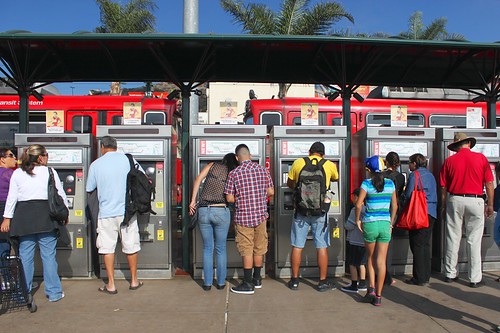
I like to think that I am fairly comfortable with digital tools and platforms, but I feel a backlash growing inside me when the digital option is pushed into my face. Here in Sweden for example, cash has become almost obsolete, there's an app for everything and shops are becoming increasingly self-service. When a shop forces you to use those awful self-service checkouts, or you can only pay for parking by downloading the special app (that I as a visitor to the town will probably never use again), or when you arrive in a new city and are faced with the challenge of negotiating the often complex automatic ticket machines (offering you a myriad of options but never the one you are looking for). The hours I have wasted on such frustrating processes that an old-fashioned human contact would have solved in seconds.
I sometimes feel I'm the only one who feels like this, but received welcome support from a post by James Clay, Digital should be a choice… The new digital solution may be welcomed by many but we also need to consider who we are excluding by installing even more self-service machines or apps. Offer us a choice and we can maybe accept the change in time, but if there is no choice people will suffer.
We often forget that sometimes people don’t like innovation and innovation doesn’t automatically always mean better. Actually most of the time innovation for a lot of people is rarely better. Sometimes its worse than what was before, most of the time it’s just different.
I simply don't want to install new apps every week that clog up my mobile's limited capacity and that I only use a handful of times a year at most. Most buses are now cashless and if you don't use the app or have a prepaid card you are punished by paying a high price for a single ticket from A to B. In many self-service shops there is a forest of machines and one manual checkout with a long queue (curious isn't it?). At one railway station with only self-service ticket machines I saw several members of staff who spent all their time helping bewildered travellers to use the machines!
James Clay applies this to education where an increasing amount of services on campus are being migrated to kiosks or chatbots. What about students or staff who for some reason can't or don't wish to go digital in this way. Is there any real person I can ask? What do I do if I don't have a mobile that supports the latest app? Some tech companies have rationalised all traces of personal contact from their customer service, replacing it with vast FAQ pages and self-help discussion forums. Sometimes I have a problem that isn't covered there or I'm not prepared to spend the next two hours combing through the site to find an answer. I just want a quick answer. Of course I can check in myself at a hotel and do everything by app but I do like to meet a person who smiles and can answer my questions (no, I don't want a humanoid robot at the desk either, no matter how polite they may be).
Whenever we innovate we need to consider whether we are excluding anyone and ensure that we have an option for them.
Sunday, April 28, 2019
Somewhere over the rainbow - the shifting perspectives of the Horizon Report

The full version of this year's Horizon Report is now available, published by Educause who rescued the publication from the threat of extinction last year. Each year a global panel of experts nominate trends in educational technology that will make an impact in the short, medium and long term and also identify key challenges facing higher education in the coming years. The report is often criticised since the same technologies seem to move backwards and forwards on the horizon and sometimes even disappear for a while before returning. This year's report is no exception with mobile learning predicted to go mainstream in the next couple of years, having been a feature of several reports in the past. Many other technology trends such as learning analytics, gaming, virtual reality and blended learning have been on the horizon for quite a while but somehow never really make the transition to mainstream practice.
Probably the most interesting feature of this year's report is a section, Fail or scale? (pages 33-39), that examines three trends that have featured in previous reports but have still not become an integral part of higher education practice: adaptive learning, virtual and augmented reality and gaming/gamification. Three experts present their analysis of why these phenomena haven't made the transition and all three analyses have some common ground. All of them have very sound cases for adoption but they all demand major changes to existing structures and models. Bryan Alexander's analysis of gaming in education makes a comment that could well be applied to many other technology trends featured in the Horizon Report over the years:
A new technology—especially one that requires significant research and training—needs to be able to work across the curriculum and in sufficient numbers to merit institutional investment. Faculty members can carry such a technology forward to some extent, but only if they are knowledgeable and engaged with it and if they can sufficiently support the hardware or software. Otherwise the technology will only appear at best in a small segment of a college or university.
Some technology applications have made the transition and become essential elements of the university's operations, such as the learning management system, lecture capture and anti-plagiarism software. It could be claimed that the reason that these applications have succeeded is that they have not challenged the traditional structures and models of higher education, they have simply added a digital version of what we do already (ie. lecture, work in defined classes and classrooms). The potential of many other technologies that so often feature in Horizon reports can only be realised by making radical changes to the way we teach and learn. As a result, they often get bogged down by all the other changes that have to take place before they can be fully implemented. Many new technologies require significant investment to realise their full potential, as outlined by Nicole Weber in her analysis of adaptive learning technologies:
With so much potential, why has adaptive learning not scaled quickly? One of the largest challenges is the investment (e.g., time, money, resources, and vision) needed to implement and scale these courseware products.
In the case of virtual and augmented reality (mixed reality), Kevin Ashford-Rowe highlights the barriers of the hardware required to implement the solutions successfully. In short, the inconvenience and expense of the VR visors make it impractical as a mainstream technology:
In his February 2018 article “3 Reasons Augmented Reality Hasn’t Achieved Widespread Adoption,” AJ Agrawal, argues that—in this order—it is due to a combination of ergonomics, basic utility, and corrective lenses. In short, no matter the benefits, “no one wants to wear a pair of goggles on their head during daily routine” (ergonomics); “even the most mind-blowing AR glasses won’t matter until they look ‘normal’ enough for everyday wear” (basic utility); and, given that three-quarters of the US population need corrective lenses, “it goes without saying that smart glasses need this option [corrective lenses].” He also points out an important distinction that should be made between VR and AR—AR possesses a natural advantage in that the information being displayed is integrated with what is in front of the user.
My conclusion here is that maybe we should not simply criticise reports like Horizon for changing their predictions and timescales but instead look at why it is so hard to change traditional educational structures. Tradition is the hardest barrier to break and it takes many years for any innovation to break through. The idea that we can see the impact of technological innovation in terms of such a short time scale as the next five years is probably flawed.
Read more on this in an article in Campus Technology, 3 Ed Tech Trends Stuck on the Horizon (and Why).
Saturday, April 13, 2019
The dawn of the platform university - the tail wagging the dog?
 |
| Photo by h heyerlein on Unsplash |
However, the tables are now turning from the platform serving higher education to higher education serving the platform, according to an article by Ben Williamson on the UK higher education blog Wonkhe, The platform university: a new data-driven business model for profiting from HE.
Basically student data is valuable raw material to platform companies enabling them to develop more attractive services and attract advertisers. The article offers several examples of companies who are benefiting from this model, for example the plagiarism detection platform that processes enormous amounts of student data in the form of all the essays and assignments it analyses every day. At the same time it would be extremely costly for institutions to develop and run such platforms themselves on a non-profit basis and so we depend more an more on commercial platforms. The danger, according to Williamson, is that the education sector is in danger of losing control.
Another new concept that has been discussed recently is platform literacy, mostly in terms of our individual awareness of the implications of using different social media platforms and tools. That literacy can now also apply at an institutional level in that we need to build an awareness of the affordances and implications of using external platforms for educational purposes.
Monday, April 8, 2019
Destination Indonesia
 I have just returned from an extremely interesting exchange visit to one of my university's partner institutions, State University of Malang (Universitas Negeri Malang), in eastern Java, Indonesia. My job there was to lecture and run workshops for staff and students on digital skills development and online collaboration as well as discussing aspects of technology in education with management, teachers and administrators. I must complement my hosts for excellent hospitality and a very warm welcome. It's always fascinating to discuss with colleagues in different countries and finding that although we have different cultures, history, languages and educational context we have so much in common. Higher education all over the world is in the midst of a digitalisation process that is forcing us all to revise our concepts of teaching and learning. This process is never simple nor straightforward, with frequent barriers and backlashes to overcome. Once we start talking, we recognise each other's difficulties and hopefully can learn from each other.


Another topic of interest was how to use technology to build bridges between the university's three campuses which, although they are all in the same region, are far enough from each other to limit contacts. Video conferencing is of course an interesting option to build bridges and there was interest in developing this in the near future. Transport between locations (up to 80 km) is not so easy with heavy congestion meaning that journeys of even a few kilometres take up to an hour. As a result the three campuses are largely self-contained.
Finally I must add that these are simply my impressions from a one week visit and not an attempt to provide a any overview of Indonesian higher education.
Sunday, November 4, 2018
Towards smarter classrooms
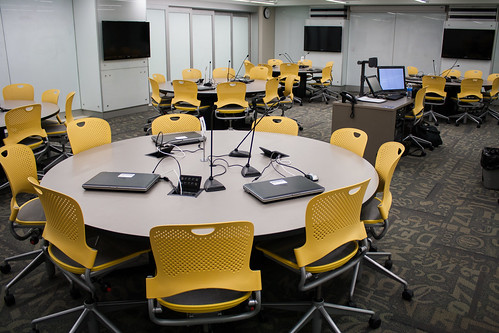
Classroom technology can be extremely frustrating. Every room I use seems to have different equipment and controls. Some rooms have old-school wall switches and several remote controls that activate the projectors and screens. Other rooms have a touch screen that controls everything. I tend to get to the room at least 15 minutes before the start of the session, preferably 30 minutes, in case the infrastructure doesn't like me. Sometimes everything just works and I am pleasantly surprised but other times I simply can't work out how to get the system to recognise my laptop or in some cases I can't get the blinds to work. Sometimes there are a row of switches with no indication of what they do and so when I try to turn on a light the black-out curtain starts descending. If all classrooms had the same interface that would be fine but they seem to be all different. This takes up a lot of time and energy from the teacher.
I was therefore pleased to read about a project at Indiana University to create smart classrooms as described in an article in Campus Tech, Are 'Smart' Classrooms the Future?. The vision is to have truly smart classrooms that log you in as you walk in the door and then automatically setting up the lighting, screens, browser, slideshows etc according to your preferences. Students can also log into the room and get access to the necessary resources for the session. No mysterious switches or confusing touch screens to negotiate. If you are going to get teachers to buy into using technology then that technology must make life easier for them and free them from irritatingly time-consuming activities. According to Stacy Morrone, IU associate vice president for learning technologies:
"We want to free up faculty from many of the routine tasks they need to complete during every class period to give them more time to interact with their students, starting from the moment they walk into the classroom."
IU invited a number of stakeholders to participate in a working group to brainstorm ideas for realising the smart classroom of the future. Their conclusions can be found in a report, the Indiana University Smart Classroom Summit. Among the ideas was to have smartboard functionality on walls and tables so that students could write and draw anywhere and be able to save everything digitally. Most importantly the technology should become invisible and biometrically or voice-activated.
Even more interesting would be to have classrooms that are designed to fully integrate distance students into the class with smart microphones and cameras that track whoever is speaking in the room as well as allowing distance students to contribute seamlessly. The vital element here is that the online participants are always visible and can participate in all activities. This could mean that they can be assigned to work in a group with classroom students or working as an online group but contributing to the common work spaces shared by the whole class. In today's classrooms the online students are usually passive spectators.
I look forward to walking into my first smart classroom where everything just works.
I look forward to walking into my first smart classroom where everything just works.
Sunday, July 8, 2018
Is edtech simply automating tradition?
 |
| CC BY-SA Some rights reserved by ISAPUT on Wikimedia Commons |
A post by Mike Crowley, Google, ISTE, and the Death of EdTech, reflects on the recent ISTE conference and sees worrying tendencies that today's edtech industry is increasingly about control rather than creativity. Technology is being used to make traditional practice more efficient rather than fostering real learning.
All week, the ISTE Expo Hall gushed with predictions that Artificial Intelligence will automate the traditional classroom. Auto-grading is now a thing. Marketeers touted emerging tools to help students study smarter, by enabling them to memorise more information faster. Ultimately, though, the Big News, like Google Classroom, is the proliferation of software that allows teachers to monitor and keep students on-task. The lofty ambitions for education were summed up thus. Make tradition more efficient. Stop bored students from cheating on mindless, low-level assessments. Deliver content like Windows 98 is the next big thing. New tools. Old thinking. Systems, not learners.
The tyranny of tradition is extremely hard to escape from. The traditional educational paradigm of learning facts that can be easily tested and categorised is a perfect fit for the smart systems of today. We can use analytics and AI to provide the statistical illusion that students have achieved the learning objectives we set them. But technology can and should be able to do so much more and that's why Crowley states:
Make no mistake about it. EdTech as we currently know it is dead, it’s over. We should retire the phrase right now. If education is to be the target of an industry that has grown increasingly obsessed with standardization, control, automation, and delivery efficiencies, then we must opt out.
Related to this is the use of automated grading of assignments that has been under development for several years now. This involves computer analysis of a written assignment to check for coherence, argumentation, linguistic style, grammar and fluency. An article on NPR, More States Opting To 'Robo-Grade' Student Essays By Computer, examines recent experience of automated grading at several US universities. Many educators are impressed by the accuracy of these tools, often giving similar grades to human examiners and if the computer is unsure it flags for teacher assessment. The potential savings are obvious and very attractive to cash-strapped institutions.
Several states including Utah and Ohio already use automated grading on their standardized tests. Cyndee Carter, assessment development coordinator for the Utah State Board of Education, says the state began very cautiously, at first making sure every machine-graded essay was also read by a real person. But she says the computer scoring has proven "spot-on" and Utah now lets machines be the sole judge of the vast majority of essays. In about 20 percent of cases, she says, when the computer detects something unusual, or is on the fence between two scores, it flags an essay for human review. But all in all, she says the automated scoring system has been a boon for the state, not only for the cost savings, but also because it enables teachers to get test results back in minutes rather than months.
Impressive indeed, but there will always be ways to hack the system and already there are examples of text generators that produce nonsensical texts that satisfy the grading system's preferences. This type of cat-and-mouse game has nothing to do with learning. When the only purpose of writing an assignment is to get a grade then people will simply do whatever it takes to get that grade as easily as possible. If the assignment has real meaning to more people than simply an examiner (or a robot) then the game element disappears. We need to develop methods of assessing student ability based on the impact of their projects on real people. Maybe traditional for-teacher's-eyes-only assignments are the problem.
One clear use for automated grading systems is to help the students improve their writing skills. The system can provide repeated formative assessment opportunities, helping students to improve the coherence and style of their assignments. They can submit several times during the writing process, something that no teacher could ever have time to deal with, and then submit the final version to the teacher for grading. However a more collaborative approach already used by many teachers is to encourage peer assessment with fellow students providing feedback during the writing process. This method benefits everyone and the students can learn a lot from being actively involved in the assessment process.
The real purpose of technology should be to facilitate human collaboration and learning. I love using digital tools to facilitate creative and collaborative activities and that's where educational technology should be focused. The use of big data in education, however is worrying and we need to be very careful not to be tempted into handing over control of our students to big business.
Saturday, May 26, 2018
Projectors and microphones - devices we just can't get used to

No matter how digital we may be today there are some devices that we don't seem to ever come to terms with.
My first example is the projector. At every conference or meeting I attend someone has problems with these deceptively simple devices and sometimes these problems can escalate into lengthy battles as the audience murmurs sympathetically and knowingly in the background. We've all been there. You have your slides ready, connect the laptop to the projector but nothing happens ... no signal detected. Even hardened tech professionals can be reduced to looking like embarrassed novices when confronted with a cranky projector. Projectors are totally unpredictable creatures who can be affectionate and happy one minute and then suddenly act as if they've never seen you before. They tend to be faithful to only certain devices and bitter enemies to all the rest and they really take objection to newcomers. Most conferences therefore play safe and insist on uploading all presentations to a computer that they know the projector will trust. Anyone who tries to plug in an outsider simply gets what's coming to them. If you're just going to show a slideshow then that's fine but if you're going to log into different web services and tools during your session it's very complex doing so on a strange device that may object to the sites you try to log into and your own device just works seamlessly. Even when you do make contact with the projector it nearly always chooses a bizarre screen resolution that means that my screen appears in magnified format and you need to play around with various controls to get something that the audience can see properly.
If I was asked to be counsel for the defense, I would probably build my case on how difficult it is for a poor simple projector to adapt to the myriad of settings and applications that people have on their devices. Older projectors simply can't keep up with the pace of chance and maybe it's unrealistic to expect them to do so. However, I do wish we could find a way for laptops and projectors to understand each other a little better.
My other example is the microphone. Here there are two issues: the device itself and our attitudes towards them. Wireless microphones have a habit of running out of battery power in the middle of a session or there's some loose connection somewhere that cuts off the sound at regular intervals. If there's no reserve device close at hand this can result in major interruptions and irritation. This problem is of course easy to remedy with good preparation. The other, trickier issue is people's extreme reluctance to use microphones at all. Even if the venue has microphones ready to use there are always speakers who ask the rhetorical question, "I don't need a microphone do I?" and the audience seldom objects. However those whose hearing is not 100% will seldom raise an objection even if they can hardly hear what is being said. If we are serious about inclusion in education the default should be to use a microphone. It doesn't hurt and everyone can hear you.
I admit that headsets can be awkward to put on but do it before you start and you'll be fine. Handheld microphones are trickier and you need to hold them close to your mouth. I've seen so many speakers gesticulating with their microphone hand or holding the mike too far from the mouth and so only the front rows can hear them at all. But with a bit of concentration and a positive attitude it works well and everyone can hear you. Let's see microphones as inclusive technology and use them better.
Sunday, April 9, 2017
Learning spaces - from monofunctional to multifunctional
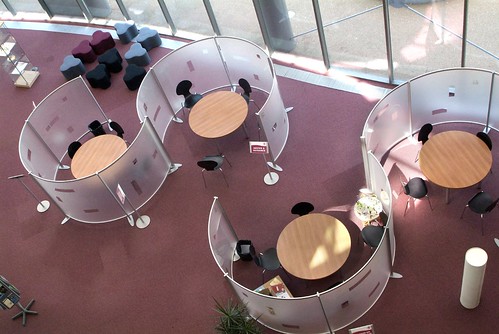
Redesigning learning spaces is one of the hottest fields in education just now and I doubt if there are many institutions that are not planning some kind of makeover to their campus in the near future. The almost ubiquitous use of educational technology together with the transition from teacher-centered content delivery to active collaborative learning require a major rethink of how the institution uses its campus space and also how the digital campus can be realised. A couple of weeks ago I attended and spoke at a conference in London on this theme, Next Generation Learning Spaces. There were many inspiring projects in the programme, though of course only a small selection of what is taking place globally. Although my focus was on how we can redesign the digital spaces to facilitate collaboration and reduce feelings of distance (see my presentation slides), I would like to present some of the most interesting aspects of campus redesign that were presented.
Reviving "dead" spaces
One speaker reminded us that today's designs are creating a legacy for the future and that we have to be careful not to let today's inspired design become tomorrow's headache. One legacy from the sixties and seventies that we are trying to deal with today is the problem of how to revive all the dead spaces around the campus: long corridors, concrete squares, dull entrance halls etc. These are spaces that people simply pass through as quickly as possible but could be exploited with a little imagination.
One impressive initiative was the Creative Campus project at the University of Kent that studied how students used formal and informal spaces on campus. Students were invited to propose solutions to revive these dead spaces in innovative ways. These solutions included transforming enclosed corridors into a cafe study area with colourful furnishings designed for group work and with a solid wall being replaced by glass panels that could be opened in the summer onto a patio area (see example). Drop-down screens make it possible to run semi-formal seminars. The furniture is multi-purpose; you can quickly build a stage with it or the tables can be turned on end to become poster boards for exhibitions of student work. Another solution was to make use of the parkland around the campus to include outdoor classrooms and a theatre and these can now be booked in the university system just like any other teaching space (see example). This was an excellent example of students making their mark on the campus and some of them went on to starting their own companies as a result.
A presentation of how a large, dark and unused basement area at Edinburgh University has recently been transformed into a lively and popular learning space was of particular interest to me. As an Edinburgh student back in the seventies I remember that exact area in its most uninspiring period and can vouch for the fact that you didn't want to hang around there. See what it looks like now.
A presentation of how a large, dark and unused basement area at Edinburgh University has recently been transformed into a lively and popular learning space was of particular interest to me. As an Edinburgh student back in the seventies I remember that exact area in its most uninspiring period and can vouch for the fact that you didn't want to hang around there. See what it looks like now.
From monofunctional to multifunctional
Another clear trend was the move towards multifunctionality, where all spaces can be used for many different activities rather than having dedicated lecture halls, classrooms or computer labs. This requires close collaboration between design teams, staff and students to ensure all needs are covered. At the University of Glasgow students and teachers are involved in the design process, testing new furniture, equipment and spaces at showcase events. They can try out the new designs, work in them, move the furniture around and generally get a feeling of what works and what doesn't work.
The Manchester Engineering Campus Development (MECD) project at Manchester University mixes and integrates teaching and workshop spaces. A larger workshop area includes areas that can quickly be turned into a temporary teaching spaces using screens and flexible furniture. Teaching and practical work are thus integrated and students can move naturally from one to the other without changing rooms. They have also built a blended lecture theatre which adjoins a café and group rooms. For some lectures or events the screens could be rolled back allowing the people in the cafe to eavesdrop on to the event and the lecture hall also had a large window out to the street where passers-by might notice what was going on and be tempted to come inside. This would seem perfect for lunch seminars and allows serendipitous learning. The central entrance hall was also designed for easy conversion into a conference venue or a graduation ceremony where the stairs and balcony areas can be used as seating accommodation.
At the Said Business School, University of Oxford, they are converting a derelict power station into a custom business school (see Osney Power Station Development). Here the idea is to think of campus spaces as film sets that can be transformed by moving in a variety of props and that all spaces can be used in a number of ways. By allowing this multifunctionality we may be ensuring that the legacy of today's developments does not become a headache for tomorrow. A further example of multifunctionality is the University of Sheffield's Diamond building. Here local schools were able to book the university facilities and meet faculty and there seems to be an increase in this sort of outreach with more integration between educational sectors. One speaker summed up the design process as making what you do fit the building and make the building fit what you do.
Breaking the vicious circle
the lack of use of innovative teaching practices reduces the demand for new and flexible rooms, which reinforces the traditional habits of teachers.
Teachers need training and support to see how new types of learning spaces and digital media can offer a wider spectrum of teaching strategies and that the development of new learning spaces must go hand in hand with pedagogical development.
In order to stimulate teaching and management staff, ALINA is developing a model and an accompanying tool. This tool could assist teachers in choosing the right learning space for their didactic method and vice-versa. Therefore the application will be able to provide manuals to a broad range of learning methods who will be linked to specific features available in certain learning spaces. For management staff, the tool can help to develop a consistent policy about learning spaces by collecting data on the needs of teachers and the available learning spaces.
Teachers need training and support to see how new types of learning spaces and digital media can offer a wider spectrum of teaching strategies and that the development of new learning spaces must go hand in hand with pedagogical development.
In order to stimulate teaching and management staff, ALINA is developing a model and an accompanying tool. This tool could assist teachers in choosing the right learning space for their didactic method and vice-versa. Therefore the application will be able to provide manuals to a broad range of learning methods who will be linked to specific features available in certain learning spaces. For management staff, the tool can help to develop a consistent policy about learning spaces by collecting data on the needs of teachers and the available learning spaces.
Finally I can warmly recommend the newly published UK HE Learning Space Toolkit that has been produced by UCISA (Universities and Colleges Information Systems Association) and several other UK associations. Here you can find plenty of inspiration and practical advice for all types of redesign projects.
The overall message is clear; a shift from specialised spaces to generic, multifunctional and informal spaces. However changing the physical learning environment on campus is only one aspect of the problem, though it is the most noticeable one. A rapidly growing number of students are learning in off-campus spaces and how good is the digital campus that we offer them?. We need to link together many different learning spaces, organisations and communities, including workplaces and schools. That aspect gets very little investment compared to the physical spaces and it's time to include the digital campus in the overall discussion.
Saturday, October 1, 2016
Towards seamless learning - redesigning learning spaces
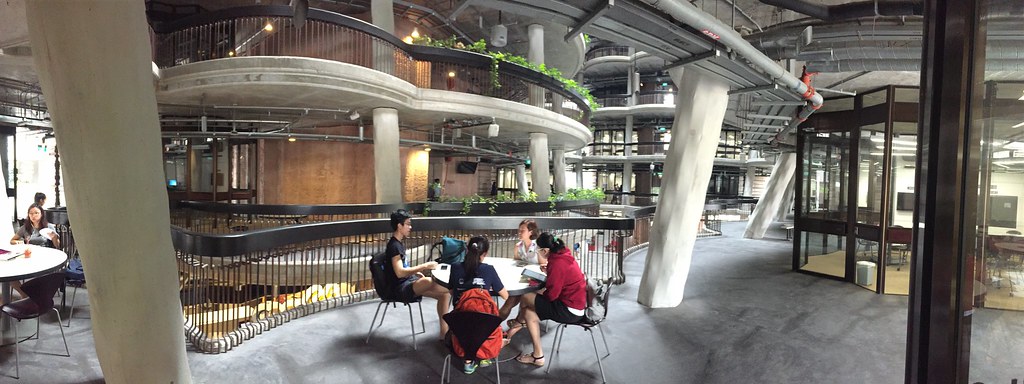
As we move further towards collaborative learning and the integration of technology in education there is an increasing focus on how we design learning spaces, both physical and digital. Schools and colleges all over the world are building new facilities as well as redesigning existing spaces to facilitate and stimulate effective learning and collaboration. This was the focus of a conference I attended in Prague recently, Innovative learning spaces. The participants came from a wide range of fields, from architects to facilities management, from university leaders to teachers and e-learning specialists and that mix produced many good discussions.
As we move from seeing education as the transfer of information to active investigation, collaboration and meaning making we need to design learning spaces that facilitate this. Both physical and digital spaces are all too often designed for teacher-centred information transfer with limited or less than inspiring opportunities for discussion. The traditional lecture hall, classroom and to a certain extent traditional learning management systems are examples of this but many institutions are now redesigning these. Classrooms are becoming active learning classrooms, a model developed by the University of Minnesota, where students work in problem-solving groups with the teacher as facilitator. Lecture halls can be converted to a cabaret layout where students sit around tables to enable group work whilst the teacher contributes with short input from the front but is in general more of a facilitator/moderator.
One interesting approach suggested is to design learning spaces to mirror spaces we generally enjoy being in: parks, cafés, lounges, kitchens etc. If you create a familiar and comforable setting people will naturally gather there. For individual work there are many examples of cosy self-study areas with comfortable armchairs, screens for privacy and a quiet reflective ambience. Even indoor areas can be designed to feel like a park with plants and ponds and combining areas for group work with more secluded corners for quiet study. Even corridors can be transformed by providing furniture and fittings that can easily be arranged into areas for group work. We can't predict how people will use these spaces but if they are designed with flexibility in mind they can be adapted to suit the needs that emerge. At the same time the devil is often in the detail, those elements that are often overlooked such as availability of electricity sockets or placement of lights, see especially David Hopkins' post Learning spaces – are we doing enough?
Much of the conference's focus was naturally on transforming physical learning spaces but what about the digital arena? Up until recently digital spaces simply reproduced traditional teaching, closed-group teaching in the LMS, lecture capture systems and storage for countless PowerPoints and pdf files. Many of today's digital tools are simply too complex, trying to cram in too many features and options. All too often design and usability have been sacrificed and the result is the digital equivalent of the Swiss army knife; lots of functions but not very good at any of them.
Universities today often have several campus sites, often geographically far apart and so the one space that all staff and students have in common in the digital space. Isn't it time to devote more time and resources to redesigning our digital spaces? New buildings are extremely costly and are seldom even questioned whereas any significant investment in the digital spaces comes under intense scrutiny. One important concept developed during the conference by several speakers was that we should strive to fully integrate the physical and digital spaces and foster seamless learning. Students need to learn how to move easily between their physical and digital spaces and see them as all part of the learning process.
The overall impression I got from the conference is that there are plenty of exciting innovative developments taking place in the physical space. We saw lots of inspiring photos of new buildings and concepts that are transforming the concept of the university campus. In the digital space there are certainly inspiring examples of virtual and augmented reality applications as well as the increasing interest in gamification and simulation. However I feel that in order to fully realise the concept of seamless learning more work is needed in the digital space. How can we create the digital equivalents of the parks, cafés and lounges that are now becoming so central on campus? How do we design a digital campus that students feel comfortable with and integrates seamlessly with the physical spaces?
Presentations from the conference will be published in the near future I believe but in the meantime you are welcome to look through the slideshow of my own contribution.
Monday, June 6, 2016
When does a MOOC become a regular online course?

What's the difference between a MOOC and a regular online course? The answer seemed obvious a couple of years ago and most institutions made it very clear that the two should not mix. MOOCs had no entry requirements or tuition fees and only gave certificates of completion, often without even the logo of the university on the certificate, to ensure that they should not be seen by employers as university qualifications. Today, however, as more and more universities are offering MOOCs for credit by offering proctored examinations either on a campus or online, the two forms are beginning to merge. In addition the main consortia are packaging courses into specialisations or nanodegrees with graded final project assignments that lead to new forms of credentials that are not credit equivalent but may form a new layer of credentials below degree level.
University of Leeds and the Open University recently announced that they will be offering MOOCs for credit through the FutureLearn consortium according to an article in the Guardian, Moocs to earn degree credits for first time in UK at two universities. This will costs you a bit but less than taking the course on campus.
To complete programmes that attract an academic credit or offer a qualification, students may have to pay and pass an assessment module. Universities will award credit against the grade achieved which will then count towards a degree ... In the Leeds offering, for example, each course certificate will cost £59 and there are five taught courses; the sixth assessment course, which leads to 10 credits, is priced at £250 – making a total cost of £545 – which will also cover access to online library content.
Arizona State University have a scheme called Global Freshman Academy on the EdX platform giving students the chance to replace their first year of study with a selection of MOOCs and those who pass can then apply to start their campus programme from the start of year two. Here we see MOOCs doing the job of regular online courses so where's the difference? The outcomes and content are converging but the openness of application process is what differentiates the two forms. ASU are opening up entry to study by allowing anyone to start their MOOCs and then seeing who succeeds before accepting them on to year two. Similar thinking lies behind the two UK examples.
Basically regular for-credit courses are starting to absorb some of the MOOC concept. The effect could be that students will be able to test higher education by taking a selection of first year courses and deciding during the course whether they want to take the examination for credit. The selection process is thus moved to the the end of each course. Many will still choose to complete the course without credit as pure competence development whilst others will opt for credit and continue towards full-time study. The entry to university studies can either be a full commitment from the start with full-time campus studies from year one but also an alternative path that is more open and flrxible and most importantly less expensive. Four year campus studies is simply too expensive in many countries and inconvenient for many older students who do not wish to move from their home areas due to work and family. For them any way of cutting the time on campus and increasing flexibility is very welcome.
I expect to see more for-credit courses taking a MOOC approach to recruitment by opening up admission and then allowing the most motivated the option of paying to take the examination. This doesn't mean that regular online courses will simply become like MOOCs but they will adopt some of features just as MOOCs (or whatever they will be called in the future) will adopt many featurs of regular courses. The interest in MOOCs as pure lifelong learning will continue but only if the institutions providing them can find a sustainable financing model and an alignment with the mainstream would seem the safest route.
Thursday, May 5, 2016
More than three and a tree - What is a university?
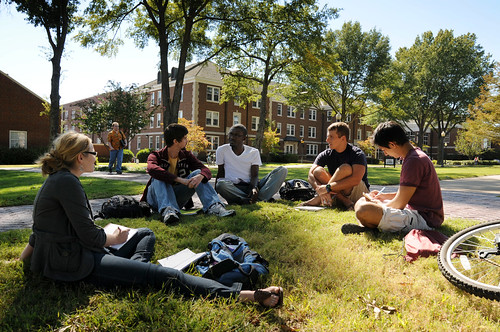
The photo above represents the public image of most universities; 18-22 year old students on campus. Practically every university website features photos like this and most see campus as their core business. The trouble is that when every institution uses very similar images matched with very similar slogans and mission statements it becomes very difficult to tell the difference. Is this image really a fair representation of what a university is today and what it could become? An article in Inside Higher Ed called Your Future Starts Here. Or Here. Or Here, pokes gentle fun at stereotyped marketing, referring to a book called Three and a tree published a few years ago.
A college suffers from Three and a Tree (or TAAT) when its brochures feature pictures of “three students of varying ethnicities and gender, dressed head to toe in college-branded merchandise.”
The book is a guide to university marketing and offers an escape from the stereotyped and rather shallow approaches still favoured by many today. Since a traditional campus degree is one of the most expensive investments you make in your life you will be looking for a university that offers something special. The vast majority of institutions have interchangeable visions and strategies and so there are enormous gains to be made from more targeted marketing. One particularly interesting proposal is creating a separate web site for recruitment that focuses on the questions that prospective students have. University web sites try to include every aspect of their activities on their website with the result that prospective students drown in information. So the conclusion is to create a dual site university with one student recruitment site plus the main information site for everyone else.
However the book doesn't really tackle the greatest potential market for higher education; professional development and lifelong learning for those well over 22. I haven't seen many websites that integrate images of older students (professional development, distance learners, lifelong learners etc) into their mainstream marketing. The three and a tree imagery still dominates. At many universities today an increasing number of students are very seldom, if ever, on campus though you would never guess that by browsing through the website, the videos or the brochures. This extremely important target group is at best relegated to a sub-heading somewhere in the menus.
So what actually constitutes a university today? It's so much more than just the impressive administrative building, the lawns or the lecture halls. This is discussed in a blog post by Mark Smithers entitled Because universities are more than just girls under trees. He also wants the focus to move from student recruitment to a much more complex concept.
Now don’t get me wrong, teaching students is a core function of a university but for me personally universities are about much more than that. At their heart they are communities of scholars or learners at different stages in their learning. These communities can be virtual, physical, blended. They can be in any form; what is important is not the space but the ideas.
So what actually constitutes a university today? It's so much more than just the impressive administrative building, the lawns or the lecture halls. This is discussed in a blog post by Mark Smithers entitled Because universities are more than just girls under trees. He also wants the focus to move from student recruitment to a much more complex concept.
Now don’t get me wrong, teaching students is a core function of a university but for me personally universities are about much more than that. At their heart they are communities of scholars or learners at different stages in their learning. These communities can be virtual, physical, blended. They can be in any form; what is important is not the space but the ideas.
University is not a place it's a community of communities linking people across generations and professions. There may or may not be an impressive campus but that is just the tip of the iceberg. What unites all connected with the institution is not so much the physical location but the networks and collaboration that are the real lifeblood. Once you realise that, the clichéd stock photos become redundant and a new image emerges that is much more inclusive and representant of reality. The real impact of a university reaches all through society and the campus becomes simply one aspect (still important) of a complex eco-system. It's time that complexity was communicated more clearly.
Sunday, March 8, 2015
Evolution not revolution

 by j0sh (www.pixael.com)
Many of us who work with the use of technology in education get frustrated at the slow uptake of seemingly excellent tools and methods. We see the potential of open networked learning to empower and engage students as well as increasing collaboration, widening participation and fostering creativity and can't understand why our institutions are so slow to acknowledge and absorb these exciting developments.
A common complaint is that whilst so much of society has been changed radically by digital technology, universities look pretty well the same as they did ten/twenty/a hundred years ago (select time scale according to desired shock effect). I confess to having used this argument myself but it's worth taking a few moments to question our rhetoric now and then. Martin Weller does just this in a new post, The hidden tech shift in higher ed, describing how universities actually have changed over the last ten years. The student demographics have changed with many more older students who are studying online, part-time or not living on campus. Technology has actually become ubiquitous though maybe not as much as we would have hoped. Most courses today use learning management systems like Moodle, Blackboard etc and most students use their own devices to access their courses making the old computer labs almost extinct. Administrative procedures are now almost completely digital in many countries and even if the traditional written examination would seem to be the final bastion against digitalisation there are also many examples of digital examination as well as new methods for peer assessment and problem-based learning.
I still believe that there is a suspicion of technology in higher education and a reluctance to experiment but there are also significant structural barriers that we sometimes forget. Weller points to the barrier our classrooms and lecture halls place in the way of pedagogical innovation. Most universities are stuck with legacy architecture.
I think a real problem for higher ed is the legacy of the physical environment for example. We do lectures because we have lecture theatres. More significantly we can’t conceive of doing anything else because the lecture theatres says “do lectures”. It would be very difficult, for instance, to implement a flipped approach in many university courses because the face to face space is built for lecturing and not doing the other things you might want to utilize that time for.
Rebuilding and redesigning our learning spaces is an expensive business and not something that will happen overnight. However many universities are busy doing just that (my own university included) and there are many inspiring examples of new campuses and redesigned buildings that offer flexible, stimulating and technology-friendly learning environments.
Another structural barrier to digitalisation is the fact that teachers are paid for lecture hours in the classroom and when you're provided with lecture halls to meet the students it's no surprise that the lecture still dominates. Time spent on online support and tutoring is often not paid at the same rate as face-to-face lecturing. The administration has simply not adapted to seeing online teaching as being just as valid as classroom teaching and that helps to maintain the status quo. In addition many teachers feel over-stretched in terms of workload and there is simply no time for experimentation and learning new skills. When resources are limited as they often are in higher education there's little margin for experimentation and great pressure to simply effectivise existing activities.
Actually a lot has changed but maybe not as quickly as many of us would wish and maybe not in the right directions. Maybe we also need to realise that the issue of digitalisation is one of many intertwined issues facing education today and that there are no quick fixes. As I have written before it's about evolution not revolution.
Saturday, April 19, 2014
LMS - from red giant to white dwarf?


Learning Management Systems like Moodle, Blackboard and many others are the backbone of almost all universities' and schools' use of educational technology. However there is increasing interest among teachers and students in using free and open social media for discussion, collaboration and production. The LMS designers have responded by integrating social media into the platform, thus retaining the one-stop shop status of the LMS. This one-stop shop model (or walled garden in the eyes of its critics) has its advantages in that students get access to all the course resources in one place but despite this students still tend to discuss and collaborate elsewhere.
This is the subject of an article in eLearn Magazine, Outside the LMS box: An interview with Ashley Tan. Dr. Ashley Tan is head of the Centre for e-Learning (CeL) at the National Institute of Education (NIE) in Singapore and has been studying students' use and non-use of LMS. He sees a clear move by students away from the LMS towards social media and that this is tied to a need for more genuine interactivity and sharing than is normally seen inside the LMS.
However, both the instructors and the students seem to be unhappy with the LMS because it is a closed system and less user-friendly than other tools or platforms. Over the last three years, the use of the LMS for social learning has dropped to 50 percent among our serious users of the platform, and the more innovative instructors have moved to open social platforms like Google Sites and Facebook. The use of our LMS is mostly for relatively low-level tasks: content repository, basic online communication, and assignment submission.
Tan sees the LMS model as focusing too much on content delivery, assignment submission and assessment and offering little to encourage interaction.
When blending learning with an LMS, instructors and eLearning practitioners often focus on content repositories or delivery. The didactic model is dominant. When blending learning with open and social systems, the focus tends to shift to interaction and negotiation. The facilitative model comes to the fore.
So instead of the LMS growing into a red giant offering everything under one roof the tendency is for it to shrink into a white dwarf, used for certain crucial functions and letting the more interactive activities take place outside. Although I agree with Tan's conclusions I don't see the LMS disappearing any time soon. Many students are certainly quite comfortable using a variety of tools and platforms and can certainly handle the diversity of the solution described in the article. However there are also students who appreciate the simplicity of having everything in one place and lack the confidence and digital skills necessary to use a variety of social media. It's a similar situation to the MOOC discussion; the linear and more traditional courses provided by the main MOOC providers appeal to students who need more order and structure whereas the connectivist MOOCs appeal to digitally proficient and self-sufficient learners.
I don't think the red giant model will apply to the LMS. Instead I see them as heading to the white dwarf stage, concentrating on what they do best; offering a secure administrative core for a course where sensitive data such as students identity and examination results are stored. The discussions and interaction can then take place mostly outside the LMS but all examination material must be linked or imported for archiving.
Wednesday, January 8, 2014
Horizon 2014


One of the highlights of the edtech year is the release of the annual NMC Horizon Report with its predictions on the most important trends in educational technology for the coming years. We don't need to wait in suspense for this year's report because NMC (New Media Consortium) have already released a preview report listing the key trends and challenges facing higher education: NMC Horizon Report - 2014 Higher Education Preview. This preview gives a summary of the main findings in the report but does not provide all the excellent examples and case studies that the final report provides.
Here are the trends they see in the usual classification of short-term, medium-term and long-term. I have added some comments of my own on each point.
Fast moving trends (1-2 years)
- Online, hybrid, and collaborative learning
This refers to the integration of online and classroom learning where students are able to combine online collaboration and face-to-face instruction. Often referred to as hybrid or blended learning this is already a reality at many institutions where online is default in all courses. However what is often missing is systematic quality assurance to ensure that technology is implemented in a strategic and consistent manner. This is a trend that I see coming to the fore in the next couple of years, integrating technology use into mainstream quality assurance systems for higher education. - Social media use in learning
This is no real surprise either since educators and students have been using social media for years but the issue here is that social media are now gaining mainstream acceptance and have gained credibility in the academic world. We can expect to see social media used more naturally in education and only by the pioneers.
- The creator society
Teachers and students are increasingly creating their own learning resources in the form of videos, e-books, Wikipedia entries, podcasts etc. Creating such resources is a powerful learning process and moves the focus from content consumption (reading textbooks, listening to lectures) to content creation and co-creation. - Data-driven learning and assessment
Learning analytics has been on the Horizon list for a few years now though has now changed name. Data is the new oil and we are now learning how to refine the raw data and develop tools to help us find the right educational resources that will be adapted to our learning preferences. Giants like Google, Facebook and Apple are hot on the trail and many speculate that MOOC consortia like Coursera are hoping to develop powerful tools that can exploit the vast archive of student data they have already acquired.
- Agile approaches to change
The Lean movement is already well established in industry along with the concept of agile development. It's all about leading innovative organisations that are flexible and can react quickly to change. This is not something we generally associate with higher education to say the least. Does this mean universities functioning like Silicon Valley startups? I'm doubtful on this one but look forward to reading the full report's analysis. - Making online learning natural
This is about integrating more natural communication into online learning by using more audio and video rather than the present text-only learning environments. I can already see this trend in progress with teachers giving feedback by audio or video and asynchronous video/audio discussion forums using tools like VoiceThread. Most learning management systems also offer voice or video communication options that are becoming increasingly attractive but it is taking time for educators and students to actually start using them. I don't see this trend on the long-term list, rather medium-term.
The report also highlights a number of significant challenges impeding ed tech adoption in higher education and these make all too familiar reading though all are well worth repeating and emphasizing. Teachers' low level of digital fluency and the lack of rewards for good teaching are placed on the list of factors that demand urgent attention. Linked to this is the problem of scaling up teaching innovations. Many teachers are innovative but how can this energy be transformed into new practice at institutional level?
One common thread I notice is that educational technology is finally moving into the mainstream of education but urgent work is needed to revise quality assurance systems to embrace technology integration and to develop faculty digital skills. The final NMC Horizon report should not just be read by the ed tech specialists but needs to be on the desks of all educational decision makers.
Read also David Hopkins' post on the Horizon preview on the University of Leicester staff blog.
One common thread I notice is that educational technology is finally moving into the mainstream of education but urgent work is needed to revise quality assurance systems to embrace technology integration and to develop faculty digital skills. The final NMC Horizon report should not just be read by the ed tech specialists but needs to be on the desks of all educational decision makers.
Read also David Hopkins' post on the Horizon preview on the University of Leicester staff blog.
Friday, January 11, 2013
Technology must add value

Simply using technology in class does not help students learn. Using technology to simply replace books, blackboards or pencils will not make any difference either no matter how cool the technology may seem. It's not the technology that makes the difference it's the way it is used and that it is used for the right purposes.
This is demonstrated very well in a post by Kathy Cassidy, The Use and Abuse of Technology in the Classroom, which makes a list of when technology makes a difference and when it does not. The article is aimed at primary school teachers but the arguments apply almost as well to university level. The main argument is to use technology to do things that are simply not possible in the traditional classroom. If something can be done just as well without computers there may not be any relevance in using one. It has to make a difference to the experience and not just act as an electronic substitute.
"I have been concerned, though, by some of the ways that I see technology being used. Technology should not just allow us to do things in a more engaging way; it should allow us to do new things that we thought were not possible. It is those new things that are the real value technology provides. It is not enough to USE technology. You must use it well."
Here are Kathy's five justifications for technology. Read the article for her explanation and examples:
- Technology should be for accessing what was inaccessible
- Technology should be for doing good things in better ways
- Technology should be for sharing with the world.
- Technology should be for connecting
- Technology should give choices.
Wednesday, December 5, 2012
Top IT issues


What's the trend of the year in educational technology? Most people would immediately shout out MOOCs (as I predicted way back in January, 2012 - the year of the MOOC) but according to an Educause survey, Top-10 IT issues 2012, the most important concerns are not whether to join the MOOC movement but the fundamental issue of how to integrate IT into all of the university's activities and develop more mature strategies for the use of technology.
The survey asked a panel of higher education IT experts what the biggest single IT-realted issue facing their institution had been in 2012. Here's their top ten:
- Updating IT professionals' skills and roles to accommodate new technologies and changing IT delivery models
- Supporting IT consumerization and bring-your-own device programs
- Developing a cloud strategy
- Improving the institution's operational efficiency through IT
- Integrating IT into institutional decision-making
- Using analytics to support the important institutional outcomes
- Funding IT initiatives
- Transforming the institution's business with IT
- Supporting research with high-performance computing, large data, and analytics
- Establishing and implementing IT governance throughout the institution
The common thread here is the need to integrate technology use into all areas of the university from the management down and to ensure that staff have the right competence to deal with this change. IT is no longer simply a technology issue and is no longer limited to the IT department; it supports all processes and affects every member of staff. Educational technology is moving from a marginal pioneer movement of enthusiasts to mainstream and default. Institutional strategies are now needed where before there were simply uncoordinated grassroots initiatives. The tools and software that were once provided in-house are now freely available in the cloud and at the same time the carefully controlled infrastructure of university owned computer labs is being replaced by students using their own devices and expecting access anywhere any time.
The challenges facing the role of IT in higher education are finding strategies of benefitting from the diversity and freedom of cloud-based solutions and personal devices while maintaining some level of control and security. The survey highlight above all else the rapidly changing role of the university IT department.
"This year's list transcends the IT org chart with two predominant themes: the IT organization's obligation to the institution; and the IT organization's relationship to technology outside the institution. The former views the IT organization as an enabler and partner in helping colleges and universities adapt to and even capitalize on changing realities and needs via automation (Issue #4), analytics (Issue #6), business transformation (Issue #8), and research computing (Issue #9). It also recognizes that the IT organization's relationship with institutional leaders must be effective for it to truly support institutional priorities, by integrating information technology into institutional decision-making (Issue #5), funding information technology strategically (Issue #7), and establishing and implementing IT governance throughout the institution (Issue #10)."
Read more in an article in Campus Technology, Reflecting on the Top IT Issues of 2012
Friday, July 27, 2012
The magic formula
I've just read yet another report that shows no difference in learning outcomes between online courses and traditional classroom courses (see Campus Technology, Interactive Online Learning Produces Learning Outcomes on Par with Traditional Teaching Methods). Nothing wrong with the study of course and I've read many similar ones, mostly with a similar conclusion. Traditionalists like to point to such studies as justification for continuing to ignore technology but these studies are missing the main issue I feel.
It's not a matter of one form of teaching being somehow "better" than another, we should be investigating how learning can be fostered using a good mix of the various tools and learning situations available today. It's a bit like investigating whether students learn more in a modern well-equipped classroom compared to a more traditional classroom. It all depends on what goes on in there, who teaches, what methods are used, students' attitudes to the course being taught, exam contraints, class dynamics and so on. The room in itself does not magically lead to better learning just as the mere use of computers or mobiles or whatever will not magically lead to better learning.
Computers are no magic ingredient; it depends on what the teacher and the students do with them. That's what we need to be examining in research. Simply face-offs between online and classroom prove very little and simplify the issues.

It's not a matter of one form of teaching being somehow "better" than another, we should be investigating how learning can be fostered using a good mix of the various tools and learning situations available today. It's a bit like investigating whether students learn more in a modern well-equipped classroom compared to a more traditional classroom. It all depends on what goes on in there, who teaches, what methods are used, students' attitudes to the course being taught, exam contraints, class dynamics and so on. The room in itself does not magically lead to better learning just as the mere use of computers or mobiles or whatever will not magically lead to better learning.
Computers are no magic ingredient; it depends on what the teacher and the students do with them. That's what we need to be examining in research. Simply face-offs between online and classroom prove very little and simplify the issues.
Thursday, September 1, 2011
Why is lecture capture so popular?
The lecture is one of the holiest rituals in education going back hundreds of years and therefore is seldom questioned. At its best a lecture can be inspiring, provocative and entertaining as many of the popular TED talks clearly demonstrate. However an awful lot of them are rather tedious and do not contribute very much to learning. Yesterday's bored students doodled, read a magazine or daydreamed. Today's bored students chat on the net. Why do we still believe that you can get a hundred individuals in a lecture hall and expect them to all learn in the same way from a monologue? Shouldn't we study whether this form of teaching is effective? Lectures are a part of the academic furniture and no course is complete without at least one a week. Students expect to be lectured to and teachers are expected to lecture. Noone wonders if the emperor has any clothes on or not.
Today's technology gives us limitless opportunities to explore new pedagogies but instead we use technology to continue doing what we've always done. Online lectures are everywhere, freely available from iTunes, Academic Earth, YouTube Edu and almost every university's web site. They're very popular and many of them are indeed excellent. On the other hand many of them should never have been released.
That's the subject of a critical article by Mark Smithers entitled Is lecture capture the worst educational technology?. He's not against lectures when done well but the practice of simply recording every lecture on campus and putting it on the net is largely counter productive. A dull lecture is twice as dull on the net.
"Traditional lectures aren’t designed for online delivery. They’re too long. Their length is designed to fit in with the timetabling constraints of the buildings in which lectures take place not for any pedagogical reason. Why should this physical constraint be allowed to migrate its way into flexible online delivery?"
The answer is to divide the lecture into shorter sessions and record them with a net audience as the target. Smithers states that mass use of lecture capture is simply an easy way out for universities under pressure to show that they are keeping up with digital development. Filming lectures shows you are involved in online learning without having to change your methods and traditions. Universities who really use the potential of the net (like, say Open University or Athabasca University) have had to invest an awful lot of time and resources rethinking how they teach and plan courses. That costs money and forces a lot of radical changes. Not everyone is ready to open Pandora's box.
"The argument is that staff can deliver their material online but still maintain their traditional delivery practice as well. That is to say, all they need to do is click a button and they’re delivering material online. I’m not really quite sure why an ability to avoid providing staff development is seen as a positive attribute for an edtech but it would seem to the case here. Actually, I do know the reason, it’s because staff development involves cultural and organisational change within a higher education institution and that is much harder than installing servers and recording devices."


Today's technology gives us limitless opportunities to explore new pedagogies but instead we use technology to continue doing what we've always done. Online lectures are everywhere, freely available from iTunes, Academic Earth, YouTube Edu and almost every university's web site. They're very popular and many of them are indeed excellent. On the other hand many of them should never have been released.
That's the subject of a critical article by Mark Smithers entitled Is lecture capture the worst educational technology?. He's not against lectures when done well but the practice of simply recording every lecture on campus and putting it on the net is largely counter productive. A dull lecture is twice as dull on the net.
"Traditional lectures aren’t designed for online delivery. They’re too long. Their length is designed to fit in with the timetabling constraints of the buildings in which lectures take place not for any pedagogical reason. Why should this physical constraint be allowed to migrate its way into flexible online delivery?"
The answer is to divide the lecture into shorter sessions and record them with a net audience as the target. Smithers states that mass use of lecture capture is simply an easy way out for universities under pressure to show that they are keeping up with digital development. Filming lectures shows you are involved in online learning without having to change your methods and traditions. Universities who really use the potential of the net (like, say Open University or Athabasca University) have had to invest an awful lot of time and resources rethinking how they teach and plan courses. That costs money and forces a lot of radical changes. Not everyone is ready to open Pandora's box.
"The argument is that staff can deliver their material online but still maintain their traditional delivery practice as well. That is to say, all they need to do is click a button and they’re delivering material online. I’m not really quite sure why an ability to avoid providing staff development is seen as a positive attribute for an edtech but it would seem to the case here. Actually, I do know the reason, it’s because staff development involves cultural and organisational change within a higher education institution and that is much harder than installing servers and recording devices."
Subscribe to:
Posts (Atom)