Showing posts with label social networking. Show all posts

Wednesday, December 27, 2023

Looking back - inspirations and highlights

Photo by Kalle Kortelainen on Unsplash

Oh dear, I realise that I have rather neglected my blog in recent months. After so many years of writing a post every week and sometimes more frequently I feel a bit ashamed at the long breaks this year. Since retirement my engagement in the world of educational technology has faded somewhat and I am finding other interests to fill my life. However, maybe it's good to look back at my journey over the past 15 years, remembering people and events that have inspired me and somehow summing up the experience. Since no one will have read the story through all those hundreds of blog posts through the years, here's a short retrospective.

I stumbled into higher education in 2004 after many years in adult education and corporate training. I got a job as coordinator of distance education and found the whole concept fascinating. I was inspired by the idea of higher education becoming available to all and not just for those who are able to move to campus and study full-time. I was sure that this vision would inspire governments to fund a shift in higher education towards lifelong learning and widened participation, driven by the development of digital technology. My focus was on trying to promote the benefits of distance education and persuading colleagues to offer more distance and online courses. I had a steep learning curve to understand the complexities of higher education. As a student I didn't really pay any attention to how the university was run or who does what so I felt completely lost at some of the meetings and discussions I attended in my first couple of years. Some aspects of academic life are still a mystery to me quite honestly. I made many mistakes but hopefully learned from most of them.

Inspirational visit to Canada

As I became more familiar with the field I began getting involved in networks with colleagues from other universities in Sweden and through this I got the opportunity to go on a study visit to Canada in October 2005. This was a life-changing visit, or at least career-changing. We visited universities in Vancouver and Edmonton to learn more about how they were offering distance and online education. We saw media production departments with over a hundred employees creating online course material at a time when we had no such unit. The most inspirational institution was Athabasca University, based in a tiny town in the wilds of Alberta but offering online education to students all over Canada and beyond. The idea of a distance university was never implemented in Sweden and I saw a model that we could implement if there was the political will. We had a great meeting with representatives from the university including one of my educational heroes, Terry Anderson, whose work got me really thinking about this new world I had stepped into. 

We also heard a lot about a new concept for us in the form of social software (later social media) and wondered how we could use this in education. I came home laden with notes, references and links and spent the following months investigating all sorts of digital communities and tools. We were busy getting acceptance for learning management systems but I was more interested in the future and started wondering what wonderful things we could do with these new social networks like Facebook, MySpace and Twitter as well as collaborative writing tools, blogs and wikis. As is often the case with visits like this I came home full of enthusiasm and was eager to tell eveyone about all the new things I'd seen and heard. But it's hard to transfer that enthusiasm to colleagues who are often already overworked and focused on current deadlines and priorities. 

EDEN

Another landmark event for me was my first EDEN (European Distance and E-learning Network) conference in Dublin in 2011. This was my first real taste of a major international conference in educational technology and it gave me the chance to listen to and meet some of the big names in the field as well as further developing my network. Once again, I came home with masses of references and ideas to follow up. Read my blog post on the conference and some memorable quotes. Since then I have participated in and contributed to many EDEN activities and have benefitted greatly from the expertise and experience of fellow members. The value of organisations like this was to realise that I wasn't the only person who thought that digital technology was a key to the development of education. The sense of community is so valuable when you are still trying to make sense of things and the presence of respected researchers and professors confirms that the field is not just a passing trend. 

Inspirational institutions

Over the years I been able to visit many universities around the world and opened my eyes to other ways of working with online and distance eduation. I realised that even if we have different cultures and contexts we all has so much in common in terms of how to apply educational technology in a pedagogical manner. Some visits were thanks to European or Nordic project funding whilst others were due to invitations to speak at conferences. 

One of the most inspirational was in my homeland, Scotland, namely the University of the Highlands and Islands (UHI). Their decentralised structure with 13 partner colleges and around 70 learning centres spread around the sparsely populated highlands and islands of Scotland inspired several projects in the hope of awakening interest in a similar model for Sweden. I particularly loved the way the boundaries between campus and distance have been blurred or even erased and the focus is on providing access to higher education wherever you live and with options for how you want to study. I have written several posts about UHI in this blog, most recently after a visit in 2019 as well as older visits such as in 2014.

I have always found the concept of open universities particularly interesting as the best way to open up education to all. Distance and online are essential features of these institutions since few of their target group can afford to move to a campus for several years. I have always admired people who study later on in life and manage to transform their lives through education without leaving their home area and thereby contributing to the survival of rural commuities. I have visited several open universities around the world. For example, Allama Iqbal Open University based in Islamabad, Pakistan, offering a mixture of distance and campus education to an annual enrollment of over a million students. Although the courses have a lot of online content and interaction it is simply not feasible to have everything online since so many people have limited or no internet access. I visited their publishing and mailing centre where enormous numbers of course books and compendiums are sent by post all over the country, making them one of the Pakistani post office's biggest customers. They were very much involved in digital content production and their staff were as well informed on developments as my colleagues back in Sweden but they had to offer a combination of digital and analogue in order to reach out to as many students as possible. Read my post on this visit from 2018.

In a similar vein was my visit to another open university working in difficult circumstances, Al Quds Open University, based in Ramallah in Palestine but with campuses aorund the West Bank and in Gaza. I was impressed by their TV studios and the fact they offered courses via broadcast TV to complement their online content. The difficulties of travelling between the different campuses made digital technology an essential part of all operations. I wonder how their institution will recover after the current brutalities in the West Bank not to speak of the appalling destruction going on in Gaza. Read more in my post from 2018.

Inspirational people

It would be impossible to name all the people who have inspired me over the years and helped me to better understand the field of educational technology and how it can be applied. However a few stand out and my shortlist has a distinctive Canadian flavour. As I mentioned above an early influencer was Terry Anderson of Athabasca University and in the spirit of the new networked world I discovered the concept of connectivism and openness thanks to people like George Siemens and Stephen Downes. I loved the idea of learning as part of connected networks and that people could learn together by sharing resources, discussing and collaborating. I saw a future where learning was ubiquitous and encompassed a wide range of formats, from traditional campus programmes to non-formal online study groups where the group members could decide together what and how to study. Another early influence was Morten Flate Paulsen from Norway, former president of EDEN and a leading light in Scandinavian distance and online education. I saw that online universities were not only possible but an essential factor in the development of wider access to higher education. 

However, as the years went by I began to realise that our favourite platforms, tools and communities were not as free and open as we had assumed and that they were driven by the same factors that have always existed - profit and greed. Reading Audrey Watters' now defunct blog, Hack Education, opened my eyes to the dangers of educational technology - profiting from our personal data, facilitating surveillance and locking us into proprietary solutions. Her predictions were often disregarded at the time but have proved to be disturbingly true, leading to my own disenchantment with the whole field.

My own blogging habit was developed with inspiration from long distance academic bloggers like Tony BatesMartin Weller, Maha Bali, and Steve Wheeler. I never reached their heights of course but I am amazed at how my posts have still reached far and wide. My greatest thrills early on were when one of my role models actually retweeted a link to one of my blog posts and I saw the number of site views suddenly leap. A simple retweet or like can mean a lot when you're finding your way - never dismiss such things as trivial!

Open Networked Learning

This open online problem-based learning (PBL) course started back in 2013 and I was involved as a course organiser and facilitator till 2022. It was certainly the most complex course I have ever been involved in and is run in collaboration with 12-15 universities in 5-8 different countries. Learners are divided into PBL groups to work through five scenarios on different aspects of learning in collaborative networks, aided by a facilitator and co-facilitator. We always tried to make the course as open as possible, indeed the whole course has a Creative Commons license, even if we had to move some parts behind log-ins later on to conform with the European GDPR legislation on data privacy. The course is still offered twice a year and you can find out more on the course site (Open Networked Learning).

I learned so much from each iteration of the course, both from my fellow organisers and facilitators but also from the participants. No names here but you all know who you are. Thanks so much for that amazing experience and I hope the course continues to develop in the coming years.

Networks and unexpected activities

Over the years I have built up a very valuable personal learning network based on social media activity (my blogs, Twitter, LinkedIn, Facebook and so on) as well as through the various organisations that I have belonged to and worked with. That network was a constant source of inspiration and practical help. Often I could post a question on social media and within hours I had several useful answers with links. One opening led to another and I found myself involved in several committees in Sweden, the Nordic region and internationally as well as lots of projects. Some of these took me well out of my comfort zone, working with people who were far more qualified and experienced, but as ever I learnt a lot and hopefully also contributed constructively. The most notable of those "uncomfortable" activities was being a member of the committee that wrote the standard ISO21001, Management systems for educational organizations. I had no previous experience of ISO and realised what an enormous organisation it is and the meticulous work involved in writing and developing standards. I was immensely impressed by many colleagues' attention to detail and ability to handle the constant revisions and discussions.

So, those were some highlights of my journey. I was able to follow many new paths thanks to the understanding of my university who often gave me the benefit of the doubt in terms of my external activities and projects. Often, I was able to cover a large share of my expenses through project funding and fees. It wasn't all success stories, there were quite a few flops and bumps and I was certainly a bit too hasty and enthusiastic at times, especially early on. I certainly didn't follow any traditional academic path and to a large extent let my curiosity guide me. Somehow I made it through to retirement but I hope I have managed to encourage and even inspire colleagues to try new technology and rethink their practice.

Tuesday, July 25, 2023

Farewell Twitter - breaking up is hard to do

Photo by Alexander Shatov on Unsplash

It looks like it is time to leave the sinking ship of the app formerly known as Twitter after almost 15 years of tweeting. Elon Musk, looking and behaving more and more like a classic James Bond villain, has succeeded in destroying a major social media channel in one year of chaotic ownership. His strategy seems to be to scare off all serious users and create a new platform, X, for right wing extremism, conspiracy theories and disinformation. In that case he has succeeded. 

However, I'm sad to leave because over the years I have made so many valuable connections on Twitter that have lead to collaboration and new friendships, as well as countless useful links, inspirational chats and moral support. I've met people on Twitter who I have then met at conferences, written articles with and formed projects with. It took me a few years of work to build up a network on Twitter. Many colleagues gave up with it because they had so few connections and didn't work out how to attract more. There was little or no interest in the platform here in Sweden back then so I reached out internationally, following educators I knew and admired and then checking who they followed. That way I built up a network of trusted sources. Then I had to find ways of getting people to follow me otherwise I'd be simply tweeting into a vacuum. I focused on sharing useful content (articles, news, threads) and using hashtags to reach as many as possible. Slowly people started following me and connections began to happen. I followed people and channels who offered useful content for my work and assumed that some of themwould find me a useful contact. I also started using Twitter to generate traffic to my blogs and that certainly helped them thrive. I remember the day one of my educational gurus retweeted one of my blog posts and I saw the sudden peak in page views - I really felt I'd made the big time! That has happened quite often since then but I still get a great feeling when a major name in my field notices what I've done. No names mentioned but I thank you all. 

I have made many exciting contacts and one in particular still makes me smile. I saw a tweet one day from a school teacher in Canada  who had seen a nice Swedish brochure about using Creative Commons licenses in school. She wondered if anyone could translate it to English. I happened to know the person who wrote the original and we very quickly created a new English version and sent it to the Canadian teacher. This then spread and was used in many schools. I then got an invitation from the teacher to meet her class on Skype one afternoon and talk about Creative Commons as well as answering the pupils' questions about life in Sweden. All that because I answered a tweet.

Then there have been all the tweetchats. I have taken part in many of these and organised many too. If you have never tried one before it goes like this. You announce a chat session in advance and a suitable hashtag. At the proposed time you send a tweet with the hashtag welcoming everyone to the tweetchat. Participants "tune in" by searching for the hashtag on Twitter or whatever app you use for it. The participants can then introduce themselves and you can make a few welcoming remarks and repeat the chat rules. The key is that the hashtag must appear on every post. Then you ask a question and wait for responses. As the answers come in you can comment on them and encourage participants to comment on each others' posts. You keep feeding the discussion until the time is up, usually after one hour. It's rather chaotic - some people find it stressful and confusing whilst others thrive. I love hosting but you end up typing almost non-stop for an hour. If you have experienced users the chat just flies along and participants share links, ideas and new perspectives. I will miss this and even if the same thing can be done on other platforms I don't really have the energy to start all over again.

As Twitter implodes into a platform called X it is time for the world's media, institutions, companies and leaders to leave and stop using it as a channel for serious dissemination and discussion. I hope that world politics will no longer be conducted on X. I'm not sure where they should move to though. Do we really trust Meta's new Threads? Is Mastodon able to become a default news source? Or is the new social media landscape too fragmented? Twitter has been an extremely powerful medium for 15 years and it is hard to understand how it could be destroyed so quickly.

Curiously, I have never really seen the dark side of Twitter. Maybe it's due to a combination of being careful who I follow and the algorithms being very effective at feeding me content that I want to see. Anyway, my feed has always been full of education content as well as increasing amounts of climate research and humanitarian posts with almost no trace of the toxic garbage that have made the platform so infamous, especially since Musk turned off all the safety controls. I'm still reluctant to completely switch off because I still get good useful content from both contacts and trusted news media. I've deleted Twitter from my mobile but haven't quite pressed the button to completely exit. Breaking up is hard to do.

PS. I have now deleted my account.

Thursday, July 13, 2023

Wave goodbye to the edtech cruisers and focus on real community building

Photo by Peter Hansen on Unsplash

One year after retirement and it's a strange feeling standing on the quay watching the edtech ship sail away from me and onwards towards the horizon. I've tried to maintain contact with the issues I used to find so important but if you're not onboard and involved it all feels more remote every day until the ship disappears over the horizon. There are new technologies and platforms on board now and my personal learning environment has become almost obsolete.I thrived on the social media boom of blogs, Twitter, Facebook, LinkedIn, Diigo and so on and the opportunities these fascinating channels offered for networking, collaboration, sharing and creativity. It was a great ride for about 12 years but it has all turned sour as the platforms have become polluted with algorithm-driven ads, propaganda and toxicity. Having spent so long urging teachers to use social media to widen their horizons, increase their impact and foster collaboration I realised that I might now be leading them into a trap. So now the edtech cruiser is sailing away loaded with new technologies and platforms that I simply can't relate to anymore. But maybe we have to reset our ambitions about networking and settle for less flashy but more sustainable solutions.

A post by Inger Mewburn in her excellent blog The thesis whispererThe enshittification of academic social media, really rang a lot of bells for me. She has also been a strong advocate of academics using social media to promote their work and build networks. But now she advises caution with using social media on the grounds that no matter how good the content you share may be you will not get exposure thanks to algorithms that prioritise content that will generate income. It's also hard to make contact with others when the algorithms continually push other stuff in front of you.

Maybe Threads is the next big platform and indeed the initial uptake is spectacular, though here in the EU it is blocked since it is full of major privacy issues that violate the GDPR regulations (well played EU!). But even if you can use Threads it's probably not a good idea. It looks good but it feeds off your privacy and is fully integrated with the rest of Meta's platforms.

Inger proposes a revised set of recommendations to academics wanting to use social media in their work. Think very carefully before you use mainstream social media in your teaching. Think especially about the privacy issues to which you may be exposing students and colleagues. Use these channels for social contacts if you want but don't share content there; own your content by having your own space for it. For building a network she suggests the good old-fashioned mailing lists. I certainly found e-mail newsletters a good way to reach out though there are issues with that, especially the problem that many organisations ' firewalls automatically block newsletters as suspected spam. But certainly you can reach out to known subscribers and build your community through that.

Email is still the best distribution medium of them all: cost free and free from algorithms. I just started a mailing list for people interested in my neurodiversity in the PhD research – I already have 160 or so people signed up, which is so incredible (thank you!). I plan to use this list to test out research ideas and get feedback on research in progress. Much more effective than shouting into the wind on Threads or something.

She also mentions a possible revival of blogging, something I would of course welcome. Use your blog as a space to share your ideas and offer advice. The best way to blog is to host the blog yourself and be in complete control. I made the mistake of opting for the convenience of Google's Blogger platform back in the days when I believed they were working for the common good and so all my writing is in their domain. 

Of course Mastodon and its family of open source social media in the Fediverse is the sustainable and uncommercial option to create communities, though it's always a good idea to check each platform first to see if it's right for you (don't assume that all are automatically trustworthy). If I was still active that's where I'd go. The Fediverse will not go mainstream and will remain a refuge for those who see through the glitter and flashy facade of the Big Five, but maybe we have to accept that meaningful collaboration is limited in scale. Leave the big platforms and connect with people rather than bots and trolls. It may not be as flashy and may not have all the bells and whistles but it works.

Wednesday, April 12, 2023

Reading around the world, with a little help from my network


I read a lot; it goes with the job of course but even outside work I just keep reading. At the moment I'm busy with an extremely rewarding project to read at least one novel from every country I have visited, 56 in total. In view of the environmental impact of air travel, I can't hope for any more international travel unless overland, so I will now focus on travel in my own part of the world and appreciating my past travels. One way to do that is by reading.

The idea for my reading project came from Ann Morgan's inspirational book blog, A year of reading around the world, where she documents her quest to read a book from every country in the world in one year, all 195 of them - yes, even the Vatican City! I believe in setting achievable targets and decided to limit my total, but maybe once I've done them all I could just go on and see how far I get. To get the inside story of Ann's reading marathon you can watch the TED talk she gave a few years ago.

She reached out to her readers for tips on which books to choose and I decided to make use of my own network of educators around the world in the same way. I've written many times on the concept of personal learning networks and how my contacts have helped me in so many ways over the years, answering questions, recommending work literature and sharing practice. So this time I contacted them and asked for recommended reading from their countries. So most of my reading list has come from personal recommendations making the books even more special, reflecting both the country and the tastes of my friends.

I have also been a bit liberal with my definition of countries. Three of them are self-governing Nordic territories, Greenland, Faroe Islands and the Ã…land Islands, but they all have distinct histories and culture and deserve special status in my list. I have also included a country that no longer exists, East Germany (DDR), that I visited several times and also had its own literary culture far removed from that of  West Germany. Some countries like the UK, Ireland, Sweden, Finland, Norway, Denmark, France, Russia and Germany were well covered before I even started but I was surprised to discover that I had never actually read anything from countries like Spain, Portugal or Italy (apart from Roman authors from 2,000 years ago). I've now got 16 left before I reach my goal. The trickiest hurdle to clear will be Liechtenstein since as far as I can see has no novelists who have been translated into English. I have a basic knowledge of German but have never studied it and couldn't tackle a novel. Even Ann Morgan had trouble with this one and in the end read a travel book about Tibet by an author from Liechtenstein. I am restricted to reading books in English or the Scandinavian languages though maybe with a bit of patience I could manage one in French.

We tend to be very ethnocentric in our reading. Most people focus on authors from their own country or from the homes of the major publishers: the USA and the UK. Only when the Nobel prize is announced each year do authors from other countries get a chance to be in the spotlight. Just reading one book from a country doesn't give me much insight to its culture but at least I have opened the door. In many cases I have found other books that I will hopefully follow up in the future.

Another aspect of this activity is that I am affirming my love of printed books. I have a lot of packed bookshelves in the house and this project is filling them to the last centimetre. Of course I could save space and time by reading them as e-books or even audio books but then I couldn't really see my collection. My bookshelves are like a trophy cabinet in the same way my record collection used to be. My disenchantment with the digital tsunami has lead me to return to reading printed material, even the daily newspaper in the letterbox.

After the sadness of my previous post I have decided that I want to keep this blog going but widen its horizons outside the confines of educational technology. I don't intend to turn it into a book blog but I think I may include posts that reflect on my reading in the footsteps of my travels.

Thursday, November 3, 2022

The end of social media?

Photo by Dasha Urvachova on Unsplash

Are the social media platforms that have dominated our lives for the past 15 years or so nearing the end of their useful lives? As Meta/Facebook transforms itself into the so-called metaverse and the Bond villain lookalike Elon Musk takes over Twitter, these platforms are likely to be completely transformed and millions of users, like me, will choose to leave. An article by Ben Werdmuller, The end of Twitter, mourns the demise of a networking platform that has been so important to many in education over the years but is now drowning in the vitriolic hatred and disinformation that has polluted today's society and is likely to get even worse as Musk makes massive staff cuts and reinstates banned accounts, thereby removing the present inadequate controls against hate and threats. Indeed, since Musk's takeover the levels of hate content has risen steeply, according to an article in The Guardian. Community and collaboration are being sacrificed for whatever gives the best financial returns and today that means scandals, insults, lies and conflict.

I have benefited greatly from social media over the years, allowing me to build a global network of educators and friends who have inspired and encouraged me and I hope I have returned the favours. I would be so much poorer without access to this network but sadly I see the end of this era rapidly approaching. Facebook and Twitter will not disappear overnight but will either fade into irrelevance or drown in trash and hatred. They will no longer offer the social interaction and and sense of community that they pioneered and that we have all enjoyed. 

I have a Mastodon account, the multi-server platform that offers a safer alternative to Twitter, but have not really discovered how to make it work for me. I haven't found many of my Twitter contacts in there yet and have no appetite for building up a network from scratch - it took several years to build my Twitter network. It's not so easy to start all over again but there are, however, some useful tips by for example Martin Fowler, Exploring Mastodon. The same applies to alternatives to Facebook like MeWe (I'm sure there are many others out there). Ideally I'd like a social platform that is safe and where I can continue to interact with the people and groups I have built up over the last 15 years. If that doesn't work then I will have to rediscover what life was like back in the nineties.

Werdmuller sees a shift to a multitude of new social media channels and a more complex landscape.  

As big tech silos diminish in stature, the all-in-one town squares we’ve enjoyed on the internet are going to start to fade from view. In some ways, it’s akin to the decline of the broadcast television networks: whereas there used to be a handful of channels that entire nations tuned into together, we now enjoy content that’s fragmented over hundreds. The same will be true of our community hangouts and conversations. In the same way that broadcast television didn’t really capture the needs of the breadth of its audience but instead enjoyed its popularity because that’s what was there at the time, we’ll find that fragmented communities better fit the needs of the breadth of diverse society. It’s a natural evolution.
The main benefit of the major platforms was that everyone was there. If we all scatter into a multitude of closed communities we lose that global connectivity that was so empowering and fun. The embryo to this inter-connectivity already exists in the Fediverse concept, gathering a number of open source social media platforms like Mastodon and PeerTube and allowing people to connect across the platforms. I haven't dared to investigate this much but it seems rather complicated and I wonder how many of my contacts are out there.  

I deeply dislike both Twitter and Facebook and how they profit from the spread of lies, hatred and horror but I still appreciate the human contacts I have made through them. But I sense that very soon I will have to move out. I can maybe find another platform that offers some consolation but I fear that many contacts and groups will be lost forever. Very sad.

Saturday, May 7, 2022

Non-commercial social networking - a safe haven in a world of insecurity and surveillance?

With so many of our social media tools controlled by multi-billionaires and thriving on our personal data, it's no surprise to find that more and more people are opting out. In the wake of Elon Musk's takeover of Twitter there has been a significant rise in subscriptions to Mastodon, the non-profit open source alternative. This week, the European Union's European Data Protection Supervisor announced the pilot testing of two new platforms, EU Voice and EU Video, that are open source and meet the data privacy conditions set down by GDPR (General Data Protection Regulation) and the Schrems II ruling (EDPS launches pilot phase of two social media platforms). They are based on existing non-commercial social platforms, PeerTube and Mastodon, and are now being pilot tested by a number of EU agencies. Wojciech Wiewiórowski, EDPS, makes the case for this initiative:

With the pilot launch of EU Voice and EU Video, we aim to offer alternative social media platforms that prioritise individuals and their rights to privacy and data protection. In concrete terms this means, for example, that EU Voice and EU Video do not rely on transfers of personal data to countries outside the European Union and the European Economic Area; there are no advertisements on the platforms; and there is no profiling of individuals that may use the platforms. These measures, amongst others, give individuals the choice on and control over how their personal data is used.

I hope this initiative succeeds. I love social media but find the present set-up increasingly distasteful and long for the opportunity to enjoy the benefits of networking without commercial exploitation. 

In addition there is now a growing number of open source social platforms that are interconnected under the banner of Fediverse. This means that if you belong to one platform you can interact with members of other platforms seamlessly even if you are not a member of the other platforms. Similar to using e-mail or good old telephony; you can contact anyone thanks to common standards. The video below explains the concept quite nicely.


Here's a film about PeerTube, offering a safe alternative to YouTube and Vimeo for posting video material.


Of course these communities are dwarfed by the commercial giants but maybe, just maybe, the tide could be turning as more people realise that you can be social without accepting tracking, profiling and exploitation. The idea of interconnected communities is so obvious that I wonder how we have been duped into accepting the commercial walled gardens as normal. I wish I could say that I have moved my digital activities over to Fediverse, but the fact is that I have so many valuable contacts, groups and communities that are only on Facebook, Twitter etc and don't want to lose them. My contacts on Mastodon number only a handful compared to Twitter. I also wonder if people really want security and protection and that the attraction of the commercial platforms is that absolutely everything and everyone is there, from the sublime to the ridiculous and beyond. Don't underestimate the thrill and fascination generated by all the insane  photos and film clips available on YouTube, Facebook, Instagram and TikTok, even the vitriolic comments that follow. Maybe it's the crazy stuff that keeps us scrolling. Will we be equally fascinated by a nicely organised and clean version, no matter how secure and respectful it may be?

 Of course I welcome an alternative to the insanity and surveillance but although it may only become a niche phenomenon, it's a vital safe haven for those of us who need to find a safer and more respectful part of the internet to live in. I don't see the giants being felled any time soon by the power of open source, but's what's important is showing that there are other ways of organising how we communicate on the internet and that big tech is not the only solution. 

Saturday, April 2, 2022

Some students just want to learn alone - when community becomes an inconvenience

Photo by Suganth on Unsplash

Most people learn well in groups or communities where ideas are discussed and new insights emerge in a collaborative process. We get energy and inspiration from others and develop in a supportive environment where there are common goals and a shared interest. However, there are a lot of people who find such collaboration daunting and prefer to study alone. The same applies to the workplace where the ability to work from home during the pandemic has led to a divide between those who enjoy the social interaction of the office and those who prefer the peace and quiet of the home office. Many studies of student experience during the pandemic show that the hardest part was the lack of social contact and sense of community. This is probably the main reason students chose to study on campus - the friendships, contacts and social events that come from that common experience. Online students, however, have a different perspective on their studies. They already have their social contacts and networks established where they live and see little benefit from all but the most necessary interaction with fellow students. 

This discussion is put into perspective by David White in a fascinating post, Belonging is inconvenient. When discussing student needs universities often assume that all students behave as campus students, what he calls a residential assumption

As we develop, or expand, our fully online provision it’s important not to fall into the trap of designing with ‘residential assumptions’. What I mean by this is that we can assume that online students will want what our residential students demand (or what they missed when things moved online). Part of that is the need for community and belonging.

We need to accept that there are many students who do not need the sense of community and are happy to learn on their own. Those who are combining study and work do so to get qualifications for their professional development and therefore want to learn what they need, get the certificate and move on. For them all the process of forming a community and working in groups is extremely time-consuming and offers little practical reward, in short they see belonging as an inconvenience. White discusses three modes of learning shown in the diagram below: independent learning, communal learning and networked learning. Independent learners are those who prefer to go it alone and see group work as a burden and distraction though there are some who do enjoy the experience given time to adjust. At the other end of this spectrum are the networked learners who already have their own personal learning networks and use them rather than imposed groupings in a given course.


These modes are of course very fluid but show that we are dealing with a diverse group when we offer an online course, especially the hybrid mode so often discussed today. Mixing campus and online students sounds like a good idea but they have very diverse perceptions and preferences about the course and how they learn. White suggests that we need to focus more on inclusion rather and offering a variety of ways to engage with the course.

We need to design on the basis that there are multiple authentic modes of learning for multiple communities of students. Not all of these require belonging and community but where they do we need to acknowledge that it’s hard work, time consuming, and that access-to-a-building or being-in-a-cohort is not a proxy for membership-of-a-community.

Sunday, June 13, 2021

Busyness and the quest for approval

Is the cult of busyness in danger of dying out at last in the wake of the pandemic? Being extremely busy has been a status symbol for many years and social media have been full of busy people proudly telling everyone else how busy they are. It's a lifestyle that is reflected and spurred by popular culture presenting role models who effortlessly combine extremely demanding careers with family, ambitious building and renovation projects, vibrant social life, hobbies and work for charity. Holidays are as filled with activity as working days and just hanging around doing nothing special is not an option. This stress is not always due to pressure from employers, much of it is self-imposed in an attempt to prove your worth and gain approval. Social media have flourished as a channel for this.

The potential demise of this frenzied lifestyle is discussed in an article by Shayla Love in Vice magazineThe cult of busyness. Busyness is full of paradoxes.Those who are most proud of their busyness are those who could easily afford to take it easy but seek status by being constantly booked up and stressed. Those who are poorer don't see their lack of time as a status symbol - for them it's the only way to make ends meet in a gig economy where one job is never enough.

Busyness is a powerful social signal, though a somewhat counterintuitive one. At the turn of the 20th century, economists predicted that the ultimate symbol of wealth and success would be leisure—showing others that you were so successful that you could abstain from work. Instead, the opposite occurred. It’s not free time, but busyness, that gestures to a person’s relevance.

The education sector is particularly afflicted with busyness. In higher education the pressure to design and run courses as well as conducting research, writing articles and applying for funding means that many are putting in far more working hours than they will ever be paid for. Sadly many posts in social media glorify this kind of lifestyle and create a culture of guilt among those who can't match the extreme productivity of those who post that over the weekend they have graded so many exam papers, applied for research funding, written a new book chapter and had a fun day out with the family. Stress creates stress and becomes a hamster wheel that we can't escape from.

The past year has forced many to reconsider their busyness. When you work from home and there are no events or meetings to rush to there is suddenly more time available. You realise how much of your working days were spent in transit to meetings or classes. The article describes the process of deceleration where the number of busy activities is drastically reduced and there is more time to focus on what's left. Many people realise that they don't want to go back to commuting to the office, drinking coffee on the go or eating lunch in front of a screen. 

I can't see us completely abandoning busyness, but a slower lifestyle has at least gained approval and there are more status updates in social media showing more relaxing activities like walks in the country, gardening or other hobbies. Even when we return to our offices I suspect there will be new routines and many of us will not want to go there every day. Pressures will remain but if we can at least think twice before we post updates boasting of how many tasks we have completed today that will be an improvement. Think what effect your update will have on others and tag down a bit. Share your good moments but not your stress.

Will these changes stick? Or will we go right back to worshipping busyness at the cost of everything else? Bellezza isn’t as optimistic about deceleration replacing busyness as the leading social status signal, but she acknowledged that when she started studying busyness, there wasn’t any discussion about deceleration at all. She’s glad it’s entered the conversation, and tries to practice deceleration in her own life.

A final thought. This phenomenon is of course available to people in well-paid stable jobs that allow the freedom to choose how they work. Most people don't have the option. We need to remember that before we generalise about the future of work. But that's another topic.

Sunday, April 26, 2020

Are trolls born or can we all be one?


Social media are the hunting grounds of trolls and few news media comments sections escape their attention, leading in many cases to the withdrawal of such sections. There are of course different degrees of trolldom from the infamous troll factories who make money deliberately sabotaging political discussion to individuals with anger management issues. I often wonder how people can thrive on such negativity and enjoy insulting, threatening and winding up other people, but it seems they do. But is there a little troll inside us all, waiting for the right cues to rise to the surface?

There is of course research on troll behaviour and I can recommend this article from researchers at Stanford and Cornell Universities, Anyone Can Become a Troll: Causes of Trolling Behavior in Online Discussions. They carried out an extensive survey of comments on CNN news stories as well as conducting a simulated online discussion to see what patterns of troll behaviour emerged and whether such behaviour is infectious. It seems that trolls are not just born, we all risk getting sucked into a certain element of trolling if the right conditions are met.
While prior work suggests that trolling behavior is confined to a vocal and antisocial minority, we demonstrate that ordinary people can engage in such behavior as well. We propose two primary trigger mechanisms: the individual’s mood, and the surrounding context of a discussion (e.g., exposure to prior trolling behavior). Through an experiment simulating an online discussion, we find that both negative mood and seeing troll posts by others significantly increases the probability of a user trolling, and together double this probability.
I think many of us will admit to firing off the occasional sarcastic retort on Twitter or Facebook especially when someone has made an unfair or abusive comment. We might even get involved in a mud slinging session that we later regret. However for me a troll is someone who joins a discussion with the deliberate intent to sabotage a discussion or to bully particular members of the group. For me, trolling is bullying, taking pleasure in hurting others. In many online communities there are volunteers who devote their evenings and even nights to patrolling the digital streets and trying to defuse potentially dangerous situations. By immediately intervening in a thread that is going out of control they can defuse the situation but only when they are dealing with people who are simply overreacting or in a foul mood. The genuine trolls are almost impossible to stop since they thrive on confrontation and the only way to deal with them is by ejecting them from the community.

In such well-managed discussion groups with clear guidelines, timely moderation and real name policy, trolling can be kept at a minimum and this leads to a supportive and tolerant community. It requires great sensitivity on the part of the administrators to be able to distinguish between people who are just having a bad day and go too far once in a while and genuinely malevolent trolls. In many groups an administrator will try to reason with the offender, preferably in a private chat, and this often results in that person deleting their offensive comments and agreeing to abide by the group rules in the future. Many have a policy of three strikes and you're out, giving warnings and then if the abuse continues the offender is ejected. In some cases instant ejection is the only way to deal with abuse but for many a certain amount of leeway might help. The article ends by warning against simply banning everyone who steps out of line and recommends greater flexibility.
Trolling stems from both innate and situational factors – where prior work has discussed the former, this work focuses on the latter, and reveals that both mood and discussion context affect trolling behavior. This suggests the importance of different design affordances to manage either type of trolling. Rather than banning all users who troll and violate community norms, also considering measures that mitigate the situational factors that lead to trolling may better reflect the reality of how trolling occurs.
Reference
Cheng, J., Bernstein, M., Danescu-Niculescu-Mizil, C., Leskovec, J. (2017) Anyone Can Become a Troll: Causes of Trolling Behavior in Online Discussions. CSCW '17: Proceedings of the 2017 ACM Conference on Computer Supported Cooperative Work and Social Computing, February 2017. Pages 1217–1230 https://doi.org/10.1145/2998181.2998213

Sunday, May 12, 2019

Communicative noise - a barrier to creativity?


For many people e-mail has become a communication black hole with an inbox that is out of control. As we drown in e-mail we hope to find salvation in exciting new communication platforms like Slack, Teams and Workplace that promise to streamline your messaging and help teams work more efficiently. The problem is that even if we start using new platforms we can't escape the gravitational pull of e-mail which is still the default communication tool in most organisations. As a result we end up having several communication channels open all day and each of them overflowing. Most days I have e-mail, Skype, Zoom, Messenger, Twitter and Whatsapp all open and although I can't say my own feeds are overwhelming, I can imagine that some people have moved from having only one overloaded communication tool to now having several. The trouble is that easy-to-use communication tools lead to us communicating even more and thus adding to the communicative noise.

This is the topic of an article by Rani Molla in Vox, The productivity pit: how Slack is ruining work. The problem with team platforms like Slack is that they are so easy to use that they facilitate endless discussions that eat up valuable working and thinking time. E-mail "discussions" can be very irritating especially if everyone uses the "reply all" button every time they write something. However in platforms like Slack, these chatty discussions go viral and the channel becomes extremely noisy and hard to switch off due to fear of missing out or being seen as anti-social. We often confuse communication with productivity. People or groups who are "noisy", in speech or in writing, are generally considered more active and therefore more productive/effective than those who are quiet. We get worried about students who are silent or groups who don't seem to be discussing as actively as others. If you don't contribute to the discussion you aren't doing your job, though in reality the reverse may be truer.

Remote workers are under particular strain to prove that they are working. For people not in an office, messaging colleagues or posting information becomes a way of demonstrating that they are doing their jobs.

There's also a link to our physical work spaces that are increasingly open and flexible to facilitate teamwork and spontaneous brainstorming. The problem here is that it's very hard to concentrate when there are dynamic discussions going on nearby. You can't help overhearing or wanting to join in the fun. Once again we reward and encourage noise rather than silence. Combine the noise in the physical environment to all the digital noise and we have a major problem.

Keeping up with these conversations can seem like a full-time job. After a while, the software goes from helping you work to making it impossible to get work done ... Also, workplace software doesn’t seem to have supplanted the very thing it was supposed to fix: email. Most people use both.

The success of workplace software is because they offer similar rewards to the social media platforms we use outside the workplace. They are extremely sticky, stimulating our need for recognition and belonging through likes, emojis and small talk. Of course they can also be used very creatively and can indeed enhance collaboration but on the other hand they can easily eat up lots of valuable time. Their stickiness also leads to them invading your private life.

There’s a reason you’re checking your work app at night and it’s not because you love your job. It’s because the communications and digital affirmations from your coworkers feel good.

The outcome of all this for me is that we need to reassess the value of "noisy" communication and stop equating it with productivity, efficiency or creativity. Truly creative ideas often come through silent reflection, free from distraction, but we have somehow forgotten this as we create increasingly noisy environments (the ubiquitous use of non-stop background music in public spaces is a further plague). Noisy communication is good in certain contexts like brainstorming, socialising and meetings but we need to reclaim the right to silence (both verbal and digital) for the really creative work.

Sunday, April 28, 2019

Creating informal online meetings


A few weeks ago I wrote a post about the missing link in online conferences; the opportunity to network and discuss during mingle parties, coffee breaks and sightseeing tours. This week my Austrian colleague, David Röthler, and I arranged an experimental webinar to show a variety of tools and methods for creating such informal meeting spaces. The recorded webinar can be seen above. The idea was to showcase a few of the many platforms and tools for more effective virtual meetings and collaboration and discuss the opportunities they offer for more informal interaction.

We ran most of the session in the web-meeting platform Zoom, including a virtual coffee break where we randomly created groups of 4-5 participants who had all grabbed a cup of tea or coffee before the start of the meeting. This strategy could be used at many online events as an option before, during of after the session to let participants socialise and reflect together. Many new opportunities could arise from such chance meetings.

One of the platforms we highlighted was a virtual office solution called Remo. We were lucky to have the founder of the platform, Ho Yin Cheung, in our group and he invited our participants into Remo to continue discussing in a new environment. As a result our session ended in a slightly messy overlap where some of the group was already discussing in Remo, some were still in Zoom and some were in both spaces. The advantage of Remo (and similar solutions such as Sococo and Walkabout) is that participants can choose to sit in an office, a meeting room, a lobby or even an auditorium depending on what they want to do. When two or more sit in the same room they are able to have a video meeting with screensharing and chat. In this way people can easily change rooms, join different discussions and invite others to join. Or you can simply work alone in a room but indicate that your are available for consultation if needed. Maybe a good way to have a virtual mingle party for an online conference.

Our guided city tour had to be rather brief to fit in with our short time slot but David was able to go out on the roof and show us a fine view of Salzburg castle and the monastery where some scenes of the famous movie, Sound of Music, was filmed. A tour guide can be filmed with a mobile device mounted on a gimbal for stability and show participants around a city, allowing remote participants the chance to ask questions either by audio or in a chat. One of our participants made the exciting suggestion of offering a variety of city tours with conference participants offering to lead a tour around their own city for a small group. The evening programme could then include a number of optional tours around several famous cities. An alternative could be a series of short virtual study visits to different universities (interesting new buildings and facilities), places of natural beauty (virtual bird watching perhaps?) and so on.

The technology is already in place and is developing rapidly and the only thing missing is the willingness of educators to start experimenting with new forms of online meetings. Of course it's not the same as meeting people in a physical space but considering the present climate crisis it may soon be the only option for international collaboration.

Saturday, March 23, 2019

Social media in education - it's complicated

CC0 Public domain on Pexels
The use of commercial social media in education has brought many benefits and taken online collaboration to new levels. I cannot even imagine my work without access to these platforms and tools (including the Blogger platform this blog uses). The tools we use every day are overwhelmingly commercial and our data is being stored and even sold to third parties. However these platforms and tools are today so firmly embedded into all sectors of education and in most cases there are few credible alternatives. The commercial social media are slick, well-designed, user-friendly and in many cases integrate nicely with each other whilst the non-commercial alternatives tend to be more complicated to set up and a bit clunkier in design. We have many reasons to review our use of these platforms and tools but are they simply too addictive and attractive to consider giving up?

This dilemma is very well discussed in a new article by Terry Anderson (one of the people who first inspired me to get interested in social media about 15 years ago) in the latest issue of the Journal of Learning for Development, Challenges and Opportunities for use of Social Media in Higher Education. He lists the benefits of social media in education along with references to research in the field as well as all the reservations and misgivings that have emerged in recent years and states that "The biggest reason that persons stay active users of social media is not because they feel secure and comfortable but, rather, they appreciate the value or service that the media provides." The value and convenience still outweigh the privacy concerns and the question is whether we continue to tolerate this or look for alternative solutions.

We see that the large potential benefit to social media use is coupled with deep threats to our privacy and control over our own activity and thought. Obviously, using these commercial products, with their questionable ethical practices, are not the type of learning product or environment that public higher education institutions have traditionally used. Is the pedagogical and motivational value sufficient to allow institutions to hold their collective noses and use the product anyway?

At the same time, informal learning thrives on social media and offers us instant access to educational material. If you want to fix something then a quick search on YouTube will almost always provide you with a solution. Google's product range enables simple and effective collaboration and networking opportunities. There are countless Facebook groups offering a forum for discussion and advice on practically every topic under the sun. Similarly there are hashtags on Twitter providing professionals with a convenient space for dissemination and discussion. The crossover from informal to the formal education is unavoidable. However it is hard to do research on how social media are used in education since the data is strictly protected by the companies that offer the platforms.

If we should somehow wean ourselves off commercial social media in education couldn't we build our own alternatives that institutions can control? Anderson describes in the article how a social networking platform was developed at Athabasca University and but even if it offered a secure environment for discussion, sharing and creation it simply couldn't match the rapid development and attractiveness of the commercial players. It never managed to build the critical mass so essential for a social network.

Our system, like other social media, only becomes useful when it is used and is only used when it becomes useful.

The conclusion is that if we are going to continue to use social media in education, institutions need to become much more platform literate and be able to make informed choices about which tools to use and which to avoid. The GDPR legislation in Europe for example is an important step in the right direction of protecting personal data.

Education has unparalleled opportunity to monitor and improve its own practices. Teachers have new ways to connect with students and, as importantly, means to monitor and intervene in student learning so as to increase the efficacy of both teaching and learning. Students have new ways to find, retrieve and share their learning products and opportunities. However, the cost of these benefits currently is reduction in privacy and user control. Continuous monitoring, research and surveillance of the is of critical importance to the development of educational quality and opportunity.

Sunday, March 3, 2019

Informal networking - the missing link in online conferences?

Mingling by Alaska Library Association, on Flickr
"Mingling" (CC BY-NC-SA 2.0) by Alaska Library Association
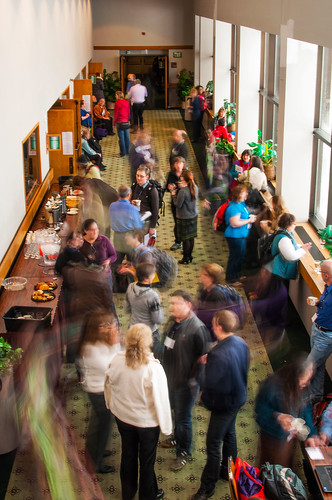
If we are going to see a rise in online conferences in order to reduce the carbon footprint of educational conferences, we need to find ways of replicating the most positive features of the on-site conference. For most people the best part of a conference is the chance to make new contacts in the informal spaces of the conference: during coffee and lunch breaks, between sessions and during the social programme. Online platforms can already deliver the keynote lectures and we are learning how to run interactive workshops and seminars online using collaborative documents, breakout groups and so on. However the chance meetings in the corridor or at an informal reception are where the online meetings fall flat.

However, a colleague recently showed me an online meeting platform called Sococo that offers a way forward for online conferences. Sococo is aimed at the corporate market but the concept can certainly be developed for academic purposes, either by them or a completely different organisation. Have a look at the video below to get an idea of how this works. Basically you can design a virtual office with a lobby, group rooms, large meeting room and so on. The plan shows where each participant is and you can move to different rooms to talk with someone or have a small meeting. Or everyone can gather in the main hall for a large meeting or lecture. Everyone in a room can then have video and audio contact with everyone else as well as being able to screenshare and chat as in all other web meeting platforms. The difference is that you can invite someone to meet you in the lobby or in a smaller room for more informal contact, or even in a hall or lobby. You can even knock on the door to a room and ask to join the discussion in there.

I particularly like the simple interface with the participants represented simply by coloured dots and names. When you are in a room you can see everyone via their web cameras but the office plan shows you where everyone else is at the moment. The step from the most popular web meeting tools to this one is therefore very small and is therefore more appealing than using a virtual world solution where you first need to create an avatar and then work out how to navigate. I don't think Sococo is designed for large conferences but it would be interesting to try it with smaller gatherings. We could also offer virtual city tours using GoPro cameras. The conference dinner will be hard to accomplish but maybe you could create a number of web meeting group rooms, divide up the participants into random groups and ask them all to have their own dinners in front of them.

Creating a sense of space and interaction is a vital factor as we develop more engaging online meeting environments. I don't think we can fully replicate the advantages of face-to-face on-site meetings but if those become less acceptable this is the only way forward.

Sunday, January 20, 2019

Goodbye Google+


Google are pulling the plug on their social network Google+ with as little ceremony as possible. It's not even clear exactly when the lights will be switched off but it will probably be in April. It is no big surprise to many users since the service has been largely left to wither over the last few years with few signs of any loving care from its owners. It now follows a line of Google services that have been quietly laid to rest over the years when they failed to gain the impact that their often over-hyped launches promised. Remember Google Wave for example? It was the platform that would revolutionise online communication and was introduced cleverly by invitation only in 2009. Invitations to try Google Wave became status symbols and expectations were sky-high. However the platform didn't meet these expectations and was quietly phased out a mere two years later.

There's a good eulogy to Google+ by Gideon Rosenblatt, Can You Fall in Love with a Social Network?, where he tracks the rise and fall of the platform and explains why he embraced it so enthusiastically, as did many others including myself. Although it is often presented as Google's challenge to Facebook, Google+ offered a different approach built on forming interest groups based on circles of friends and colleagues. I've been using it for several years as a platform for our online course Open Networked Learning, both as a community for the whole course and for small communities for each of the study groups in the course. It has worked very well and has an attractive layout that is easy to work with. A few years ago Google+ was fully integrated with Google Hangouts, the web-conferencing tool, and this made group work extremely easy, allowing all participants to arrange and run events in the form of a Hangout. Sadly Hangouts was suddenly disconnected from Google+ a few years ago and we have had to find other conferencing tools instead. Hangouts still lives on as a service, but it is very much under the radar and I hardly know anyone who uses it any more. Another case of a good service dying through neglect.

The main lesson here is that platforms and tools come and go. That means you will always need a plan B and somewhere safe to store the data you value.

The main lesson of Google+ is that it’s time to stop trusting our creations and our relationships to companies like Google, Facebook, and Twitter, in the hopes that they will do the right thing with them. They will do the right thing as long as it maps to their primary purpose, which is maximizing returns for their shareholders. When that stops being true, well, then, that assumption of trust disappears. Google+ demonstrates this problem more vividly than any product or service shutdown that I can remember.

I will miss Google+ but not in the form it has taken in recent years, where it became less useful with every so-called update. It lost its spark a few years ago and instead of being a place for innovative new functions and dynamic communities it became a slowly stagnating backwater. Our online course is now using BuddyPress, a WordPress plug-in, to create communities and this looks like a more reliable solution that we have greater control over and can run on our own server.

If you want to see how you can save at least some of your content on Google+, I can recommend a post by Sue Beckingham, Google+ is now closing in April 2019 – How to download what you have curated.

Friday, August 31, 2018

We have always been easily distracted


A recurring story in the media is that our powers of attention and concentration have been seriously eroded by the rise of digital communication and in particular social media. Almost every day I see news items, blog posts, memes, rants and discussions on how we are slaves to our digital devices and can't focus on one task at a time. We fondly believe that in pre-digital days we were so much better at deep reading, reflection, writing and listening and seldom got distracted by trivia. If I try to think back to my younger days, especially as a student, I think I had trouble focusing even then. Even if the level of distractions was lower than today, I'm not sure I was so efficient. I remember that my mind wandered regularly to irrelevant thoughts, I stared out of windows, went to get more coffee - anything to avoid the task in hand. When I had an assignment to write and the deadline was approaching I deliberately went to the most boring and obscure corner of the university library to escape the distractions of other students, good views or proximity to a cafe. I got the work done but despite the spartan surroundings I still found it so hard to focus.

Maybe we've always been easily distracted. An article in The Outline, No, the internet has not destroyed our attention spans, refers to new research indicating that our short attention spans are the same as they've always been. Researchers at Princeton University have been comparing attention spans of humans and macaque monkeys and found that we have a lot in common. Both species have the ability to switch rapidly between a focused activity and checking the surrounding environment for potential danger and that this switch occurs four times a second. This ability has been vital to our survival as a species quite simply.

... well before the invention of mobile phones, humans were a cognitively distracted species that can only focus on one thing in quarter-of-a-second blocks. This inability to focus isn’t a flaw, but an evolutionary adaptation: Being able to flick between highly focused and diffuse attention gives us the ability to concentrate on a complex task while also being aware of our surroundings, making us the dynamic, hyper-alert creatures that we are today.

It seems we have an in-built need to continually monitor the world around us as a basic survival instinct and that makes us even more susceptible to the lures of social media. The research at Princeton is further described in an article in EurekAlert!The spotlight of attention is more like a strobe. We don't simply switch on and off four times a second but we are always ready to switch focus even if we don't notice the process.

Perception doesn't flicker on and off, the researchers emphasized, but four times per second it cycles between periods of maximum focus and periods of a broader situational awareness.

"Every 250 milliseconds, you have an opportunity to switch attention," said Ian Fiebelkorn, an associate research scholar in PNI and the first author on the macaque-focused paper. You won't necessarily shift your focus to a new subject, he said, but your brain has a chance to re-examine your priorities and decide if it wants to.

There is no doubt that the modern world has a vast range of distractions to tempt us with and we need to work hard to resist them and even try to minimise their intrusiveness. However it's somehow comforting to know that our potential for distraction is no greater today than it was 2,000 years ago.

Wednesday, June 6, 2018

Ten years of blogging

I just realised that this blog celebrated its tenth birthday at the start of April and I completely forgot to buy the birthday cake. It all started on Saturday 5 April 2008 with this hesitant post, Why? I was busy investigating all the exciting new social media that were being launched (remember Web 2.0?) and enjoyed reading the blogs of leading researchers and experts in the field. I was unsure about blogging myself on the grounds that no one would be interested in my half-baked ideas but I persuaded myself that maybe the best reason was to use the blog as a place to write my reflections and notes. If anyone else found them useful then that would be nice but the main point was to try blogging for myself and see where it took me. So I started writing short posts about things I thought were interesting and it was fun to have a voice, however faint. I began to realise that the real power of social media lay in making connections across different platforms and to get the most out of this exciting new world I needed to work out my own private communication plan. So I decided that I would use my blog for certain purposes, Twitter for other reasons, Facebook in another way and so on. They all fitted together somehow and still do, at least in my head.

The stats for this blog may not be impressive among major bloggers, but for someone like me with only modest academic credentials I'm amazed at how far I have come. My 792 posts so far (this one makes it 793) have a total of just under 700,000 views according to Google. If someone had said ten years ago that I would have figures like that I would have laughed. In 2009 I added my Swedish blog, Flexspan, with shorter news items about educational technology and it also fitted nicely into my social media ecosystem. That blog has very recently passed one million page views so there's another landmark I am recognising belatedly. So over the past ten years I don't think I have more than a handful of blog-free weeks. Blogging has become a way of life.

At first I was concerned that there were very few comments on my posts even if there were plenty of visitors. I saw how the major bloggers had intensive and absorbing debates on their blogs and thought that was the norm. However, I now realise that most people read and then leave without commenting and I behave similarly. I seldom comment on other blogs even if I read many posts every day. If I find something really interesting I reply in kind by writing about the post on my own blog and referring to the original. What has been rewarding is when the original author of an article I wrote about then comments on my blog. I remember the thrill when one of the major edtech bloggers tweeted about one of my posts and I saw my page view figures spike! That's a great feeling and one that all educators and students should experience. Recognition from a leading figure in the field is an extremely strong motivator.

After a while I began to get e-mails from people who had read my posts and wanted to invite me to speak at a conference or take part in a project and then one activity lead to others. As a result I have had the privilege of travelling to many fascinating places and meeting with so many inspiring people. I have been part of initiatives way above my formal academic level and I am continually amazed that this has been possible. Maybe not only because of the blogging but it has played a large part. The blog has almost replaced my CV since if anyone wants to see what I work with this is where to go.

I will continue to blog as long as there's someone out there who finds it interesting and useful. I thank all of you for your interest.

Tuesday, March 27, 2018

Terms and conditions apply - what went wrong?

Terms and Conditions by Nick Youngson CC BY-SA 3.0 Alpha Stock Images
"If it's free then you are the product". Yes, we've heard that many times over the years but somehow chose not to take it so seriously. We merrily approved all the terms and conditions that popped up when we signed up for all of our social media networks and tools and kept on clicking. We basically gave Google, Facebook, Twitter and the rest of them the freedom to gather enormous amounts of personal data and sell it to anyone willing to pay for it, whatever their motives. Now with Facebook in the eye of a storm of outrage and Google in similar trouble, we can see what the cost of "free" actually is. Basically most commercial online media that are "free" are also in the business of tracking and selling data to advertisers (read more in Doc Searls Weblog, Facebook’s Cambridge Analytica problems are nothing compared to what’s coming for all of online publishing). At the same time we are so hooked on "free" that it's hard to break away. Try to imagine your digital life without all these commercial giants, especially Google. I'm trying to limit the damage at present by switching platforms (e.g. moving from Chrome to Vivaldi and searching with DuckDuckGo), going through all the security settings and so on, but it feels like I'm hopelessly enmeshed.

So what about education in an age where free has been compromised? So many communities of educators and students are built around Facebook, Google, Twitter etc. Do we close them down and move elsewhere and if so where to go? Some institutions offer safe platforms for staff and student blogs and wikis, as Tony Bates describes in his post Our responsibility in protecting institutional, student and personal data in online learning. There are also still plenty of open source wiki sites and other non-profit services but they lack the glitter and stickiness of the commercial solutions. Many users will no doubt set up new alternative networks and platforms but they involve considerable administration and development and will cost time and resources. Some will try to limit the damage and continue to use the old favourites but being more aware of their limitations (e.g. Siva Vaidhyanathan's article in the New York Times, Don’t Delete Facebook. Do Something About It). Whatever happens we need to revise our practices and attitudes.

One interesting aspect of this mess is raised in an excellent post by Autumn CainesPlatform Literacy in a Time of Mass Gaslighting – Or – That Time I Asked Cambridge Analytica for My Data. She proposes platform literacy as a key skill for the future; the awareness of the power that platforms have and the ability to limit the amount of data that platforms can acquire from you. Personalisation it seems has been the pied piper leading the children to their doom.

Personalization in learning and advertising is enabled by platforms. Just as there are deep problems with personalization of advertising, we will find it is multiplied by tens of thousands when we apply it to learning. Utopian views that ignore the problems of platforms and personalization are only going to end up looking like what we are seeing now with Facebook and CA. The thing that I can’t shake is this feeling that the platform itself is the thing that we need more people to understand.

Platforms gather data and data is the new oil. That crude data can now be distilled and some of the applications are proving to be deadly, threatening democracy itself. Maybe we are now beginning to realise what that often misused term "disruption" really means? Even our learning management systems are powerful platforms that gather data on students' interactions, access to material and performance. This can be used to enhance learning as many experts in learning analytics have demonstrated, but what if the data escapes into the wrong hands? We need to become more aware of the power of platforms and what we can and cannot share on them. 

What if we were really transparent with the data that learning systems have about students and focused on making the student aware of the existence of their data and emphasised their ownership over their data? What if we taught data literacy to the student with their own data?