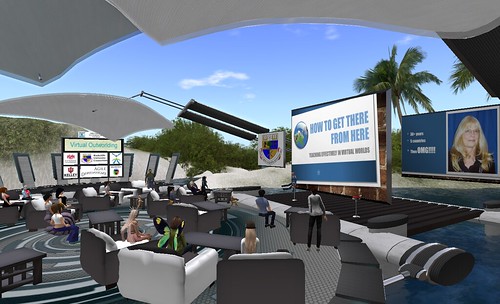
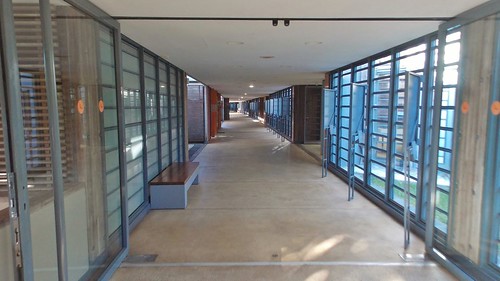
The battle for the metaverse is on with most of the media buzz focused on Meta (a k a Facebook) and their plans to engage us all in their virtual market and meeting place. Already there are companies setting up virtual hubs and universities are also creating their virtual reality campuses which they hope will soon be full of student avatars. Reading about this in an article in Campus Technology, 10 Institutions Opening 'Metaversity' Campuses, took me back about 14 years to the heady days of Second Life and I wonder what we have learnt since then. These virtual campuses are built using EngageVR where you can design your own spaces and make them more or less accessible to visitors and residents. The best way to interact in the metaverse is through VR visors but you can also interact using your computer, though not so immersively. Students and teachers can then meet as avatars in the virtual campus and interact with objects, graphics, diagrams etc with voice communication and the ability to explore different environments together.
The new metaversity at Stanford is described like this:
The metaversity courses will be synchronous, and students can attend whether they are learning on campus or remotely. Each student will receive a Meta Quest 2 virtual reality headset for use during their course (courses can also be accessed via PC). Within the virtual learning environment, they will be able to engage with other students and their instructor in VR experiences such as delving into human anatomy, taking a time machine through history or studying astronomy on a spaceship.
Here's a video showing Stanford's virtual learning space using the EngageVR platform.
The screenshots on Engage's site seem almost indistinguishable from the views of business centres and campuses on Second Life all those years ago. Apart from the VR headsets and better graphics I wonder what's new. Most academic experiments in Second Life simply recreated virtual versions of reality with copies of their campus environment complete with lecture halls where avatars could show PowerPoint slides to an audience of student avatars seated in rows. The new VR spaces seem to be doing the same thing. In a virtual world where the laws of physics don't apply and you are free to create any space you can imagine, why do we keep building classrooms and auditoriums? Why is it so difficult to escape the stereotypes?
I really enjoyed exploring Second Life back then in the tech-optimist days of 2007. It was probably ahead of its time but it demanded high-end graphics for a smooth experience, so many users gave up when they realised that their devices simply couldn't cope. Second Life is still going and has a devoted band of users who have obviously enjoyed the experience. What was really interesting about it was you could develop your own fantastic spaces and choose whether they were open to all or restricted access. You could build realistic copies of well-known places or complete fantasy worlds. You could choose alternative identities and take part in very convincing simulations that would not be possible anywhere else. A whole virtual economy was developed with people willing to pay real money for virtual real estate. There was a vibrant cultural life with concerts, art exhibitions, sculptures and fashion shows. I enjoyed exploring new areas of the vast virtual world that was built up and did actually have useful encounters with people I would never have met otherwise. The openness gave enormous opportunities but sadly also threats as the trolls and spammers found their way into the new world. The new VR spaces are much more restricted and controlled but maybe the freedom and creativity of Second Life was its greatest attraction.
If VR is going to be relevant to education it has to contribute something new and offer possibilities that are hard to offer in any other environment. That means more than just looking at 3D models of cars or DNA strings that the publicity films tend to show. There are great examples of simulation applications in areas such as medicine and the opportunity to offer realistic roleplay situations for professional development. However, the need for visors and expensive software means it will probably be accessible only for wealthy institutions and for specific niches where VR can really prove its value. Focus on the really innovative and pedagogically valid uses of VR and skip the reproductions of campus buildings and auditoriums.
Most of us now spend a large part of our time engaged in video meetings with colleagues, students, family and friends and the web is overflowing with advice about how to make these meetings more effective, interactive and engaging. The weaknesses of online meetings have been exposed and discussed with privacy and security as major themes. Many people feel uncomfortable putting themselves on view to so many relative or complete strangers with the risk that someone finds it amusing to take screenshots that could be used later. In tools like Zoom, the meeting host has little or no control over how the participants view the session and there's a risk that some of them spend the meeting gazing at, say, a female student who they find attractive without her being able to stop such unwanted attention.
Some people decide therefore to keep their cameras switched off during online sessions. This may be to prevent unwanted attention or because they are ashamed of their chaotic home or because they don't feel confident or presentable enough to be visible in the meeting. This can be disconcerting for a teacher as in a recent Norwegian article (see Khrono - in Norwegian) where a university teacher wrote about the loneliness of teaching in Zoom to an invisible and generally silent group of students. They were willing to use the chat but did not want to be seen or heard.
At the same time, Facebook have been promoting a tool to help you create a relatively lifelike caricature avatar for your profile. This attracts many users who prefer not to use a real photo of themselves in social media and I wonder if it's time for the return of avatars in synchronous video meetings. About 12 years ago many of us were experimenting with meetings in the virtual world of Second Life. Back then it was still a bit unstable for those who lacked good graphics cards or bandwidth, but we were able to meet and discuss in interesting virtual environments (under the sea, in space, on a tropical island, you name it). It gave an added sense of place to the online meetings rather than the two-dimensional wall of talking heads we have in today's meetings. Second Life is still there and is used by all sorts of enthusiasts, including many educators, for roleplay, simulations and exhibitions. There are also numerous other virtual world tools offering customised environments for virtual exhibitions or conferences and the chance to wander around as an avatar, mingling and interacting with other visitors (see, for example, IMVU, Virtway)
Despite a barrage of hype, Second Life was probably ahead of its time back around 2008, but I always liked the spatial element. I still remember discussions sitting around a camp fire in a forest or listening to an evening outdoor piano concert in a small town by the sea with about 100 other avatars. According to one article a colleague of mine wrote back then, some students felt more comfortable communicating in the virtual world than in a regular video meeting because it was their avatar who was speaking. There are of course very good reasons for meetings where participants must show their faces, but I wonder if some discussions could benefit from a certain degree of anonymity.
Most learning takes place outside the classroom. Of course, the opportunity to meet, discuss and practice in a structured setting is extremely important but the real battle to understand and implement new knowledge takes place in informal settings: at home, in the library, discussing in a cafe or during a long walk or run in the park. But a relatively unexploited learning space is the area outside the classroom and the corridors linking the formal learning spaces.
These spaces in between are discussed in an article by Luke McCrone in Wonkhe, Learning in the spaces in between. Valuable interaction often takes places before and after a class between students and between students and teachers, but only if the space provides a comfortable environment for this. The furnishings can invite groups to sit and discuss, use their digital devices or even discuss with an absent colleague by video. Previously dead areas such as corridors can become collaborative spaces if there are comfortable seats, power sockets, tables etc.
Frankly, the availability of this sort of transitional space should be prioritised. It is a relatively low-cost intervention that could be the difference between student interaction and disconnectedness. Kitted out with comfortable furniture and other amenities at the fringe of a lecture theatre, it has proven transformational. A student clarifying misunderstandings with the lecturer, or a chance encounter between two friends reflecting on an exam are examples of some of the active learning behaviours I have observed.
There is no doubt great potential here but no mention is made in the article about digital spaces. In most universities the digital campus is the learning management system, divided into class or course silos, offering very little interaction between students from different courses to meet and discuss. The discussion forums are seldom attractive spaces for more informal discussions since students often feel that anything written there is likely to be observed and assessed. Where are the digital spaces in between? How can we create them? Can we set up bookable digital group rooms so that students can meet with full video, audio, chat and screen-sharing functionality. How about social spaces that can lead to meetings with students from other disciplines but without the risk of meeting spammers and trolls?
Way back in the heyday of Second Life there were universities experimenting with virtual campuses where such chance meetings and group work were possible. Those spaces were generally restricted with only password access. The technology wasn't quite mature enough then, nor were most users, but the next generation of virtual worlds and virtual meeting spaces could lead to a much more interactive and social virtual campus. McCrone's research will be interesting to follow, but we mustn't forget the digital spaces. The campus spaces are used by many students but the digital space is the only one that unites the whole university. We need to build it for the future.
In my last post I wrote about how physical learning spaces are being redesigned so that the boundaries between formal and informal spaces becomes increasingly blurred. Spaces can quickly be transformed from social areas to a seminar venue and previously unexploited spaces such as corridors and entrance halls are now used for group work, private study or events. I love the idea of designing spaces to enable serendipitous learning; you're sitting drinking coffee when you hear that a short lecture is beginning a few metres away and you simply can't help listening and being drawn in. Similarly you may strike up a conversation with another coffee drinker and suddenly you find common interests. Admittedly spontaneous discussions between strangers are pretty rare but maybe if the environment is right.
If we can transform the physical spaces to foster socialising or learning then maybe we should examine the digital space. Can we offer a greater flexibility in digital spaces allowing people to mingle or set up discussion groups on the fly? There are lots of tools that already do this to some extent but each tool or platform is a silo relying on all your contacts being members. I often have problems arranging video meetings where some people lack an account with the tool being used or work for an organisation that blocks that particular tool. Do we really have a digital equivalent of the informal learning spaces now appearing on many campuses? Digital cafes, commons areas, squares and parks. I don't think we're there yet but in the last couple of weeks I've found a couple of interesting new digital spaces that promise some new dimensions.
The first is a new webinar tool called Shindig. This seems to raise the bar for more interactive and flexible webinars and I'm very curious to try it out. In a typical session you have 2-3 presenters who lead the webinar and they are seen in larger video windows at the top of the screen. The participants are represented by smaller video windows to form a visible audience in the bottom half of the screen. Each participants can quickly set up their audio and video and there are no downloads or add-ins to complicate things; everything works in your browser. Every participant can ask to speak and can then be invited on "stage" with their video window joining the speaker(s) at the top of the screen. This is possible in existing webinar tools but this seems so much simpler.
The point that excites me about Shindig is that the participants can gather in small groups and "mingle". If you see someone you know you can "sit" next to them and even start your own private video or audio session. Before a session starts this feature can allow for the sort of mingle that is often so interesting at conferences. Group work can easily be organised by simply asking participants to discuss with their neighbours rather than the complicated procedures needed for breakout groups in existing webinar platforms. Add in features like the capacity to accommodate over 1000 participants, social media integration (live streaming on Facebook or YouTube), recording and the ability to open private chats with any participant and you can see why I am so enthusiastic (full list of features here). At present you can apply to arrange an event but the platform isn't yet available for purchase (I assume this will costs a bit). Have a look at the publicity film here.
Virtual worlds had a hype peak with the Second Life boom about 10 years ago but it never really became mainstream as many of us had hoped. However with the advance of virtual (VR) and augmented reality (AR) there are now plenty of new virtual worlds to build and explore, often superimposed on "real reality" like Pokemon Go and so on. One thing that has been lacking in VR applications is the opportunity to invite your friends to meet you in the virtual space and that's where Facebook's new VR applicationFacebook Spaceshopes to create a niche.
The idea is that when you're in your VR environment, maybe exploring a rain forest or the sights of a major city, you can invite some of your Facebook contacts to join you for a discussion. In the VR environment you should already have created an avatar but if your contact doesn't have an avatar they can appear as a video window instead. The key to this, as in Second Life, was that you could meet people in a particular environment and give a spatial and experiential aspect to the online meeting that is otherwise generally just a meeting of talking heads. You create a shared experience; "remember that time we met beside that amazing waterfall". read more on this in a review of Facebook Spaces on Wired, Facebook’s Bizarre VR App Is Exactly Why Zuck Bought Oculus.
Facebook Spaces could be the next big thing or it could sink without a trace but the main point is that there is an increasing focus on making digital spaces more interactive. This can facilitate, say, socialisation and group work between campus and online students, two groups that up till now seldom interact. Many more tools will come and go but the trend towards integrating formal and informal digital learning spaces is clear. Watch this space.
Whatever happened to virtual worlds like Second Life? I get asked that question quite often since I was an enthusiastic supporter during the high profile years around.2006-8. Virtual worlds (VW) are still used in education but mostly in a small niche often related to role play and simulation. Before the VW boom distance learning/e-learning was far too one-dimensional and text-based. VWs offered immersive environments that encouraged group work, offered participants shared experiences and new opportunities for taking learning beyond the traditional teacher-lead classroom model. Suddenly we saw the potential of taking the distance out of education.
I've just read an excellent article by Sarah Smith-Robbins in eLearn Magazine, Are Virtual Worlds (still) Relevant in Education?, which tries to explain why virtual worlds never quite broke through in education. The main reasons for the failure of VWs are given as:
Economy - cash-strapped universities have cut back on such experimental technologies often because they haven't been able to replace any existing investments.
Steep learning curve - VWs have proved too different from other tools used in education and therefore take too long to learn for most students and teachers.
VW providers unresponsive to needs of educators - VWs like Second Life were updated irritatingly often and often had little or no support for users. Payment for services was often difficult and many universities lost patience.
VWs part of a bigger picture - education is changing thanks to many new technologies of which VWs are just one small factor. Social media are at present the dominant force enabling change.
The main contribution of virtual worlds has been to inspire new ways of thinking about education. Thanks to VWs and a host of other technologies the static, text-based e-learning concept is being replaced by collaborative arenas where learners create and share insights and resources using a wide range of multimedia tools. Virtual worlds are back in the shadows today but the experiments were far from a waste of time. VWs did not change education, just as iPads, augmented reality, cloud computing or whatever are not in themselves going to change education. It's more a question of what we do with all these tools and how we integrate them into teaching and educational practice that will change things. Here's Sarah's conclusion:
"Ultimately, regardless of whether VWs are broadly used, their place in this broader conversation of technology's place in the university and the struggles over maintaining high quality with smaller budgets, the movement that VWs initiated is one that we shouldn't dismiss. Their adoption (or lack thereof) has a wider meaning. Educators know that there is room for improvement and we're dedicated to looking for solutions. A single technology will not solve the issues. However, the meaning behind the enthusiasm for such a tool may help us think deeper about what we're hoping to change and how we can go about it. VWs may not be as broadly relevant in education as many had hoped but that underlying hope is still very relevant."
It's been a while since I wrote about Second Life and I confess my visits to the virtual world have become all too seldom. I still find the whole concept fascinating but I simply don't have the contacts there that I used to have and I haven't found a reason for going there recently. However I found a short item on the SL blog New World Notes that shows a nice link-up between Second Life and Microsoft's new gesture-controlled gaming system Kinect.
Instead of controlling your SL avatar by mouse clicks you can use your body. Your avatar will imitate your physical gestures (within limitations of course). At present my avatar just stands passively all the time unless I prompt it by clicking on a gesture menu. If I could get it to mimic the way I really gesture this would add to the communicative potential of SL. Since body language and gestures are so crucial to communication maybe this is the way forward to making virtual worlds more compelling places for holding meetings.
Many universities are having to consider pulling out of Second Life if the owners, Linden Labs, implement their decision to charge educational institutes full rates for using the virtual world (see article in The Chronicle of Higher Education, Academics discuss mass migration from Second Life). Up till now educational users have been able to use SL at a discount rate and as a result there is considerable academic activity there.
Earlier this year the social networking tool Ning decided to make all users pay for the service and this resulted in many networks being forced to find a new free host environment or closing down for good. This is of course one of the risks of using freemium solutions run by commercial players - at some point they may very well decide to charge for the service or raise the rates. It's no real surprise but we seem to think that free will always be free.
Linden Labs would seem to risk losing a considerable and dedicated group of followers if they carry out this price hike. Already some educators are planning to migrate to other virtual worlds but the same questions apply as in the case of Ning. How do you know that the solution you move to will not raise the price later on? Commercial solutions need income to survive and if the free model doesn't meet the profit demands then the price will go up. Solutions like SL cost a lot of money to run and develop so what's so surprising about the company wanting to raise the price?
I suspect that those who are committed to using Second Life and have clear reasons for being there will pay up and continue. Those who are not so dedicated will of course close down or move elsewhere. There are plenty other worlds to inhabit though maybe not as diverse and populated as Second Life.
At a conference in Stockholm last week I saw one presentation that made an impression. Dai Hounsell from my alma mater, the University of Edinburgh, talked about the difficulties of genuine innovation in higher education. All too often you hear colleagues dismissing new technology or methods by saying things like "We tried that 3 years ago and it didn't work." The question is if they ever gave it an honest chance. Did they fully understand the innovation, did they properly plan how to implement it, were they using it in the right way, had they looked at how others used it? It takes time to get things right of course.How often do you get things right first time?
People make similar mistakes when it comes to social media. It's easy to start a blog, wiki, Facebook page or Twitter account but it takes considerable work to get people to notice you never mind follow you. Some people seem to think that as soon as you put something on the net the world flocks to your door. Unfortunately you have to do quite a lot of marketing before anyone but your closest friends will give you a second of their time Few will follow a non-celebrity Twitter account unless you regularly deliver useful information to your target group. Facebook groups can sometimes gather quite a few "fans" at first but if you want to generate any kind of interaction and discussion there you need to come up with something special. The same was true for many universities' experiments with Second Life, often abandoned after a short project and unrealistic expectations. Those who persisted and tried different approaches found in the end successful models.
This ties in with an article in Times Higher Education, Don't be afraid to share, which looks at the reluctance of many in higher education to use social media. Media focus on the trivial uses of Twitter and Facebook frightens academic users from even trying social media in "serious" situations.
Alan Cann, senior lecturer in biology at the University of Leicester, says it is very difficult to change the minds of people who disparage social media and dismiss them as useless - partly because it is hard to convey the nature of the experience to those with no familiarity with it. "It's frustrating because all of this is experiential," he says. "When you have someone who doesn't use Twitter, it's very difficult to explain the value of it."
Innovation takes time and it is essential that universities create a climate which doesn't expect instant success and allows new ideas to be tried and tested. This is very difficult in times like these when cash is in short supply and budgets are tight but it is even more of a waste of funding to make impatient and only partly thought-out innovations that are abandoned without a fair trial.
Over the last few years I've built up an amazing network of contacts all over the world thanks to various social media. Some days I spend more time interacting with people outside my university than inside and I often get involved in interesting projects with the most unexpected combinatons of people.
Two examples from the past week that show the power of the social web:
Earlier last week I suddenly noticed a Twitter entry from a guy who wanted help translating a text from Swedish to English. That sounded right up my street so I replied. Turned out to be Rodd Lucier in Canada (whose blog The Clever Sheep I can warmly recommend) who had seen a Swedish brochure on how teachers can use Creative Commons and he wanted to use it with schools in Ontario. I know the people responsible for the brochure at the Swedish Agency for Education so the assignment was soon given the all-clear. Now I've done the translation and soon Rodd can produce a Canadian version for the schools he's working with.
I have been involved in a project with the Belarusian State University in Minsk and a colleague there contacted me on Skype the other evening. She's involved in a project in intercultural communication which is using Second Life as a forum for learning. I was put in touch with a lady in France who's been working on the sim in SL. I've now been given instructions to test the Belarusian simulation and report any glitches. Another case of a simple contact leading to unexpected collaboration.
Of course all this is done in my spare time and is purely for fun but I never fail to be impressed by the way such opportunities just turn up on the net. Such global collaboration was unthinkable only a few years ago. The trouble is that many teachers have still not discovered the possibilities of opening up the classroom to global collaboration. Once you've tried it you'll never close the door again.
After a couple of fairly intensive years I've become a rather irregular visitor to Second Life. I generally go there to meet someone or do something specific and I seldom spend time generally sightseeing as I did at first. All too often I visit old haunts only to find them completely empty. The crowds have quite simply moved on elsewhere because I can see that there are more people in SL today than there ever were in the hyped days of 2006.
One of the best SL blogs, New World Notes, effectively answers the common criticism that SL is a wasteland in a post entitled The crowded empty paradox. The users are there as a look at the in-world SL map will clearly show. The problem is that most users have created urban environments on their sims with large buildings, shopping malls, conference centres, castles and so on without a population to inhabit them. These buildings are simply impressive illusions of population. The users are not necessarily in the built up areas as we would expect in the "real world". In SL the presence of buildings is no indication of activity and since avatars do not need buildings at all some of the most popular gathering places in SL are open, rural environments.
Many companies built impressive corporate offices in SL with massive futuristic glass palaces that could never hope to be filled. Even if there were hundreds of avatars to fill these sims the server capacity of each sim only permits gatherings of around 40 avatars before serious lag sets in.
The moral of the story? There's plenty happening in SL but don't think it's happening where all the impressive buildings are. Maybe empty sims should be deleted after a while to reduce the feeling of desolation. It's the same story on the net in general where there are millions of dead or near-dead web sites that haven't had a visitor for months. The difference is that when you visit a web site you have no idea if you're alone or have company. In SL you can see who's there, or not.
The massive hype around virtual worlds died down over a year ago as the spotlight shifted over to Facebook and Twitter. According to Gartner's newly released 2009 Hype Cycle Report, virtual worlds are stuck in the deep valley of their trough of disillusionment (nice name for a blog that!) as is the supposed fate of all superhyped phenomena. They may have sunk below the media radar but there's plenty going on as a recent short article in the Guardian (Virtual worlds are getting a second life) shows.
According to the article, "membership of virtual worlds grew by 39% in the second quarter of 2009 to an estimated 579 million". This includes all types of virtual world with World of Warcraft, Second Life and Entropia being the most famous. Hardly the trough of disillusionment.
The main point of the article is that virtual worlds are actually earning money in stark contrast to Facebook and Twitter. This income comes from millions of micropayments since members are willing to part with real money to buy virtual fashion, weapons, special powers, real estate and so on. There's so much focus just now on the free aspect of the net that it's fascinating to find an area where everything costs, but not enough that you'd notice. Virtual clothes, bodies and weapons are indeed digital but in the virtual world they are scarce resources, difficult to reproduce and therefore they can be bought and sold. The inhabitants of SL and WoW seem to have bought into the concept of a commercial virtual world and I haven't heard many cries for it all to be free.
SL has suffered over the years for its infamous tendency to lag and crash often due to the fact that all the content is user-created and sometimes an area is too graphics intensive to support more than a handful of avatars at one time. Giving users the ability to freely build and create and then earn money from their creativity is the main strength of worlds like SL but the downside is that this freedom is at the expense of performance reliability. WoW on the other hand has excellent graphics and less lag due to the world being created by the owners and with very little user creativity.
The next stage is the long awaited ability to move from one world to another and resolving the graphics issues. Then maybe the technology will merit a place on Gartner's slope of enlightenment leading to the plateau of productivity.
Most people start off in Second Life with the free basic account. You can see the sights, meet people and change your appearance without paying but after a while you realize that you need a proper account and a wad of Linden dollars to be able to do interesting things like creating objects or getting a more interesting appearance. The price tags on all these virtual clothes, furniture, skins, textures and works of art are very low indeed but people are perfectly willing to pay for them.
Similarly the success of low-cost text messaging has provided mobile operators with considerable income over the years with very little protest from the customers. People have been willing to pay relatively small sums for trivial downloads such as virtual pets, ring tones, icons, sound effects or screensavers. In Japan in particular this trend has been the norm for many years and the key seems to be buying pre-paid credits rather than charging a credit card.
A recent article in Tech Radar, How nanopayments finally came of age, argues that so-called nanopayments could be one answer to the problems caused by file-sharing and suchlike. If we paid very small sums of money (or even virtual money) for services on the net there would be income for the artists/writers/companies but at a level that doesn't make a noticeable impact on users' wallets. In Second Life many people "earn" virtual money in order to pay for their in-world consumption and maybe this would be possible on the net in general (fill in a questionnaire and earn enough to download a few free songs on iTunes).
Somehow the content on the net must be paid for and maybe it's better for millions of people to pay very small fees for a service than a few thousand paying today's commercial rate. The only problem is that such a solution requires universal consent; it won't work if there is still an alternative service that costs nothing.
There's a good article in Times Higher Education on the future of distance learning, Coming to a screen near you. It discusses the growth in distance learning in the UK and the increasing use of Web 2.0 tools in higher education. The net is a prerequisite to most university education today with both campus and distance courses making increasing use of podcasted lectures, video feedback, social networks, mobile learning and meetings in Second Life.
Whilst students clearly value face-to-face contact they also expect to be able to access course material and to participate in on-line discussion. "Students have increasing expectations about the use of technology on campus, but importantly they continue to value face-to-face contact. It's not a question of removing face-to-face contact, it's about developing a broader and richer mix. I don't see any evidence at all of lessening demand for campus-based institutions."
The big problem just now is the lack of solid research into evaluating the success of new technologies in education. There is, of course, research in progress but it needs to reach a critical level in order to gain full credibility. At the same time I wonder how much research is available into the effectiveness of, say, paper, pencils, whiteboards or lectures in the learning process.
We should see modern net-based tools as complements or improvement on traditional tools. You don't learn more just because you use a particular tool (analogue or digital), learning is the process going on in your head. The tools can aid that process and provide alternative paths to more effective learning. All the technology in the world, however, will not help you learn unless you have the necessary motivation, enthusiasm and curiosity. Those qualities cannot be downloaded.
My university (Kalmar in south-east Sweden) had 40% of its students as distance learners in 2008. The figure has been steadily climbing for several years and the question is whether the off-campus students will some day be in the majority. Many universities have already crossed that line, though few have actually made the psychological adjustment. Throughout history schools and universities have been seen as places where people come to learn. Generations of students have developed high levels of loyalty to their alma mater represented by the campus area and the often impressive buildings there.
What happens then when most of a university's students hardly ever visit the campus and learn instead on the net? This is taken up in an article in the magazine Inside Higher Ed, The Distance Ed Tipping Point. Traditions and loyalty are much harder to maintain on the net though some are trying to counter that. Bryant & Stratton College in the US, for example, are holding a virtual graduation ceremony in Second Life for 40 of its distance students, complete with avatars in academic robes (see article in Campus Technology).
So what has to change as the university goes more net-based?
When most students are on the net suddenly net-based learning is core business and administrative routines have to be revised accordingly.
The role of the teaching staff changes when lecture time is no longer so relevant.
Staff training has to focus on the new skills of teaching effectively on the net.
Digital competence becomes a key factor in staff recruitment.
The use of campus buildings, classrooms and infrastructure needs to be reviewed.
Many universities are supported by local authorities and industry and are seen as integral to the region's development so what happens when most of the students live outside the region?
Like most people I've got an impressive and ever more bewildering collection of user names and passwords to all the different web services I use. It's not always possible to be consistent because a user name that works for some sites doesn't work for others and therefore you need to invent a new variant that you will hopefully remember when you next log in a few weeks/months later. Just coming up with yet another vaguely memorable user name can cause many minutes of creative thought.
Furthermore all the social networking tools encourage you to paste a nice photo of yourself and once again you're faced with choices. Do I put the same boring mugshot on all my networks thereby showing a consistent identity or do I go for variation and show the full range of my personality? Some people put up very artistic photos of themselves taken from curious angles thus revealing their creative flair. Others even upload pictures of cartoon characters they identify with. The question is how many identities can you maintain on the net? I suppose you can present different images of yourself in different networks. You have have to keep track of which is which.
Now I've discovered several places that ask me to create an avatar to represent myself, the latest being the new Xbox (yes I finally gave in to the pressure and bought it, enabling me to continue playing NFL and NBA). I've already got a couple of Second Life avatars and now an Xbox one too. The more virtual worlds you join the more avatars you need. Should I present a consistent "look" in virtual reality, resemble my "real" self or send forth a diverse range of virtual selves none of which have much in common with me at all? I tried having two different avatars in SL but found that behind them lay the real me and I couldn't really take on a new personality. Some people manage to have completely separate personalities in RL and SL but it must take a lot of concentrated effort to be consistent.
I was talking to a teacher today about classrooms and how the standard layout has remained the same despite the advent of the net, problem-based learning, collaborative learning etc etc. The traditional model of a teacher up front with students sitting in rows taking notes prevails and shows little sign of disappearing any time soon.
The virtual world of Second Life should have inspired us to try out radical new learning environments. You can meet people in the sky, under the sea or on top of a mountain and there are of course a few who really do try out new ideas. However it's interesting to see how many still build classrooms, lecture halls and libraries just like the "real" world. My avatar has been to several seminars in SL and has sat together with rows of other avatars listening to someone presenting PowerPoint shows (and my real self has in turn watched the avatar ... see earlier entry!). I can't be too critical here because I've also been guilty of this but it just goes to show how difficult it is to escape from the traditional paradigm.
When we design new schools and lecture halls do we get the teachers and students involved in the design process from the beginning? I've just read a stimulating new report on how to create stimulating learning environments produced by the British organisation JISC. It's called Designing Spaces for Effective Learning - A guide to 21st century learning space design and has many examples of how colleges and universities are trying to create learning spaces for the 21st century.
I particularly like the example of a university that has abandoned the traditional lecture model in favour of: "active learning sessions, involving mini-lectures, videos, demonstrations and problem solving. Questioning and discussion replaced knowledge transfer as the main model of delivery, and a custom-built lecture theatre – the InterActive ClassRoom – was created" (example from the University of Strathclyde, Glasgow).
Related to all this is an interesting film on the gap between traditional learning environments and students' reality produced by students at Kansas State University.
I attended a conference in Second Life today. Or rather I eavesdropped on a conference since I generally find that on-line events tend to run in the background when you're at work. Whether you participate via an e-meeting tool or SL it's very easy to hide and do other things at the same time I'm afraid. So I half-listen to the speakers whilst writing e-mails, documents or answering phone calls. I imagine most people do the same unless something very special grabs your attention. However, it does allow you the luxury of being part of an event and hearing some of the content without the travelling and organisation (but minus the all-important networking and discussion).
One feature however did make me think. I sat at my desk looking into a screen where my SL avatar was sitting looking at another screen in SL that showed a film of other people at the real life conference looking at a screen showing someone's presentation. Then one of the presenters at the conference showed an e-meeting on the screen where a presenter somewhere else showed his presentation on a screen in the e-meeting tool.
It would have been fun if the guy in the e-meeting had shown a feed from SL showing us watching the conference watching him etc etc.
I attended an interesting seminar in Second Life yesterday. I've been to quite a lot of events there over the last year or two and still find it fascinating to see my avatar sitting with other avatars participating in a meeting while I sit at my RL desk drinking coffee. This one was about how business and the academic world in Norway were using SL and it struck me that SL seems to have reached a plateau after the explosive development of 2007. Plenty of companies, universities and other institutions working in there but it's still in its infancy really. When will virtual worlds become mainstream? It's still a bit too exclusive. SL in particular requires client software, regular updates and most importantly a really good graphics card. I've already had 2 computers who couldn't cope with SL and several people I know have given up with SL when their computers started struggling. There are now several new virtual worlds on the market (Google's Lively, Vivaty and 3DXplorer) but all seem to have drawbacks and none are as massive and immersive as SL. The new ones work in your browser and are integrated to the web (great!) but restrict communication to text chat and have only pre-set environments (game set and match to SL). Businesses in SL are testing the technology and waiting for a mass market which doesn't seem to be happening as fast as we had hoped for last year. Waiting for the killer application takes time and when it comes it's not often what you expected. Look at SMS. Originally it was a rather basic and dull signalling function in GSM phones to enable operators to tell you that you had a voice mail message. It's not even so simple to use since you have to text everything on a tiny keypad with multiple clicks. The developers could never have imagined that SMS would take off the way it did and even today, when mobiles have every function under the sun, people still text SMS messages like never before. Virtual worlds need to be linked to each other with servers all over the world as with the web. You create your avatar and can teleport to any other world. You need to have free, open worlds where anyone can meet anyone and anything can happen and you need other worlds where special rules apply and with restricted access and privacy (as on the web). Just now it's all rather fragmented and mainly for enthusiasts. But I'm probably just too impatient.