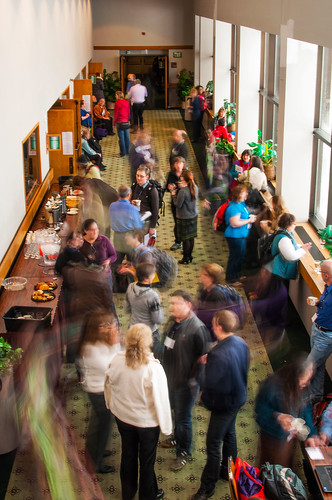
Showing posts with label conference. Show all posts

Wednesday, December 27, 2023

Looking back - inspirations and highlights

Photo by Kalle Kortelainen on Unsplash

Oh dear, I realise that I have rather neglected my blog in recent months. After so many years of writing a post every week and sometimes more frequently I feel a bit ashamed at the long breaks this year. Since retirement my engagement in the world of educational technology has faded somewhat and I am finding other interests to fill my life. However, maybe it's good to look back at my journey over the past 15 years, remembering people and events that have inspired me and somehow summing up the experience. Since no one will have read the story through all those hundreds of blog posts through the years, here's a short retrospective.

I stumbled into higher education in 2004 after many years in adult education and corporate training. I got a job as coordinator of distance education and found the whole concept fascinating. I was inspired by the idea of higher education becoming available to all and not just for those who are able to move to campus and study full-time. I was sure that this vision would inspire governments to fund a shift in higher education towards lifelong learning and widened participation, driven by the development of digital technology. My focus was on trying to promote the benefits of distance education and persuading colleagues to offer more distance and online courses. I had a steep learning curve to understand the complexities of higher education. As a student I didn't really pay any attention to how the university was run or who does what so I felt completely lost at some of the meetings and discussions I attended in my first couple of years. Some aspects of academic life are still a mystery to me quite honestly. I made many mistakes but hopefully learned from most of them.

Inspirational visit to Canada

As I became more familiar with the field I began getting involved in networks with colleagues from other universities in Sweden and through this I got the opportunity to go on a study visit to Canada in October 2005. This was a life-changing visit, or at least career-changing. We visited universities in Vancouver and Edmonton to learn more about how they were offering distance and online education. We saw media production departments with over a hundred employees creating online course material at a time when we had no such unit. The most inspirational institution was Athabasca University, based in a tiny town in the wilds of Alberta but offering online education to students all over Canada and beyond. The idea of a distance university was never implemented in Sweden and I saw a model that we could implement if there was the political will. We had a great meeting with representatives from the university including one of my educational heroes, Terry Anderson, whose work got me really thinking about this new world I had stepped into. 

We also heard a lot about a new concept for us in the form of social software (later social media) and wondered how we could use this in education. I came home laden with notes, references and links and spent the following months investigating all sorts of digital communities and tools. We were busy getting acceptance for learning management systems but I was more interested in the future and started wondering what wonderful things we could do with these new social networks like Facebook, MySpace and Twitter as well as collaborative writing tools, blogs and wikis. As is often the case with visits like this I came home full of enthusiasm and was eager to tell eveyone about all the new things I'd seen and heard. But it's hard to transfer that enthusiasm to colleagues who are often already overworked and focused on current deadlines and priorities. 

EDEN

Another landmark event for me was my first EDEN (European Distance and E-learning Network) conference in Dublin in 2011. This was my first real taste of a major international conference in educational technology and it gave me the chance to listen to and meet some of the big names in the field as well as further developing my network. Once again, I came home with masses of references and ideas to follow up. Read my blog post on the conference and some memorable quotes. Since then I have participated in and contributed to many EDEN activities and have benefitted greatly from the expertise and experience of fellow members. The value of organisations like this was to realise that I wasn't the only person who thought that digital technology was a key to the development of education. The sense of community is so valuable when you are still trying to make sense of things and the presence of respected researchers and professors confirms that the field is not just a passing trend. 

Inspirational institutions

Over the years I been able to visit many universities around the world and opened my eyes to other ways of working with online and distance eduation. I realised that even if we have different cultures and contexts we all has so much in common in terms of how to apply educational technology in a pedagogical manner. Some visits were thanks to European or Nordic project funding whilst others were due to invitations to speak at conferences. 

One of the most inspirational was in my homeland, Scotland, namely the University of the Highlands and Islands (UHI). Their decentralised structure with 13 partner colleges and around 70 learning centres spread around the sparsely populated highlands and islands of Scotland inspired several projects in the hope of awakening interest in a similar model for Sweden. I particularly loved the way the boundaries between campus and distance have been blurred or even erased and the focus is on providing access to higher education wherever you live and with options for how you want to study. I have written several posts about UHI in this blog, most recently after a visit in 2019 as well as older visits such as in 2014.

I have always found the concept of open universities particularly interesting as the best way to open up education to all. Distance and online are essential features of these institutions since few of their target group can afford to move to a campus for several years. I have always admired people who study later on in life and manage to transform their lives through education without leaving their home area and thereby contributing to the survival of rural commuities. I have visited several open universities around the world. For example, Allama Iqbal Open University based in Islamabad, Pakistan, offering a mixture of distance and campus education to an annual enrollment of over a million students. Although the courses have a lot of online content and interaction it is simply not feasible to have everything online since so many people have limited or no internet access. I visited their publishing and mailing centre where enormous numbers of course books and compendiums are sent by post all over the country, making them one of the Pakistani post office's biggest customers. They were very much involved in digital content production and their staff were as well informed on developments as my colleagues back in Sweden but they had to offer a combination of digital and analogue in order to reach out to as many students as possible. Read my post on this visit from 2018.

In a similar vein was my visit to another open university working in difficult circumstances, Al Quds Open University, based in Ramallah in Palestine but with campuses aorund the West Bank and in Gaza. I was impressed by their TV studios and the fact they offered courses via broadcast TV to complement their online content. The difficulties of travelling between the different campuses made digital technology an essential part of all operations. I wonder how their institution will recover after the current brutalities in the West Bank not to speak of the appalling destruction going on in Gaza. Read more in my post from 2018.

Inspirational people

It would be impossible to name all the people who have inspired me over the years and helped me to better understand the field of educational technology and how it can be applied. However a few stand out and my shortlist has a distinctive Canadian flavour. As I mentioned above an early influencer was Terry Anderson of Athabasca University and in the spirit of the new networked world I discovered the concept of connectivism and openness thanks to people like George Siemens and Stephen Downes. I loved the idea of learning as part of connected networks and that people could learn together by sharing resources, discussing and collaborating. I saw a future where learning was ubiquitous and encompassed a wide range of formats, from traditional campus programmes to non-formal online study groups where the group members could decide together what and how to study. Another early influence was Morten Flate Paulsen from Norway, former president of EDEN and a leading light in Scandinavian distance and online education. I saw that online universities were not only possible but an essential factor in the development of wider access to higher education. 

However, as the years went by I began to realise that our favourite platforms, tools and communities were not as free and open as we had assumed and that they were driven by the same factors that have always existed - profit and greed. Reading Audrey Watters' now defunct blog, Hack Education, opened my eyes to the dangers of educational technology - profiting from our personal data, facilitating surveillance and locking us into proprietary solutions. Her predictions were often disregarded at the time but have proved to be disturbingly true, leading to my own disenchantment with the whole field.

My own blogging habit was developed with inspiration from long distance academic bloggers like Tony Bates, Martin Weller, Maha Bali, and Steve Wheeler. I never reached their heights of course but I am amazed at how my posts have still reached far and wide. My greatest thrills early on were when one of my role models actually retweeted a link to one of my blog posts and I saw the number of site views suddenly leap. A simple retweet or like can mean a lot when you're finding your way - never dismiss such things as trivial!

Open Networked Learning

This open online problem-based learning (PBL) course started back in 2013 and I was involved as a course organiser and facilitator till 2022. It was certainly the most complex course I have ever been involved in and is run in collaboration with 12-15 universities in 5-8 different countries. Learners are divided into PBL groups to work through five scenarios on different aspects of learning in collaborative networks, aided by a facilitator and co-facilitator. We always tried to make the course as open as possible, indeed the whole course has a Creative Commons license, even if we had to move some parts behind log-ins later on to conform with the European GDPR legislation on data privacy. The course is still offered twice a year and you can find out more on the course site (Open Networked Learning).

I learned so much from each iteration of the course, both from my fellow organisers and facilitators but also from the participants. No names here but you all know who you are. Thanks so much for that amazing experience and I hope the course continues to develop in the coming years.

Networks and unexpected activities

Over the years I have built up a very valuable personal learning network based on social media activity (my blogs, Twitter, LinkedIn, Facebook and so on) as well as through the various organisations that I have belonged to and worked with. That network was a constant source of inspiration and practical help. Often I could post a question on social media and within hours I had several useful answers with links. One opening led to another and I found myself involved in several committees in Sweden, the Nordic region and internationally as well as lots of projects. Some of these took me well out of my comfort zone, working with people who were far more qualified and experienced, but as ever I learnt a lot and hopefully also contributed constructively. The most notable of those "uncomfortable" activities was being a member of the committee that wrote the standard ISO21001, Management systems for educational organizations. I had no previous experience of ISO and realised what an enormous organisation it is and the meticulous work involved in writing and developing standards. I was immensely impressed by many colleagues' attention to detail and ability to handle the constant revisions and discussions.

So, those were some highlights of my journey. I was able to follow many new paths thanks to the understanding of my university who often gave me the benefit of the doubt in terms of my external activities and projects. Often, I was able to cover a large share of my expenses through project funding and fees. It wasn't all success stories, there were quite a few flops and bumps and I was certainly a bit too hasty and enthusiastic at times, especially early on. I certainly didn't follow any traditional academic path and to a large extent let my curiosity guide me. Somehow I made it through to retirement but I hope I have managed to encourage and even inspire colleagues to try new technology and rethink their practice.

Wednesday, August 3, 2022

Is it still a conference if the keynote speakers are all online?

Photo by Luis Quintero on Pexels

Conferences are reverting to their traditional on-site format but the effects of the pandemic can still be felt in that it has become difficult to attract speakers to attend in person. Many speakers prefer to contribute online for both environmental and time-saving reasons. Travelling half way round the world to speak for 45 minutes, with the resultant massive carbon footprint, is simply not sustainable. The appearance can take several days out of a speaker's schedule and although the experience of seeing new places and making new contacts is very enjoyable, it disrupts regular work activities. During the pandemic we all realised that keynote presentations work very well online and now that the conferences are back on site many of the speakers are not. But what happens to an on-site conference when the speakers are all on screen and no one is actually on stage? Why pay high fees to watch a video meeting?

Conference organisers are now trying to put pressure on speakers to attend in person according to an article in Times Higher Education, Academic conferences scale back hybrid ambitions. Having the keynote speakers on-site means that they also attend other sessions and chat with participants during the breaks, meals and mingles. This adds value to the conference and justifies the fee. 
The moves follow concerns that the travel-free option for speakers is leading to empty podiums and an “us and them” culture between remote panellists and assembled delegates. Some organisers have also flagged the logistical complexity of enabling online speakers and the vastly inflated cost of running hybrid events, which often require numerous video and audio production staff, producers and technical support.

Many conferences are adopting a hybrid format, or at least a semblance of one, but the default is still on-site. Online participants can only attend some of the sessions and few have attempted hybrid mingling or social events. Of course there are technical difficulties with hybrid. Just as in teaching you need an advanced technical set-up to make hybrid work reasonably well and in my experience the online participants tend to take a back seat in the sessions. Online keynotes work best when everyone else is online but when you mix online and on-site there are always risks of bandwidth issues, sound and video quality or other technical hitches.

I generally present live on Zoom or Teams but when the conference venue is far away I prefer to record my session and let them play the recording in the conference hall. Then I am available live for questions afterwards. This minimises the risk of bandwidth issues and they get a high quality video to watch. At the same time I never get any real impression of the audience and no sense of place at all. The question time is often rather awkward since I can't hear or even see the people asking the questions and need to rely on a moderator. In addition, few participants are willing to ask a question in a hall at the best of times and even more so when the speaker isn't even in the room.

I have written on this theme several times here and firmly believe that large on-site international conferences are not sustainable and need to be phased out. It is absurd that while our colleagues in environmental science are sounding the alarm bells about the climate crisis, higher education is still responsible for high levels of carbon emissions due to our reliance on international air travel. On-site conferences are very rewarding but only for those who can afford them. Online conferences are not the same as on-site ones and we should stop comparing the two. They are still evolving and need time to develop new forms of interaction rather than trying to replicate traditional practice. They can be more inclusive and diverse and offer opportunities for longer collaborative processes.

But it's not a matter of a free choice between two alternatives. One offers us hope for the future, the other doesn't.


Tuesday, June 28, 2022

Conference conclusions part 2

Photo by John-Mark Smith on Unsplash

Following my previous post I would like to summarise some takeaways from the two conferences I attended recently, NU2022 i Stockholm and EDEN2022 in Tallinn, Estonia. I didn't make detailed notes this time so here is a list of themes that made an impact for me. There were of course many sessions about the perils of hybrid teaching but generally the focus was on improving teaching and learning rather than about using tools and platforms. I don't think that the pandemic has fundamentaly changed education but I do believe that we have finally realised that technology is now fully integrated into all pedagogical discussions. Here are a few themes I noted, in no particular order.

The changing role of the campus.

If we can deliver content, discuss, collaborate and network very well online and in some cases better than on-site the awkward question of the future role of the campus emerges. We need to offer sound reasons for being there and identify the unmissable elements of the campus experience. This is clear for the traditional target group of young students but the benefits are much less clear for the growing ranks of older online students. An interesting perspective on this came from the head of the Stockholm School of Economics who talked about the importance of appealing to all the senses - not just what your campus looks like but also trying to capture the feel, smell, sound and taste. We had an evening event at that institution and saw how they had cooperated with artists to have thought-provoking paintings, photos and sculptures in the corridors and learning spaces.They also ran very popular book circles to emphasize the importance of the humanities even in an economics degree. 

In Tallinn a presentation by a student raised the need for us to develop a coherent digital campus that allows students and teachers to interact, form groups, network and socialise. Today's digital campus consists of closed and often incompatible silos and the presentation showed that during the pandemic lockdown students at Tallinn University had to negotiate 11 different platforms as part of their everyday course work.

Students as partners

Nobel Prize winner Carl Weiman of Stanford University made an interesting online presentation at the Stockholm conference. Not about his research in physics that won him the prize but about the theme of the conference - pedagogical development. What struck me most was the fact that he presented in such down-to-earth terms and stressed the need to have students as partners in the learning process and in course design. Admittedly he was preaching to the converted but he reinforced the advantages of active learning and of peer feedback.

Discussing with a fellow student is more effective than listening to an expert instructor.

Pia Lappalainen, Aalto University in Finland, reinforced this theme by showing evidence for how regular small-scale feedback promoted learning more than detailed summative feedback.

New initiatives for promoting digital literacies

A representative from the European Commission presented news of further initiatives to promote digital literacies in education and in society in general through the updated version of the European Digital Competence Framework for Citizens, version 2.2. There was also enthusiasm about the launch of the Digital education hub. The hub is an ambitious venture to offer professional development for teachers as well as a store of learning resources and lesson plans.
The open online collaborative community for digital education stakeholders in Europe and beyond.
Even if there are excellent guidelines and criteria for assessing and developing teachers' digital literacies there are unexpected issues in trying to gain an objective assessment within an institution. Linda Helene Sillat and Mart Laanpere of Tallinn University showed the dangers of self-assessment where some teachers over-estimated their competence levels whilst other did the opposite. Objective tests at the university failed since teachers simply refused to take the tests, seeing it possibly as an affront to their professional abilities and suspecting that poor test results would negatively affect their career opportunities. 

Quality perspectives

Quality in the field of online education is a complex issue. Despite a plethora of quality frameworks (over 100 different frameworks according to Mark Brown of Dublin City University, there is still a reluctance to address the issue in higher education. Maybe this is due to universities being daunted by both the bewildering variety of frameworks and the diversity of overlapping terminology in the field. The question remains of whether quality in the use of technology in education should be assessed as part of the regular educational quality framework or as a separate feature.

My final takeaway was a presentation by Lesley Gourlay of University College London, questioning the use of the word virtual in an educational perspective. This opened up a wider theme that deserves a longer post to itself. I will break new ground on this blog by creating a cliff-hanger. 

To be continued ...


Friday, June 24, 2022

My farewell to on-site conferences - at least as a university employee

Session in the EDEN conference (CC BY Alastair Creelman)

I have just returned home from the last educational conferences of my professional career. I am retiring this summer and any conferences after that will either have to be by invitation or if I feel rich enough to pay it all privately (unlikely). I attended NU2022 in Stockholm, a Swedish national conference on pedagogical development in higher education, and EDEN's (European Distance and E-learning Network) annual conference in Tallinn, Estonia. My next post will discuss some of the issues raised at these conferences but here I will just make some general comments.

I must admit that although I have spent the last few years organising, hosting and participating in many online conferences and meetings, the chance to finally attend an on-site event was very welcome. It was wonderful to meet colleagues, mingle, nibble snacks and do a bit of sightseeing in the evenings. A reminder of days gone by and a nice way to round off my days of university employment. 

One theme I would like to comment on here is that of the role of the online participants and their use of the back channels. Both conferences were billed as hybrid with live streaming of many sessions and the option of a Q&A function or chat to interact with the on-site audience. In the Stockholm conference there were hybrid parallel sessions and although the production was fine there was virtually no input from the online participants. In my two sessions I tried to encourage questions and comments in the chat but sadly nothing came. At EDEN there was a Q&A function in the streaming platform that was used quite often but there was no room for discussion between participants. One interesting feature of the EDEN conference was the inclusion of sessions held exclusively on Zoom. Here, on-site participants, including presenters, had to find a quiet corner to sit in to take part in these sessions so that they were fully online and therefore avoided the risk of the on-site participants dominating the discussion. I did not participate in the Zoom sessions at EDEN but I am sure they were more interactive than the hybrid sessions because everyone was online and had access to chat and microphone. Maybe the conclusion is that the focus in hybrid sessions is almost always on the on-site event and the online participants do not see themselves as full participants. If you really want the online participants to be active then offer fully online sessions.

Both conferences had hashtags for Twitter but only a few participants took advantage of this to share ideas and links. I have always enjoyed the Twitter feeds at conferences because I get so many good reflections and interaction with other participants. It's also great to see non-conference people getting involved, thus widening the reach of the conference. I use Twitter to write reflections, links and quotes and then refer to the feed when I write about the conference later. The next post will do just that. It's sad that the Twitter discussions this time were a bit limited. Are people tired of back channels in general or of Twitter in particular or are people just reluctant to share their ideas?

Then there is the sustainability of on-site conferences. I firmly believe that we cannot continue holding large-scale international on-site conferences if we want to have any environmental credibility, given that most people have to fly to attend. Maybe justifiable if the majority of participants can travel by land. I travelled to Estonia by train and boat but I strongly suspect that the carbon emissions of today's giant ferries may even be higher than travelling by plane. I have not dared to investigate this.

I will try to keep up with future conferences by online participation unless something remarkable happens. But I thoroughly enjoyed this final fling.

Part 2 of this post will follow in the next few days.

Sunday, October 31, 2021

On-site, online or hybrid? It depends on what you want to achieve.

Photo by Alexandre Pellaes on Unsplash

As more and more conferences return to on-site mode, many feel the need to offer a hybrid mode where most of the event is also available to online participants. Is this just a symbolic gesture to show that we have learned something from the pandemic? How involved are the online participants and how do organisers charge for the online experience? How do we facilitate true interaction between the two groups of participants? Most importantly I think is the question of whether hybrid is the way forward of just an awkward and technically demanding add-on. 

Attending an online conference is very different from actually being there for many reasons. I have found that I sign up for more online conferences than I would ever attend physically but when I'm online I only attend the interesting parts and skip the rest. In some sessions I listen with one ear and continue with other work. I attend but I don't really engage. I am still at work and the conference becomes like background music with a few highlights when I fully concentrate on it. Maybe similar things happen with hybrid teaching. It would be interesting to study the distraction levels of campus and online students.

But maybe the answer is not to try and cater for everyone but focus on your target group. If the whole point of the event is for people to meet and discuss on-site then make that clear and restrict it to on-site delivery. However if an on-site event would automatically exclude important members of the target group then make the event fully online or even asynchronous. By trying to include everyone you risk excluding everyone and the event becomes a messy compromise.

I started thinking about these questions after reading an article by Mark Carrigan on the LSE blog, Is hybrid a desirable ‘new normal’ for academic events? The problems with hybrid are well known in terms of technical complexity and the risk of online participants being flies on the wall, passive observers. If you want an online audience then focus on that and don't try to do two things at the same time. Conferences can instead become processes with asynchronous online interaction over a whole week or several weeks. 

The equipment and expertise which are currently necessary to run a hybrid event mean it probably isn’t the right (or sustainable) choice for a relatively niche event that is unlikely to attract much of an online audience. In which case it might make more sense to have a physical event, with a collective output which can be distributed asynchronously. Digital artefacts like blogposts and podcasts have a tendency to circulate far beyond their original creators. The raw fact of access can be valuable, but the careful packaging of ideas and discussions can be a much more effective way of facilitating remote participation. It might be that only a small number of people would tune in synchronously to engage with an event, but a digital output from that event over time might assemble a significantly larger audience.

It's similar with hybrid teaching. Some sessions must be on campus and therefore we need to make that clear well in advance. Other sessions can be online only and even campus students will join the session from their own laptops. Maybe some sessions can be hybrid but we need to work hard to make them truly inclusive and collaborative. Hybrid sounds like the best of both worlds but can so easily be messy and a disappointment for all. The solution is to decide on the best format for the group you want to be involved. There is no default in the future - decide the optimal format each time.  

This isn’t an argument against physical meetings, but rather a plea that we avoid drifting back to them. The familiar rhythms of seminars and conferences feel intensely alluring after the isolation and suffering which have characterised the last eighteen months. However, do we really want to return to a situation where they are the default? Or could we imagine an approach to academic events which recognises how these options (face-to-face, hybrid, digital) are equally worthwhile depending on what we’re trying to achieve?

Thursday, September 16, 2021

Being there - that feeling we can't achieve online

Photo by Aranxa Esteve on Unsplash

No matter how many amazing new platforms and tools for online events we create, none of them really match the feeling of physically being there. The online event can actually be more flexible, more interactive, more inclusive and offer higher quality video and audio than sitting at the back of a hot and stuffy lecture theatre but it can't match that feeling of presence. It's the same with TV coverage of concerts and sporting events. You can sit at home and watch it all in super high-definition quality with surround sound, close-ups, slow motion replays, commentary and analysis but the sad truth is that you weren't really there. There are no credibility points for saying that you saw it on TV. I've been to many memorable events where I couldn't see or hear the action very well, was packed in a sweaty and noisy crowd, had great difficulty getting there and getting away afterwards (endless queues, pushing, noise, waiting) but I can always boast that I was there and that's what impresses people later on. That feeling of being part of something, an exclusive community, cannot be underestimated. That's why people will still pay extortionate amounts of money to attend events that are broadcast live. Feelings are worth more than quality. Even if there are billions of photos and films from all angles of, say, the Taj Mahal, I would still take at least a hundred more just to show that I have also been there.

If we think of academic conferences and events there are digital solutions for almost all the usual activities. You can mingle and network using platforms like SpatialChat, Wonder or Gather, use Zoom for plenary sessions and group discussions, create exciting virtual world conference or exhibition centres with Virbela or Virtway, go on virtual city tours, sightseeing with Google Streetview, have immersive virtual reality meetings in Spatial and so on. The list of platforms is impressive and is growing weekly so logically there should be no reason to return to on-site events. In addition, the environmental arguments against returning to large on-site conferences are overwhelming. 

But no matter how much we can achieve online we will still want to meet at a physical location. The need to be there is all about intangible factors: emotion, atmosphere, sense of belonging, sense of space. We can achieve a lot online but maybe we have to accept that some elements will always be missing.


Sunday, May 23, 2021

Conferences - from exclusive to inclusive events

Photo by Belinda Fewings on Unsplash

Technology is often used simply to enable us to continue doing what we have always done but in a digital space. The same seems to be true for online conferences. New platforms and tools are being launched almost weekly and there is a bewildering diversity for organisers to choose between. The corporate market for online conferences is booming and will no doubt replace many of the on-site conferences after the pandemic has faded (though that could be further in the future than most would like to imagine). Digital media have the potential to help us rethink the conference into inclusive and accessible spaces for networking and sharing and there have indeed been many innovative examples in recent months, offering more spaces for discussion and networking as well as offering both synchronous and asynchronous activities. However, it is extremely hard to break from tradition and academic conferences are vital rites of passage for young researchers by having a conference paper accepted. 

This week I enjoyed reading a couple of articles by Catherine Oliver of the London School of Economics. Her article in The Post-pandemic University, Post-Pandemic Conferences: Academic networks and changing conference spaces, describes how online conferences have the potential to become more inclusive but that there is a risk that we will return to the the old hierarchies and privileges. Changing traditions involves so much more than simply creating the potential for change, there has to be an awareness that things need to change. The academic conference model is tried, tested and comfortable. After the pandemic most people will want to return to their comfort zones.

The doors of the academic conference create a boundary that not only produces insiders and outsiders, but also the outsiders within. The doors of the academic conference have opened during Covid-19, but a return to in-person conferences threatens to slam them shut.
There are new opportunities to open up conferences but technology does not automatically bring change. It enables change but the will to change has to be there.  
Conferences are an important space for the making (and breaking) of academic communities. The doors to the academic conference are, in theory, more open than ever. But, with the UK government’s intention to get life “back to normal” by the 21st June 2021, the doors might be about to slam on accessible conferences. Conference hierarchies have not been flattened by the pandemic, but new spaces and opportunities are beginning to emerge. While conferences produce insiders and outsiders, they also allow for radical connections to be made; encounters that are more difficult to replicate at virtual conferences. Online networking comes with a host of new relations and rules. But, as we move to post-pandemic hybrid conferences, we must maintain the momentum to radically reimagine not only our academic spaces, but our academic communities.
Another article by Catherine Oliver, on the LSE's site, Online conferences: opening opportunities or reproducing inequality?, looks at those who are often marginalised in traditional conferences, precarious academics such as doctoral students looking for their first foothold on the academic ladder and researchers without the resources to travel. Many have benefited from this year's online conferences, being able to participate and contribute at very low cost and without the need for travel and lengthy visa applications. Many conferences have seen significant increases in attendance by going online and reducing or even waiving attendance fees. It is important not to forget them in our rush "back to normal".
The same care and attention owed to ‘in-person’ events needs to be paid to the organisation of online academic conferences if they are to be fertile spaces for doing academia differently. As we face uncertain futures, now is not the time to abandon precarious academics but to radically reimagine our knowledge production and communication spaces with accessibility, transparency, and openness at the centre.

There will certainly be a sigh of relief when on-site conferences return and many will flock back to the sense of community and shared experience that they offer. But we must remember that such events are always exclusive and many voices are never heard there. We need to learn from the past year and create more innovative and inclusive online conferences with a much lower threshold for involvement. The traditional conferences may hopefully also widen their scope and allow a variety of forms of participation.

Sunday, May 2, 2021

Mind your language - the problems of English as default

Photo by Nothing Ahead from Pexels

English is the default language of international communication but at the same time this puts native speakers in an extremely privileged position. Most international conferences feature keynotes by native English speakers and these voices tend to be prominent in most workshops and seminar sessions. Those whose command of English is less than perfect tend to sit quietly and listen. It would be interesting to see a study of whether active participation is directly linked to confidence in English. Even those whose English is extremely proficient may have trouble understanding the native speakers who often use idioms  or jokes and cultural references that only native speakers will be familiar with. I have often listened to speeches and wondered if anyone else in the hall understood the highly culturally specific reference made by the speaker. It's not enough to simply be proficient at English, you need to learn an entire culture.

This is illustrated by the opening of an article in KQED, Tower Of Babble: Nonnative Speakers Navigate The World Of 'Good' And 'Bad' English.

Picture this: A group of nonnative English speakers is in a room. There are people from Germany, Singapore, South Korea, Nigeria and France. They're having a great time speaking to each other in English, and communication is smooth. And then an American walks into the room. The American speaks quickly, using esoteric jargon ("let's take a holistic approach") and sports idioms ("you hit it out of the park!"). And the conversation trickles to a halt.

I've had similar experiences when I was learning Swedish many years ago. We non-native speakers could have very good discussions because we had all learned the same vocabulary and grammar, but when a Swede entered the conversation we suddenly got tongue-tied. They used expressions we didn't recognise and spoke so quickly. No-one wanted to reveal their limitations. 

The article gives several examples of how non-native speakers can be excluded or marginalised and the main point is that native speakers should learn to adapt their language to the audience they are speaking to. This doesn't mean simplifying, but being able to recognise idioms and references that the audience cannot be expected to grasp. English speakers who have never tried to learn another language are often insensitive to this and often speak as they would to their colleagues at home not realising how they are failing to connect with the audience.

The tests that non-native English speakers need to pass to gain access to international work are also unfairly discriminatory according to the article. They test a very particular form of English and people who have an excellent command of the language for the work they do can fail tests like the TOEFL (Test of English as a Foreign Language) because they haven't grasped the finer points of written academic English or indeed the differences between American and British English.

The test also requires making a clear choice between British and American spelling and vocabulary. That "can trip up people whose English comes from various sources" — say, a third from British textbooks and two-thirds from American movies.

Indeed, the differences between American and British English are becoming increasingly blurred especially in the UK where American media and culture are so prevalent. I'm sure you'll find a mix of the two in my writing. Is this worth testing today? What matters if whether the candidate has the level of English to do their job. According to Lithuanian journalist Daiva Repečkaitė:

"As the pandemic rages," she said, "I worry that there might be countless refugee doctors and nurses who just haven't read enough Shakespeare or haven't practiced enough multiple-choice, fill-in exercises to pass these tests in English-speaking countries." Especially at a time when the burden of COVID-19 weighs heavily on the world, Repečkaitė says, we all suffer when skilled professionals like doctors are prevented from helping people.

Linguistic integration is a two-way process and native speakers need to learn to adapt their language in international contexts. Avoid unnecessary idioms, references and jokes, speak a little more slowly and clearly and your message will be clear. Otherwise the audience may still give polite applause but they will not have understood your message. 

Sunday, March 7, 2021

We'll meet again, don't know where, don't know when - the future of international conferences

Photo by Andrei Stratu on Unsplash

The future of international conferences is uncertain now that we have realised that you can have very productive meetings without the financial costs of travelling and accommodation as well as the environmental damage of hundreds of delegates flying in from all over the world. On-site conferences are always exclusive events due to costs, travel restrictions, linguistic barriers and accessibility issues. Only delegates from wealthy organisations can attend and those are the voices heard. Of course a digital event is not the same thing but that is hardly the point. We cannot go on meeting like this, for the sake of our planet's future.

These issues are raised in a new article by Holly J. Niner and Sophia N. Wassermann in the journal Frontiers in Marine Science, Better for Whom? Leveling the Injustices of International Conferences by Moving Online. They describe how the 6th International Marine Conservation Congress (IMCC6) was re-arranged as a digital conference and the effects this had on participation and delegate experience. Not surprisingly they increased the global impact of the event considerably; attendance increased by 74% compared to the previous on-site event with a significantly wider range of countries represented. Many of the delegates would not have been able to participate if the event had been on-site. They raise the value of benefits such as flexibility, convenience, the availability of recorded sessions and other on-line resources, lower cost and networking opportunities. The majority found the digital experience better than expected and were appreciative of being able to be part of such an event. However, many looked forward to attending in person for the next conference but admitted that a hybrid format would be able to offer an attractive alternative for those unable to attend in person.

Attending a digital conference also raises the issue of workplace culture. If you are in the office you are expected to perform your regular tasks and it is hard to simply refuse on the grounds that you are attending a conference just now. Many who attend on-site conferences enjoy the opportunity to escape the pressures of the workplace for a couple of days and add an automatic reply on the work e-mail account. It's not so easy if you're physically in the office.

Several survey respondents indicated that they struggled to “set aside” time to engage with the conference, owing to competing work demands that they were unable to step away from when attending a conference at home, instead of a location-based conference. Conversely, others enjoyed the flexibility of being able to dip in and out of the conference and to fit attendance around their commitments, many of which could prevent or challenge in-person attendance.
A move to online conferences will of course threaten many businesses, especially hotels, conference centres travel agencies and airlines. My own university has saved around €4 million over the past year in reduced travel and hotel costs. Organising an online event still involves a lot of planning and organisation as well as costs for platform, studios and production but the reduced costs mean that attendance fees can be reduced significantly and thus widen participation.

The big question is whether or not a return to the on-site format is at all desirable and the authors focus on a factor they call the privilege of preferring an in-person option. It's great to meet in person, if you can afford it. But so many people do not have that option.
This year has highlighted that online conferences can be valuable, inclusive and an opportunity to address many of the moral dilemmas posed by traditional conference models, particularly for the marine conservation community and others working in the fields of environmental or sustainability science and management. If organizations neglect the lessons learned from the pandemic and fail to embrace the opportunities of remote conference attendance, they knowingly exclude people. On an individual level, those of us able to attend a conference no matter where it is held should be cognizant of the fact that the option to prefer an in-person conference is predicated on the ability to attend one.

After the pandemic we have three options ahead of us: to rush back to the traditional formats and continue as before, to make some adjustments to the traditional format such as making some sessions available online in a hybrid model or to radically change how we meet and exchange ideas with a focus on developing collaborative and accessible online spaces. 

Wednesday, February 10, 2021

Keynotes on demand


I have been invited to speak at many online conferences and webinars over the past year and although I always try to adapt my content to the audience, I often feel I'm just playing variations on a theme. I can imagine how it feels for the major speakers in the field and how many invitations they get each week to speak on much the same theme each time. In the past this meant extensive travel to international conferences, but today you can tour the world from the comfort of your own home.

One of the experts in demand just now is Tony Bates and he has announced an innovative approach to keynoting. He has an impressive track record in digital learning and despite "retiring" a few years ago he has maintained an impressive level of production with a very valuable blog, reports, lectures and one of the best books on online education, Teaching in a Digital Age (available as an open access book, practising what he preaches). Being in such demand it becomes hard to say no even if such appearances sometimes demand very uncomfortable working hours. You have to draw the line somewhere, but how to do that without disappointing?

So his innovative solution, described in a post, Five free keynotes on online learning for streaming into virtual conferences, is to record five different keynote speeches and offer them to any conference organisers under a Creative Commons license (CC BY-SA). They can be accessed from Commonwealth of Learning’s online institutional repository for learning resources and publications, OAsis, and can even be downloaded. This means conferences can include a major speaker as keynote without any live links, though he can make himself available for a personal Q&A session afterwards, either synchronously or if the time is inconvenient, asynchronously.

Here are direct links to the lectures:
Could this become more common in the future? Of course there are advantages of appearing live but since the purpose of a keynote is for inspiration it is feasible to use recorded lectures and focus the live sessions on discussion and interaction. An on-site conference has high profile keynote speakers as a major incentive to attend with the attraction of possibly meeting that person in a mingle session later on. In an online conference that advantage is largely lost so maybe we'll see more virtual keynotes that act as catalysts for more active discussion instead.

Saturday, November 14, 2020

Who's afraid of group work?

Photo by Markus Spiske from Pexels

Many webinars and online conferences today try to increase engagement by sending participants into small breakout groups, giving everyone the chance to contribute to the discussion. Evaluations show that most participants appreciate the opportunity to talk with colleagues and exchange ideas rather than simply listening to guest speakers. However, every time I set up a group activity I notice that some participants simply leave the meeting. Many colleagues have noticed this behaviour and it seems that for some people the prospect of group discussion is not appealing. Working in groups is an important skill and a vital part of the student experience, but is it always essential in webinars and conferences where participants are attending voluntarily and are not being assessed in any way?  

I have read comments that group work can be stressful when you are suddenly thrown into a group with total strangers and expected to have a meaningful discussion in only 20 minutes. Sometimes there are group members who dominate the session giving no room for other contributions. Other times there is an awkward silence when no-one really has a strong opinion about the question posed by the organisers. A few have commented that they attended the webinar to learn about a subject they knew very little about and therefore wanted to listen to the experts rather than discussing with other people who also knew very little about the subject. Some group members do not have a microphone or camera and cannot contribute at all or others have a very poor internet connection resulting in poor audio, echo or other strange noises. And some people just don't like group work and prefer to reflect alone.

What can we learn from this then? Here are some ideas but I'm sure there are more.

  • Zoom's new function that allows participants to choose which group they join or even to change group can help. At the same time, it can lead to confusion as people move from one group to another and thus disturbing potentially good discussions.
  • Offering an opt-out option before group work. Those who do not wish to join a group can stay in the main room and simply mute and switch off cameras and use the time for quiet reflection. Make it clear that this option is just as valid as joining a group. What they do with that time is up to them but maybe they will still be there when the groups return. 
  • Don't overdo the collaborative elements in a conference or webinar. Many people really enjoy just listening to an expert and have no need to discuss all the time. There is always a risk that group work is included without any real purpose other than just to make the session look interactive. Too many polls, breakout sessions, word clouds etc can get very tiresome.
  • Group work takes time to be useful. Explain why you're doing it, "sell" the benefits and give them at least 20 minutes to discuss, preferably longer. Less time is generally pointless. Remember that six strangers who land together in a room need a few minutes for introductions and ice-breaking before starting the discussion.


Saturday, May 30, 2020

Online conferences should be different


Online conferences have become mainstream in just a few months and many organisers have had to hastily adapt their original on-site schedule to an online format. I have written many times about how we could find new models for academic conferences and we now have the chance to review the whole concept. At present most organisers are simply switching the classic conference format to an online set-up, using Zoom or similar platforms to run plenary and parallel sessions as well as providing spaces for a certain amount of social interaction. The social interaction aspect is particularly interesting since that is the feature of regular conferences that most people appreciate most. Curiously it's not the high profile keynote speakers that attract people to attend a conference, it is the opportunity to meet colleagues and expand your network.

There are many tools that can to some extent simulate social interaction. One that I have just discovered is called Online Town. This is extremely simple but rather ingenious. You log into a room where you are represented by a simple photo that you can move around the space. As you approach a group of faces they appear as video feeds, as in a Zoom or Skype meeting. If you all stand close together you can have a video meeting but if you move away the other speakers' video feed gets weaker and then disappears. In this way you can mingle as you might at a reception, the main difference being that you don't have to balance a drink and a plate of nibbles whilst chatting with colleagues. It's a rather basic tool but the idea is perfect for conference settings.

But maybe we shouldn't simply translate the on-site conference to an online setting. Why should we sit in front of a screen intensively for two or three days? It doesn't work, so why not rethink the conference to exploit the strengths of online spaces for asynchronous collaboration. This is voiced by Matt Webb in a short post, A month long conference is a neat concept. Why not spread the conference over several weeks with short and intensive synchronous sessions interspersed with asynchronous collaboration and group work over several days or even weeks? The impact of such a conference would be greater and the asynchronous discussions and collaboration would certainly lead to more networking and lasting relationships than many regular conferences.
There was something about the weekly rhythm which meant that there was time for me to digest each download of new thoughts. The session stayed with me for the week. … A week is time to discuss with friends, contemplate, see the deeper patterns.
One platform that embraces this concept is Qiqo chat. This integrates Zoom with collaborative documents in Google Drive or teamwork tools like Slack and allows participants to form their own breakout groups and change groups at will.
QiqoChat (Qiqo) provides a wrapper around Zoom meetings so that participants can move themselves into different breakout rooms. For example, Qiqo is good for when you want participants to have more freedom (such as an online conference or workshop where you want people to be able to move freely in and out between sessions).
For a conference you can create a large group space for synchronous meetings or keynotes and then let the participants move to working groups where they can then spend hours or even days working on a position paper, brainstorming solutions to a problem or editing a website. In the groups they can mix video meetings with collaborative writing before reporting back to the main event at a given time. The solution is already used for intensive collaborative events like hackathons. This short demonstration video gives you a good overview of the solution.


I haven't participated in a Qiqo session yet but I can see that this type of solution widens the potential of conferences. I'm sure there are also many other exciting solutions out there that I simply haven't discovered yet. Even when on-site conferences are again possible we could gather people for a shorter time and then continue the conference discussions for several weeks before final conclusions are reached. More hybrid conferences will be available where online participation can be as active as on-site. There are already many problems with the traditional on-site academic conference: one-way communication, passive consumption, exclusive access, extremely expensive. There is no better time than the presence to try new models and see if we can create a better experience for all.

Sunday, February 16, 2020

Deconferencing or unconferencing?


Educational conferences are big business and whatever field you work in you'll find a conference somewhere every week of the year. Take a look, for example, at Contact North's excellent overview of conferences in educational technology for the year ahead - a breathtaking 1700 of them! All of them involving a hefty carbon footprint in terms of air travel. As I've written before, we can't go on meeting like this.

Now there's a growing interest in deconferencing; reducing the number of conferences you attend, ultimately to zero. This is not just about reducing our climate anxiety, there is also the question of what you actually gain from attending conferences. Are the benefits to you and your organisation worth the time and effort or do you go simply because you are expected to or simply due to habit? After a while you realise that you have heard most things before and the number of eureka moments per conference is alarmingly low. Over the last year I have been trying to only attend conferences that can be reached by train. One advantage of this is that you have to think carefully before signing up for a conference. Is it really worth those lengthy train journeys and a lot of leisure time sitting on trains and waiting at stations? I'm also aware that train journeys are not always environmentally friendly, especially if the trains are hauled by diesel locomotives. But it's not just about cutting the air miles, it's about rethinking the meaning of conferences and trying to finding new arenas to meet.

I can recommend an excellent post on the topic by Alan Levine (aka CogDog), On deconferencing. He has withdrawn from the conference circuit and explains the reasons and it's not just about carbon footprints. It's also about the exclusivity of big conferences. Many of us who get paid to attend conferences tend to take it all for granted and seldom stop to think how privileged we are. We are part of an exclusive club and we tend to forget that there are millions of academics who cannot afford to attend or face visa restrictions and other barriers even if they can afford the fees. He admits that he was one of the club:
It was for work. It was just part of the job. Even later, when going independent, others still paid my fares in exchange for presenting/workshopping. I earned it, right? And it felt, yes, a bit glamorous. And I was there to to tweet out all the foibles of travel woes, missed planes, rude TSA agents, bland food.
Never thinking about how that looked to someone who did not get such opportunities.
As a road warrior, I was so… justified.
However his main reason for unconferencing is the search for deeper discussion and the limitations of the traditional conference format:
Even now, I picture these large conference halls where most folks are there tweeting slides. 
We need to rethink our conferences or better still devise new arenas for meaningful, accessible and inclusive discussion with less dependence on airlines and expensive hotels.
Conference on… but I am deconferencing. I am looking for better ways to share knowledge, ideas that can include more people and less travel, but just plain… better.
Experiments with digital conferences are promising but we shouldn't focus only on the digital arena. The concept of the unconference has been around for many years and is a physical gathering, generally small-scale, where groups get together and discuss issues of common interest without any keynotes or slideshows. These could also be arranged online. Many conferences fail to harvest the vast amount of knowledge and experience among the participants and the unconference is all about that. Maybe the future is more about more focused small-scale discussion groups, mixing synchronous and asynchronous as well as on-site and online collaboration.

I don't mean we scrap major conferences completely but we will certainly need to reduce their number and find other ways to meet. A major driver of academic conferences is their importance to researchers and demands for accepted conference papers as professional recognition. Maybe we can find new ways of recognising researchers in a more inclusive and interactive arena.

Saturday, October 5, 2019

Organising a digital conference

Post-conference organisers' meeting (CC BY Markus Schneider)
If we are serious about limiting our carbon footprint in the education sector we have to develop formats for online conferences to at least partly replace the flora of on-site conferences. The technology is available but we have to overcome many preconceptions about online meetings and dare to experiment. Over the past months I have been part of a team from both the Swedish Higher Education Authority (UKÄ) and the Swedish Network for IT in Higher Education (ITHU) arranging a national digital conference on teaching and learning in higher education with a focus on digitalisation. Finally last week, 27 September, the conference was held with a total of over 500 participants from all over the country and several from abroad. Most of the registered participants attended; some attended all the sessions whilst others chose the sessions that were most relevant for them. At most we had over 350 people simultaneously and nearly all sessions had at least 50 participants. The conference was a great success and the technology worked perfectly all the way. The most important fact was that we showed that a digital conference of this dignity can be organised and can include social events and the chance to network, just like an on-site conference. It was so much more than a string of streamed presentations. We wanted to create the feel of a conference with a reception area, social breaks, online lunch and plenty of interaction in the sessions including many small group discussions.

The main aim of the conference was for the authority to inform and stimulate discussion about current national initiatives in the field of quality in teaching and learning. Normally this type of activity would be held in Stockholm and this naturally limits participation of those who have furthest to travel or have limited budgets.A digital conference is therefore more inclusive and saves a considerable amount of money that would otherwise be spent on the conference venue and catering as well as all the flights, train travel and hotel nights. the participants came from almost all the higher education institutions in Sweden as well as representatives from other educational sectors such as schools, learning centres and adult education. We also had many representatives from other government authorities who were mostly interested in seeing how a virtual conference could be organised.

Conference structure and technical set-up
On the technical side the conference used the e-meeting tool Zoom which all Swedish universities have access to and is familiar to many of the participants. You can see the conference programme on the conference site (in Swedish, but use a translation tool and it should be understandable). We decided to use Zoom's webinar room for for the plenary sessions since it can handle large numbers of participants. Here the participants are unable to activate their microphones and webcams and can only communicate by chat. This keeps the interface "clean" and puts the focus on the speakers. It also eliminates the risk of an unmuted microphone creating background noise. However all plenary sessions featured polls in the tool Mentimeter or encouraged questions and reflections in the chat, both of which proved extremely popular.

For the parallel sessions we used Zoom's large group rooms and here the particpants could be seen and heard and this enable a much freer discussion. These sessions involved between 50 and 150 participants and many involved small group discussions in breakout groups of 4-6. this also worked well and enabled participants to meet new colleagues. We devoted considerable planning time to testing various options and even carried out a stress test to see if there were any limitations when a room had hundreds of participants. We also documented all sorts of rules and guidelines for all the speakers, moderators, chat moderators, hosts and technical support staff and in many cases we had alternative plans if anything went wrong. This meticulous planning was the foundation of the conference's success and some of my colleagues worked extremely hard to cover all eventualities.

Social activities
We aimed to make all the sessions as interactive as possible but decided to experiment a little by also arranging the sort of social opportunities that make on-site conferences so valuable. Before the conference started we offered a mingle meeting in our reception/helpdesk room. This room was manned all through the conference to answer questions or help people set up their audio and video but in the early morning it was a drop-in mingle. I hosted this and was amazed that more than 70 people logged in from around 08:00 am just to say hello and test things. We allowed all to use their webcams and microphones and it was nice to have some small talk before we all moved to the main webinar room for the opening plenary. At lunch we offered a wide selection of rooms where you could simply eat your lunch with random colleagues from around the country. However the most interesting lunchtime activities were the rooms that featured mindfulness, yoga and even a German conversation course. We weren't sure anyone would dare to participate in these but they were all well attended and received plenty of positive feedback.

Feedback and reflections
After the dust had settled, all the organising team had a euphoric after-work session (online of course!). The relief that everything had worked beyond our wildest dreams was almost tangible and we all agreed that this experience will lead the way towards many more such ventures. The feedback from the participants was overwhelmingly positive and I can't recall any serious issues at all. The most common themes in the feedback were:
  • Inclusion. Many participants wrote that if the conference had been held in Stockholm they would not have attended. This meant that the conference gathered a much wider cross-section of the education sector than a physical conference could have achieved. Many claimed that they felt more active and included in the discussion than at a more traditional conference. The atmosphere was relaxed and friendly.
  • Combining conference and work. Many appreciated that they could choose to attend certain sessions and still be able to do their regular tasks in between. It was also easy to drop into a session late without that awkward feeling you have when you walk into a room and make excuses.
  • Networking. Some felt that they had been able to met more people and discuss than at many regular conferences where you listen most of the time and eat lunch with colleagues.
  • Convenience. Even those who could easily have attended an on-site event appreciated the ability to participate without travel.
  • Participation. Some invited colleagues to sit in the same room with them and discuss the issues together. This meant that the conference reached many more participants than those who had registered and hopefully sparked interesting internal discussions. Some even participated on the move from a train or bus.
Finally, on a personal note this event confirmed many of the ideas I have written about in earlier posts about the potential of digital conferences and how we can also include social events and networking activities in an online space. I was part of a committed and creative team and thoroughly enjoyed the experience. I have learnt a lot from this and feel now that we have made an important breakthrough. We will still need on-site meetings in the future but we need to make them exceptions rather than the rule. Digital events are not the same experience but they can be equally if not more stimulating and enjoyable.

Wednesday, June 26, 2019

Trans Europe express - flightless conference travel

Hamburg Hbf, one of many stops on my travels
Having been responsible for a considerably large carbon footprint due to frequent flights to conferences and project meetings I decided this year to try and cut unnecessary flights from my work schedule. I have travelled by train to two activities in Norway and last week I tried a more ambitious project. I attended both the EDEN 2019 (European Distance and E-learning Network) conference in Bruges, Belgium and a project event and meeting in The Hague, Netherlands and did it all by train. I felt doubly motivated for this since I and a colleague planned to run a workshop at the conference on the challenge of organising engaging, interactive online conferences to minimise the need for air travel. I simply couldn't fly to the conference to run a workshop on that theme! Sadly the workshop did not attract much interest this time but we will try again elsewhere later in the year. You can read the abstract for our workshop in the EDEN 2019 Book of abstracts (p 72).

Changing train in Amersfoort, Netherlands
Some reflections then on my feelings after my first Interrail journey for almost 40 years. The whole journey consisted of 15 trains, two ferries and two rail replacement buses and took a total of three days and two extra overnight stays. Only one train was seriously late and although I missed my planned connection there was a later train I could take. I had planned to get some work done on the journey but to my surprise almost none of the trains had any wifi to offer and several did not even have electricity sockets so once the rather weak battery of my iPhone ran out of juice that was the end of the little connectivity I had. Many hours of just sitting on trains takes its toll and I was very tired after a long day on rails. Changing trains was always quite exciting working out which platform to get to and carrying my bags from one platform to another. I did however make short excursions outside many stations dragging my case on a bit of fast sightseeing, something you certainly can't do at airports. I read a lot, gazed at some beautiful German, Belgian and Dutch countryside and made brief contact with many cities I knew about but had never visited. It was a generally pleasant experience and gave me a sense of distance that you lose completely when flying. It just takes so much time.

My Interrail pass - valid all over Europe
There is no doubt that the explosive increase in international air travel over the last 20 years has had a major effect on global CO2 levels and that we need to reduce this as quickly as possible. Of course this is only one of many factors that are contributing to our environmental crisis but it's one that we can directly change if we only put our minds to it. However, if even a fraction of today's air travellers changed to rail transport then today's railways simply could not cope with the increased demand. Long-distance trains are already full and in most countries there are major capacity issues that need to be fixed immediately. It will take billions of euros to upgrade Europe's railways to meet the massive demand of the future and this investment must happen now, not in ten years or later.

At the same time we need to continue meeting each other to find global solutions to global problems. The need for effective digital meeting spaces is therefore the key to international development and we can certainly replace many physical events with online meetings, as long as we are prepared to test new methods and change our traditional approach. It may not be the same as meeting physically but in today's climate crisis, we simply don't have that alternative, at least not as the default form of meeting.

Sunday, March 3, 2019

Informal networking - the missing link in online conferences?

Mingling by Alaska Library Association, on Flickr
"Mingling" (CC BY-NC-SA 2.0) by Alaska Library Association
If we are going to see a rise in online conferences in order to reduce the carbon footprint of educational conferences, we need to find ways of replicating the most positive features of the on-site conference. For most people the best part of a conference is the chance to make new contacts in the informal spaces of the conference: during coffee and lunch breaks, between sessions and during the social programme. Online platforms can already deliver the keynote lectures and we are learning how to run interactive workshops and seminars online using collaborative documents, breakout groups and so on. However the chance meetings in the corridor or at an informal reception are where the online meetings fall flat.

However, a colleague recently showed me an online meeting platform called Sococo that offers a way forward for online conferences. Sococo is aimed at the corporate market but the concept can certainly be developed for academic purposes, either by them or a completely different organisation. Have a look at the video below to get an idea of how this works. Basically you can design a virtual office with a lobby, group rooms, large meeting room and so on. The plan shows where each participant is and you can move to different rooms to talk with someone or have a small meeting. Or everyone can gather in the main hall for a large meeting or lecture. Everyone in a room can then have video and audio contact with everyone else as well as being able to screenshare and chat as in all other web meeting platforms. The difference is that you can invite someone to meet you in the lobby or in a smaller room for more informal contact, or even in a hall or lobby. You can even knock on the door to a room and ask to join the discussion in there.

I particularly like the simple interface with the participants represented simply by coloured dots and names. When you are in a room you can see everyone via their web cameras but the office plan shows you where everyone else is at the moment. The step from the most popular web meeting tools to this one is therefore very small and is therefore more appealing than using a virtual world solution where you first need to create an avatar and then work out how to navigate. I don't think Sococo is designed for large conferences but it would be interesting to try it with smaller gatherings. We could also offer virtual city tours using GoPro cameras. The conference dinner will be hard to accomplish but maybe you could create a number of web meeting group rooms, divide up the participants into random groups and ask them all to have their own dinners in front of them.

Creating a sense of space and interaction is a vital factor as we develop more engaging online meeting environments. I don't think we can fully replicate the advantages of face-to-face on-site meetings but if those become less acceptable this is the only way forward.