Showing posts with label cheating. Show all posts

Monday, February 6, 2023

Artificial intelligence - instant gratification but what do we learn?

Photo by Joakim Honkasalo on Unsplash

Artificial intelligence (AI) has become the default centre of attention in education this year with enthusiasts telling us to accept and even welcome it into our teaching and learning whilst sceptics are busy looking for tools that can detect AI-generated texts, videos and images in order to combat the expected wave of cheating. The tech giants are already on the case with Microsoft planning to embed ChatGPT and now Google has announced a launch of their version of the tool. There's big money to be made out there and lots of data to be harvested and distilled. 

Cheating in exams is probably the least of our worries. This eternal battle reminds me of the wonderful Spy versus spy cartoons in Mad magazine where two spies, identical except for one being dressed in white, the other in black, engage in a never-ending tit-for-tat battle using all sorts of secret weapons. Every new secret weapon prompts an even better anti secret-weapon weapon in a parody of the cold war antics of the USA and the USSR. In recent years we've had waves of plagiarism detection tools countered with essay mills where you can buy off-the-shelf essays or pay someong else to write it all for you. Interestingly the biggest vendor of plagiarism detection software Turnitin has announced its own AI-detection software. And so it goes on. It's time to break this war of attrition by changing to other forms of assessment based on personal reflection, interviews and projects. Many teachers have already made this transition. 

A more balanced response to AI in education appears in an article on SlateYou’re Not Going to Like How Colleges Respond to ChatGPT. The authors see the spy versus spy scenario as one orchestrated by the tech companies so that educators will feel forced to invest in AI detection software (you can bet your life that this will need to be updated regularly and create a never-ending income stream).

Whenever fears of technology-aided plagiarism appear in schools and universities, it’s a safe bet that technology-aided plagiarism detection will be pitched as a solution. Almost concurrent with the wave of articles on the chatbot was a slew of articles touting solutions. A Princeton student spent a chunk of his winter break creating GPTZero, an app he claims can detect whether a given piece of writing was done by a human or ChatGPT. Plagiarism-detection leviathan Turnitin is touting its own “A.I.” solutions to confront the burgeoning issue. Even instructors across the country are reportedly catching students submitting essays written by the chatbot. OpenAI itself, in a moment of selling us all both the affliction and the cure, has proposed plagiarism detection or even some form of watermark to notify people of when the tech has been used. Unfortunately, the tool released is, according to the company, “not fully reliable.”

Once again it's a case of whether we should develop new technologies just because we can and then let the world deal with the consequences. Who benefits? Certainly not educators or students but then again nobody asked us.

However, one thing we can be sure of is this: OpenAI is not thinking about educators very much. It has decided to “disrupt” and walk away, with no afterthought about what schools should do with the program.

The texts produced by AI are often impressive - articles with references, instant summaries, creative writing, poetry, programming - but the shortcomings are becoming clearer as people experiment more deeply. Basically it reformulates what it finds on the sources it trawls, including some that would not be considered reliable, and sometimes it simply makes a guess at an answer, as Maha Bali describes in How *Not* To Be Overly Impressed with #ChatGPT. These flaws make it untrustworthy at present but I suspect it will improve very rapidly.

Yes, it's impressive to get an instant blog post or essay but what do you learn from that? Isn't learning all about doing this ourselves: researching other sources, working out connections, following a train of thought and putting it all together in a coherant text? The instant answer teaches you nothing. There are no magic shortcuts to learning as we should have realised by now after so many commercially driven hype cycles around things like smartboards, iPads, MOOCs, virtual reality and so on. The learning process is complex and takes place in your head, irrespective of the gadgets you have available. The Slate article continues:

To outsource idea generation to an A.I. machine is to miss the constant revision that reflection causes in our thinking. Not to mention that the biggest difference between a calculator and ChatGPT is that a calculator doesn’t have to check its answer against the loud chaos of everything toxic and hateful that has ever been posted on the internet.

AI will soon be able to write fact and fiction, compose music, produce art works, write programs, design clothes, automatically translate from one language to another and much more. When all this has been automated what is left for us to do apart from endless consumption? We need to learn how to use AI for our benefit but focus more on our own creative energy and the value of learning for our own development. We must not simply accept technology just because it's there. 

It’s a failure of imagination to think that we must learn to live with an A.I. writing tool just because it was built.
AI is developing fast and I'm struggling to make some kind of sense of it and how it affects education. Please view this post as muddled work in progress.

Thursday, January 5, 2023

Artificial intelligence - opening Pandora's box


It has been a while since I last wrote here due to life events taking precedence. Meanwhile the world of educational technology has been buzzing about the advent of the AI application ChatGPT. This is a more user-friendly upgrade of GPT that I wrote about back in October, The end of the essay? Ask ChatGPT a question and you'll get a very plausible and often accurate answer, in most languages. There are lots of interesting reviews out there and we're all trying to digest the potential consequences this will have for education. For example have a look at a post by Tony BatesPlaying with ChatGPT: now I’m scared (a little), where he analyses the tool's answers to questions in his own field of expertise. 

Of course the main topic for the media has been how students can use this to cheat without the risk of running foul of anti-plagiarism tools. Why do we always assume the worst in our students? I've seen calls to return to the exam hall with paper and pencil examinations (though some institutions have never left this scenario) and speculation on tools that can detect AI-generated text (it takes a thief to catch a thief I suppose). But these are futile attempts to stop the tide and it is vital that educators and decision makers keep up with the development of AI and find strategies to use it wisely. There are several good articles about how to use ChatGPT in your teaching, for example Ryan Watkins'Update Your Course Syllabus for chatGPT. Tips include asking students to fact check and improve on the tool's answers to questions and using other media for assignments such as mindmaps, podcasts and video at least until AI can generate even those!).

There are of course limitations with ChatGPT. According to a presentation by Torrey Trust, ChatGPT and education, the tool is not actually connected to the internet and cannot access texts and information from later than 2021. I assume that this is a temporary inconvenience and we can count on more advanced versions and competitors very soon. In addition the tool collects data from all its users that can then be shared with third parties (surprise surprise!). So before using this with students you'll bneed to discuss the privacy implications, as well as the implications for their own learning.

Just because the tool produces plausible and accurate answers to a lot of questions it can also pick up biases from texts it analyses and in some cases can provide false or misleading information, even backed up by non-existent sources, as shown in an article by Lucas Ropek in Gizmodo, How to Talk to ChatGPT, the Uncanny New AI-Fueled Chatbot That Makes a Lot of Stuff Up.

However, there is a bizarre exception to the program’s automated smoothness. The part where things get slightly uncanny (and, in this writer’s opinion, more creepy) is when the chatbot makes mistakes. The reason this is so weird is that instead of just short-circuiting or spitting out an automated response like “Error” or “Please Try Again” when it doesn’t know something, ChatGPT actually makes something up. Often this thing is a rough approximation of the correct answer. This is weird because it’s also what humans tend to do, conversationally. Unsure of how to answer a particular question or address a topic, most people try to bullshit their way out of it. Well, so does ChatGPT.

In some cases it will admit its limitations, for example when asked to make predictions, summarise texts or make personal reflections, but many writers have found it worryingly good at providing flawed answers. The danger is that we trust AI too much and assume it knows everything. Using it in say health care, social work and employment would seem to be asking for trouble.

Then we have the thorny issue of copyright. Who owns the texts produced by AI and how can they be cited? Does the person who wrote the prompt have copyright, or the programmers who devised the tool, or the owner of the company? Jonathan Binns (The impact of AI on copyright law) asked ChatGPT what the impact of AI would be on UK copyright law and got this answer:
It is difficult to predict the exact impact that AI will have on copyright law in the UK. However, it is likely that the use of AI in creative industries, such as music and art, will raise questions about the ownership of works created by AI. There may also be discussions about whether AI itself can hold copyrights for works it creates. It is possible that the UK government will need to update copyright laws to address these issues.
AI is also making a big impact on creative industries like music. ChatGPT and other tools can write song lyrics to order in seconds in the style of any famous artist. Music generator tools are already producing songs, jingles and soundtracks and although they are hardly masterpieces they certainly threaten a lot of people's livelihoods, as described in an article in Billboard, What Happens to Songwriters When AI Can Generate Music? and in a video by Rick Beato, How Auto-Tune DESTROYED Popular Music. The point in Beato's video is that since so much popular music over the last 20 years has been increasingly computer-generated the jump to AI may not be noticed.

All this raises so many questions about the future of education and work and we are only glimpsing the start of AI's development. We have opened Pandora's box and, as in the myth, it will be impossible to close it again. There are many exciting uses but the opportunities for manipulating between fact and fiction are clearly enormous to the point that it may soon be impossible to distinguish between them. What happens when we can't trust anything? I am not confident that we are able to handle the genie we have created.

Monday, October 3, 2022

The end of the essay?

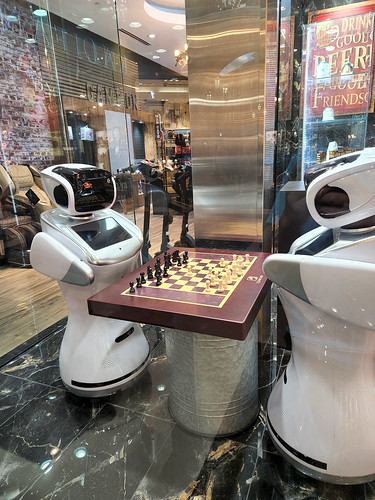
Robots Playing Chess by Joe Shlabotnik, on Flickr

Will artificial intelligence kill off the essay as an assessment form? That seems very likely after reading an article from the University of Sydney, Assessment and integrity in the age of essay-writing artificial intelligence. It describes how you can generate a plausible and well-argued essay on just about any topic using AI algorithms without any risk of falling foul of anti-plagiarism software. The text will be original and offer a variety of perspectives gathered from analysis of countless related texts on the net. In many cases these essays are far better than many students could ever write themselves and the technology is developing rapidly. Similarly the use of AI in teaching is progressing rapidly and we face the prospect of robots teaching and assessing robots.

The most remarkable aspect of this article is that it was written by an AI application called GPT-3 with some minor human edits. It analyses the arguments for and against AI in education and gives examples of how AI generated texts could be used in a positive manner: for example, letting AI generate a text on an introductory paragraph and asking students to compare the AI text with the original. It is remarkably insightful on its own limitations and how academics need to rethink traditional practices to counter the threat of AI.

Because artificial intelligence is trained on a huge corpus of text and has access to the entire internet, it excels at writing and responding to textual prompts. This includes topics that would otherwise be perceived as meeting criteria for authentic assessment. This presents a challenge for higher education academics because we are so accustomed to using exams and other assessments that focus on student knowledge. If artificial intelligence can write essays and answer exam questions, higher education academics need to radically rethink learning, teaching, and assessment in the post-machine era.

But the question remains of whether the essay is a valid form of academic assessment and what new methods we should turn to. The gut reaction to the problem could be doubling down on traditional proctored exam hall tests with no access to digital devices or textbooks but I hope we can think further than this. Learning to write a well argued essay or article is a fundamental skill in all forms of science and it is hard to imagine higher education without this crucial element. But if we can instantly generate an acceptable imitation the exercise becomes somewhat futile. Problem and project-based learning as well as a greater focus on interviews and live seminar discussions would seem to be more relevant both in terms of assessment and as training for professional practice. Writing and critical thinking skills must be learned and practiced but somehow we need new ways to use them. There are already examples of AI-generated texts getting accepted for journal publication and as conference submissions. The foundations of academia are under threat and we need to develop new strategies and methods. 

Jon Dron writes about this in a post, So, this is a thing… and sees the answer in a refocus on people and genuine interaction.

This is a wake-up call. Soon, if not already, most of the training data for the AIs will be generated by AIs. Unchecked, the result is going to be a set of ever-worse copies of copies, that become what the next generation consumes and learns from, in a vicious spiral that leaves us at best stagnant, at worst something akin to the Eloi in H.G. Wells’s Time Machine. If we don’t want this to happen then it is time for educators to reclaim, to celebrate, and (perhaps a little) to reinvent our humanity. We need, more and more, to think of education as a process of learning to be, not of learning to do, except insofar as the doing contributes to our being. It’s about people, learning to be people, in the presence of and through interaction with other people. It’s about creativity, compassion, and meaning, not the achievement of outcomes a machine could replicate with ease. I think it should always have been this way.

Another article, Will artificial intelligence be able to write my college essay? by Eamon Costello and Mark Brown, Dublin City University, raises the need to rethink how we assess learning rather than finding ways to defend the traditional essay. 

Do we try to tame AI to protect old ways of learning or should we embrace its potential and reimagine our assessment practices to reflect the modern reality of living in the 21st century? One creative educator had his students purposefully use and evaluate AI essay writers as part of their assignment.

Finally, this perspective is echoed by the AI-generated article itself, showing a surprising level of insight on its own limitations.

In particular, there is a need to focus on developing higher-order thinking skills such as creativity, critical thinking, and problem-solving, which are not easily replicated by machines. Additionally, it will be important to create opportunities for students to interact with each other and with their instructors on a regular basis, in order to promote the social and emotional skills that are essential for success in the workplace.


Thursday, May 19, 2022

AI-generated essays - time to rethink written assignments


Students will employ AI to write assignments. Teachers will use AI to assess them. Nobody learns, nobody gains. If ever there were a time to rethink assessment, it’s now.

This is a quote from an article by Mike Sharples, London School of Economics, New AI tools that can write student essays require educators to rethink teaching and assessment. There are now tools that use artificial intelligence (AI) to generate highly plausible academic essays, complete with references. The article takes an example of a short essay about the problems around the popular concept of learning styles generated by a Transformer AI program, GPT-3. The user simply entered the first sentence and AI completed the essay. The result is not particularly insightful but good enough to pass and it won't show up in any plagiarism control since the text is completely original. If the essay is fed back into the tool by the teacher it can write a similarly plausible comment on the essay. The whole assignment can therefore be performed by AI, prompting the quote above.

Even if some of the essays generated this way may still have weaknesses (the example in the article has false citations) the whole point of AI is that it is constantly learning and improving. The phenomenon is not new, it has been possible for many years to pay someone else to write your essays for you via essay mills, but now the human element has finally been removed. Does this mean the end of the written assignment as an examination form? 

The author suggests a few ways of using the AI transformer in a constructive way, for example by getting students to generate AI texts and then find faults in them and improve them. This reminds me of how some teachers tackled plagiarism by writing a sample essay/article that included several form of plagiarism as well as poor citation practice and asked the students to find the problems and correct them. 

But the main point here is that we need to move on to new ways of assessing students and avoid examination methods that ask questions that can be automatically generated or copied from the internet. 
Finally, as educators, if we are setting students assignments that can be answered by AI Transformers, are we really helping students learn? There are many better ways to assess for learning: constructive feedback, peer assessment, teachback. If Transformer AI systems have a lasting influence on education, maybe that will come from educators and policy makers having to rethink how to assess students, away from setting assignments that machines can answer, towards assessment for learning.
Live assessment activities like interviews, presentations, debates or round table discussions can be run either on-site or online and are almost impossible to cheat in. But that brings us to the eternal question of how to move the focus in education from extrinsic motivation (exams, credentials) to intrinsic motivation (satisfaction, self-confidence, pride). Focus on competition, rewards and results encourages cheating among some, whereas activities that focus on community, learning for pleasure and intangible rewards are generally free of cheating. If learning is in the forefront there is simply no point in cheating. Hopefully AI-generated essays will remain a mere curiosity.

Wednesday, July 29, 2020

Online exam cheating - a matter of trust and support

One of the most discussed aspects of the last few months has been the issue of online examination. The sudden transition to online delivery worked reasonably well for teaching and collaboration, but teachers whose courses rely on traditional written examinations had difficulties and there are plenty of news stories on the increase in cheating in such settings. Many exams relied on makeshift invigilation via Zoom/Teams/Skype since there was no time to find a more secure option. Online proctoring systems were purchased by many institutions, often hastily, and have resulted in some privacy issues as illustrated in an article in Sydney Morning Herald, 'You’re being watched and recorded, every breath': Students unsettled by exam software.
It’s not fun, knowing you’re being watched and recorded, every breath and movement. It’s even more invasive than a normal exam. Someone is staring at just you, but you have no idea who it is.
In many cases it was not possible to change the whole assessment process so quickly since such changes in a curriculum must be announced to students before commencing the course. 

There's a good discussion on online cheating in an article in Inside Higher EdBest Way to Stop Cheating in Online Courses? ‘Teach Better’. It's based on a webcast, The Academic Integrity Braintrust, featuring three experts in the field, Tricia Bertram Gallant (University of California San Diego), Douglas Harrison (University of Maryland) and David RettingerUniversity of Mary Washington. One important point to remember when judging spring term 2020 is that it was a global crisis when all university education went online with virtually no preparation time. Students were forced to study from home, in less than perfect learning spaces and with often considerable pressure and stress. The temptation to cheat is very strong and if the opportunity arises to cut a corner, many of us will. 

An important factor that leads to cheating is when students feel isolated and out of touch with teachers and colleagues. Harrison picks up this theme:
... when students don’t feel connected and a sense of belonging to the learning community, whether it's online or face-to-face, they are more likely to detach from any sense of collective community responsibility or ethics and substitute for that a pure ethic of mercenary self-interest.
 Maybe increased focus on team-building activities and collaborative learning could create a climate where cheating becomes irrelevant, especially if the course builds on group assignments and the demonstration of skills. Ramping up surveillance and prevention only leads to a cat and mouse mentality. Harrison again:
We end up focusing on the worst possible negative outcomes that the most malicious and malintended student would engage in, rather than starting with, 'What’s the best teaching and learning experience I can construct and deliver for the vast majority of students who are there to learn authentically and who want to succeed?
As a way forward, David Rettinger offers a list of small scaleable changes for improving academic integrity, based largely on community building and the redesign of assignments and assessments. Establishing a sense of community takes time and requires careful planning, but if the class can agree on common ground rules for how they want to work this can lead to a sense of group loyalty that makes cheating extremely difficult to consider. Academic integrity issues need to be taught and discussed and institutional policies made clear to all. Basically, if the students are consulted and involved in how they learn they will be much less likely to cheat. In terms of examination forms, using numerous low-stake tests or assignments reduces stress and makes cheating less tempting.
Rettinger said he had replaced exams in some courses with lots of low-stakes quizzes -- with "stakes so low that it’s not worth cheating." When his courses do include final exams, they are open book, and all of the questions on them are drawn from those students have shared in discussion boards over the course of the term, so that "gives them a sense of control over the assignment."
Maybe this experience will see a drop in traditional 3-4 hour exam hall testing once our campuses open up again. Maybe we can move to more project-based assessment and assignments that reflect the skills and knowledge used in professional situations. Maybe ...

Saturday, March 4, 2017

In your own words ...


The cat and mouse game of plagiarism detection is becoming increasingly difficult for schools and universities as the technology that assists cheating becomes increasingly sophisticated and hard to detect. Simple straight plagiarism generally gets caught by the widely used detection tools like Turnitin but these tools are relatively powerless against more advanced forms of cheating. The most effective method is a human solution like essay mills where students can earn money writing other students' essays and guaranteeing "originality". This is almost impossible to detect unless there are genuine examples of the students' writing to compare with. However a new grey area of plagiarism has come to light with the rise of automatic paraphrasing tools that can rephrase a text so that it will not be flagged as plagiarism in automatic checks.

Paraphrasing is one of the most important skills that students must learn. Summarising a text to capture the essence in your own words and of course providing a reference to the source is a skill that takes years to perfect. However many people are unsure of where the line is drawn between paraphrasing and copying; simply changing a few words to synonyms is not enough and in all cases the original text must be cited. A new study by Ann M. Rogerson and Grace McCarthyUsing Internet based paraphrasing tools: Original work, patchwriting or facilitated plagiarism?, examines how these paraphrasing tools, also known as essay spinning, can be used to evade plagiarism detection and the implications for both students and teachers.

There are many free paraphrasing/essay spinning tools, for example Paraphrasing Tool and GoParaphrase are both tested in the study, and all you do is paste in the text you want summarised and then click for the new text. The results are not impressive, often with many unusual synonyms and awkward turns of phrase but in many cases the text is sufficiently far from the original to avoid being detected in a plagiarism check. If you are willing to pay there are more sophisticated tools that no doubt produce more polished paraphrasing. The study showed that the resultant texts were not detected as plagiarism by standard anti-plagiarism tools. So how can we detect this practice and more importantly how can we prevent people from being tempted to use such tools in the first place?

One aspect that interests me is when paraphrasing is used by non-native English speakers who may be weak at paraphrasing on their own due to limited vocabulary and lack of linguistic fluency. The unusual vocabulary that the paraphrasing tools dig up could be seen by the teacher grading the essay as simply linguistic inexperience rather than signs of automatic paraphrasing. For native speakers this would hopefully start alarm bells ringing but it's not so easy for non-native speakers, most of whom will make similar errors when genuinely paraphrasing themselves.

Where a student is considered to lack the necessary linguistic skills, the errors or inaccuracies may be interpreted by assessors as a student having a poor understanding of academic writing conventions rather than recognising that a student may not have written the work themselves. Where an academic is working in an additional language, they may find the detection of the errors or inaccuracies more difficult to identify.

Another aspect is when the paraphrased text includes references. One amusing side effect of these tools is that even the references get paraphrased and the titles of cited articles get changed beyond recognition, as well as finding synonyms for the authors' surnames. However if you paraphrase a text and use the citations without acknowledging that you did not find these references yourself then that is also dishonest. Finding your own references to support your arguments is an integral part of academic writing.

Furthermore, students using an online paraphrasing system fail to demonstrate their understanding of the assessment task and hence fail to provide evidence of achieving learning outcomes. If they do not acknowledge the source of the text which they have put through the paraphrasing tool, they are also guilty of academic misconduct. On both counts, they would not merit a pass in the subject for which they submit such material.

What can educators do to prevent students from using these tools? The most obvious strategy is to discuss the issue regularly in class, showing that you are aware of these tools and pointing out the dangers. I suspect that many students are simply unaware that automatic paraphrasing is wrong. More support should be offered developing paraphrasing skills and why it they are so vital. Furthermore, the wider use of oral testing is recommended in the article since it is much harder for a student to take short cuts and the teacher can quickly gauge the student's understanding of the subject. Finally educators need to learn how to spot signs of machine translation and automatic paraphrasing and realise that their own professional judgement is still the most important element in assessing student work, even when anti-plagiarism tools are in place.

Of course this post is itself an example of paraphrasing to a certain extent. I hope I pass the test!

Reference
Rogerson AM, McCarthy G.(2017) Using Internet based paraphrasing tools: Original work, patchwriting or facilitated plagiarism? International Journal for Educational Integrity

Sunday, May 22, 2016

Cat and mouse - cheating in education

Cat and Mouse by katie_mccolgan, on Flickr
"Cat and Mouse" (CC BY 2.0) by katie_mccolgan

Every week there are reports of cheating in school and university exams and assignments and it's easy for some to inperpret this as a purely modern phenomenon enabled primarily by digital technology. Is cheating really on the rise or has technology enabled us to detect it more easily? What makes people go to such lengths and expenses to cheat the system? A recent revelation here in Sweden showed that some people were paying well over €10,000 to cheat on their university entrance exams. If you have the cash you can get someone else to write your essay for you and they will also guarantee that it will pass any plagiarism detection system. University entrance and qualifications are hard currency and whenever there are clear rewards on the table the temptation to cheat will always be there. It's certainly prevalent in business, politics and sport so it's naive to think that education should be exempt.

Cheating and counter-cheating is becoming a frantic arms race as each side tries to out-trick the other. Online examination proctoring services are flourishing such as Proctor U and Software Secure. These solutions offer secure online examination by locking down the students' computer and using multi-factor identification, screen, webcam and microphone surveillance and keystroke analysis. In the traditional campus exam hall students can now use their laptops but in most cases they are offline, locked into the exam administration system and monitored. However for every new solution to increase exam security there are counter moves from the cheaters. A classic case of cat and mouse.

This cat and mouse game is discussed in a new post by Donald ClarkLecture, essay, cheat, repeat… plagiarism, why it's endemic and 10 ways to avoid. He sees the traditional reliance on summative assessment as the main problem. Predictable exam questions can easily be memorized and it's easy to get ready-made answers to many common titles, especially if you're willing to pay for it. He suggests several alternatives to summative assessment methods.

Essays are sometimes appropriate assignments if one wants long-form critical thought. But in many subjects shorter, more targeted assignments and testing are far better. There’s a lot of formative assessment techniques out there and essays are just one of them. Short answer questions, open-response, formative testing, adaptive testing. I’d argue that student blogs are often better than essays as one can see progress and it’s not something that’s easy to plagiarise. Truth be told, HE wants it easy, and essays are easy to set. They also have to accept that they are also easy to cheat.
One simple trick Clark suggests is googling your essay question and see if the answers are already out there. We simply have to set assignments that aren't so easy to cheat. If you do set an essay then provide formative assessment by reviewing the drafts to see how the work is progressing. Interviews, face-to-face or video, can give an excellent idea of the student's ability and are very difficult to cheat in. The investment from the teacher's part is often less than that of marking written papers. despite this very few dare to move away from the examination methods that are so clearly easy to cheat. Clark blames institutional inertia and tradition for the situation:

This has reached crisis point. Everyone knows it but there’s a conspiracy of silence. Universities are scared to admit the scale of the problem, as they trade on reputation. We’ve created this monster but institutional inertia is incapable of solving the problem, as they refuses to change.

Clearly no-one benefits from playing cat and mouse and although we'll never eliminate cheating from education there must be better ways of assessing students' ability. The essay or scientific article has for so long been the prime medium of academic communication but maybe we should widen our scope and include other forms of expression for assessment, moving the focus to a richer assessment mix of formative and summative methods as well as using peer assessment and assessment of practical work experience. By widening the focus like this we can at least make cheating extremely difficult.

Tuesday, September 1, 2015

Learning means getting below the surface


When I was a student I knew a few guys who almost never went to lectures and spent most of term either asleep or in the bar. Then a couple of weeks before the exam they suddenly burst into action, borrowed friends' notes and assorted books and then scraped through the test. I imagine there are still people like that at most universities. They didn't learn much but they had worked out the secret of knowing enough to pass the exam. It worked at least for the first two years but I've no idea how they got on after that. Hopefully they woke up and got involved when the course began to get more interesting. The reason I bring this up is to show that some people have always tried to take shortcuts, even on campus courses, and that this is not a problem exclusive to online education as many people try to make us believe. Some courses, both face-to-face and online, make it too easy to take shortcuts and not surprisingly many people are happy to capitalize.

A couple of articles in Inside Higher Ed sparked off this train of thought. Firstly one about cheating in some MOOCs, Multiple Personalities, Disorder, where researchers from Harvard and MIT have discovered that some participants were using multiple registrations to find out the right answers to the tests. Many courses use multiple choice tests to assess progress and when you have completed the test you can see the answers. So once you've seen the answers using your fake identity you simply log in as yourself and pass the test. If you make it so easy to cheat then it's no surprise that some people do. These types of self-correction tests are fine for helping students to grasp basic concepts and as a quick memory check but they should not be used as criteria for awarding certificates.

Secondly an investigation into the shortcomings of introductory courses provided by non-traditional education providers, General Ed Cheap and Easy. There are a number of online educational companies that have set up MOOC-like courses and the article shows how easy it is to get certificates and in some cases the opportunity to be awarded university credits without having understood so much. Once again the courses basically packaging content and then asking you if you remember what was in unit 2. The author tried a course in marketing and was able to get good results despite very little knowledge of the subject and without having to read too much.

Through inferring the correct answers, lucky guesswork, and trial and error, I completed 40 of the course’s roughly 240 units. I have a perfect score in all but two. I have never taken a course or worked in marketing.

This type of content delivery and memory testing can of course help you get a very broad grasp of a subject, just like reading a book or watching a few lectures. But the worrying thing is that some of these courses are getting accredited and can lead to you being awarded university credits. There's a lot of discussion about the unbundling of education and the promise of non-traditional providers and alternative paths to learning. I have written enthusiastically on this many times here and believe there is huge potential here, if managed carefully. However we have to be wary of courses that merely offer simple information transfer and superficial testing and not confuse these with courses that promote real learning and force learners to discuss, question, rethink and come to their own conclusions. Learning means digging below the surface of facts, figures and multiple choice tests. Many new providers have very slick and convincing marketing to show that they are more flexible, learner-centred, effective and enjoyable than traditional education. The sirens sing very enchantingly.

Some providers deliver what they promise but many are simply old wine in shiny new bottles. Some are pure bluff, verging on degree mills and suchlike. The problem is that they reinforce the view that this is typical of online education. The online element does make it easier to set up less professional operations but bad practice is not simply connected to form of delivery. When well designed and professionally run, online education can be as interactive, challenging and engaging as any face-to-face course. Those who offer accreditation need to learn how to see through the smokescreen and tell the serious professional providers from the rest. It's also our responsibility to become more discerning students and learn how to filter out the buzzwords and glossy surface.

Tuesday, May 7, 2013

A MOOC on cheating

Online Test  = Open CHEAT! by Mr_Stein, on Flickr
Creative Commons Attribution-Noncommercial-Share Alike 2.0 Generic License  by Mr_Stein

Cheating in online courses always attracts a good deal of media attention and is often accompanied by cries for tougher measures to counter cheating as well as criticism of online learning in general. So if we are going to deal with this issue how about organising a course on the subject? This is exactly what is now offered by Bernard Bull of Concordia University Wisconsin - a new MOOC called Understanding Cheating in Online Courses. It's a course for educators to investigate different types of academic cheating, how to spot them and especially how to design courses that make cheating either very difficult or irrelevant. Not surprisingly the course is already full (1000 students) but is most likely to be repeated given the current interest.

"Participants in this eight-week open course will examine philosophical and psychological perspectives on cheating; consider instructor, institutional, and student perspectives on cheating; learn about specific strategies and practices used by students to cheat in online courses; and develop a plan for cultivating a culture of honesty, integrity, and accountability in online courses. The end goal of the course is for participants to gain a deeper understanding of cheating in online courses."

As with most MOOCs there are no credits available for the course (not worth cheating basically) but there are a number of badges available for successful completion of the modules. However it may inspire other universities to include for-credit courses in this field since we need to investigate and understand more fully what we really mean by cheating and whether we even invite cheating by choosing certain types of instruction methods. 

In a networked world where we borrow, remix and reuse other's work in increasingly sophisticated and creative manners we really need to revise our ideas on "cheating". Copying and imitating others is a vital part of learning, as long as we clearly show that we are doing just that. When you don't know how to approach a problem at work you consult your network to see if someone has the answers or at least some assistance. At work this shows initiative whilst if you did that with an examination task it would be cheating.

Read a good overview of the course in an article in The Chronicle of Higher EducationMOOC Teaches How to Cheat in Online Courses, With Eye to Prevention.

Sunday, December 2, 2012

Online cheating - the discussion rolls on

Cheating Cheaters and the Cheaters Who L by Mr_Stein, on Flickr
Creative Commons Attribution-Noncommercial-Share Alike 2.0 Generic License  by  Mr_Stein

The debate about cheating in online courses seems never-ending and, honestly, as long as we set assignments where the answers can easily be found on the net it's not going to go away. Tony Bates writes about the problem in a post called Tools to prevent online cheating. He refers to a recent post by Ki Mae Heussner on Gigaom, Five ways online education can keep its students honest, which lists methods to counter student cheating. These methods involve setting up web cameras to watch students as they take the test, keystroke pattern recognition, browser lockdown and anti-plagiarism software.

If you want to test a student's ability to remember facts then traditional invigilated examinations are still probably the most effective method, though far from foolproof. An alternative often used around the world is local learning centres that can offer students in the region the chance to take tests in an invigilated environment in cooperation with the university. In these situations you can easily have ID checks and ensure that the right person is sitting the exam.

Online tests, however, are always going to be problematic unless we simply stop using this type of examination. A web meeting using for example Skype where the teacher can question the student face-to-face is ideal and reliable but too time consuming for classes with more than a small number of participants. However continuous assessment through a variety of assignments and using different media can give a reliable picture of the students' ability since the teacher can learn to recognize the student's style of expression. The key however is to base assessment on tasks that demand relating practical experience with personal learning; thus making the answers so personal and specific that it is virtually impossible to cheat.

Bates' conclusion however puts the cheating issue into perspective. Cheating means you have missed the point of education and the main person you're cheating is yourself.

"Cheating is often the result of a poor educational process or experience. Once again, this comes down to the distinction between learning as transferring information vs learning as a developmental process. If, as I do, you believe education is a developmental process, it is the student in the end who loses from cheating, because they have missed the point of the exercise, which is self development and growth."

Tuesday, September 25, 2012

Remote control

There have always been people who offer to write your essays or assignments for you at a price. It's inevitable that such services will now thrive on line and it's no surprise to read in Inside Higher Ed this week an article called Paying for an A. It highlights web services like We take your classes that offer to do your online courses for you while you concentrate on more interesting activities.

In the past such services offered to write a single assignment for you whereas now they can take the whole course. It's not cheap and is probably not an option for the vast majority of students but with so many online courses available today there must be plenty where identity checks are less stringent than they should be. Instead of being outraged and deciding that online education is wide open for cheats we should maybe look a little deeper at this type of scam and what it really says about education.

If you can let someone else do the course for you then the provider has definitely got serious quality issues to deal with. The article in Inside Higher Ed gives examples of colleges who have quite rigorous security checks on online students to ensure that the right person is answering the questions. Random questions, video sessions, bank-style personal security log-ins and biometrics may all feature in online learning before long. However we also have to look at the way many online courses are designed. Courses that are based on the transfer of information and are heavily content-based tend to have examination forms that lend themselves to cheating. The greater the interaction between teacher and student and between students the harder it gets to cheat like this. According to Kyle Johnson, an independent higher ed consultant:

“What kind of experience are we providing for students if someone is able to take an entire class for a student and we never figure it out from the interaction? At a pedagogical level, that’s my concern. Are we really just dumping information at them so someone can come in and take a couple of quizzes and they’re done?”

Two conclusions from this case then. We need to move from linear, content-based courses to collaborative, task-based courses where assessment comes from successful completion of projects and where networking and dialogue make cheating extremely difficult. We also need to find better ways of checking identity online and maybe more complex log-ins as described in the article may be part of the solution.

Thursday, September 20, 2012

Don't shoot the piano-player

Copy Find Paste by shakakahnevan, on Flickr
Creative Commons Attribution-Noncommercial-No Derivative Works 2.0 Generic License  by  shakakahnevan

There's a steady stream of headlines about cheating in education. It's mostly cases of plagiarism and an underlying tone in many of the reports is that this is rising due to the use of computers in schools and universities. We bemoan today's cut-and-paste culture and many are increasingly sceptical of online examination. It's easy to blame technology for the increase in plagiarism but you seldom read about the technology that detects the cheaters. Is plagiarism really on the rise or are we getting better at discovering it?

Back in the good old days when I went to university I suspect that cheating was just as frequent, if not more so. Today a teacher can use anti-plagiarism software to check a student essay but in the past the teacher had to be very sharp to detect any signs of cheating. A clever student could certainly cut and paste from old essays and more obscure journal articles and run very little risk of being detected.

We regularly read about politicians, business people, celebrities and sports stars who cheat and cut corners to win the big deals and honours. Therefore the idea that education would be any different is absurd. If there are material rewards at stake then some people will be tempted to cheat. The greater the rewards the greater the temptation. It's not the net that causes people to cheat, we've been good at that for centuries.

Monday, October 17, 2011

What did you learn in school today?

In the formal education system the main aim for most is to get the grades needed to get a good job. Passing exams is therefore hard currency allowing you access to well-paid jobs, and so students everywhere learn to give top priority to tasks that will ensure that they pass the next hurdle. It's no surprise then that many are willing to take short-cuts to success by cheating in ever more ingenious ways. That's the theme of an article in Mind/Shift called What's behind the culture of academic dishonesty?.According to the article cheating in higher education is at an all-time high and even the most gifted students are doing it to ensure they get the top grades they need.

Day 23 - Exam hall by jackhynes, on Flickr
Creative Commons Attribution-Noncommercial-Share Alike 2.0 Generic License  by  jackhynes 

An article in Psychology Today (School is a Breeding Ground for Cheaters) by Peter Gray of Boston College argues that the present school system is to blame. You're not at school to learn, you're there to learn how to pass the tests. That's how students and schools are judged and we seem to be increasingly obsessed with league tables showing how effective schools are. This leads of course to schools teaching how to pass the tests to ensure that they move up the rankings. It's a destructive circle.

"Students become convinced that high grades and advancement to the next level are the be-all and end-all of their school work. By the time they are 11 or 12 years old, most are realistically cynical about the idea that school is fundamentally a place for learning. They realize that much of what they are required to do is senseless and that they will forget most of what they are tested on shortly after the test. They see little direct connection--because there usually is none--between their school assignments and the real world in which they live. They learn that their own questions and interests don't count. What counts are their abilities to provide the "correct" answers to questions that they did not ask and that do not interest them. And "correct" means the answers that the teachers or the test-producers are looking for, not answers that the students really understand to be correct."

In stark contrast look at all the learning that takes place away from the classroom. Many pupils and students who go through the motions of learning in school become passionate learners in their "spare" time pursuing their own interests, whether it be motorcycle maintenance, geneology, gardening or following a favourite football team. Learning for the sheer pleasure of discovery and becoming an expert in your particular passion. Think of how much energy people put into this type of learning; hours of reading, long discussions with fellow enthusiasts, endless practice, trial and error until mastery is achieved. There are no exams and nobody cheats - there's no point.

Just imagine that level of devotion applied to school or university work. People love to learn if the motivation is from within and even if there are no tangible rewards apart from sheer pride in being good at something. Whenever we put grading and financial rewards into the equation the stakes are raised and corners are there to be cut. We need to look more closely at informal learning and learning psychology and find ways of making the formal system more meaningful.

Monday, December 27, 2010

Cheating or learning ?

All through school and university I was conditioned into thinking that learning was a solitary process. Studying meant hiding away in a room for hours, sometimes days, silently reading, memorising and note-taking. The idea that I could learn anything from my fellow students never really occurred to me; only teachers could teach me. Group work was extremely rare and academic ability was assessed on what you could write during a 3 hour session, completely unaided and relying solely on memory.


This attitude to education is still very entrenched in society although many educators are trying to change things. In most workplaces you can't simply sit on your own to solve a problem. You need the ability to quickly find people who can help you.with a problem. No-one expects you to solve things completely on your own and even if you did you'd still need to sell your solution to your colleagues. The modern workplace demands teamwork, social competence, networking and information retrieval skills; none of which are given much time in the traditional educational system.

I've just read a good article on this theme in The Washington Post, What some call cheating can help learning. The author points out how inconsistent the education system is today when it comes to student collaboration. In one school pupils are allowed to take notes into the exam hall whereas another school wuld consider that as cheating. Some schools encourage group work and collaboration whereas others outlaw it since they want to assess each pupil on thier own skills.

"At these two institutions dedicated to equality under the law, what my daughter did during exams at one could have been considered cheating if she attended the other. What are we to make of the uneven nature of such rules, just as unpredictable as those found in our public K-12 schools? Open-book exams are okay some places, not in others. Cooperating with friends on homework is encouraged by some teachers, denounced elsewhere as a sign of declining American moral fiber."

Would we ever be faced with a task at work where we would not be allowed access to reference material or advice from colleagues? Don't we "cheat" every day at work by seeing if we can find a colleague with previous experience of the same problem? The article suggests that homework would be far more effective if the social learning aspect could be stressed as opposed to the solitary and often dull activity it always has been.

Maybe it's time for the education system to find ways of assessing a pupils skills at teamwork, networking and collaboration and valuing them as highly as the individual skills presently assessed.

Friday, April 24, 2009

Is cheating creative?

I read a short article in my local newspaper yesterday about a survey of the most popular websites amongst 10-15 year-olds. The top two were predictable, YouTube and MSN, but in third place was a Swedish site called fuska.nu. This web address can be translated as cheat.now. Here you get masses of cheat codes for virtually all games, enabling you to beat everyone without bothering to learn the finer points yourself. Many games take weeks or even months to work up to a higher level but many players are evidently tempted to take short cuts to glory.

Similarly, there’s the phenomenon of people selling ready-made heroes or high status attributes on eBay and suchlike. Those who have no patience with the long learning process in the game can buy their way to instant status.

Does this mean that cheating is becoming more acceptable? The site doesn’t try to disguise its content so the word must be more positive than in the past. The “cheaters” compete with each other in trying to uncover the bugs and loopholes in the latest games and make them public as quickly as possible. Those who spend their time testing and finding cheat codes are indeed creative talents and actually provide some pretty concrete feedback to the games’ programmers by revealing the glitches. However those who simply use the cheat codes to find a short cut to beating their friends are not being particularly creative.

Sometimes you have to admire the ingenuity involved in cheating effectively. Why not use that creativity to do something more positive instead? But then again there’s the challenge of beating the system and the glory of succeeding. The file sharing community is very much about “beating the system” and finding ever more ingenious methods for doing so and avoiding discovery. At the same time the companies they are fighting against battle in vain to close down the loopholes and improve security. It's a fascinating battle.

Maybe all this can be seen as necessary irritants to force an otherwise complacent industry from getting too powerful. They are forcing the computer, telecom, music, film and gaming industries to be constantly on their guard and in some cases realize their vulnerability if they don’t adapt. It’s all part of a grey zone between relatively honest creative experimentation and the hardcore criminal activities of the major hackers.