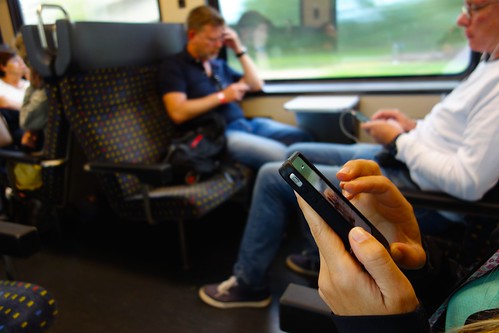
Showing posts with label choice. Show all posts

Sunday, November 7, 2021

Digital default and the end of privacy

There's a shoe repair shop in town that I visit now and again that is making a brave last stand against the compulsory digitalisation of our lives. Not only is the concept of repairing anything unthinkable for most people today, but the owner only accepts cash - no cards, no mobile payment apps. I wished him the best of luck but in the end the digital juggernaut will run him over. I still carry cash as a futile personal protest against everything I do being tracked and stored by corporations I have no control over. It's nice to be able to do something that is off the record. Digital products and services have totally changed our society and of course I benefit from them in so many ways but I'm increasingly uncomfortable about the abolition of privacy that we are happily consenting to as we accept terms and conditions that we never even read let alone understand.

Compulsory digitalisation is marginalising society's most vulnerable making even simple tasks almost impossible without a smartphone or laptop. It is becoming increasingly difficult to survive without at least a smartphone, devices that are not exactly free of charge. Many smaller shops and cafes here don't accept cash anymore. We are so dependent on our mobiles that we seldom dare to actually turn them off anymore. If the net went down for more than a few hours society would grind to a halt. I realise this sounds like typical grumpy old man behaviour, but this week I found solace in a couple of articles in the Guardian.

Firstly Jen Wasserstein writes about life without a smartphone, My life without a smartphone is getting harder and harder. She's a professional with a very digital working life but has decided to stick with an old-school mobile that only does phone calls and texts. She feels the world slowly shutting her out as even restaurant menus are now hidden behind QR-codes. Indeed parking a car, buying a bus ticket or even getting into unstaffed self-service mini-stores require apps. I admire her tenacity but I suspect that she too will soon concede defeat and join the digital captives.

At a recent dinner with friends, after some initial chatting, everyone stared at menus on their phones. I sat there for a minute looking around the table and then whispered to my neighbor, discreetly asking to look on. When I eat out alone, I show my flip-phone to the waiter and ask for a proper menu. After an eye-roll, they’ll either bring out a paper menu from some vault in the back or hand me their own phone to use.

We have become so dependent that we have forgotten how to do things without our digital devices. We often discuss all the new "21st century" skills we have acquired but we have probably lost just as many. This is the topic of a new book by Pamela Paul, 100 Things We’ve Lost to the Internet (Random House USA), What does tech take from us? Meet the writer who has counted 100 big losses. Some of the lost skills are now irrelevant anyway - finding people in gigantic phone directories or writing cheques for example - but Paul's book reminds us of many other skills and experiences we have lost in the digital takeover. She's not an off-grid type but simply wonders about the everyday experiences that fallen by the wayside in our hyper-connected lives, such as being bored, getting undivided attention from parents/children, finding your own way, writing letters etc. I particularly like this comment:

In general, when I hear the phrase ‘There’s an app for that’, my first question is: ‘Does there need to be?’
We should have a choice but we're choosing to not to. It's a combination of commercial and group pressure as well as a rather naive view of the benefits of technology. People are vaguely aware of the dangers of mass surveillance but seem to think that those are only issues in authoritarian countries - it can't happen here.
Here, perhaps, is a modern paradox. We embrace the internet because it seems to hugely increase our autonomy, but the online world soon gives us the sense that, when it comes to what it offers us, we have no meaningful choices at all. The only thing to do is to drop the old, embrace the new and live with the consequences.


Saturday, September 21, 2019

Digital by default - who is excluded?


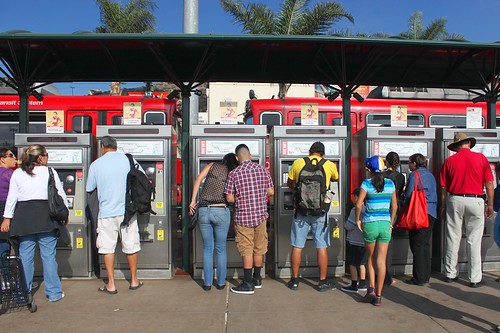
I like to think that I am fairly comfortable with digital tools and platforms, but I feel a backlash growing inside me when the digital option is pushed into my face. Here in Sweden for example, cash has become almost obsolete, there's an app for everything and shops are becoming increasingly self-service. When a shop forces you to use those awful self-service checkouts, or you can only pay for parking by downloading the special app (that I as a visitor to the town will probably never use again), or when you arrive in a new city and are faced with the challenge of negotiating the often complex automatic ticket machines (offering you a myriad of options but never the one you are looking for). The hours I have wasted on such frustrating processes that an old-fashioned human contact would have solved in seconds.

I sometimes feel I'm the only one who feels like this, but received welcome support from a post by James Clay, Digital should be a choice… The new digital solution may be welcomed by many but we also need to consider who we are excluding by installing even more self-service machines or apps. Offer us a choice and we can maybe accept the change in time, but if there is no choice people will suffer.

We often forget that sometimes people don’t like innovation and innovation doesn’t automatically always mean better. Actually most of the time innovation for a lot of people is rarely better. Sometimes its worse than what was before, most of the time it’s just different.

I simply don't want to install new apps every week that clog up my mobile's limited capacity and that I only use a handful of times a year at most. Most buses are now cashless and if you don't use the app or have a prepaid card you are punished by paying a high price for a single ticket from A to B. In many self-service shops there is a forest of machines and one manual checkout with a long queue (curious isn't it?). At one railway station with only self-service ticket machines I saw several members of staff who spent all their time helping bewildered travellers to use the machines!

James Clay applies this to education where an increasing amount of services on campus are being migrated to kiosks or chatbots. What about students or staff who for some reason can't or don't wish to go digital in this way. Is there any real person I can ask? What do I do if I don't have a mobile that supports the latest app? Some tech companies have rationalised all traces of personal contact from their customer service, replacing it with vast FAQ pages and self-help discussion forums. Sometimes I have a problem that isn't covered there or I'm not prepared to spend the next two hours combing through the site to find an answer. I just want a quick answer. Of course I can check in myself at a hotel and do everything by app but I do like to meet a person who smiles and can answer my questions (no, I don't want a humanoid robot at the desk either, no matter how polite they may be).

Digital by default means making the first option digital, but there needs to be a second option, one that may require the use of people to deliver the service.

Whenever we innovate we need to consider whether we are excluding anyone and ensure that we have an option for them. 

Sunday, May 7, 2017

Online, distance, blended, mobile, campus, hybrid - it's all about learning


We love to put labels on everything but the problem is that the object or concept that we label refuses to obediently stand still and remain true to the label we placed on it. Many concepts have changed significantly but remain trapped under an outdated label, charged with often inaccurate preconceptions and prejudices. This is very true in education, especially when discussing the use of technology, and has resulted in a host of terms to describe education that involves some element of technology to allow participation that is not strictly tied to a physical classroom.

I'm very uncomfortable with all the terms used to describe this field: online, distance, blended, mobile, hybrid, technology-enhanced, web-based etc. As soon as you add one of these epithets you put it in a box, apart from the mainstream term learning, thereby encouraging a polarisation between traditional (standard) and "alternative" forms. Being asked to read a printed book at home and write an essay on it is considered standard whereas doing the same thing on a screen is suddenly alternative and different.

Tony Bates has written an interesting post about a major survey of online and distance learning in Canada that he is involved in, What is online learning? Seeking definition. An essential part of such a survey is being able to define what types of education to include and not surprisingly there is a plethora of terms and definitions with considerable variation in interpretation between universities and colleges. The distinctions that existed 20 years ago have now become blurred and it is questionable whether some terms should be maintained at all.

Although from about the late 1990s until quite recently, most online learning was asynchronous, and based primarily on the use of text-based learning management systems, that context appears to be rapidly shifting, with more synchronous approaches either replacing or being combined with asynchronous learning (another definition of ‘blended’), and the increasing use of streamed audio and video. What is already clear from the piloting is that we are trying to describe a very dynamic and fast changing phenomenon, and the terminology often struggles to keep up with the reality of what is happening.

For me all learning today is blended in some way or another: instruction and collaboration, online and on-site, synchronous and asynchronous. Labeling creates an illusion of order but in truth most education today involves some element of technology and it is becoming impossible to maintain clear definitions. Let's move on to using a mix of modern and traditional tools and methods to design courses that offer flexibility and inclusion allowing learners to participate and interact in a variety of ways and not be restricted to only one space, method or tool. It's about learning, using the media, tools and methods that are available today in the most appropriate way to support the learning outcomes. Labels confuse more than they enlighten.

Saturday, October 8, 2016

Promoting linguistic diversity


I follow people on Facebook and Twitter who speak many different languages; some I understand well, some a little and some I don't understand at all. I also post in different languages, mostly English and Swedish, and know that when I tweet in Swedish I only reach a few of my potential audience, the others will just not read it. However once you get used to clicking on the translate button suddenly new communication channels open up for you. The translations are not perfect but a lot better than not understanding at all. Unfortunately I fear very few people take the trouble to do this. Most people in the world live in a multilingual environment where a working knowledge of several languages is not unusual. However on the net that diversity is often missing, even if there are rapidly improving tools that could enable multiligualism. In general all international discussions are in English and those who are not fluent are relegated to the sidelines and passive observers.

Linguistic diversity has of course always existed. It's only in the last 150 years that we, especially in Europe and North America, have adopted the arrogant notion of each country having only one language and as a result any diversity has been viewed as uncomfortable, sometimes even undermining the notion of the monocultural nation state. English is now the undisputed language of international communication but even accepting this I still think that those who are not fluent deserve the right to be heard and it's time to learn again to live with diversity. In the case of a rapid-fire chat on Twitter you don't have time to sit and think about how to formulate yourself correctly and if you can do that faster in your own language, why not? Automatic text translation is improving every year and with that comes the opportunity for silent participants to become active participants.

A colleague alerted me recently to the concept of translanguaging that is being increasingly used in multilingual classrooms around the world. Here bilingual students are encouraged to use their full linguistic range by, for example, doing group work in one language and reporting back in another. Students are encouraged to translate for each other and as a result multilingualism becomes embedded in everyday practice. You accept that you can't understand everything in every language but the group soon works out strategies to minimise misunderstanding and many acquire new language skills simply through exposure and help from friends. This might be seen as a challenge to the teacher's authority but it can help shift the teacher's role towards that of facilitator and mentor. Even if the teacher is monolingual it is possible to learn basic expressions in all the class's languages and empowering the students as interpreters. The result is that everyone can express themselves and noone is excluded on language grounds. If this can be achieved in the classroom where the spoken word is so vital then surely it's possible in an online environment with all the tools and apps we have at our disposal.

Translanguaging pedagogy requires a different type of teacher, a co-learner. Classrooms are increasingly multilingual in the world. It is impossible for teachers to know all the languages of students. But it is possible for teachers to build a classroom ecology where there are books and signage in multiple languages; where collaborative groupings are constructed according to home language so that students can deeply discuss a text in the dominant school language with all their language resources; where students are allowed to write and speak with whatever resources they have and not wait until they have the “legitimate” ones to develop a voice; where all students language practices are included so as to work against the linguistic hierarchies that exist in schools; where families with different language practices are included. Any teacher, including a monolingual one, can take up translanguaging to enable their bilingual students to make deeper meaning and legitimize their home language practices.
What is Translanguaging? An interview with Ofelia GarcĂ­a (Psychology Today, March 2016)

Of course there will always be a lingua franca in every class, group or community and it is essential that everyone has at least a working knowledge of it to be part of that group. However we can still facilitate a more multilingual environment to be as inclusive as possible. The main difficulty is winning over monolinguals to seeing it not as a threat but as an enabler. If we can get used to seeing comments in an online discussion in a variety of languages and can cope with the momentary inconvenience of clicking the translate button we may finally hear what previously silent colleagues think and the discussion can only benefit from new perspectives.


Thursday, June 30, 2016

How would you like your course?

CC0 Public Domain on Pixabay
Pretty well every MOOC provider today builds in some kind of arena for interaction and collaboration and although many participants still operate in self-study mode there are many who see the course as a networking opportunity and simply learn better in the company of peers. Interaction and collaboration have long been seen as the key to raising the completion rates in MOOCs. The problem is that we all have our own preferences when it comes to interaction; some enjoy synchronous video or audio meetings whilst other prefer asynchronous chat or discussion threads. We also have cultural differences in how willing we are to discuss with strangers and seeing learning as a collaborative process. Add to this the linguistic difficulties many non-native English speakers experince especially when entering an advanced academic discussion with highly eloquent native speakers. Just offering an arena and hoping people will discuss simply doesn't work. But maybe if we first ask the participants how they would like to learn?

A new study from Penn State University, highlighted in an article on Campus Technology, Grouping MOOC Students by Communication Mode Doesnt Help Completion, offered MOOC participants a choice of how they would like to interact with peers in their MOOC and put them into study groups according to those preferences.

A team of seven researchers undertook an examination of participants in a Penn State MOOC, "Creativity, Innovation and Change," which was delivered on Coursera and drew 200,000 people from 190 countries in 2013 and 2014. Volunteers in the course were asked to fill out a pre-course survey online to provide demographic information and designate their learning preferences: Did they prefer to be part of a group that used asynchronous text posts, synchronous text chats, or synchronous video and audio as their primary channels for communication?

The results were not particularly encouraging as far as raising completion rates was concerned but the study does offer new insights into interaction preferences. For example participants over 40 were more likely to complete the course than younger participants and female participants were more interested in study groups than males. Further study in more courses will hopefully be made.

Statistically significant relationships were found between learners’ preferred communication modes and their level of English proficiency, gender, level of education, and age. Although placing learners in groups based on their preferences and introducing them to each other did not improve course performance or completion, our findings on preferred communication modes, combined with more formal instruction of how to function as group members may prove to enhance learning and engagement in MOOCs.

Since MOOCs are free and without formal demands it is unlikely that completion rates will ever be particularly high but I'm sure that creating a sense of community is a key factor to helping more participants stay the course. One area that needs to be developed is not just asking about collaboration preferences but providing support on collaborative literacy. Many people simply don't know how to work collaboratively, especially online and some kind of pre-course guide on how to get the most out of your course followed by a choice of participation options could help a lot. Study groups could be offered around synchronous or asynchronous interaction, self-study, geographic location, native language or a mix. Can we somehow offer supportive and safe study groups as a complement to massive openness then maybe that will lead to more people benefitting from this type of education.

Reference
Exploring the communication preferences of MOOC learners and the value of preference-based groups: Is grouping enough? Qing Zhang, Kyle L. Peck , Adelina Hristova, Kathryn W. Jablokow, Vicki Hoffman, Eunsung Park, Rebecca Yvonne Bayeck.  Educational Technology Research and Development pp 1-29 (March 2016).

Thursday, August 15, 2013

Too much cake


I wrote recently about self-service learning and how MOOCs offer a convenient complement to formal education. The analogy of the self-service cafeteria where learners can compose their own blend of short courses is very attractive and I believe that we are seeing the emergence of a much more varied and flexible ecosystem for learning combining the benefits of short, just-in-time online courses with longer formal courses and programmes. You choose the option that best fits your current lifestyle and needs.

However there is a danger of letting everyone compose their own education by piecing together dishes from a gigantic buffet. What happens if you only choose the cakes and miss out the vegetables? This is the theme of an article in the Washington Post by Robert F Bruner: Commentary: Without structure, learning crumbles. He's worried that the new educational buffet will mean that people will only learn what they want to learn and thus will miss the less attractive but essential details that put everything into context. It's a bit like the problem of personalization on the web. If we can tweak our preferences so that we are only exposed to news and information that we agree with we will simply live in a bubble, unaware of other points of view or sheltered from unpleasant information. Our own preferences are not enough. Someone has to ensure that we have a balanced diet.

"Too much dessert and not enough broccoli. Students who simply follow their appetites will eventually find some educational candy: courses that may gratify an immediate interest, but don’t really build one’s capabilities. Like a healthy diet, a great education consists of a balance of intellectual nutrition. Eat your vegetables. They are good for you."

How do we make sure students "eat their greens" as well as benefitting from the flexibility and diversity of today's learning environment?

Wednesday, April 3, 2013

The future of education is diversity

learn by Mark Brannan, on Flickr
Creative Commons Attribution-Noncommercial-Share Alike 2.0 Generic License  by Mark Brannan

There are a lot of articles about the future of education/schools/universities full of claims and counter-claims about exactly which technology or method will prevail. I think the answer is that education and learning will take place in a wide variety of settings from traditional classrooms to virtual worlds and in many modes from independent self-study to small collaborative projects to massive online courses. In the past education was more limited to face-to-face meetings at set times or to correspondence courses with long response times. Today there are so many options available to satisfy all preferences. MOOCs are not going to replace regular university courses, they simply add new options and new arenas for learning for those who learn well in that type of setting.

There are plenty innovative platforms for learning. One such that has just caught my attention is the London based site The Amazings. The idea here is that people with a passion for a practical skill can offer classes to anyone in the area via the site. The focus is on older people (over 50) being able to offer their knowledge and skills to the community and earn money for it. These classes, workshops and courses range from £15 to £140 and are all face to face sessions in the London area though they plan to expand to other cities as demand increases. The teachers are not necessarily qualified but are all enthusiasts who want to share their knowledge. Classes take place in all sorts of places but never in a classroom. Their tone is refreshingly honest and hype-free:

"Who are the classes for?
Anyone who wants to learn but hates formality. We want to make learning more fun, more friendly, more social, and more personal. If you want certificates or diplomas, keep on walking. If you're interested in learning for its own sake, we've probably got a class for you."

Read more about the Amazings in an article in the Independent, Meet the Amazings! Keeping knowledge alive. Here's a short video that presents one of the courses, how to play steel drums:


At present there are very few online courses in the Amazings but a similar service that has been around a while now, Skillshare, offers a wide range of online informal courses as well as face-to-face sessions in various cities (mostly in the USA).

People helping other people to learn, online, in person, anywhere, any time. If you can't meet physically you meet online. It's all about people communicating, helping, learning. There is no best method, no killer app, no disruption. It's about diversity, choice and flexibility.

Wednesday, February 13, 2013

Space to think

We learn through collaboration, discussion and sharing. However we also learn by quiet contemplation and by the often solitary processes of reading and writing. Most levels of education today, both classroom and online, stress the importance of group work and our ability to function in groups is highly valued. However there's a risk that we are forgetting the importance of working alone and thereby losing the opportunity to think deeply.

This is the theme of an excellent TED talk by Susan Cain called The power of introverts where she argues the case of all introverts who aren't comfortable with group work and seldom contribute to class discussions. This is not because they have nothing to contribute - often quite the contrary - but that they need time to think before expressing themselves. Classroom discussions are generally dominated by a few confident students and group work is also dominated by those who enjoy speaking and being the centre of attention. Crowds are not always as wise as we think and are sometimes easily lead to the wrong conclusions by dominant or manipulative members, both in class and online. She argues that society puts too much emphasis on groups and social interaction and sees solitary activities as negative. Offices are now mostly open landscapes and few people have the luxury of a quiet space to work. Open spaces can be creative but creativity also needs peace and quiet.

A teacher's perspective on this issue is presented in a blog post by Monica Edinger, In the Classroom: A Few Classroom Teaching Suggestions from an Introverted Teacher. She presents a selection of strategies to enable the less vocal students have a say in class discussions. This involves waiting for answers in silence rather than always feeling obliged to say more. It also involves not giving the dominant speakers so much space to dominate, doing much less group work and giving students more time and space to think. Written communication, often as an online private dialogue between student and teacher, gives more introvert students a more appropriate channel to reflect and discuss their learning.

The main idea behind the concepts of flexible or blended learning is that we have the tools and methods to let students learn the way that suits them best. There is a need for dynamic group work and that must be available but we shouldn't forget that many people learn best on their own and need more space to learn. The secret is in the mix.

Thursday, January 17, 2013

Narrowcasting

Roulette by stoneflower, on Flickr
Creative Commons Attribution-Share Alike 2.0 Generic License  by stoneflower

Narrowcasting is my new word of the week. It turns up in an article by Michael Petrilli, Tweet thine enemy. Basically it's about the way we tend to live in a social media bubble, only following people we agree with and seldom being exposed to opposing views. The author has compared the Twitter followers of various American political and educational figures and examined if there is much overlap.  In most comparisons between followers of republican/democrat, radical/conservative the amount of people who followed both sides was between 5% and 15%. This was also evident in educational debate between traditionalists and radicals; the two sides simply talk past each other and rarely meet.

"The bottom line is that there’s a whole lot of talking past one another in the education debate, though maybe less than in the political debate writ large. Want to be part of the solution? You might start by following on Twitter people whose views you abhor and staying open to the possibility that they might, nevertheless, have a few smart things to say."

No surprise really and I'll admit that I'm probably guilty as charged. We need more serendipity in our net lives - room for the unexpected. Maybe Twitter should introduce a pot-luck feed you can subscribe to which chooses random comments from your field of interest and where you will probably meet views you do not subscribe to. The old term surfing the web that was coined way back in the early nineties was probably the opposite of the sheltered web we live in today. I remember my early surfing days when I simply followed links wherever they took me just for the thrill of discovering what was out there. Now that I feel at home on the net I tend to visit the same places. 

One antidote to all this is StumbleUpon. Here you just click and are taken to a random site that fits the interest categories you fill into your profile. If you don't select too specific interests StumbleUpon will take you to all sorts of pages. If you're not interested you just click and you get a new page and you keep clicking until you stumble upon something interesting. The idea is that StumbleUpon will slowly learn what you like as you refine your preferences and choose ever more specific categories in your profile. However if you don't refine your profile and just keep it guessing you have an extremely random and serendipitous web browser and you never know what you will find. A lot of the selections are just useless, some are bizarre but quite often you find something unexpected. Worth trying now and again to avoid the trap of narrowcasting.

Saturday, December 15, 2012

A new layered model for education

CC BY-NC-SA Some rights reserved by Sanctu
This week saw the emergence of yet another player in the MOOC market as a group of 12 UK universities under the leadership of Open University formed a new company called  Futurelearn (UK universities embrace the free, open, online future of higher education powered by The Open University). They plan to offer a range of massive open online courses starting next year and thus offering an alternative to the US-based established trio of edX, Coursera and Udacity.

Once again the media is full of enthusiastic quotes from academic leaders and politicians praising this move as revolutionary and it certainly opens up new avenues in higher education particularly in light of the sharp rises in student fees in England and Wales over recent years. However, sometimes it feels as if online learning has only just been invented with the arrival of all the MOOCs of the past year and that there is now only one model in town. The diversity of online learning is seldom discussed and the fact that plenty excellent online education already takes place as part of established universities' regular portfolios. Does the advent of heavyweight MOOC consortia mean that participating universities will transfer existing online courses to the MOOC world and keep their core business of traditional campus teaching under their own roof?

Instead of seeing all this as some kind of conflict between the the old and the new I think we are seeing the establishment of universal access to education. There is an unprecedented global demand for education that schools and universities cannot ever hope to meet since the actual buildings of these institutions can only accommodate so many students. Even if we could build new institutions every week they could never hope to cope with the global demand for education. By making educational resources freely available on the net we can make education accessible to all even if there are major infrastructure problems in many countries. With the help of internet cafes, libraries, learning centres and smart mobiles educational resources can be accessed even by the millions without any hope of owning a computer or mobile.

What is now being established is a free basic layer offering universal access to learning resources and organised course models. This content is provided by institutions (such as the MOOC providers) as well as millions of teachers, students and experts who share their knowledge under Creative Commons licenses. On top of that foundation we can augment the free material with service layers such as teaching, tutoring, guidance, collaboration opportunities, quality assurance, assessment, feedback and examination. These services may be offered by one institution as in the traditional campus university or by various organisations and the student is able to pick and mix from many providers. These add-on layers will be organised in many ways: free, for-profit, high status, bundled, certified, professional, peer-driven etc.

The key is that the foundation layer is freely available for all. Some people will have the skills to learn in peer groups using this material with the simple goal for learning for the sheer sake of learning. Others will be willing to pay for extra tuition and many will be able to pay for examination and certification. There may be low-cost or free certification schemes such as open badges and there will be high status certification at a cost. Some will want the whole experience under one roof and will continue to attend campus universities since they provide all layers in one package and with credible credentials at the end. Others who cannot afford the campus university will need to find a package that suits their learning needs and their financial situation.

So maybe instead of seeing the present trends in open education as a disruptive we should see it all as the establishment of a new educational ecosystem with this layered model emerging. Where access to learning resources is a fundamental right but with many options for interacting and benefitting from them.

Friday, April 16, 2010

Knowledge management

Freedom of choice has been a favourite phrase of politicians all over the world in recent years. The problem today is that too much choice causes increasing stress as we try to decide which brands of margarine, pension funds or internet service providers to choose. Most of us resort to just picking one and hoping for the best or sometimes not even choosing.

It's much the same with knowledge. In the past we had a limited number of books to read on a certain subject and they had all been approved by publishers. At school we usually had one book which we read our way through each year. Since that book was part of a national curriculum we all assumed that it contained the truth and nothing but the truth.We seldom had access to books which presented alternative interpretations. History was always presented with a strong national bias and our own country was seldom if ever presented as being "on the wrong side" in a war. If you read school history books from different countries describing the same conflict you wonder if you're reading about the same events. Take a look at encyclopedia entries from different countries and you'll see how villians become heroes depending on the nationality of the authors. Yet in the absence of any alternatives we all accepted our textbooks as the truth.

Today it's much more complicated. On the net we have access to an almost infinite variety of sources when researching; from all countries and from all political viewpoints. Who's telling the truth? Who's biased? Is anyone, even the most eminent professor, objective? When we had a limited choice of sources it all seemed so easy. Today we can see the complexity of most issues and reach the conclusion that there are many truths and no one solution to a problem.

The vast range of information on the net is of course bewildering and the fact that everyone and anyone can contribute is disturbing for many. Clearly there is no real "truth" and that only by reading a variety of accounts can we reach some kind of balanced interpretation. We should treat everything as one writer's contribution to a discussion. Everything is a blog post and you always have the write to comment. Instead of consuming knowledge by accepting what we read we should be entering the discussion and contributing to the development of knowledge. Maybe that is one of the key 21st century skills for schools to focus on.

Photo: Used books by babblingdweeb on Flickr, Creative Commons BY-ND-NC

Tuesday, April 6, 2010

Goodbye cellphone

With over 100% penetration in many countries and 4.6 billion subscribers worldwide the cellphone has become more than just a communication device. I remember in the early nineties hearing friends scoffing at the idea of owning one at all and the idea that everyone in the country would own at least one would have been dismissed as wild fantasy. Losing your cellphone today is for many people worse than losing your wallet.

However the role of the cellphone has already changed radically. It is no longer primarily a device for voice communication. We still use terms like cellphone and mobile phone but will soon have to change our vocabulary. According to an article from The Guardian, A new first in mobile,  mobile devices are now used more for data than for voice. We're using them to check websites, socialising on Facebook and Twitter, watching videos, taking and sharing photos and films and so on. The telephone function has officially been relegated to accessory. We can see this trend most clearly amongst teenagers where phone calls are few and far between and texting and instant messaging dominate. As George Siemens comments on his blog elearnspace:

"I would rather give up the call functionality of my phone than data/app functionality. My voice time is rather limited – I spend my time looking at my phone, rather than talking into it."

The moral of all this for education? It's time to revise our views on the use of mobile devices in school. It's time to take them out of quarantine and see them as the students' device of choice for net access. Instead of saying "take out your books and turn to page 54" we should be saying "switch on your mobiles and check this link."

Tuesday, October 20, 2009

Nine till Five

Remember that seventies comedy with Dolly Parton about life in an office? Thirty years on, we've dumped the typewriters but most of us are still stuck in the office working nine till five as the song goes. We study more and more on-line and flexible learning has become an relatively accepted part of educational terminology but what about distance working? We can network with people from all corners of the globe and all knowledge is just a mouse click away but we still spend hours commuting to get to the place from where we do all that.

There's an article on this theme in Inside Higher Ed, Decentralized Work: The Final Frontier. Many universities that have extensive distance learning opportunities have not developed distance working to the same extent. I must admit I work very seldom from home even if there is seldom any good reason for not doing so. But very few of my colleagues do so and it just doesn't seem totally acceptable unless in exceptional circumstances. There's no law against it but the important point is there's no encouragement to do so either.

We're still set in our old industrial ways and somehow the feeling that if you're at your desk you're being productive is hard to erase. With all the fuss about swine flu I would guess that home working would be one way round the problem of infection but I haven't heard of any organisation that has tried this. Of course most people enjoy the social side of the workplace and there's no doubt that all the corridor and coffee room chat is important. However I find some days that I have more interaction with people in other towns and countries than I have with colleagues in the same building and therefore I could probably be able to do most of my work from home without interfering with my social contacts.

As the article writes:
"Whether you call it teleworking, Web working, telecommuting, distance working, or e-working, the concept is the same: Work isn’t some place you go, it’s something you do. It focuses on the information-age idea of decentralizing the office, as opposed to the industrial-age idea of bringing everyone to one single location."

Many people would probably work more efficiently from home and many would benefit from not having to commute every weekday but it requires the management to lead the way and make it not only possible but accepted. The technology is all there it's just the mindset that hasn't caught up.

Friday, September 11, 2009

Don't believe the hype

It's wonderful that the world isn't as simple as it seems sometimes. It's easy to make sweeping and comfy generalisations that seem to explain something but then discover that the truth is frustratingly complex. If all the simple explanations were true we wouldn't have much left to discover and discuss.

In the last few months the whole net generation issue has been turned on its head as we realize that generations can't be categorized in such simplistic terms. It sounded plausible for a while as it was a good way of forcing the establishment to notice what was happening on the net and realize that it was going to radically change the way we run education. However we now see that the net generation is more complicated than that. Many young people do use new technology intuitively but very many do not. The same holds true for all age groups basically; it's mostly down to interest, curiosity and peer influence. Indeed it seems to me that the driving force behind the growth of social media is not teenagers as previously assumed; it's net enthusiasts over 30 and often well over. Some of the most innovative people I know are older than me! Indeed I've read that many young people are abandoning Facebook because it's full of their teachers and parents.

Who decides what tools to use on courses - the students? We hotly debate the pros and cons of different systems but do the students really care which learning management system we use as long as it is well-structured and reliable? If teachers try to use, say, Facebook as a communication tool on a course isn't there a risk that some students will resent their studies encroaching on their social arena? I read of a teacher who wanted the class to hand in assignments as audio files but met with resistance on the grounds that students were there to learn the subject and not a lot of technology. There have to be convincing reasons for using technology and the learning curve cannot be too demanding. However, the right preparation and motivation can work wonders. One course at my university is held completely in Second Life and the students are all SL beginners at the start yet it works well thanks to good groundwork at the start.

I love testing new tools and write enthusiastically about many of them but it is easy to get carried away. It's rather sobering to show off a new discovery to colleagues expecting them to share your enthusiasm only to be met with a resounding shrugging of shoulders.

People's attitudes to "technology" vary greatly. To many the word has very negative connotations; something that is unreliable, complicated and to be avoided. Anything we don't really like or are intimidated by is immediately dismissed as "technical". Many people still debate whether we should use "technology" in education at all (aren't whiteboards, OH-projectors, pens and microphones also technology?). I meet people who work successfully with complex Excel spreadsheets or administrative systems (that scare me to death!) but are wary of, say, Skype, wikis and blogs because they are too "technical". Beauty is in the eye of the beholder indeed.

Wednesday, July 8, 2009

Nanopayments

Most people start off in Second Life with the free basic account. You can see the sights, meet people and change your appearance without paying but after a while you realize that you need a proper account and a wad of Linden dollars to be able to do interesting things like creating objects or getting a more interesting appearance. The price tags on all these virtual clothes, furniture, skins, textures and works of art are very low indeed but people are perfectly willing to pay for them.

Similarly the success of low-cost text messaging has provided mobile operators with considerable income over the years with very little protest from the customers. People have been willing to pay relatively small sums for trivial downloads such as virtual pets, ring tones, icons, sound effects or screensavers. In Japan in particular this trend has been the norm for many years and the key seems to be buying pre-paid credits rather than charging a credit card.

A recent article in Tech Radar, How nanopayments finally came of age, argues that so-called nanopayments could be one answer to the problems caused by file-sharing and suchlike. If we paid very small sums of money (or even virtual money) for services on the net there would be income for the artists/writers/companies but at a level that doesn't make a noticeable impact on users' wallets. In Second Life many people "earn" virtual money in order to pay for their in-world consumption and maybe this would be possible on the net in general (fill in a questionnaire and earn enough to download a few free songs on iTunes).

Somehow the content on the net must be paid for and maybe it's better for millions of people to pay very small fees for a service than a few thousand paying today's commercial rate. The only problem is that such a solution requires universal consent; it won't work if there is still an alternative service that costs nothing.

Sunday, May 10, 2009

Not without my iPod

The University of Missouri's journalism school has decided to require students to use either an iPod Touch or iPhone as part of their studies according to an article in The Wired Campus (even more interesting to read all the comments). See also a report in the Missourian. The reason for this move is to enable students to view podcasted lectures and communicate and follows a clear trend towards mobile learning solutions. The difference here is that the students are being asked to buy one particular brand and although Apple is generally regarded as cool, not everyone on campus is enthusiastic resulting in an anti-Apple group on Facebook.

The idea of podcasting lectures and other learning objects is excellent but we have to be able to do this to a variety of terminals and platforms giving users a choice. Most places have admittedly been locked into Windows for years but in recent years it has been possible to study using Apple or Linux computers. It really shouldn't matter what you use and we have to move away from all these proprietary solutions. It's particularly tough on students who have recently invested in shiny, happy terminals from other vendors.

One of the comments on Wired Campus claims that the university is starting to phase out campus computer labs thereby passing that cost over to the students who have to fork out for their mobile terminals. I think the age of the computer labs is soon over (let's face it, they are seldom inspiring learning environments) and that WiFi access and laptops is a much more attractive and flexible solution. The question is who finances the purchase or all those laptops and mobiles; let the students pay, offer leasing deals or even subsidised giveaways.

Missouri is one of many universities that are moving towards more mobile and flexible ways of distributing educational material. With so many universities distributing lectures via iTunes, Apple obviously have a massive student market but it's vital that education doesn't get locked into one particular brand or technology.

Tuesday, January 27, 2009

How green is the net?

We often claim that using the net more will cut our carbon footprint. More e-meetings mean fewer flights and car journeys. There's no doubt that we can save enormous amounts of money and time by having smarter ways of meeting and collaborating.

But maybe we shouldn't be too smug here. Better not mention concepts like the paperless office - ever seen one? Despite everything being on the net we still print embarrassing amounts of unneccessary hard copies every day in every office I've ever been in. Then there's the question of all the equipment we throw away every couple of years. Perfectly good machines are being sent to the scrapheap after only a few years because the industry demands that we update regularly.

There's a new report from the British organisation JISC (Joint Information Systems Committee) called Sustainable ICT in Further and Higher Education that deals with the environmental footprint of our computerised higher education sector. They estimate that in UK higher education alone there are nearly 1.5 million computers plus around 250,000 printers and a similar number of servers. The electricity bill for all these is substantial but the main worry is that all of these have fairly short useful lives before new software and capacity demands render them obsolete. Computer graveyards are overflowing.

The report looks at the problems and offers a variety of possible solutions. The thin-client/cloud computing model seems promising since this puts the applications in "the cloud" rather than on your hard drive and maybe we won't need to replace our terminals so often. We can learn to print out less, manage our storage space more actively (many servers are clogged up with useless and obsolete files) and find more ways of saving energy.

There are many excellent proposals here but it's a hard battle when the industry demands new products every month and make sure that whatever you buy today will be hopelessly out of date in a couple of years. The first wave of flat screen TVs are already turning up at the recycling plants.

Monday, November 3, 2008

Built-in obsolescence

Those wonderful market forces demand that we have to replace all electronic devices in our lives every few years to keep up with the accelerating gallop of technical development. This sad fact was once again made clear to me when I tried to find a replacement cartridge for our trusty old printer. It has worked flawlessly now for about 8-9 years and is still going strong. However I've now discovered that the print cartridge for it isn't in stock any more and as a result we'll have to dump the printer. What's more, a new printer costs about the same price as the cartridge would have cost had it still been available! So it's time to buy a new printer and reckon on it lasting a handfull of years at most.
Imagine now a world where we buy devices that can be upgraded over the net. The hardware is built to last (give me chrome fenders and leather upholstery!) and you pay to download all the upgrades you may need over the years. I admit it's tricky to download printing ink but I really hate to take perfectly functioning machines to the rubbish dump. What about the IT industry doing its bit for the environment and working towards net-based solutions rather than this hysterical production of billions of devices to replace the ones produced only last year. Just visit any major electronics store to see the overwhelming range of products these days.
Maybe a revamp of the old thin client principle with all the applications available on the net rather than sitting on your bulging hard-disc. Many are working in this direction so we can hope for more sanity in the future.
Farewell then old printer, let's hope we can be a bit smarter in the future.

Thursday, October 16, 2008

A wiki world

Wikis are everywhere these days. Not as many as there are blogs but still. What started with the ever-expanding Wikipedia in around 230 different languages has developed into many fascinating spin-offs.

Since wikis are all about sharing and collaborating they're particularly relevant for education. Teachers and developers can share teaching material, collaborate on course development or share learning objects via a wiki and the principle of Creative Commons. This way you are free to use the material as long as you give due credit to the author(s).
  • Wikiversity has course material and even entire courses in most subject areas and offers the chance to further develop what is there.
  • Wikimedia Commons is a massive database of photos, films, diagrams and drawings that can be used in course material.
  • WikiEducator is a forum for collaboration and project work.
  • Wikibooks is a free library of educational books that anyone can edit.

The list goes on and it's fascinating just browsing around to see what's in there.

There are also plenty wiki tools for you to write your own wiki. I've done my own basic first attempt on web 2.0 tools (in Swedish) and found it easy to set up and build without demanding any knowledge of strange symbols or codes. Last week I heard about a site that compares all the wiki tools available. It's called WikiMatrix and the list of wiki tools in there takes a bit of scrolling! Once again you feel like a rabbit caught in the headlights of a truck and wonder why the world needs 130 different wiki tools. Five or six would be tricky enough but this is ridiculous. We're drowning in choice.

Friday, August 8, 2008

Dazzled by choice

Back to work again and I'm warming up by checking through the e-mails and clicking on interesting links. I read an interesting piece which likens Web 2.0 to a Turkish bazaar (see article by Trent Batson, "Web Bazaar: The Problem of Abundance," Campus Technology, 8/6/2008). We're used to shopping at convenient and comfortable supermarkets with clearly displayed product ranges and set prices. Web 2.0 is however rather chaotic in comparison and you have to shop your way through a confusing maze of products and services produced by a bewildering number of suppliers.

Nice comparison and it explains some of the problems of trying to explain Web 2.0 to sceptical colleagues. People shop at supermarkets because it's convenient and everything is available under one roof. Teachers who feel unsure of net-based education in general find the supermarket of the IT world daunting enough never mind venturing into the dark alleyways of the Web 2.0 bazaar, especially when you don't even speak the local language. There are some excellent applications in there but which will be the winners and how many will still be here this time next year? It's an exciting place to shop, there's infinite choice but you need to be well-versed in the field to be able to find the right solution.

I like the idea that we are beginners at handling abundance. Choice is stressful as I have no doubt written before. Wouldn't it be wonderful to get say 20 relevant hits when you Google something instead of 10 million? We're not used to dealing with having too much of everything.

How much choice can we cope with? How many different social networking tools do we need? How many video editing applications? How many platforms? How many different types of car insurance? How many different types of pizza? I've been to pizzerias with a take-away menu of over 100 pizzas to choose between. I end up choosing the same one every time because the vast range of choices leaves me like a rabbit caught in a car's headlights and so when the guy asks me what I want I just turn on the auto-pilot.

We need filters/guides/agents/brokers in order to make sensible choices in all the confusion and those who can develop these functions will be winners in the future Web 2.0 bazaar.