Showing posts with label change. Show all posts

Saturday, April 1, 2023

Frozen in the headlights of AI

Photo by Eugene Triguba on Unsplash

This has been the longest break between blog posts since I started this in 2008. I've been busy with other things but I also have to admit that it's hard to find a topic that inspires me just now. My retirement last year has meant that I no longer spend hours reading reports, articles and news items in the field and I am not in direct daily contact with educators and researchers to provide input and inspiration. I am still taking short assignments but have no intention of returning to full-time work. A major reason for retiring early was that I realised that I had lost my enthusiasm for the field. Educational technology is all about big business and is dominated by a few global corporations profiting from all the data they acquire from students and teachers alike. Although there are still havens of openness and collaboration, most of the internet is controlled by the big five corporations and driven by greed. I'm not sure I want to continue encouraging the use of technologies that I'm feeling increasingly uncomfortable about. This theme has been well documented by Audrey Watters who after many years of exposing the myths and bluffs of the educational technology industry finally decided to leave the field completely and start a new life (see her present blog which today is about fitness and nutrition instead of technology).

I find myself frozen in the headlights of the AI juggernaut and realise that I don't have the curiosity and energy to find out more and test new opportunities. I see many colleagues presenting optimistic ideas for how we can use AI to benefit education and how tools like ChatGPT are simply the modern equivalents of the advent of the pocket calculator or the iPhone. Yes, there are certainly benefits to using AI in education as long as we do so with caution and as long as we have control over how the data gathered is stored and used in the future. But I can't see that happening when there are such overwhelming commercial interests involved. I see enormous potential for misuse in the form of surveillance, control, automation of skilled work and an explosion of fake news and propaganda. Stop the world, I want to get off.

I found some consolation reading Tony Bates' latest post, What are the main issues facing digital learning in the future?, where he announces that he will be scaling down his work in educational technology and citing AI as the insurmountable barrier. 

I could continue in the field and still contribute to the important but specific areas of online and digital learning, but AI is the deal breaker. I would have to work so hard to become expert in this area (and even then I may not have the mathematical skills), and it is now so critical to the future of digital learning that expertise and full understanding of AI and the issues around its use in post-secondary education and teaching are absolutely essential. I hope there are younger, brighter educators coming into the field who are willing to develop this area of expertise.

The challenge of learning about AI and its implications are one step too far for me too. AI is a complete game changer and if I am not willing to devote a lot of time to learning more about it, I don't think I can be relevant in the field anymore. So I'm unsure about the future of this blog which has been a part of my life for so long. I'll wait and see if I find new inspiration in the coming months and if not I can round it off with a review of what I have learned from the process.

Saturday, January 15, 2022

Waiting for the storm to pass is not a solution - dealing with uncertainty

Photo by Zoltan Tasi on Unsplash

We used to believe that we could plan for a relatively predictable future, a clear linear pathway for our medium and even long-term strategies. Today however the future is wildly unpredictable and just about anything can happen, as the pandemic has clearly shown. We continue to plan for the day when the pandemic disappears and we can get back to normal, but how realistic is this, especially given the increasingly serious effects of the climate crisis and the growth of political instability around the world? This pandemic could continue for years, returning in new variants and, if that is not enough, climate and political instability will lead to further crises. The only way forward is to plan for dealing with constant uncertainty. We cannot put changes on hold until the pandemic dies down. 

This theme turned up in two articles I read this week. The first is by Debbie McVitty in the journal Wonkhe, Making peace with uncertainty in 2022. Many people in education leadership are trying to revert to normality and restore order in the disorder of the last two years. Universities look to the government to lead the way back to normality and unpredictability but what if that state never returns? One positive side to the present crisis is that it has forced us to rethink processes and practices that we have always taken for granted.

When things are uncertain, it becomes necessary to ask more searching questions about the various things that might happen – and in doing so gain an insight into the way things work and how they might work differently or better – like the many teaching and learning innovations that arose from the uncertain environment of online and hybrid learning. Uncertainty also means learning to deal with unexpected consequences – like student over-recruitment – a nice problem to have certainly, but also one that requires serious creative thinking to ensure students get what they’ve been offered in an acceptable way.

In fact there is a great danger in pretending that we can manage and control the future, ... the illusion of certainty may be more dangerous than confronting the reality of ambiguity. When the virus died down last year many universities joyfully reverted to the old order as soon as possible. For example, experiments with online examination were put aside as we reopened the examination halls again. We need to continue developing alternative methods rather than putting them back on the shelf because we simply don't know when we will have to handle the next crisis.

One area that needs to be developed is that of risk analysis and contingency planning and it's time to employ people to lead this work. This is highlighted in an article by Javeria Salman in The Hechinger ReportHow to plan for a future of education where disruption is the norm, describing the work of one such person, Andrew Smith, chief administrative and strategic planning officer for the Rowan-Salisbury School District in North Carolina. He gets management to develop plans for a variety of scenarios so that the organisation develops a certain crisis resilience. 

The leaders asked: What is the worst that could happen? What is the risk to schools, teachers and students? Then they asked whether the district was prepared to handle each scenario. Smith said they considered questions like: “What happens if kids never come back? Or if staff aren’t allowed in the buildings?” They even asked seniors for ideas in planning for socially distant graduation ceremonies.

We have been able to test many alternative solutions for teaching and learning over the last two years and we need to continue with this rather than waiting for the storm to pass.

Schools can’t keep waiting for an end to the pandemic for problems to go away, the solution “has to be now, not later,” Smith said. “Because every time you keep waiting for the end … how many hours kids are waiting for you?”

Sunday, November 7, 2021

Digital default and the end of privacy

There's a shoe repair shop in town that I visit now and again that is making a brave last stand against the compulsory digitalisation of our lives. Not only is the concept of repairing anything unthinkable for most people today, but the owner only accepts cash - no cards, no mobile payment apps. I wished him the best of luck but in the end the digital juggernaut will run him over. I still carry cash as a futile personal protest against everything I do being tracked and stored by corporations I have no control over. It's nice to be able to do something that is off the record. Digital products and services have totally changed our society and of course I benefit from them in so many ways but I'm increasingly uncomfortable about the abolition of privacy that we are happily consenting to as we accept terms and conditions that we never even read let alone understand.

Compulsory digitalisation is marginalising society's most vulnerable making even simple tasks almost impossible without a smartphone or laptop. It is becoming increasingly difficult to survive without at least a smartphone, devices that are not exactly free of charge. Many smaller shops and cafes here don't accept cash anymore. We are so dependent on our mobiles that we seldom dare to actually turn them off anymore. If the net went down for more than a few hours society would grind to a halt. I realise this sounds like typical grumpy old man behaviour, but this week I found solace in a couple of articles in the Guardian.

Firstly Jen Wasserstein writes about life without a smartphone, My life without a smartphone is getting harder and harder. She's a professional with a very digital working life but has decided to stick with an old-school mobile that only does phone calls and texts. She feels the world slowly shutting her out as even restaurant menus are now hidden behind QR-codes. Indeed parking a car, buying a bus ticket or even getting into unstaffed self-service mini-stores require apps. I admire her tenacity but I suspect that she too will soon concede defeat and join the digital captives.

At a recent dinner with friends, after some initial chatting, everyone stared at menus on their phones. I sat there for a minute looking around the table and then whispered to my neighbor, discreetly asking to look on. When I eat out alone, I show my flip-phone to the waiter and ask for a proper menu. After an eye-roll, they’ll either bring out a paper menu from some vault in the back or hand me their own phone to use.

We have become so dependent that we have forgotten how to do things without our digital devices. We often discuss all the new "21st century" skills we have acquired but we have probably lost just as many. This is the topic of a new book by Pamela Paul100 Things We’ve Lost to the Internet (Random House USA), What does tech take from us? Meet the writer who has counted 100 big losses. Some of the lost skills are now irrelevant anyway - finding people in gigantic phone directories or writing cheques for example - but Paul's book reminds us of many other skills and experiences we have lost in the digital takeover. She's not an off-grid type but simply wonders about the everyday experiences that fallen by the wayside in our hyper-connected lives, such as being bored, getting undivided attention from parents/children, finding your own way, writing letters etc. I particularly like this comment:

In general, when I hear the phrase ‘There’s an app for that’, my first question is: ‘Does there need to be?’
We should have a choice but we're choosing to not to. It's a combination of commercial and group pressure as well as a rather naive view of the benefits of technology. People are vaguely aware of the dangers of mass surveillance but seem to think that those are only issues in authoritarian countries - it can't happen here.
Here, perhaps, is a modern paradox. We embrace the internet because it seems to hugely increase our autonomy, but the online world soon gives us the sense that, when it comes to what it offers us, we have no meaningful choices at all. The only thing to do is to drop the old, embrace the new and live with the consequences.


Thursday, September 16, 2021

Being there - that feeling we can't achieve online

Photo by Aranxa Esteve on Unsplash

No matter how many amazing new platforms and tools for online events we create, none of them really match the feeling of physically being there. The online event can actually be more flexible, more interactive, more inclusive and offer higher quality video and audio than sitting at the back of a hot and stuffy lecture theatre but it can't match that feeling of presence. It's the same with TV coverage of concerts and sporting events. You can sit at home and watch it all in super high-definition quality with surround sound, close-ups, slow motion replays, commentary and analysis but the sad truth is that you weren't really there. There are no credibility points for saying that you saw it on TV. I've been to many memorable events where I couldn't see or hear the action very well, was packed in a sweaty and noisy crowd, had great difficulty getting there and getting away afterwards (endless queues, pushing, noise, waiting) but I can always boast that I was there and that's what impresses people later on. That feeling of being part of something, an exclusive community, cannot be underestimated. That's why people will still pay extortionate amounts of money to attend events that are broadcast live. Feelings are worth more than quality. Even if there are billions of photos and films from all angles of, say, the Taj Mahal, I would still take at least a hundred more just to show that I have also been there.

If we think of academic conferences and events there are digital solutions for almost all the usual activities. You can mingle and network using platforms like SpatialChat, Wonder or Gather, use Zoom for plenary sessions and group discussions, create exciting virtual world conference or exhibition centres with Virbela or Virtway, go on virtual city tours, sightseeing with Google Streetview, have immersive virtual reality meetings in Spatial and so on. The list of platforms is impressive and is growing weekly so logically there should be no reason to return to on-site events. In addition, the environmental arguments against returning to large on-site conferences are overwhelming. 

But no matter how much we can achieve online we will still want to meet at a physical location. The need to be there is all about intangible factors: emotion, atmosphere, sense of belonging, sense of space. We can achieve a lot online but maybe we have to accept that some elements will always be missing.


Sunday, June 13, 2021

Busyness and the quest for approval

Is the cult of busyness in danger of dying out at last in the wake of the pandemic? Being extremely busy has been a status symbol for many years and social media have been full of busy people proudly telling everyone else how busy they are. It's a lifestyle that is reflected and spurred by popular culture presenting role models who effortlessly combine extremely demanding careers with family, ambitious building and renovation projects, vibrant social life, hobbies and work for charity. Holidays are as filled with activity as working days and just hanging around doing nothing special is not an option. This stress is not always due to pressure from employers, much of it is self-imposed in an attempt to prove your worth and gain approval. Social media have flourished as a channel for this.

The potential demise of this frenzied lifestyle is discussed in an article by Shayla Love in Vice magazineThe cult of busyness. Busyness is full of paradoxes.Those who are most proud of their busyness are those who could easily afford to take it easy but seek status by being constantly booked up and stressed. Those who are poorer don't see their lack of time as a status symbol - for them it's the only way to make ends meet in a gig economy where one job is never enough.

Busyness is a powerful social signal, though a somewhat counterintuitive one. At the turn of the 20th century, economists predicted that the ultimate symbol of wealth and success would be leisure—showing others that you were so successful that you could abstain from work. Instead, the opposite occurred. It’s not free time, but busyness, that gestures to a person’s relevance.

The education sector is particularly afflicted with busyness. In higher education the pressure to design and run courses as well as conducting research, writing articles and applying for funding means that many are putting in far more working hours than they will ever be paid for. Sadly many posts in social media glorify this kind of lifestyle and create a culture of guilt among those who can't match the extreme productivity of those who post that over the weekend they have graded so many exam papers, applied for research funding, written a new book chapter and had a fun day out with the family. Stress creates stress and becomes a hamster wheel that we can't escape from.

The past year has forced many to reconsider their busyness. When you work from home and there are no events or meetings to rush to there is suddenly more time available. You realise how much of your working days were spent in transit to meetings or classes. The article describes the process of deceleration where the number of busy activities is drastically reduced and there is more time to focus on what's left. Many people realise that they don't want to go back to commuting to the office, drinking coffee on the go or eating lunch in front of a screen. 

I can't see us completely abandoning busyness, but a slower lifestyle has at least gained approval and there are more status updates in social media showing more relaxing activities like walks in the country, gardening or other hobbies. Even when we return to our offices I suspect there will be new routines and many of us will not want to go there every day. Pressures will remain but if we can at least think twice before we post updates boasting of how many tasks we have completed today that will be an improvement. Think what effect your update will have on others and tag down a bit. Share your good moments but not your stress.

Will these changes stick? Or will we go right back to worshipping busyness at the cost of everything else? Bellezza isn’t as optimistic about deceleration replacing busyness as the leading social status signal, but she acknowledged that when she started studying busyness, there wasn’t any discussion about deceleration at all. She’s glad it’s entered the conversation, and tries to practice deceleration in her own life.

A final thought. This phenomenon is of course available to people in well-paid stable jobs that allow the freedom to choose how they work. Most people don't have the option. We need to remember that before we generalise about the future of work. But that's another topic.

Monday, January 13, 2020

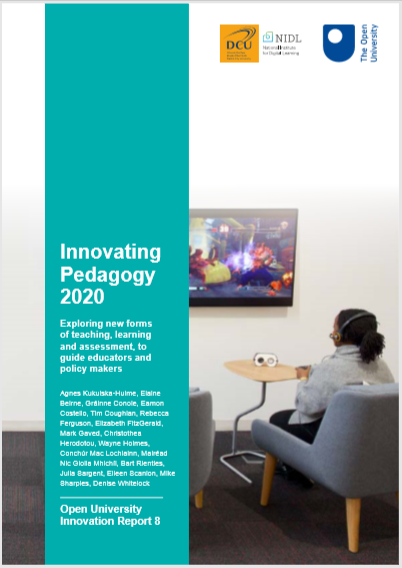
Innovating pedagogy 2020 - time for sustainable education?

CC BY-NC Some rights reserved by The Open University
The UK's Open University, in collaboration with the National Institute for Digital Learning (NIDL), Dublin City University, Ireland, has published its annual review of innovations in teaching and learning in higher education, Innovating pedagogy 2020. This the eighth report in a row and has common features with the much hyped NMC Horizon reports, such as predictions about the potential impact and timescales of each innovative practice described. These criteria are notoriously inaccurate (especially in the Horizon reports) and should not be taken too seriously but the descriptions, conclusions and references are interesting as indications on the present wind directions in the use of technology in higher education.

The ten areas examined by the report are:
  • Artificial intelligence in education. This means learning for, about and with AI. It is also vital that educators are involved in the implementation of AI and make sure it is used to benefit teaching and learning.
    ... what is clear is that the topic of AI in education is too important to be left to engineers and entrepreneurs. Instead, it is critical that educators, learning scientists and other stakeholders engage, to ensure that the AI applied in educational contexts best supports the learners, the teachers and the learning.
  • Posthumanist perspectives. This concerns the blurring of boundaries between humans and machines and the potential of this interaction for the benefit of education.
  • Learning through open data. Public organisations all over the world produce enormous amounts of open data that should be used in universities to enable students to use authentic data for research purposes.
  • Engaging with ethics. The (un)ethical use of personal data has been in the headlines for the last couple of years with the rise of what is often termed as surveillance capitalism. It is vital that students learn to learn how their data is used and misused and to gain a mature and informed attitude to the platforms and tools they use.
    Teachers and other education practitioners can actively engage their students with ethics by presenting authentic case-studies and giving opportunities for active discussion, ideally with people from different cultural settings and backgrounds. Only by engaging with ethics can we learn that our own mindset might not necessarily be shared by others.
  • Social justice pedagogy. Developing the ability to see issues from different perspectives, especially in terms of power structures, prejudice, roles, accessibility issues etc.
    For individuals, the process of thinking about how they came to know what they know, and what they think about what they know, can be very challenging. Specific teacher education may be required, to encourage and prepare teachers to adopt a social justice pedagogy and to deal with how the approach may play out in class.
  • Esports. The world of online gaming shows the power of learning and problem-solving in a community. These lessons are now being applied to create immersive learning communities.
  • Learning from animations. Animations are being increasingly used to show processes, procedures and movement.
  • Multisensory learning. Smell,taste and touch can be used more in learning activities.
  • Offline networked learning. Millions of people have limited or no internet access but can still benefit from digital resources in local networks run on battery or solar powered servers.
  • Online laboratories. Access to realistic virtual online labs give authentic laboratory experience to students who would otherwise never have access to such physical facilities.
The report is in general positive about the future as long as we can learn to harness the dangers of big data and artificial intelligence. Our attitudes to technology have changed and we need to be much more critical and cautious of the global tech giants.

The theme that interests me most is that of offline networked learning. Using battery powered mini servers and a wireless network, students in remote areas can work together with digital resources in a closed offline network (see also my post, Online learning - unplugged). This solution is also being used for education in prisons where internet access is not appropriate. However it is not only a solution for remote regions, there are arguments for closed networks even in developed regions. The report mentions the concept of  slow learning:

Networked offline learning brings people together in meaningful collaboration and sharing activities that can create opportunities for a slower, more deliberate learning experience than is typical on the Internet. 

Maybe we need to experiment with working in such distraction-free digital spaces to relearn how to focus. I don't mean that we go completely offline but a future skill will be learning to go offline in order to focus without losing the advantages of digital collaboration.

However, the biggest issue of all today is how education intends to face the greatest challenge of all today - the climate crisis. This is mentioned only briefly in the report but none of the innovations discussed will be of any relevance if the climate issue is not addressed immediately. Unless radical and uncomfortable changes take place on a global scale in the next ten years the future looks extremely dark. The educational sector must push harder for these changes, through further research but more importantly by integrating the message of United Nations sustainable development goals 2030 in every course and classroom. As I have previously written, we must develop sustainable ways to meet and collaborate, primarily through digital meetings and conferences. The carbon footprint of the higher education sector is extremely high through countless international projects and conferences (read more in this article in University World News, Time to cut international education’s carbon footprint). We cannot stop this completely but we could surely half the level if we develop better digital arenas for collaboration and learn how to use them effectively. As with all other aspects of the climate crisis, we know the dangers and we have solutions but entrenched attitudes and habits are the hardest things to change. My top trend for 2020 would be rethinking academic culture and focusing on sustainable education.

Reference
Kukulska-Hulme, A., Beirne, E., Conole, G., Costello, E., Coughlan, T., Ferguson, R., FitzGerald, E., Gaved, M., Herodotou, C., Holmes, W., Mac Lochlainn, C., Nic Giolla Mhichíl, M., Rienties, B., Sargent, J., Scanlon, E., Sharples, M. and Whitelock, D. (2020). Innovating Pedagogy 2020: Open University Innovation Report 8. Milton Keynes: The Open University.

Saturday, November 2, 2019

Attention seekers - taking innovation from project to mainstream


There is no shortage of innovative and exciting projects in education full of enthusiasts investigating new ways to enhance learning or widen the horizons of current educational practice. However the challenge of moving from project to mainstream often proves too great and few innovations get a chance to make a real impact on the institution's core activities.This is a source of frustration for all of us who have been working with educational technology but it's worthwhile stepping back a bit and looking at all the other important issues that are competing for the attention of policy makers and management: internationalisation, accessibility, diversity, sustainability, pedagogical development, quality assurance etc. Educational institutions must deliver what is asked of them by their government authorities or owners and if these requirements do not include specific objectives for the issues mentioned above, then those issues will naturally be of secondary importance to the management. If your cause is not on that priority list then your chances of getting noticed are low.

In recent years in Sweden there has been little coherent strategy from the top on the use of educational technology and as a result development has largely been fragmented and responsibility delegated to each institution. Things are changing now with the issue once again on the agenda of the government authorities but for many years it was hard to see real progress. There have been many projects and initiatives but almost always bottom-up and dependent on short-term financing. If bottom-up is not met half way by top-down strategies, commitment and incentives then all that energy just evaporates into thin air.

The struggle to catch the eye of the decision makers was nicely captured in a lecture I attended the other week by Melissa de Wilde from Gent University in Belgium. She is a researcher in educational innovation and described her efforts to promote virtual exchange at her university. Her story was familiar to everyone who has tried to introduce new concepts and perspectives. The challenge of simply getting people's attention is probably the greatest and demands resilience and stubborn persistence to make any kind of headway. Decision makers are the hardest to influence unless your issue can help them tick at least one of the boxes on their to-do list. Teachers can often be interested in your cause, but simply don't have the time or energy to get involved, especially since your cause is just one of many admirable but non-essential ones vying for the attention. Key success factors according to Melissa are simply getting your foot in the door and not withdrawing, getting help from a high status staff member or an external expert (deus ex machina), providing support to those who do engage, making sure to document, measure and analyse the process, creating  opportunities to share experiences and success stories and simply making yourself and your colleagues hard to ignore (creating a buzz).

However, no matter how hard you try, nothing helps your cause more than it becoming national policy and part of the institution's mission, so you need to address the policy makers as well as the grassroots. If we can join forces with other causes vying for attention and show that you can tick several boxes in one go then the chances of mainstream adoption must be high. Digitalisation can for example help to build sustainability (reduced air travel, paper use), promote internationalisation (virtual exchange, online collaboration), widen access to education (online courses), enhance inclusion (digital tools for text-speech-text, translation, sub-titles) and pedagogical development (open pedagogy, online courses, collaborative learning, best practice dissemination). If we have to compete for attention we will not get very far. Joining forces must be the answer.

Sunday, April 28, 2019

Somewhere over the rainbow - the shifting perspectives of the Horizon Report


The full version of this year's Horizon Report is now available, published by Educause who rescued the publication from the threat of extinction last year. Each year a global panel of experts nominate trends in educational technology that will make an impact in the short, medium and long term and also identify key challenges facing higher education in the coming years. The report is often criticised since the same technologies seem to move backwards and forwards on the horizon and sometimes even disappear for a while before returning. This year's report is no exception with mobile learning predicted to go mainstream in the next couple of years, having been a feature of several reports in the past. Many other technology trends such as learning analytics, gaming, virtual reality and blended learning have been on the horizon for quite a while but somehow never really make the transition to mainstream practice.

Probably the most interesting feature of this year's report is a section, Fail or scale? (pages 33-39), that examines three trends that have featured in previous reports but have still not become an integral part of higher education practice: adaptive learning, virtual and augmented reality and gaming/gamification. Three experts present their analysis of why these phenomena haven't made the transition and all three analyses have some common ground. All of them have very sound cases for adoption but they all demand major changes to existing structures and models. Bryan Alexander's analysis of gaming in education makes a comment that could well be applied to many other technology trends featured in the Horizon Report over the years:

A new technology—especially one that requires significant research and training—needs to be able to work across the curriculum and in sufficient numbers to merit institutional investment. Faculty members can carry such a technology forward to some extent, but only if they are knowledgeable and engaged with it and if they can sufficiently support the hardware or software. Otherwise the technology will only appear at best in a small segment of a college or university.

Some technology applications have made the transition and become essential elements of the university's operations, such as the learning management system, lecture capture and anti-plagiarism software. It could be claimed that the reason that these applications have succeeded is that they have not challenged the traditional structures and models of higher education, they have simply added a digital version of what we do already (ie. lecture, work in defined classes and classrooms). The potential of many other technologies that so often feature in Horizon reports can only be realised by making radical changes to the way we teach and learn. As a result, they often get bogged down by all the other changes that have to take place before they can be fully implemented. Many new technologies require significant investment to realise their full potential, as outlined by Nicole Weber in her analysis of adaptive learning technologies:

With so much potential, why has adaptive learning not scaled quickly? One of the largest challenges is the investment (e.g., time, money, resources, and vision) needed to implement and scale these courseware products.

In the case of virtual and augmented reality (mixed reality), Kevin Ashford-Rowe highlights the barriers of the hardware required to implement the solutions successfully. In short, the inconvenience and expense of the VR visors make it impractical as a mainstream technology:

In his February 2018 article “3 Reasons Augmented Reality Hasn’t Achieved Widespread Adoption,” AJ Agrawal, argues that—in this order—it is due to a combination of ergonomics, basic utility, and corrective lenses. In short, no matter the benefits, “no one wants to wear a pair of goggles on their head during daily routine” (ergonomics); “even the most mind-blowing AR glasses won’t matter until they look ‘normal’ enough for everyday wear” (basic utility); and, given that three-quarters of the US population need corrective lenses, “it goes without saying that smart glasses need this option [corrective lenses].” He also points out an important distinction that should be made between VR and AR—AR possesses a natural advantage in that the information being displayed is integrated with what is in front of the user.

My conclusion here is that maybe we should not simply criticise reports like Horizon for changing their predictions and timescales but instead look at why it is so hard to change traditional educational structures. Tradition is the hardest barrier to break and it takes many years for any innovation to break through. The idea that we can see the impact of technological innovation in terms of such a short time scale as the next five years is probably flawed.

Read more on this in an article in Campus Technology, 3 Ed Tech Trends Stuck on the Horizon (and Why).

Thursday, February 14, 2019

How would you change education if you could choose?


What would the education system look like if you had the power and resources to change it? We have all been discussing educational change for years at conferences, in publications, communities and blogs, pointing out shortcomings of the present system and proposing new strategies, teaching methods, organisation forms, platforms, devices and tools as possible solutions. But what do we actually want? What would our schools and colleges look like if you could choose? That was the basis of a panel discussion at this week's ICDE Lifelong learning summit 2019 in Lillehammer, Norway that I attended. So I decided to take up the challenge and try to briefly outline what sort of education system I would like to see. This is very much a first draft with some general principles but maybe the starting point for further discussion and reflection.

Schools and universities are part of society but also oases for reflection and perspective.
Education must become more integrated into the surrounding community with more opportunities for pupils and students to get involved in real community projects and work experience. This is already happening but must be further strengthened to let students apply their knowledge and skills in activities of real value and learn to work in a variety of different fields and with a wide range of people. Similarly companies and local authorities need to be more visible in the schools and colleges. At the same time it is also vital that educational institutions are also places where you are able to step back from the world around you; an oasis for reflection. We must not allow our education system to become simply training grounds for the labour market and there must be space for studies in philosophy and the arts to provide a healthy counter-balance. Sometimes we need an ivory tower to sit in for a while.

From bubbles to an ecosystem
Our education system is made up of a lot of bubbles. We divide schools rigidly into age-group bubbles as well as dividing the curriculum into subject bubbles, thus creating artificial barriers for the sake of administrative convenience. We need to find new ways to let age groups and subjects interact naturally, learning to use a range of knowledge and skills to solve problems together. This ties in with the increasing involvement of the community in education and of education in the community outlined above. Of course, this continues all through life and the concepts of school and college evaporate into a fluid education ecosystem for lifelong learning. Everyone in society is engaged in learning activities all through life and schools and colleges provide a framework for this. A classroom full of 12 year-olds will in this context become a rather absurd notion from the past.

Inclusion
Schools and colleges should be spaces that are open to all sections of society and where we have a chance to learn to live and work with each other. If we want to have a tolerant and cohesive society we need to foster this in our schools. Technology can help us here with tools that make learning more accessible to all and allow us to collaborate not only on-site but with colleagues from anywhere in the world. Concepts like virtual mobility allow our students to learn to work with students from many different cultures and circumstances. Technology can allow people with special needs to participate more fully than ever before in school and college work. In addition we have more teachers and other professionals who are trained in supporting people with special needs and can help to make our schools more inclusive.

Distance is no object
Today there is a vast range of online and distance learning opportunities in most countries in the world. This will continue to flourish but we need governments in particular to provide funding for  support structures to help disadvantaged people and people in remote areas to take advantage of opportunities like this. Combinations of online courses and local support are essential if we really want more inclusive education. Universities need incentives to open up their courses to the wider society and create new paths to higher education. Technically we can widen access to education but the educational systems are not quite ready for the challenges.

Technology is important but so is the absence of it
When I started thinking about this I realised that today I do not want to put technology in a headline role in my dreams of a future education system. Technology has a supporting role in all of the above but should complement and enhance human contacts. As technology becomes ubiquitous in society the need arises to find spaces where we learn to survive without it. Even if artificial intelligence will soon learn to write novels, compose music, solve complex problems, play chess, speak any language and drive our transport we will still want to be able to do these things ourselves as well. Schools of the future will need to create offline time where these skills can be learnt and practiced. Learning how to switch between plugged in and unplugged is a key literacy for the future.

All these ingredients are already present today to varying degrees around the world. I would just like us to work together to magnify them.

Update
After posting this I realised that I had forgotten to mention the theme of so many of my posts over the last couple of years - digital literacies and data security. Schools and colleges need to be able to make informed choices about the platforms and tools they use and ensure that students' data is protected from commercial interests. Similarly we need to help students make wise choices about how they use tools and services and be aware of the opportunities and limitations involved.

Thursday, November 9, 2017

The fear factor


The world is changing at a breathtaking pace and it's so easy to feel overwhelmed. Driving this change are several global megatrends: globalisation, digitalisation, environmental change, demographic change (aging population) and urbanisation. We are all familiar with these developments but an excellent blog post by Cecilia Bjursell adds an extra dimension. If you can read Swedish I can thoroughly recommend the post (Den 6:e megatrenden - well worth a read even via Google Translate). She raises an overriding trend that could outweigh all the others put together, namely fear. Fear of all the other megatrends is leading to a backlash that is threatening to derail all the trend analyses of the last few years. We have so far assumed that society is in general developing in a linear and predictable manner towards greater freedom and equality but fear of change is now twisting that linear development into something extremely volatile. Of course, fear is a natural reaction to change and healthy skepticism is essential, but all too often this fear of change leads to destructive reactions. The danger is that fear will become the overriding megatrend.

The fear factor is very evident in education. Digitalisation offers exciting new opportunities for providing flexible and accessible education for all, enabling global collaboration and making scientific research available to all. However it also demands that institutions, teachers and learners change the way they work and take on new roles. These changes are radical ad demand retraining and rethinking. In the face of this many people feel insecure, inadequate and threatened. Many base their fear on misconceptions about the changes they face. Many feel helpless and overwhelmed and instead of looking for support or ways to cope with the change simply dig a trench and defend their position. Institutions may see digitalisation as a Pandora's box and prefer to keep the lid tightly locked rather than face the horde of demons that need to be addressed if the lid is opened even slightly.

The most important issue here is to recognise fear as a major trend. Technology brings so many opportunities to create a more open, tolerant and educated world. That world may be possible to achieve but first we need to work on reducing the fear factor. Exaggerated tech-optimism tends to provoke a similarly exaggerated negative response. The backlash is all too evident. How can we respond to people's fear of change, how can we reduce the threat of change and can we change the rhetoric from threats of major disruption to the promise of natural evolution instead?

Sunday, September 17, 2017

Students and educational technology - it's complicated


A recurring narrative in educational technology is that students are driving the change. They are using the creative and collaborative opportunities offered by today's social media and demanding that universities and faculty do the same. This is used as a powerful argument by edtech companies when selling their solutions. This narrative is strongly linked to the idea of students as digital natives and is often the reason for institutions rushing head first into hasty and largely unplanned technology projects. No one wants to appear out of touch with student demands and so major technology projects are launched without first discussing the pedagogical implications and how the technology can be used to enhance teaching and learning. Of course students are using digital tools and arenas in their learning but not as widely and proficiently as the edtech narrative claims.

But are students really demanding change? My own experience leads me to question this to a certain extent. Furthermore, digital literacy is not a simple generation issue but more about whether or not a person is interested in the use of technology. Many students are highly proficient at using digital devices and social media for socialising and entertainment but are unaware of how to use them for work and learning. It would be extremely dangerous to assume that all students are proficient at information retrieval, source criticism, collaborative learning and media skills and most institutions are now integrating these soft skills into all parts of the curriculum. However, this change is not due to student demand but due to teachers becoming aware that these skills are missing and taking action to remedy the gaps.

Sometimes students can be more conservative than faculty and this issue is raised in an article in EdSurge, What If Students Are the Biggest Barrier to Innovation? Even if many students have used a wide range of digital tools and learning spaces in their high school years, whenever they arrive on campus they are told that university is different. Students are generally very pragmatic; they want to get their grades and then a degree in the most efficient way possible. They will adapt to whatever the institution demands. They also have the traditional image of university in their heads and are disappointed if their experience doesn't match it.

... the “metaphor” of the old and wise professor pouring knowledge into students through class lectures is what many graduate students expect. When they don’t get that experience because they are forced to do group work and interact with peers (who they do not view as subject-matter experts), they don’t feel like they are learning.

“I have had students tell me. I am not paying to listen to my neighbor's thoughts, I am paying to hear you,” says Pickett.


This is reinforced by the vocabulary of higher education so if we call the teachers lecturers and the lessons are called lectures then a lecture is naturally what the students expect. Teachers who focus on student-centred learning and concepts such as collaborative learning, flipped classroom, problem-based learning and so on risk negative evaluations from students who expect to be fed with wisdom and knowledge. Expectations, tradition and attitudes are major barriers to change and cannot be overcome simply by logical argument, no matter how much research evidence is available.

I would say that the main drivers of change in terms of educational technology are teachers who are using the technology successfully, often due to a desire to widen their professional skills and a genuine interest in pedagogical innovation. The problem is, however, that many of these teachers have developed their digital skills on their own initiative, usually outside working hours. This ad hoc approach means that teachers' digital skills are not evenly distributed and there is often an alarming digital divide within the teaching staff of most institutions.

This inconsistency is a concern for many students as discussed in an article from JISC in the UK, It’s official - higher education students want staff to be better with digital, not to use more of it. Students in this national survey state clearly that they want all staff to be trained in using digital tools and demand more consistent use of technology rather than more variety.

Don’t allow academic staff to pick their own ways of using digital resources. At the moment each academic uses the virtual learning environment (VLE) in a different way, making it very time consuming to keep switching approaches. It’s also obvious that academic staff have not received adequate training in using these systems.

They are not demanding more technology but a more strategic approach to technology use and fewer bottom-up ad hoc initiatives. Interestingly the survey reveals a concern that online learning lacks a face-to-face element and a fear that more technology means less classroom contact with teachers.

However, when asked what their institution should do and not do, students requested a better use of digital systems, not more, fearing it could be used to replace face-to-face time with staff.

What seems to be missing here is a realisation that online collaboration is an essential skill in many companies and organisations today and that this skill must be developed at university and integrated into all programmes. Sadly online work is still seen as a substitute for "real" contact instead of a valuable skill in itself.

The conclusion is that technology can enhance teaching and learning but to succeed it needs to be explained and introduced gradually. Both teachers and students need to change their perspectives and this takes time. Above all the process requires skilled management and leadership and only when all these conditions are fulfilled will we see successful implementation and integration of technology in education.

Sunday, June 18, 2017

Building the e-learning quality chain

Chain by robpatrick, on Flickr
"Chain" (CC BY-NC-SA 2.0) by robpatrick

At this week's EDEN 2017 conference here in Sweden there were several discussions about quality in technology enhanced education. There was a consensus that although we have sound quality assurance systems, certifications, strategies, policies and research we have still not reached mainstream integration and acceptance of educational technology. Even if some institutions have succeeded, they are prevented from full integration due to pressure from both government authorities and politicians who demand increased accountability and base their budget decisions on league tables and shallow evaluations. There are lots of success stories at faculty, institutional or even regional levels but to move forward we need a chain reaction involving all levels.

How can we enhance existing quality structures? This requires more than simply checking learner satisfaction at the end of each course or module. Quality is often mistaken for this checklist approach where each link in the chain tries to give answers that will satisfy the criteria of the next level. We ask learners to evaluate both the teachers and their own performance on each course module but the questions is whether learners recognise good teaching when they see it? Often students give the most positive evaluations to teachers who provide them with the material they need to pass the test rather than recognising the value of teachers who help them work things out for themselves.

So how can we develop learning literacy at all levels in the educational chain?
  • Learners need to develop the meta-cognitive skills to become conscious learners. To put it simply, they need to learn how to learn, becoming aware of the learning process and learning to monitor their learning through reflection and self-assessment. They need to develop their collaborative learning skills and realise how learning is a social process rather than simply cramming facts. These skills will be vital in their professional life where their development will depend on being able to learn new skills without waiting for someone to organise a course to help them.
  • The next link in the chain are the teachers who need to become more aware of their own teaching and how they themselves learn. They need to develop new skills, work in teams, learn to become facilitators rather than content providers and so on. This involves a greater emphasis on pedagogical development and how educational technology can complement and enhance traditional practice. At the teacher level this means learning to enable.
  • For this to happen we need institutional leaders who are aware of their leadership, have learnt how to empower, motivate and reward and can create a culture of sharing, support and common purpose among all staff and learners. This means learning to empower.
  • However none of this will happen without the next link in the chain. Government authorities and international bodies must lead the way by providing frameworks, strategies and policies that inspire and guide. Learning to inspire.
Today there are good examples of all the above but in order to create a true culture of learning each level must work as a chain and be clearly linked to each other. If any link in the chain is weak or missing it will never be sustainable and for me the reason why we have not achieved mainstream integration of educational technology is because one or more links in this chain are missing.

Monday, May 1, 2017

Innovation through familiarity


Educational technology has mostly been used to simply continue doing what we have always done, the innovation element being that we can now do it digitally. We've seen this in the use of learning management systems, lecture capture, digital examination and e-books, all of which don't change the paradigm or challenge tradition but add important elements of access, flexibility and convenience. These have gained mainstream acceptance probably because they don't demand any radical rethink or major investment of time and effort. It seems that most of us feel daunted by change and if we are going to accept innovation it has to be wrapped in a familiar package and must not demand too much of our time. Take the computer. Even today we still use the qwerty keyboard inherited from the typewriter of 100 years ago despite many attempts at creating a more intuitive interface. We still refer to a desktop and put documents in folders. The new expressed in terms of the old to maintain a sense of security and minimise the shock of the new.

This is the theme of an intriguing article by Nir Eyal, People Don’t Want Something Truly New, They Want the Familiar Done Differently. He takes the example of how Americans learned to love sushi; instead of using Japanese names they made it out of familiar west coast ingredients and called it a California Roll. After that the real name could be safely introduced and now everyone eats it. This shows how defining the new in terms of the old is a wise ploy and Eyal therefore proposes the California Roll Rule: People don’t want something truly new, they want the familiar done differently. How many innovations have flopped not because of any intrinsic fault or lack of potential but simply because they were just a bit too new, the wrong side of familiar.

Unfortunately, our aversion to things that are outside the norm is particularly hard on companies producing radical innovation — no matter how beneficial they may be. If using a new product does not feel familiar, it faces severe challenges.

Innovation tends to be incremental and takes time. What often happens is that something new is first adapted (tamed) to something familiar. For instance a lot of educational technology is first used to continue doing what we've always done, reinforcing the classroom or the lecture. In some cases the innovation ends in a dead end without ever fulfilling its potential, in other cases it starts breaking new ground only after several years of "tamed use". The development of open education is a case in point, starting with enormous potential but then developing into rather traditionally designed MOOCs and even becoming integrated into the regular higher education system and losing some important aspects of the concept of openness on the way. Virtual and augmented reality have taken many years to break through and one factor behind mass market acceptance was reviving the Pokemon craze; the new in terms of something old. The challenge for any innovation is staying true to its original spirit and avoiding being tamed too much. However it's a delicate balance. If you're too innovative noone will accept you and if you adapt to the traditional too much you lose your innovative spark. Innovation through familiarity..

As the pace of innovation accelerates, human behavior, not technological restraints, will be the deciding factor of whether products are adopted or discarded. If new products and services are to positively impact our lives, they must find a gateway into our daily routines.

Sunday, February 12, 2017

Change is a shared responsibility


I read a short article on the news site eLearning industry, Why There Is Lack Of Enthusiasm Some Employees Have For Social And Collaboration Tools? about why digital collaboration has not really become mainstream, despite so many compelling arguments. The article deals with the difficulties of convincing employees of the benefits of online collaboration in the corporate sector.

... while many organizations have been full-heartedly adopting social or collaborative tools, these solutions work best when all members of a team use them. In most organizations, there is an evident struggle to get all employees interested in utilizing these tools to their fullest capabilities.

The article goes on to list barriers to the adoption of collaborative tools: lack of value, poor user interface and too many features. All of these are familiar issues, both in the corporate sector and in public education, but I would like to add what I think is the most crucial barrier to technology adoption - our instinctive aversion to unnecessary effort when we are faced with change.

Those who are curious about new solutions and embrace change are generally not satisfied with the status quo. Some are naturally inquisitive and are constantly looking for new ways to solve daily problems and are willing to put in extra hours to test and refine them. Change comes at a cost; long hours of trial, failure and frustration. However, if the potential reward seems great enough we'll make that effort.

On the other hand the vast majority of us are wary of change, primarily, I believe, because change comes at a price. If we're relatively content with the way we work today, there is little motivation to adopt new technology. Even if we suspect that the technology may make some aspect of our work more effective, that improvement is not worth the time we fear it will take to master the innovation. There's also the fear of failure - what if it doesn't work, what if I make a mess of it? The longer you avoid addressing this change the greater the effort required and this creates a vicious circle that I suspect many teachers are caught up in today. Many realise that they should have adopted technology many years ago but now it feels like the gap is so great that trying to catch up at this late stage is futile.

So what is the answer to the question posed by the article? A lot of responsibility lies at management level, leading by example and using digital tools in an exemplary way. Fostering an inclusive sense of community in the organisation where innovation is encouraged and most importantly recognised and rewarded. Providing support to staff, both in terms of educational technologists and online support, is essential so that no-one feels alone and that innovation is a shared process. Increased use of online collaboration tools can also be a feature of a sustainability programme, helping to reduce paper consumption or travel. If the change is a community effort and you know you are part of a planned and shared development with support and clear rewards great things can happen. Most importantly, we need to find ways of sharing and thus reducing the extra effort and risk involved in daring to change.

Saturday, October 22, 2016

When worlds collide


We live in an age of paradoxes. We have almost instant access to vast amounts of knowledge and information, the ability to share our thoughts and reflections, create global communities of interest and practice and communicate with people anywhere on earth. This should be the most enlightened period in human history. At the same time, in what sometimes seems to be a parallel universe, there seem to be more superstitions, myths and conspiracy theories than ever before and an increasingly popular anti-factual culture that dismisses science, research and education and prefers to believe in sweeping generalisations, lies and half-truths as long as they fit into a convenient narrative.

The digital age has revolutionised the way we live and work and logically should have made us more global, more enlightened and more culturally aware. We generally assume that human history is a development (albeit rather erratic) towards greater democracy, technical and cultural advancement as well as better living standards. Digital technology should logically support this since we can now analyse vast amounts of data that enables us to combat disease, monitor environmental changes and see dangerous trends long before they become major problems. When we comment on conflicts and violence by saying that "xxx shouldn't happen in the 21st century" we assume that our century should be better than its predecessors. Maybe these things happen because we are in the 21st century and modernity should not be seen as synonymous with enlightenment?

I find the filter bubble analogy (Eli Pariser 2011) a recurring theme when discussing all aspects of today's society. Instead of widening our perspectives, the internet is wrapping us in tribal bubbles where we only meet people and information that confirm our own views. We have always formed tribal groupings but the net reinforces this and as a result it becomes almost impossible to discus with someone from another bubble/tribe/planet. The bubble I inhabit is one of global collaboration, democratic development, tolerance and a belief in the common good. We see digital media as a positive force to bring people together, empower them by giving them a voice and where the crowd is always wise. However in a parallel bubble there is a totally alien world where the wisdom of the crowd has become the fury of the mob and the net is an arena for self-promotion, intolerance, mistrust and fear-mongering. There are of course many other bubbles between these extremes but the more we retreat into these cocoons the harder it gets to engage in any kind of communication with representatives of another world whose truths are complete contradictions of those we believe in. The US presidential campaign is a prime example of this but there are similar clashes in almost all countries and the gap seems to be widening.

Another paradox is that all this is happening in an age when more people than ever before have access to free school education and access to higher education has been radically expanded. How do we deal with this bubble society in public education? How do we counter the climate of mistrust and suspicion that threatens the notion of a positive future? More than ever we need to discuss these issues at all educational levels and promote a culture of inclusion rather than exclusion. The alternative is unthinkable.

Sunday, October 16, 2016

Underestimated barriers to change


Change is often seen as a threat rather than an opportunity. It demands that I have to rethink the way I work, it will require considerable effort and there's always the risk that I somehow won't manage to adapt or may even lose my job. Those who advocate change already see a clear place for themselves in the new order and an opportunity to succeed. Others aren't so sure there's a place for them and therefore are skeptical. In education we see how difficult it is to change whether that change is about the integration of educational technology, internationalisation or learner-centred pedagogies. There are often lots of inspirational grassroots projects, training initiatives, policy and strategy documents as well as support from top management. Campus buidlings and facilities can be redesigned to foster and support the desired changes but somehow, despite all this, the changes never really take root. Are there hidden forces at work here?

Two such forces I'd like to propose are culture and administrative structures (maybe two aspects of the same thing actually). Culture is often about hidden unwritten codes of how things are done at this institution. It's about unofficial, alternative hierarchies, understandings and traditions. These are extremely hard to even identify never mind change but I think they often explain why many change initiatives never really progress beyond the enthusiasts. It can be a culture of academic freedom, a concept open for a wide range of interpretations, that gives every member of staff an opt-out clause for any change they don't really like. This can derail even initiatives that have the full support of the management. No-one opposes the change directly but simply reserve the right to opt out.

This is expressed in a short article in EdTech, On Campus, Change is Constant, and That’s Good, which identifies culture as the hardest nut to crack in any change process. Culture is often engrained in the walls of the institution and is extremely hard to identify. Many don't even realise that there is such a culture, it's simply the way we do things round here.

Every stage matters, but I believe culture may matter most. It’s also surprisingly easy to overlook. Ruben and Gigliotti define culture as “the organization’s language, history, norms, rules and traditions that may influence the dynamics of change.” In any community, these are the factors that shape individuals’ day-to-day experiences, perceptions and expectations. Tuned-in leaders craft strategies that take culture into account; out-of-touch leaders fail to do so, and as a result they risk sabotaging new initiatives.

The second factor, administrative structures, is much more obvious and can stifle innovation before it has a chance to succeed. Often an institution is limited by structures imposed from government levels; statistics, accountability, box-ticking. For example teachers are assigned a limited number of contact hours with students and these are often categorised as "lecture hours" or "tutoring hours" with the former tending to have a higher price tag than the latter. If you still call them lecture hours it is hardly any suprise that teachers will continue to lecture. If you flip the classroom the reporting structure has difficulties. More flexible course forms and new styles of teaching are generally not supported by these structures and with most countries judging universities on a narrow range of performace indicators the risk of failure is greater than the potential benefits of innovation.

Cultural change is a long-term process and it involves much more than new technology, new buildings, new strategies, new training programmes and so on. It's about changing the default attitude to innovation from skepticism to curiosity. Structural change should be easier since it involves changing the ways we administer and report education. However, any changes must come from a higher level where the culture may be very different to that at institutional level. So even if institutions can change they may be restricted by structural restrictions from above.

Catch 22?

Tuesday, September 20, 2016

Memories of an analogue world


Digital technology is such an integral part of our lives today that it's easy to forget how things were before the revolution. Unlike many of my colleagues I was completely uninterested in computers until the internet came along. Pre-1990 computers were simply more trouble than they were worth and I couldn't see any advantage in learning how to use them. But once I discovered www I was converted; suddenly the world opened up!

The fact that a large section of the population doesn't know what life was like before the digital revolution is captured in a post on Quartz, What it feels like to be the last generation to remember life before the internet. The article reviews a new book by Michael Harris called The End of Absence: Reclaiming What We’ve Lost in a World of Constant Connection. It's very popular for my generation to be skeptical or even dismissive of today's digital deluge but Harris avoids such sweeping generalisations and instead reflects on how his own behaviour has changed over the years, especially in terms of being always connected. We have become addicted to connection and terrified of missing something.

“When you wake up, you have this gift of a blank brain. You could fill it with anything. But for most of us, we have this kind of panic. Instead of wondering what should I do, we wonder what did I miss. It’s almost like our unconsciousness is a kind of failure and we can’t believe we’ve been offline for eight hours,” he says. It is habits like this that are insidious, not the internet itself. It is a personal thing.

I think we can all identify with the feeling of being a slave to our updates and feeds. They provide us with recognition, approval, belonging and those are extremely powerful motivators. Harris recommends spending a month on digital detox as a way of reflecting on your digital identity, something I haven't tried and suspect I would find extremely hard to achieve unless I combined it with a holiday in some remote part of the world.

But let's think back to the "good old days". How did we communicate then? Today I can keep in touch with hundreds of friends and colleagues on social media to the extent that when I do meet one of them in person I can immediately ask them about their daughter's recent wedding or their new job. I know contacts on Facebook are fairly superficial but for 90% of my connections the alternative is no contact whatsoever. I remember when I first moved to Sweden in 1983 I spent many hours a week writing, with pen and paper, very similar letters to friends and relatives in the UK. Without a photocopier I simply had to write the same thing again and again! This was very time consuming but was quite simply the only way I could keep these relationships going. Phone calls were extremely expensive and generally carried out in draughty phone boxes that had an insatiable appetite for coins.

Keeping in touch with the latest news was tricky until I had learnt Swedish. English language newspapers were available but tended to be at least two days old and tuning in to crackling radio broadcasts from the BBC World Service wasn't so uplifting either. The idea that I could write my own reflections, publish them myself and gain a worldwide audience (i.e. this blog) was beyond my wildest imagination. My music collection was not portable until the Sony Walkman came along and so all those hours spent waiting for buses and trains as well as the actual journeys were spent in bored silence unless I had a newspaper or book with me.

I visited many interesting places on holiday and would normally take one 36-exposure film for my camera. Developing them was pretty expensive so my memories of these days are now only a handful of decent photos (generally up to half of the photos I took were terrible!). It never occurred to me that I should take a photo of myself sometimes and the result is that I have almost no photos of myself between 18-30 years old, a period that is now seen as prime selfie time.

At work my network was pretty well restricted to the people who worked in the same office plus a few other contacts who I met now and again. When I was not in the office I was simply not available. Messages could be left with the switchboard operator or sent by post. If I needed an answer, however simple, and the person responsible was away on business or holiday I would simply have to try again next week. Collaboration with people in other cities or countries was unthinkable.

Of course our digital world has lead to a magnification of many negative human traits such as hatred, bullying, fraud and narcissism but at the same time has also enabled us to connect with people from all over the world, work together on projects that would have previously been impossible, share our ideas, learn more about other cultures and get a far broader perspective on the world than ever before. Both sides of the coin co-exist though of course we must work harder to promote the positive side. Digital technology is an enabler and the choice of how we use it is ours.

Monday, August 1, 2016

Online learning - where now?


At this time of year my news feeds dry up as most people in the business take their summer break so maybe it's a good time for me to take stock and reflect on the status of online learning today and speculate on future developments. I've been working with online learning for around twelve years now and whilst there has indeed been significant progress in some aspects we still get bogged down in the same discussions and preconceptions as we did when I started in 2004. Here's a list of recurring themes on this blog that I'm really getting tired of discussing (in no particular order).

Polarised either /or discussions
We are still trapped in endless discussions about whether online education is better or worse than traditional classroom education or whether e-books are better than print and so on. These discussions seldom lead anywhere except further entrenchment. Tony Bates outlines a much better approach in his current series of blog posts on online learning, see for example Online learning for beginners: 2. Isn’t online learning worse than face-to-face teaching? Most comparisons fail to compare like with like (ie same types of students with similar needs) and seldom see that the two modes suit different types of learners (young full-time campus students and older lifelong learners). The eternal debate on completion rates ignores the fact that distance learners have completely different life situations compared to full-time campus students who generally complete their courses regardless of the quality, simply because their funding depends on them passing. Generally these types of comparisons ask the wrong questions, see more below.

Traditional education as default
The burden of proof is overwhelmingly on the online side whilst few people investigate whether traditional methods really work as well as we think. Are classrooms always the best place for an open discussion when we know so well that these discussions favour those who like the spotlight and those who like to reflect before answering and feel intimidated in a group setting never say anything? Lectures have been central to higher education for centuries but does that mean that we learn from them? What types of learning do we test in exam halls? I would like to see an end to the burden of proof syndrome and instead accept that we need to integrate face-to-face and online to offer more nuanced approaches to education.

Asking the wrong questions
The fact that we're still falling into the traps in the previous points means that we keep asking the wrong questions. It's not about delivery method, technical platform or old versus new it's about designing education that can reach out to and empower as many learners as possible using all the tools, methods and pedagogies available today (including the traditional ones!). Once again Tony Bates offers two key questions for us to focus on:

Indeed, it is the variables or conditions for success that we should be examining, not just the technological delivery. In other words, we should be asking a question first posed by Wilbur Schramm as long ago as 1977:
What kinds of learning can different media best facilitate, and under what conditions?

In terms of making decisions then about mode of delivery, we should be asking, not which is the best method overall, but:
What are the most appropriate conditions for using face-to-face, blended or fully online learning respectively? 


One size does not fit all and the traditional system has failed millions of learners by only offering face-to-face education often at a price and only in certain locations. How can we offer more inclusive and personalised education by using the full spectrum of tools and methods available today? Getting the mix right and focusing on course design are what we need to work on today.

"The next big thing" syndrome
Every time a new device, app or tool hits the market the hype machine revs into action and soon we're drowning in posts and articles on how Google Apps/MOOCs/iPads/Facebook Live/Pokemon go/xxxx will revolutionise education. The revolution isn't going to happen but they all contribute to an evolution. The problem is that the commercial hype only increases the skepticism of many educators and prevents them from investigating the new phenomena with an open mind. As a result new technologies and methods are restricted to an edtech echo-chamber and have limited impact to the mainstream. I would like to see less hype and fireworks and more genuine curiosity and investigation before we make any claims about revolutions or disruption.

Structural barriers and the power of tradition
Many who want to be innovative are stifled by structural barriers and tradition. The increasing focus on results and accountability stifles innovation as institutions play safe to avoid failure, The tyrany of rankings mean that you focus on the criteria that help you rise in the ranking system and ignore those that do not, ie research versus teaching, campus versus distance etc, The traditional image of the university as a leafy campus full of young full-time students and high profile research is extremely hard to break, as most university websites show. Pedagogical innovation, outreach and lifelong learning simply don't win any gold stars and until they do we seem to be stuck in a mold, even though there are, of course, exceptions.

Even students can be barriers to innovation. They have been brought up on the traditional image of the university and actually expect the lectures and student life that they have seen so much in films and TV series. A teacher who abandons the traditional methods and is innovative can risk poor evaluations from students who expect to be taught (ie lectured to). 

Where do we go from here then? I don't see any radical changes in the near future but we need to get online into the mainstream and do it by asking new questions and simply not responding to either/or discussions. There are encouraging signs of a more integrated and nuanced aproach to online learning with several major international organisations taking the lead (UNESCO, OECD, European Commission, EUA and others). There are now many excellent reports, initiatives and funding schemes from these and other organisations and there are plenty of enthusiastic educators involved in projects. The barriers tend to appear in the space between these two extremes: governments, national authorities and educational leaders. For bottom-up to connect with top-down you need to work on getting the middle layers on board.