Showing posts with label concentration. Show all posts

Sunday, December 5, 2021

Attention literacy and the value of slow learning

Photo by Johannes Plenio on Unsplash

The paradox of today's society is that we are both more connected than ever before and at the same time becoming increasingly disconnected from each other and even ourselves as we drown in a flood of information, advertising, entertainment and chatter. The torrent never stops and prevents us from stopping to reflect or question what is going on and there is growing interest in finding strategies to counter this threat. These strategies are an integral part of the so-called 21st century literacies including source criticism, information literacy, media literacy, data literacy and network literacy. 

The concept attention literacy caught my attention in an article by Howard Rheingold, Attention, and Other 21st-Century Social Media Literacies (Educause Review, vol. 45, no. 5), back in 2010. He described five key social media literacies: attention, participation, collaboration, network awareness and critical consumption. The issue of attention was mostly about the digital distractions that his students were subjected to in class and he proposed establishing oases of offline interaction when all focus would be on class discussion or deeper reading. The ability to switch between online and offline was the core of attention literacy.

Since then attention literacy has expanded and is discussed in a new article by Mark Pegrum and Agnieszka Palalas in the Canadian Journal of Learning and Technology, Attentional literacy as a new literacy: Helping students deal with digital disarray. They outline the challenge presented by the concept of digital disarray: the effects of today's information overload and the algorithm-controlled digital landscape that dominates our lives. They describe three components of digital disarray:

  • digital distraction is the overwhelming volume of news, updates, entertainment and social interaction that compete for our attention every day and often prevent us from focusing on any specific task.
  • digital disorder represents the abundance of misleading information, alternatives realities and conspiracy theories and how they have divided society on increasingly polarised tribal lines.
  • digital disconnection represents a growing disconnection between people with a growing trust in dangerous stereotypes and a lack of curiosity. People can have a strong online presence but lack interpersonal skills and an ability to connect with others outside their own sphere. The result perhaps of people being trapped in their own filter bubbles.

Many "new" literacies have been described in recent years (evidently an Irish review of the field identified 100 different models of digital literacies, see Brown 2017) but the authors suggest that attention literacy is an overarching literacy and a strategy to combat this notion of digital disarray. Attention is therefore a macroliteracy.

Arguing that today’s growing focus on digital literacies in education already serves as a partial response to digital disarray, this evidence-based position paper proposes the concept of attentional literacy as a macroliteracy which interweaves elements of now established literacies with the emerging educational discourse of mindfulness.Through attentional literacy, students may gain awareness of how to focus their attention intentionally on the self, relationships with others, and the informational environment, resulting in a more considered approach to learning coupled with an appreciation of multiple shifting perspectives.

Learning to focus and filter out the digital distractions involves not simply switching off your digital devices but learning to concentrate your mind on one task and being able to approach a topic without preconceptions and biases. The authors see mindfulness as a key to developing this skill and suggest integrating elements of this in education. Their working definition of mindfulness is given as the mental capacity to pay attention intentionally and non-judgmentally to an object of choice while remaining aware of changing experiences and contexts. Whether or not the concept of mindfulness is the answer here, there is a case for more focus on rediscovering the benefits of silence, quiet reflection, deep reading and simply switching off the distractions. 

The problem is that most university courses today focus on efficiency and demands to fulfill learning outcomes as quickly as possible. Students want to earn their credits and get their qualifications and this leaves little time for a new kind of slow learning. True lifelong learning is a slow process and insights often take years to develop. We need to create more space for reflection and develop strategies for fostering deeper learning. Whether you call this mindfulness or something else we need to learn to step away from the torrent of distractions and think more about where we want to go.

Thursday, May 27, 2021

Reading print is different to reading on screen

Photo by Olena Sergienko on Unsplash
I read a lot, both on paper and in digital formats, but the way I read the two formats is different. I find it hard to read lengthy texts on a screen, no matter how sharp the resolution. Maybe it's because I'm getting old and stuck in my ways, but I just can't concentrate on a digital text in the same way as a printed one. Digital texts come complete with built-in distractions (alerts from social media, e-mails, other web sites) that are always more interesting than what I'm reading and somehow I find myself programmed to distraction when I'm on a digital device. My digital reading tends to be fragmented and unfocused - skimming through articles to get the gist, checking references, following links to new content. I can also reveal that the same is true for writing. Writing online is a very messy process for me with repeated diversions to chats, e-mails, social media etc. and this post would certainly have been written much quicker on paper.

This cannot be written off as a generational issue according to an article by Naomi S. Baron in The ConversationWhy we remember more by reading – especially print – than from audio or video. Students have similar problems in reading digital texts and the article suggests that this is because we automatically adopt an entertainment mindset when approaching digital material. Research indicates that students remember more details from printed material because it demands more focused attention in a way that the digital equivalent does not. Reading a book is a spatial experience and we often remember details connected to where on the page or on which page a particular detail is mentioned. 

Interestingly, there is also evidence that many people have difficulty remembering details from audio and video material, so popular today in education in the context of the flipped classroom approach. Somehow our mind wanders when listening to or watching a recording and we all recognise the feeling of listening to news on the radio but not remembering what you have just heard. We also tend to do other things when we listen or watch (like running, making food, checking our mobile) in our futile attempts to be efficient multitaskers. Somehow, reading printed material is one activity that still demands full concentration.

The collective research shows that digital media have common features and user practices that can constrain learning. These include diminished concentration, an entertainment mindset, a propensity to multitask, lack of a fixed physical reference point, reduced use of annotation and less frequent reviewing of what has been read, heard or viewed.

Reading, listening and viewing in an educational context are skills that need to be developed. We need to become more aware of our concentration levels and our vulnerability to distraction and employ strategies to focus. This can mean taking notes or drawing a mind map. Or simply shutting down all our distractions.

Digital texts, audio and video all have educational roles, especially when providing resources not available in print. However, for maximizing learning where mental focus and reflection are called for, educators – and parents – shouldn’t assume all media are the same, even when they contain identical words.

Paper is not inherently "better" than digital but its limitations are also an advantage in terms of not offering any potential distractions. In a world of distractions the ability to focus is a vital skill to learn.

Saturday, February 27, 2021

Avoiding Zoom fatigue and finding new ways to collaborate online

Photo by Surface on Unsplash

Many of us spend several hours a day in online meetings and the term Zoom fatigue has become a popular topic of discussion. Our extreme dependence on video meeting platforms is of course due to the exceptional times we live in and when we are able to meet face-to-face again the number of online meetings will no doubt decrease, though still much more frequent than before the pandemic. But what is missing in these online sessions? We can certainly see each other, smile, laugh, gesticulate and interact but what makes it all so tiring and rather repetitive?

A new study by Jeremy N. Bailenson of Stanford University, Nonverbal Overload: A Theoretical Argument for the Causes of Zoom Fatigue, has investigated the factors behind Zoom fatigue and offers some remedies (see also a summary of the report in an article in New Atlas, Stanford study into “Zoom Fatigue” explains why video chats are so tiring. Bailenson highlights four main issues:

  • Eye-gaze at a close distance. We see a gallery of faces, many complete strangers, looking at us all the time. This would never happen in a physical meeting and can be rather disconcerting. Are they really looking at me and what are they thinking? Do I look all right or do they notice that my hair is a bit untidy or there's a pile of junk on the desk behind me?
  • Cognitive load. We often exaggerate our non-verbal signals to make them clear, like nodding very deliberately or looking straight into the camera. It's impossible to turn and smile at a colleague or exchange a knowing glance when a common issue is mentioned. We also have chat messages and other communication tools to deal with.
  • All-day mirror. We spend a lot of time looking at ourselves and being very aware of our appearance. This is a distraction and something we never have to deal with in physical meetings. One remedy for this is to cancel the self-view option in the platform. 
  • Reduced mobility. In physical meetings we sometimes stand up or stretch our legs for a few minutes but in online meetings we generally sit still for long periods, gazing at faces or slideshows. We also tend to sit very close to the computer camera and this adds to the strain. Maybe if we sometimes switched to audio-only we could all move around while we discuss and thus take a break from the gallery gaze.

But with Zoom, all people get the front-on views of all other people nonstop. This is similar to being in a crowded subway car while being forced to stare at the person you are standing very close to, instead of looking down or at your phone. On top of this, it is as if everyone in the subway car rotated their bodies such that their faces were oriented toward your eyes. And then, instead of being scattered around your peripheral vision, somehow all those people somehow were crowded into your fovea where stimuli are particularly arousing (Reeves et al., 1999). For many Zoom users, this happens for hours consecutively.

We also need to realise that we all need some recovery time before entering the next meeting. Although you can feel super-efficient by stacking online meetings one after the other, you will be much more efficient if you schedule at least 10 minutes between those meetings to simulate the time you would spend walking from one physical meeting to the next. Get up, go outside for a few minutes and mentally tune in to the next task.

So what's the alternative to the talking heads format? Maybe we need to stop gazing at each other and do things together. A post by David WhiteSpatial collaboration: how to escape the webcam, introduces the concept of spatial collaboration, where we focus not on our faces on the screen but on interacting in a shared space such as a whiteboard, collaborative documents like Google Drive or a storyboard like Padlet, Mural or Miro. We can all write or draw on these spaces and the focus is more on the activity and collaboration than our faces. One simple but effective method is how to create a discussion with the help of a simple drawing of a table and names around it.

My suggestion was to draw a very simple diagram of a table (just a square) and place each of the participants’ names around it for each group. We then shared this simple ‘map’ into the non-space of the platform and asked the groups to go clockwise around the table. This was an easy way to establish the order the discussion should go in, but I also noticed that there was suddenly a greater sense of togetherness and place. You could imagine who you were sat next to or opposite, and while this didn’t change the functionality of the technology it did change the psychology of it. It didn’t take much to help people imagine themselves into a shared location.
This spatial collaboration does not have to be noisy to be effective. You can have very rewarding silent collaboration (see my earlier post on this), at least for a few minutes, thus providing variation and reducing fatigue.  

Of course it's great to see each other, but maybe not as much as we do now. 

Sunday, May 12, 2019

Communicative noise - a barrier to creativity?


For many people e-mail has become a communication black hole with an inbox that is out of control. As we drown in e-mail we hope to find salvation in exciting new communication platforms like Slack, Teams and Workplace that promise to streamline your messaging and help teams work more efficiently. The problem is that even if we start using new platforms we can't escape the gravitational pull of e-mail which is still the default communication tool in most organisations. As a result we end up having several communication channels open all day and each of them overflowing. Most days I have e-mail, Skype, Zoom, Messenger, Twitter and Whatsapp all open and although I can't say my own feeds are overwhelming, I can imagine that some people have moved from having only one overloaded communication tool to now having several. The trouble is that easy-to-use communication tools lead to us communicating even more and thus adding to the communicative noise.

This is the topic of an article by Rani Molla in Vox, The productivity pit: how Slack is ruining work. The problem with team platforms like Slack is that they are so easy to use that they facilitate endless discussions that eat up valuable working and thinking time. E-mail "discussions" can be very irritating especially if everyone uses the "reply all" button every time they write something. However in platforms like Slack, these chatty discussions go viral and the channel becomes extremely noisy and hard to switch off due to fear of missing out or being seen as anti-social. We often confuse communication with productivity. People or groups who are "noisy", in speech or in writing, are generally considered more active and therefore more productive/effective than those who are quiet. We get worried about students who are silent or groups who don't seem to be discussing as actively as others. If you don't contribute to the discussion you aren't doing your job, though in reality the reverse may be truer.

Remote workers are under particular strain to prove that they are working. For people not in an office, messaging colleagues or posting information becomes a way of demonstrating that they are doing their jobs.

There's also a link to our physical work spaces that are increasingly open and flexible to facilitate teamwork and spontaneous brainstorming. The problem here is that it's very hard to concentrate when there are dynamic discussions going on nearby. You can't help overhearing or wanting to join in the fun. Once again we reward and encourage noise rather than silence. Combine the noise in the physical environment to all the digital noise and we have a major problem.

Keeping up with these conversations can seem like a full-time job. After a while, the software goes from helping you work to making it impossible to get work done ... Also, workplace software doesn’t seem to have supplanted the very thing it was supposed to fix: email. Most people use both.

The success of workplace software is because they offer similar rewards to the social media platforms we use outside the workplace. They are extremely sticky, stimulating our need for recognition and belonging through likes, emojis and small talk. Of course they can also be used very creatively and can indeed enhance collaboration but on the other hand they can easily eat up lots of valuable time. Their stickiness also leads to them invading your private life.

There’s a reason you’re checking your work app at night and it’s not because you love your job. It’s because the communications and digital affirmations from your coworkers feel good.

The outcome of all this for me is that we need to reassess the value of "noisy" communication and stop equating it with productivity, efficiency or creativity. Truly creative ideas often come through silent reflection, free from distraction, but we have somehow forgotten this as we create increasingly noisy environments (the ubiquitous use of non-stop background music in public spaces is a further plague). Noisy communication is good in certain contexts like brainstorming, socialising and meetings but we need to reclaim the right to silence (both verbal and digital) for the really creative work.

Friday, August 31, 2018

We have always been easily distracted


A recurring story in the media is that our powers of attention and concentration have been seriously eroded by the rise of digital communication and in particular social media. Almost every day I see news items, blog posts, memes, rants and discussions on how we are slaves to our digital devices and can't focus on one task at a time. We fondly believe that in pre-digital days we were so much better at deep reading, reflection, writing and listening and seldom got distracted by trivia. If I try to think back to my younger days, especially as a student, I think I had trouble focusing even then. Even if the level of distractions was lower than today, I'm not sure I was so efficient. I remember that my mind wandered regularly to irrelevant thoughts, I stared out of windows, went to get more coffee - anything to avoid the task in hand. When I had an assignment to write and the deadline was approaching I deliberately went to the most boring and obscure corner of the university library to escape the distractions of other students, good views or proximity to a cafe. I got the work done but despite the spartan surroundings I still found it so hard to focus.

Maybe we've always been easily distracted. An article in The Outline, No, the internet has not destroyed our attention spans, refers to new research indicating that our short attention spans are the same as they've always been. Researchers at Princeton University have been comparing attention spans of humans and macaque monkeys and found that we have a lot in common. Both species have the ability to switch rapidly between a focused activity and checking the surrounding environment for potential danger and that this switch occurs four times a second. This ability has been vital to our survival as a species quite simply.

... well before the invention of mobile phones, humans were a cognitively distracted species that can only focus on one thing in quarter-of-a-second blocks. This inability to focus isn’t a flaw, but an evolutionary adaptation: Being able to flick between highly focused and diffuse attention gives us the ability to concentrate on a complex task while also being aware of our surroundings, making us the dynamic, hyper-alert creatures that we are today.

It seems we have an in-built need to continually monitor the world around us as a basic survival instinct and that makes us even more susceptible to the lures of social media. The research at Princeton is further described in an article in EurekAlert!The spotlight of attention is more like a strobe. We don't simply switch on and off four times a second but we are always ready to switch focus even if we don't notice the process.

Perception doesn't flicker on and off, the researchers emphasized, but four times per second it cycles between periods of maximum focus and periods of a broader situational awareness.

"Every 250 milliseconds, you have an opportunity to switch attention," said Ian Fiebelkorn, an associate research scholar in PNI and the first author on the macaque-focused paper. You won't necessarily shift your focus to a new subject, he said, but your brain has a chance to re-examine your priorities and decide if it wants to.

There is no doubt that the modern world has a vast range of distractions to tempt us with and we need to work hard to resist them and even try to minimise their intrusiveness. However it's somehow comforting to know that our potential for distraction is no greater today than it was 2,000 years ago.

Wednesday, June 21, 2017

Background music and other distractions


If you have something important to say, it is only logical that you want to be heard. So why do so many insist on adding background music that all too often becomes foreground music, drowning out the speaker? It may seem cool and I'm sure many people can cope with the combination. However it excludes people with hearing difficulties (and that includes most of us over 50) as well as those who are not native speakers of your language and need to hear what you are saying with a minimum of interference. Every week I watch educational videos where the speaker has to compete with unnecessary music. Even if I can hear the voice I can't concentrate because the music irritates me. Either music or speech but not both.

The same applies to slides. Think about inclusion every time. Yellow text on a green background is very hard to read. So is text on top of a photo. Or too much text on one slide. Slides should only show key words or short concise messages. If you want text on a photo create a text box with a plain background so the text is clearly visible. Clarity benefits everyone.

Sometimes these mistakes are combined and the effect is that most people will switch off. It's easy to do but we need to become more aware of making our material as accessible as possible and cut the potential distractions to a minimum. Even if you have clear slides and have cut out the music don't assume that everyone understands every work you say. Add subtitles to your film as extra support and reinforcement. It's not only people with hearing difficulties who turn on the subtitles. Many people appreciate the reinforcement and for those whose command of your language is not so good subtitles are essential to understanding.

Keep it simple please and cut the potential distractions.

Saturday, October 29, 2016

Silence at last!

I've written several times about how hard it is today to experience silence, especially in public places. We're constantly bombarded by music, advertising, traffic and all the bleeps and assorted sound effects from our mobile devices. Now I've discovered a possible refuge from all this noise, a potentially revolutionary gadget called Muzo.

Muzo is a small device that you place on a table or window and incredibly it tones down all the background noise, creating an oasis of peace for you to work, relax or sleep in. I find it hard to believe that your oasis will be completely silent but if they can relegate that irritating music playing in the cafe you are sitting in then I'll be buying one very soon. Another feature is that you can select your own ambient background music or sound effects to create a more peaceful environment for sleep or meditation. So if you want to sleep you just select the sounds of a summer's evening beside a river with the optional crackling of a campfire. In addition Muzo can create a sound bubble so that you can have an intimate conversation in a restaurant without anyone else being able to overhear. The product certainly seems to have struck a chord with many people since the crowdfunding campaign to finance the product raised more than four times the money asked for.

I suspect that Muzo will be able to tone down a lot of background noise but there will of course be some leakage. I hope it will be at least possible to hear a fire alarm. But the ability to create a quiet oasis around me when I want to concentrate is a dream come true. The irony in all this is that almost noone actually wants the background noise that Muzo will help us escape from. If more cafes and public places would simply turn off the pointless background music (in some cases foreground music) we could have natural peace and quiet.

Saturday, August 20, 2016

Music while you work

Homework in the Digital Age by ransomtech, on Flickr
"Homework in the Digital Age" (CC BY-NC-SA 2.0) by ransomtech

It's hard to avoid music these days. It's pumped out in every shop, cafe, mall, hotel and gym and often I find it hard to concentrate on what I really want to do; talking with friends or reading if I'm on my own. Many places can't turn off the music because they get sponsored by local radio stations to play that particular station all day long whether the customers like it or not. We seem to have an acute fear of silence and so they play often extremely irritating music while you're having your hotel breakfast or trying to have a pleasant evening meal. TV and radio seem to think that certain types of programmes have to have music while someone's talking, such as every nature programme about sharks always has heavy metal music in the background or reports from many sports events have "cool" music so you can hardly hear the voiceover (maybe this is an age issue). Don't get me wrong, I love music and listen to it many hours a day but the important point is that I want to listen on my terms and not have it forced on me. Even if they play music I like I get irritated because I don't want to hear it right now.

So what about music while you're working? Does it really help us concentrate as many suggest? This is discussed in a Guardian article, Does music really help you concentrate?, and it seems to be a highly personal issue. If the task we're trying to focus on is not particularly interesting then any other stimuli will divert our attention: people passing by, any noise, conversations and especially the siren's of social media inviting us to check out what's happening. So we have some music in the background to somehow block out other distractors.

The trouble is, while our conscious attention is focused on the task in hand, the unconscious attention system doesn’t shut down; it’s still very much online, scanning for anything important in your peripheral senses. And if what we’re doing is unpleasant or dull – so you’re already having to force your attention to stay fixed on it – the unconscious attention system is even more potent. This means that a distraction doesn’t need to be as stimulating to divert your attention on to something else.

If it's someone else's music then I can't work at all and generally will move somewhere where I can be in peace. The crucial factor with background music is that it has to be self-inflicted. Whatever music the owner/employer selects will irritate someone so maybe the solution in the future is BYOM (Bring Your Own Music); listen to whatever you want as long as you do it with a headset and don't disturb anyone else. This is bad news for commercial radio stations but the fact is that most of us simply don't want to hear them.

I generally have calm classical music in the background when I'm working, preferably baroque, but I'm not sure if it helps me concentrate at all. I just put it on to create a cosy atmosphere. I've also tried discreet background music like Brian Eno or Philip Glass that just meanders quietly without ever really grabbing my attention and therefore perfect for purpose. Anything with a catchy rhythm or songs with lyrics I understand are impossible. However I suspect that silence is still the best precondition for really concentraing on a task and that our desire for music is simply a false consolation. How can we help youngsters who have grown up with a headset permanently hanging round their neck that silence is important? Many are so convinced that they need music that they've never even contemplated the alternative.

What about you?

Wednesday, January 27, 2016

The distraction society


We live in a world where distraction is default and uninterrupted concentration a luxury that few are able to find. I'm writing this in a cafe with rather irritating and hard to ignore music in the background (it's almost impossible to find a silent cafe) as well as screens showing brightly coloured adverts and the usual billboards and logos on everything. Add to this the siren's call of my mobile buzzing to alert me to a new e-mail, text or update and it's clear that you need enormous willpower to shut out the distractions and really concentrate. We've become so used to distractions that we don't even realise their effect.

A post in Inside Higher Ed, Digital Distractions, describes the findings of a new article on digital distractions in class and student attitudes to them, Digital Distractions in the Classroom Phase II: Student Classroom Use of Digital Devices for Non-Class Related Purposes (Journal of Media Education). Most students admit there are disadvantages to multitasking in class, even resulting in lower grades, but simply can't stop themselves, citing the main reasons as wanting to keep updated and fighting boredom. However the vast majority believe that they can handle the distractions and are completely against banning devices from the classroom. The comments to the article show divided opinions among teachers from those who advocate banning mobiles completely in class to more pragmatic attitudes of allowing but trying to promote more enlightened use. I think the answer lies in the whole class agreeing on a common class culture of how to deal with distractions even if this can take time to establish. The difficulty is that society is built on distractions, digital or otherwise, and its a mindset that is hard to break.

Digital media and devices have indeed increased the distraction level significantly but there are many more forms of distraction built into today's society so the digital element is not the villain of the peace but simply a symptom of a wider trend. Digital tends to magnify existing trends in society but is not the root cause. Ubiquitous music, news updates, advertising and the ludicrously overwhelming range of shops, products and services that clamour for our attention mean that distraction is now default, especially for those born in the last thirty years or so. We simply accept distraction as perfectly normal and the problem for education is helping students to find ways of escaping and consciously creating their own bubbles of concentration. In all levels of education as well as in workplaces we need to discuss issues like distraction, attention, focus and work on consciously creating such concentration bubbles for ourselves where we allow ourselves time to think and concentrate. This is a real 21st century skill and takes time and courage to develop.

Friday, October 30, 2015

Fine tuning


I've written many times about the issue of silent learners, also known as peripheral or even drive-by learners. In all forms of education there are learners who stay in the background and remain almost invisible throughout the course. This can be due to a lack of confidence or even lack of interest but is often because the learner simply prefers to listen, observe and then reflect alone. Some people simply don't want to take part in group work or perform in front of peers. Should we try to encourage them to participate more or should we give them space to learn on their own? In the classroom this can be more easily tackled by having a chat but in an online setting, especially in a MOOC, these learners simply disappear.

I've just started a project with some colleagues from the Nordic region to investigate whether silent learners are simply "lurking" or whether they are really learning and whether we should design courses to offer space for a more silent and solo learning path (see project description). Are silent learners more or less likely to complete a course? I believe that many learners adapt their learning strategies according to the situation and that the same person can be a highly active collaborative learner in one course and then a silent learner on the next. It depends often on a conscious decision on how much you want or need to engage.

This idea was reinforced by a blog post by Simon Broek on the European adult learning portal EPALE, Thoughts on the concept of learning. Your level of engagement depends on why you take the course. If you see the course as the key to a new career you will engage wholeheartedly whereas if it is simply "good to know something about" then you will not be prepared to invest so much energy. Learning can have different intensities and purposes and the two are interrelated.

I would like to start thinking about the concept of learning by looking at different purposes and intensities of learning.
  • Learning is a broad concept having different intensities, such as adding bits of new knowledge to your body of knowledge and overthrowing everything you once understood as being true.
  • In addition, learning can have different purposes; for instance being able to answer a question, to carry out a task, or using your knowledge and understanding to develop new knowledge and start innovations.
Learning depends a large number of variable factors and all can be fine-tuned according to the situation.We all move up and down these scales even during the same course with certain periods when we are deeply involved and collaborative followed by quieter more passive periods. One week's task can inspire me to work really hard but the following week's task or material is less inspiring. One week I've got other pressures that dominate and my attention to the course suffers as a result. Maybe I joined the course without any clear reason and once it got going I felt I should tag along but with the minimum effort; maybe I'll learn something from it.

How can we help to raise learners' commitment levels without too much simple carrot and stick? An article in Edutopia, Strategies to Build Intrinsic Motivation, suggests several methods to encourage learners to set their own goals and level of commitment. Asking learners to rate how likely they are to complete the course, getting them to write public goals about their commitment to the course or the week's topic, drawing up a learning contract and getting the group to write class rules can all be ways of raising intrinsic motivation rather than relying on the rewards and rules that the teacher traditionally imposes.

In the end however I think we have to accept that learning depends on so many variables and we all adjust these constantly just like a sound studio technician. We will seldom get the mix perfect but we can at least try to create the right prerequisites.


Monday, May 11, 2015

Fragmented reality

Please Keep Your Laptops in an Upright a by cogdogblog, on Flickr
Creative Commons Creative Commons Attribution 2.0 Generic License  by cogdogblog on Flickr

Whenever a new scandal breaks involving celebrities or politicians you hear the accused person claiming that their comments were taken out of context. If we had only heard the full conversation or read a previous article we would have realised that their intentions were good even if one small quote could be misinterpreted. The problem is that today we only hear the sound bites or choice quotes and almost no-one has time to check the context. If you make a statement, give a lecture, take part in an interview or panel debate you can never know which string of words will be picked up and take on a life of their own. Someone in the audience will happen to hear one sentence, write it down with one or two unconscious changes and broadcast it on Facebook or Twitter. Once out there anything can happen in a digital game of Chinese whispers. No matter who you are you need to realise that your audience only receives a nugget or two of your message and more often than not what they understand is out of context. Many read only part of a blogpost or see a tweet quoting a few words and then use that to support their own opinions.

I have developed over the years my own structured communication plan using different channels (blogs, Twitter, Facebook, Google+ etc) for specific purposes. It all makes sense to me and naively assumes that there are people out there that will follow the whole concept. If anyone did they would be so impressed by my well-crafted approach to disseminating my observations and news ;-)
Similarly organisations and companies meticulously plan their their media channels to create a coherent communication strategy on the assumption that someone out there will see that coherence.
But sadly nobody does! We zap quickly from one source to another and pass on fragments to friends who pass on fragments of those fragments.

The message is never to assume that anyone is really listening and that you need to continually reinforce your message on many channels hoping that some of your message will stick. This is nicely highlighted in a post by Harold Jarche called nobody pays attention.

In a world of general attention deficit disorder, understanding that nobody has understood what you have produced is a critical foundation for communication, especially in business. Assume that nobody has read what you have written. For those rare exceptions, assume they have interpreted it in a manner other than intended.

So how does this apply to education? We can't assume that students have all approached the topic in the same way and share a common foundation. With so many sources to choose between they will click on the links that intrigue them most and follow the leads offered by their networks. The selected readings that you choose with great care may or may not be read. You have less time than ever before to catch students' attention and there are always more attractive distractions competing for their attention. In some ways this is a healthy situation in that students are now able to find their own sources and access a wider range of opinions and perspectives than before. However in this fragmented reality it is more important than ever to focus on three critical literacies: filtering, source criticism and attention. It is essential to be able to filter the content we find, check its credibility and cross-check with other sources and finally develop the ability to sometimes switch off all our distractors and concentrate on an article, book, discussion or lecture. We can't turn the clock back to a more manageable past but need to ensure that students (and ourselves) have the tools to make sense of our increasingly fragmented and distraction-filled world.

Tuesday, September 9, 2014

Take note

David Truss (@datruss) started something when he tweeted this photo showing an extreme version of a common phenomenon in classrooms and lecture halls everywhere. The ensuing Twitter discussion then lead to a blog post by David, 4 notes on taking notes.

The problem with this photo is that the students aren't taking notes at all, they're simply copying. They do this because the information shown on the board is only available at that moment and represents a pedagogy of scarcity and exclusivity. If the material was published on the net they wouldn't be jostling to get the best photo, they might instead be discussing the issues raised by the material. Of course it's handy to quickly take a photo of a diagram or slide that you see in class but it isn't worth anything until you actually process the information yourself. The questions that immediately arise for me are:
  • Why didn't the teacher make the slides available to the students in advance and used class time to discuss the material?
  • Why not devote more time to explaining how to take meaningful notes and the importance of processing and reworking information rather than simply copying verbatim.
  • Students are still stuck in the traditional view of learning as the memorisation of facts. 
In David Truss' blog post he comments that taking a photo is a lousy way to take notes since it is not searchable and you haven't processed the information presented. It's the same as copying a friend's notes on a lecture you missed. You get the bare facts but miss the internal processing of deciding what to note and how to express it that is so essential to learning. The learning is not in the notes it's in the process. Instead of copying these students should learn to use mind-maps and other note-taking methods to process and rework what they hear in class or in other learning spaces.

Take notes or create notes? There are times when copying notes might be a useful thing to do, but for the most part, that is a rather passive way to learn information (unless you use specific strategies to help you take those notes). Students creating the notes, or doing a task whereby the notes are used to help construct a learning experience, is far better than copying words onto a piece of paper, or into a digital document, or for that matter, taking a photo of the information.

This leads into another ongoing discussion about note-taking; whether it is better to take notes digitally or by hand. I have always believed that it's not the device or the medium that matters, it's how you work with them but an article in Scientific American, A Learning Secret: Don’t Take Notes with a Laptop, claims that handwritten notes are actually more effective. The reason is that we can usually type fast enough to simply write what is said whereas handwriting forces you to summarise and select the information you note and therefore allows you to internalise the information to a greater extent.

Technology offers innovative tools that are shaping educational experiences for students, often in positive and dynamic ways. The research by Mueller and Oppenheimer serves as a reminder, however, that even when technology allows us to do more in less time, it does not always foster learning. Learning involves more than the receipt and the regurgitation of information. If we want students to synthesize material, draw inferences, see new connections, evaluate evidence, and apply concepts in novel situations, we need to encourage the deep, effortful cognitive processes that underlie these abilities. When it comes to taking notes, students need fewer gigs, more brain power.

The moral of all this is not to abandon technology and return to the good old days as some might hope. It is once again a lesson that we need to learn to use the right methods and devices in the right situation and for the right reasons. Taking photos of someone else's notes or copying verbatim may give an illusion of learning but are an example of using powerful technology in the wrong way. We need to learn to use our devices wisely and be more aware of their possibilities and limitations. Instead of seeing a divide between old and new we should see a wide range of tools and methods all of which can help us learn as long as we choose wisely.

Note: I always try to credit the photos I use but in this case I don't know who took the original. If I have infringed on any copyright here I will of course remove the photo and link to it instead.

Monday, September 1, 2014

Who loves conference calls?


Even after many years of synchronous video meetings using free tools like Skype and Google Hangouts as well as more sophisticated e-meeting systems like Adobe Connect, Blackboard Collaborate and Webbex I'm constantly amazed that so many people still use the telephone conference call. The conference call lacks all the features available in even the free e-meeting tools on the net; you can't see who's in the meeting, you don't know who's speaking and you can't share any information. Often it's hard to tell who is speaking and when many participants are calling from their mobiles the speech quality can fluctuate greatly.

A recent article in the Atlantic, Study: Nobody Is Paying Attention on Your Conference Call, looks at conference call behaviour and reveals that the majority of participants are busy doing other things during a conference call. When no-one sees you you're free to carry on doing a host of other things and participants fade in and out of the meeting, only reacting when the subject directly affects them. Leading a conference call can be a very lonely job and sometimes it's hard to know if there's anyone out there at all. I'll admit that a well-chaired meeting with a clear agenda and committed participants can work but the conference call has few positive features to make it worth the effort.

The missing elements are presence and empathy; the feeling that you are part of a group with a common objective and the ability to see colleagues' reactions to what you say. E-meeting tools can go a long way to providing these. A participant list can at least indicate who is logged in, a chat function allows questions to be asked or useful links distributed and of course video makes everyone visible. Of course people tend to multitask and daydream even with these features but that has always been the case even in face-to-face meetings. However, the features of e-meeting tools can help to promote a higher level of participation and thereby combat the passivity of voice-only meetings.

Effective meetings, just like good courses, require focus, participation, presence and empathy. Without these elements participants' concentration wanders and they eventually switch off. Wherever we meet and interact we need stimulating and creative environments where all participants feel welcome and where the aims of the meeting are clear and meaningful to all. This applies equally to face-to-face as well as online meetings. People who feel involved in a discussion don't daydream or multitask. We all need to improve our ability to exploit the available tools and methods (digital and analogue) that facilitate greater participation.

Monday, June 2, 2014

How many devices do you need in a classroom?

Cuddling with multiple devices by adactio, on Flickr
Creative Commons Attribution 2.0 Generic License by adactio

How many devices do you need in a classroom? I imagine the standard answer would be one device per student since so many schools and colleges in the world have invested in one laptop/device per student schemes. However there is a problem with this approach as Edna Sackson describes through personal experience in a post entitled Too many iPads .... She had a special guest in her classroom, none other than the father of the school in the cloud concept Sugata Mitra. He gave the class a task which involved them finding out as much as they can about a concept without any teacher guidance, using tablets, mobiles or laptops to search the net for relevant information. Because they all had their own devices the task resulted in silence as each pupil started searching on their own.

Interestingly, the children initially stay in their own seats and investigate on their individual devices. No-one has told them not to move or converse. In fact Sugata spent some time before the question chatting with them about how often and why they move seats.

After some prompting they did start discussing and solving the problem together but the lesson here was that collaborative work can sometimes be inhibited in a one-to-one classroom. Indeed one of the key principles of Sugata Mitra's work is having around four pupils sharing one device since that forces them to discuss. This is good news for cash-strapped schools who wonder how to afford a one-to-one investment but when all pupils have their own devices and some have several devices, how can we encourage them to look up from their screens and discuss with each other? It depends on the task but I think it's perfectly feasible to agree in advance that for this particular exercise there will only be one device active in each group and let them see it as a challenge to complete the task this way. The key is learning to adapt technology use to suit the situation. Sometimes the focus is on discussion and collaboration and therefore devices can be shared and at other times the focus may be on gathering information and analysis of sources and then everyone will need their own devices.

Thursday, December 12, 2013

Reading on paper or screen - what's the difference?

IMG_4227 by Jemimus, on Flickr
Creative Commons Attribution 2.0 Generic License by Jemimus

I often get into discussions about the pros and cons of reading print or screen texts. It's an emotional issue as many book lovers feel threatened by a digital takeover and the possible demise of books and newspapers. Many find screen reading a strain and prefer to print longer texts they find on the net. Many find digital formats lack the feel and soul of the print version and enjoy the tactile appeal of a book. I read both varieties and although I still prefer print I realize that it's largely a matter of what you are accustomed to. I can't see printed media disappearing in the near future though just take a look at the music industry to see an equally radical change that took place without many people really noticing - our music collections have moved from the shelves of our living rooms to our mobiles and record stores have almost disappeared from most high streets. Certainly there is discussion about how the sound quality of digital mp3 files is far inferior to that of vinyl records but for the vast majority that doesn't seem to matter. So what about the differences between print and screen reading?

I found an article from last year by Cindy Orr called Paper Vs. Screen—Does It Matter Anymore? She reviews research evidence for a significant difference between screen and print reading and finds that previously perceived differences are slowly disappearing.
  • We're reading much faster on the screen today than a few years ago and studies indicate that the gap is narrowing into insignificance.
  • Comprehension levels are about the same even if many people think they understand a print text better.
  • We feel much more comfortable with screen reading especially with the advent of tablets.
  • Our reading behaviour, in terms of eye movements, is very similar between print and screen.
A BBC article, Young people 'prefer to read on screen', describes the rapid shift to screens among children, with over 50% preferring screen to print, and how this affects reading ability.

"Younger children who read printed books as well as used computers were more likely to have higher reading levels than those who only read on screen, the study said. Although this gap did not apply to those children who used tablet computers or e-readers."

If the differences are melting away our perceptions are not changing as fast. Maybe there are other factors that affect our attitude to screen reading. A good summary of such factors is presented in an article by Ferris Jabr in Scientific American, The Reading Brain in the Digital Age: The Science of Paper versus Screens. One important aspect is the tactile aspects of a print book or magazine. We can feel the weight of the book, easily see how far we have progressed and can quickly flick the pages to see where the present chapter ends. We also have spatial aspects of print reading, remembering where we were in the book when something happened or remembering the layout of a particular page. Screen reading is often seen as putting a strain on the eyes and affecting concentration but new studies suggest that these problems occur when using a computer where scrolling and mouse clicks are necessary. The latest tablets reproduce the feeling of a print book much more realistically and few find reading a strain on such screens.

Another interesting factor is that maybe we treat screen content as somehow less "serious" than print and are not prepared to concentrate as hard. Digital content has lots of tempting links to check and your are likely to have other applications open at the same time leading to all the tempting distractions of social media and e-mail that I wrote about in last week's post.

"An emerging collection of studies emphasizes that in addition to screens possibly taxing people's attention more than paper, people do not always bring as much mental effort to screens in the first place. Subconsciously, many people may think of reading on a computer or tablet as a less serious affair than reading on paper. Based on a detailed 2005 survey of 113 people in northern California, Ziming Liu of San Jose State University concluded that people reading on screens take a lot of shortcuts—they spend more time browsing, scanning and hunting for keywords compared with people reading on paper, and are more likely to read a document once, and only once."

Despite all this I still feel that reading is reading whatever the delivery medium. I'm sure you can read as deeply on a screen as you do in a print book but you have to make a conscious decision to concentrate. Digital reading can be distracting if you choose to keep the distractions active but the same is true with print. If you try to read a complex print book with the TV on, music in your headset or with friends or family in the same room your concentration will be equally impaired. Once again it's about focus.

Thursday, December 5, 2013

Learning to focus

Focus by toolstop, on Flickr
Creative Commons Attribution 2.0 Generic License by toolstop

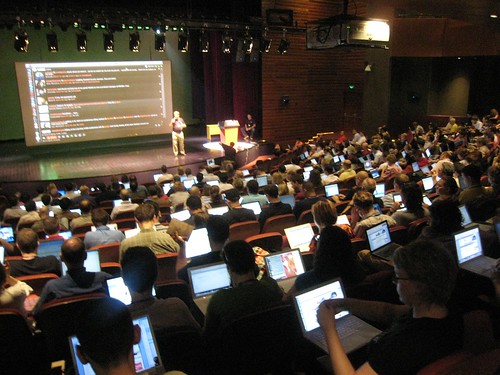
The topic of multitasking and our inability to concentrate on one thing at a time is a recurring topic in the media and on this blog (while writing this sentence an e-mail and a few Twitter messages rolled into my laptop with accompanying bleeps - must switch them off!). Our obsession with mobiles and social media is not a simple generational issue since parents and teachers are often just as likely to be distracted by the lure of their mobiles as teenagers are. If you think teenagers have difficulty concentrating in class just sit at the back of any conference room and see what adult professionals are doing on their laptops while someone is speaking on stage. Basically when it comes to digital technology we're all like cows who have just been let out into the field after a long cold winter. Few are able to control our desire for recognition, self-promotion and communication that technology offers us and we haven't yet had time to calm down and wonder what we're really doing.

So maybe the ability focus attention will become a key competence in schools in the near future. We need to explicitly practice the skill of focusing on one task like deep reading or simple silent reflection and learn to switch off all the bleeping distractions. This is the topic of an article in Mindshift, Age of Distraction: Why It’s Crucial for Students to Learn to Focus, that interviews Daniel Goleman, psychologist and author of the book Focus: The Hidden Driver of Excellence. The ability to focus is a key factor behind all high level performers. Top artists and athletes all have the ability to focus completely on their task and in some cases enter into an almost trance like state. Today's love for multitasking and switching constantly between different activities can lead to us never acquiring this vital skill.

“This ability is more important than IQ or the socio economic status of the family you grew up in for determining career success, financial success and health,” Goleman said. That could be a problem for students in the U.S. who often seem addicted to their devices, unable to put them down for even a few moments. Teachers say students are unable to comprehend the same texts that generations of students that came before them could master without problems, said Goleman. These are signs that educators may need to start paying attention to the act of attention itself. Digital natives may need help cultivating what was once an innate part of growing up.

How and when to use digital tools and devices is an essential part of the school curriculum today and that includes knowing how and when to switch off and focus. I'm not sure that having tech-free days is particularly useful because technology is ubiquitous today. Instead we should try to foster a wise use of technology. If you're focusing on writing an assignment you must of course use your laptop or tablet but you need to learn to only use the tools essential for that job and switch off the distractions. Switching off everything is an unnecessary "cold turkey" solution. We need to develop a mature relationship with technology and this will take time.


Thursday, June 13, 2013

Fast forward

Day 90 - Couch Potato by DaGoaty, on Flickr
Creative Commons Attribution 2.0 Generic License  by DaGoaty

How often do you read an article on a web site to the end? Not often I suspect and my fears are confirmed in a fascinating article by Farhad Manjoo, You Won’t Finish This Article. He cites traffic statistics from the web site Slate showing readers' habits and how long they spend on articles. According to the stats we very seldom read whole articles any more and many people seldom get past the first two paragraphs. A staggering 38% hardly read more than the first sentence. Many more show a great reluctance to scroll so anything you write below the horizon of the browser window may only be read by less than half of your "readers".

"Schwartz’s data shows that readers can’t stay focused. The more I type, the more of you tune out. And it’s not just me. It’s not just Slate. It’s everywhere online. When people land on a story, they very rarely make it all the way down the page. A lot of people don’t even make it halfway. Even more dispiriting is the relationship between scrolling and sharing. Schwartz’s data suggest that lots of people are tweeting out links to articles they haven’t fully read. If you see someone recommending a story online, you shouldn’t assume that he has read the thing he’s sharing."

So even if lots of people seem to have landed on this blog there's no guarantee that any of them have actually read my posts. Getting loads of retweets doesn't mean that any of them have read anything either, they're just sharing. So technically a blog post could get enormous coverage in social media without anyone actually reading it to the end. If you write something outrageous in the last paragraph the chances are you'll get away with it. It's the literary equivalent of TV zapping where we give a programme about 10 seconds to grab our attention before zapping onward.

It's easy for stats like this to prompt outraged end-of-civilisation-as-we-know-it responses. But the sheer volume of information we are subjected to every day makes it hard to focus on anything for long in case we miss the next big story. We've never been better at skim reading but at the cost of forgetting the art of deep reading, following an in-depth discussion, listening to a long piece of music etc. I'm as guilty as anyone and confess to often reading half an article or less and have indeed tweeted about them. I save them however and try to read them later when I have more time. Sometimes I succeed.

I'll end this by quoting Manjoo's closing remarks:

"Maybe this is just our cultural lot: We live in the age of skimming. I want to finish the whole thing, I really do. I wish you would, too. Really—stop quitting! But who am I kidding. I’m busy. You’re busy. There’s always something else to read, watch, play, or eat."

Thursday, May 9, 2013

Grabbing attention

Multitasking by williamhartz, on Flickr
Creative Commons Attribution-Noncommercial-Share Alike 2.0 Generic License  by williamhartz

I often return to the subject of attention, often because I have a problem with it myself. I have great difficulty switching off both digital and physical distractors when I'm working and could get much more done if I could resist the sirens' call. I don't believe this is a new phenomenon but the lure of social media has certainly exacerbated the problem. It has a lot to do with where your motivation comes from and the fact that if you want to be distracted you will be. If you have a task you are extremely committed to then it is much less likely that you'll bother checking e-mails, Facebook, Twitter or news feeds. If it's a task you have to do but are not particularly interested in then it's hard to focus and the task takes at least double the necessary time.

Online learning offers great flexibility and is often the only form of education available to people with full-time jobs as well as family and other commitments. However it demands high levels of self-discipline and the ability to focus and many are simply not good at that. Even when you sit down and try to focus on your studies, say a recorded lecture or an article to read, the distractions are always temptingly close and work that could easily be done in one concentrated hour can easily take two or three.

So when designing an online course are there methods for helping the student to focus on the task in hand? This area has been the subject of research by Daniel Schacter and Karl Szpunar of Harvard University and summarised in an article in Harvard Science, Online learning: It's different. The idea of breaking up lectures into small digestible segments is commonplace today but their research shows that it is not enough. You need to have regular tests of some sort between the chunks of information, not too challenging but tricky enough to make them focus.

“At the very least, what this says is that it’s not enough to break up lectures into smaller segments, or to fill that break with some activity,” he said. “What we really need to do is instill in students the expectation that they will need to express what they’ve learned at some later point. I think it’s going to be a very sobering thought for a lot of people to think that students aren’t paying attention almost half the time, but this is one way we can help them get more out of these online lectures.”

This approach applies just as well to classroom as online learning and although it doesn't sound particularly surprising they claim there is very little research in this area so far. It seems a rather primitive behaviourist carrot and stick method but we need only look to the world of gaming to see how motivating small rewards can be and the total concentration and immersion that gamers experience. Khan Academy for one has been built around this principle with short input films, tests and a system of badges and levels to show progress. Although these are important considerations I still think the article focuses on only one aspect of online learning and misses the big picture.

This article seems to focus too much on the need to force students to focus and see the testing as a form of stick rather than carrot. I think there is enormous potential to adapt the reward principles of gaming in an educational context but the focus in the article is on traditional knowledge transmission and does not deal with learning as an interactive process. The online learning focused on in the article is the traditional self-study linear model rather than collaborative networked learning arenas where digital skills, source criticism, networking and peer review are essential. The challenge is to move from external motivation where students are forced/encouraged to focus to instilling internal motivation where they actually want to focus and the distractions simply evaporate.

Thursday, March 28, 2013

Boredom is good for you

My dog being bored by joshme17, on Flickr
Creative Commons Attribution 2.0 Generic License  by joshme17

Is boredom is becoming an endangered state of mind? We have almost abolished boredom from our lives today because the second we feel the slightest hint of it we check our mobile for a game, an app, some music, a film or at least check Facebook or Twitter for updates. We used to get very bored waiting for buses or trains but not any more. Everyone is absorbed in their own private soundtrack. We all demand entertainment and contact 24-7-365.

Boredom and its colleague silence are not a popular couple these days and we try to eliminate them wherever they might appear. When was the last time you sat in a cafe, pub or restaurant that didn't have background music (often foreground music)? Runners and walkers are cocooned in their playlists. Do we ever allow ourselves to be alone, in silence and without any particular plan of what to do next?

An article from BBC News, Children should be allowed to get bored, describes research carried out by Dr Teresa Belton (University of East Anglia) on children and boredom. She has interviewed people about how boredom affected their creativity as children. She found many who were inspired to creative activities through boredom and silence:

"Enforced solitude alone with a blank page is a wonderful spur."
"As I get older, I appreciate reflection and boredom. Boredom is a very creative state."
"She happily entertained herself with making up stories, drawing pictures of her stories and going to the library."


Many people today are willing to pay for retreat weekends free from noise and distractions, hoping for inspiration and balance. Silence and a lack of stimulation are becoming exclusive commodities. Maybe it's time to reassess boredom and see its positive side.

Wednesday, February 13, 2013

Space to think

We learn through collaboration, discussion and sharing. However we also learn by quiet contemplation and by the often solitary processes of reading and writing. Most levels of education today, both classroom and online, stress the importance of group work and our ability to function in groups is highly valued. However there's a risk that we are forgetting the importance of working alone and thereby losing the opportunity to think deeply.

This is the theme of an excellent TED talk by Susan Cain called The power of introverts where she argues the case of all introverts who aren't comfortable with group work and seldom contribute to class discussions. This is not because they have nothing to contribute - often quite the contrary - but that they need time to think before expressing themselves. Classroom discussions are generally dominated by a few confident students and group work is also dominated by those who enjoy speaking and being the centre of attention. Crowds are not always as wise as we think and are sometimes easily lead to the wrong conclusions by dominant or manipulative members, both in class and online. She argues that society puts too much emphasis on groups and social interaction and sees solitary activities as negative. Offices are now mostly open landscapes and few people have the luxury of a quiet space to work. Open spaces can be creative but creativity also needs peace and quiet.

A teacher's perspective on this issue is presented in a blog post by Monica EdingerIn the Classroom: A Few Classroom Teaching Suggestions from an Introverted Teacher. She presents a selection of strategies to enable the less vocal students have a say in class discussions. This involves waiting for answers in silence rather than always feeling obliged to say more. It also involves not giving the dominant speakers so much space to dominate, doing much less group work and giving students more time and space to think. Written communication, often as an online private dialogue between student and teacher, gives more introvert students a more appropriate channel to reflect and discuss their learning.

The main idea behind the concepts of flexible or blended learning is that we have the tools and methods to let students learn the way that suits them best. There is a need for dynamic group work and that must be available but we shouldn't forget that many people learn best on their own and need more space to learn. The secret is in the mix.