Showing posts with label innovation. Show all posts

Saturday, April 22, 2023

Self-assessment of digitally enhanced learning and teaching - overcoming inertia

Photo by Ross Sneddon on Unsplash

The pandemic threw all educational institutions into the deep end of the educational technology pool. Adapting to what was for most institutions a relatively new form of teaching and learning was a traumatic but also transformative experience. In the wake of that experience the most obvious strategy was to take stock and make a thorough review of what worked, what didn't work and how to improve in terms of using digital technology. In an increasingly unstable and unpredictable world the likelihood of further crises is extremely high and therefore the need to ensure that education can quickly adapt.

There is no shortage of research, reports, guidelines, tools, webinars and conferences to help educational institutions improve their use of educational technology in teaching and learning. Organisations like the European Commission, EUA (European University Association), EDEN (European Distance and E-learning Network) and many others have run projects, produced reports and run dozens of webinars and conferences all based on extensive research but somehow they seldom result in major changes on the ground. It's not simply about the adotpion of technology, that is really not the main point, it is a change towards more inclusive and active forms of teaching and learning. It's about learning to learn by active involvement in meaningful collaborative work where technology is an enabling factor. But the main barrier is the reluctance to change from the traditional information transfer model that so many people feel comfortable with and which is perceived as effective and indeed symbolic of higher education.

An excellent way to move towards this is to look carefully at how technology is used in the institution today and how this contributes to a more holistic view of teaching and learning - a process of self-assessment. This has been the focus of a recent EUA project, DIGI-HE that I have been involved in (on the advisory board). The project has included numerous studies, consultations and thematic peer groups reaching a broad range of educational institutions and in various disciplines. One report in particular offers a comprehensive overview of the wide range of self-assessment tools available and advise on their use: Developing a high performance digital education ecosystem - Institutional self-assessment instruments.

Set against this prerogative and growing strategic interest, this report presents a review of 20 instruments from around the globe designed for self-assessment of digitally enhanced learning and teaching at higher education institutions. It offers a number of insightful observations concerning their use (or non-use) by institutions for promoting both quality enhancement and digital capacity development. It should be of immediate interest to higher education institutions, but also to policy makers, developers of instruments, and generally, to all those who seek information on such instruments.

The project also produced a MOOC on FutureLearnInside Digital Higher Education: Self-Assessment Guide for Educators. Here institutional leaders are taken through the process of reviewing the institution's current strategies and planning for a self-assessment, looking at both risks and opportunities. The course was run during the spring but is available as an asynchronous self-study course. This is a good springboard to kick-start a change process and the project's various reports provide further guidance and inspiration from institutions who have already started their transformation process. 

This is one example of the abundance of the guidance and support available for digital transformation and pedagogical development but as the saying goes: you can lead a horse to water but you can't make it drink. Despite the clear benefits of conducting a self-assessment there seems to be a great reluctance to do so, despite the lessons of the pandemic and the abundance of research into active collaborative learning. The first barrier is the abundance of tools that creates anxiety on which one to choose. Faced with too much choice we simply don't make a choice. I think we all experience feelings like this in our daily lives when faced with the myriad of choices available in everything between insurance to telecom providers. It seems that we all suffer from inertia when it comes to actions that threaten our comforable balance. 

Self-assesment also demands a lot of time and energy at a time when most people feel already stressed and overworked. It also risks exposing wasteful practices or inequalities in the present system and thus creating conflict. The pandemic was certainly disruptive (tragically so for millions around the world) and there were signs that we would need to rethink our structures and systems to adapt to new challenges. However, we seem to have simply reverted to old practices again without much reflection. Changing the way we live and work is too demanding so we return to the default. Thatä's why we can't expect too much of institutions to embark on such costly processes voluntarily (with a few exceptions). Governments and authorities need to help them find space and time for these processes and offer incentives for doing so. Then we can hopefully create some momentum that will generate interest and widen involvement.

Sunday, June 5, 2022

Innovation - a state of mind

Photo by Deniz Altindas on Unsplash
Whenever innovation in education is discussed we immediately see images of virtual reality visors, virtual worlds or 3D printers. Very impressive but hardly likely to be normal practice in schools and universities around the world. Maybe we need to look more closely at what innovation really means and discover that you can be extremely innovative in your teaching without using any advanced technology at all. Maybe sometimes you don't even need technology at all.

This is very well expressed in my article of the week by Alexandra MihaiInnovation in Higher Education. Wait, what? Innovation is not about one-off projects or expensive technology but about testing new methods and learning from experience. 

What I find most problematic these days is that innovation is mostly referred to in conjunction to the latest shiny technology (think AI, VR). Don’t get me wrong, when used in the right context, these immersive forms of technology can definitely enhance the learning experience. But, while they are the most often showcased, they are far from being the only things that qualify as “innovation”; they tend to be expensive (still), difficult to scale up and transfer between different contexts and learning goals.
Of course technology plays a significant part in innovative practice but the real innovation is about finding new ways to promote collaboration and ensuring that no students are excluded in the process. There are pockets of innovation everywhere but they seldom lead to mainstream adoption because no one is able to join the dots. Genuine innovation can mean finding new ways for multi-disciplinary collaboration and involving students in the course design process. Maybe it is about making new connections.
Innovation is connecting people, helping them to collaborate and learn effectively. This can take many shapes, from faculty co-designing curses and (why not?) programmes, ideally also involving students in the process, to faculty, educational developers and instructional designers working together as a team to create rich learning experiences. It’s all about nurturing learning communities and communities of practice.
The article closes with the statement: An innovative university is a genuine learning organisation. Genuine innovation is creating a creative environment where scientific curiosity is allowed to flourish and where new ideas are tested and assessed. Where there is room for trial and error as long as it is based on sound research-based practice. Changes don't need to be sudden or disruptive either. It takes time and patience and we need to avoid the temptation to expect quick-fix solutions. Innovation is more a state of mind.
... an innovative mindset permeates the entire institution, at all its levels.

Sunday, May 1, 2022

Déja vu - the return of virtual worlds

The battle for the metaverse is on with most of the media buzz focused on Meta (a k a Facebook) and their plans to engage us all in their virtual market and meeting place. Already there are companies setting up virtual hubs and universities are also creating their virtual reality campuses which they hope will soon be full of student avatars. Reading about this in an article in Campus Technology10 Institutions Opening 'Metaversity' Campuses, took me back about 14 years to the heady days of Second Life and I wonder what we have learnt since then. These virtual campuses are built using EngageVR where you can design your own spaces and make them more or less accessible to visitors and residents. The best way to interact in the metaverse is through VR visors but you can also interact using your computer, though not so immersively. Students and teachers can then meet as avatars in the virtual campus and interact with objects, graphics, diagrams etc with voice communication and the ability to explore different environments together.

The new metaversity at Stanford is described like this:

The metaversity courses will be synchronous, and students can attend whether they are learning on campus or remotely. Each student will receive a Meta Quest 2 virtual reality headset for use during their course (courses can also be accessed via PC). Within the virtual learning environment, they will be able to engage with other students and their instructor in VR experiences such as delving into human anatomy, taking a time machine through history or studying astronomy on a spaceship.

Here's a video showing Stanford's virtual learning space using the EngageVR platform.


The screenshots on Engage's site seem almost indistinguishable from the views of business centres and campuses on Second Life all those years ago. Apart from the VR headsets and better graphics I wonder what's new. Most academic experiments in Second Life simply recreated virtual versions of reality with copies of their campus environment complete with lecture halls where avatars could show PowerPoint slides to an audience of student avatars seated in rows. The new VR spaces seem to be doing the same thing. In a virtual world where the laws of physics don't apply and you are free to create any space you can imagine, why do we keep building classrooms and auditoriums? Why is it so difficult to escape the stereotypes?

I really enjoyed exploring Second Life back then in the tech-optimist days of 2007. It was probably ahead of its time but it demanded high-end graphics for a smooth experience, so many users gave up when they realised that their devices simply couldn't cope. Second Life is still going and has a devoted band of users who have obviously enjoyed the experience. What was really interesting about it was you could develop your own fantastic spaces and choose whether they were open to all or restricted access. You could build realistic copies of well-known places or complete fantasy worlds. You could choose alternative identities and take part in very convincing simulations that would not be possible anywhere else. A whole virtual economy was developed with people willing to pay real money for virtual real estate. There was a vibrant cultural life with concerts, art exhibitions, sculptures and fashion shows. I enjoyed exploring new areas of the vast virtual world that was built up and did actually have useful encounters with people I would never have met otherwise. The openness gave enormous opportunities but sadly also threats as the trolls and spammers found their way into the new world. The new VR spaces are much more restricted and controlled but maybe the freedom and creativity of Second Life was its greatest attraction.

If VR is going to be relevant to education it has to contribute something new and offer possibilities that are hard to offer in any other environment. That means more than just looking at 3D models of cars or DNA strings that the publicity films tend to show. There are great examples of simulation applications in areas such as medicine and the opportunity to offer realistic roleplay situations for professional development. However, the need for visors and expensive software means it will probably be accessible only for wealthy institutions and for specific niches where VR can really prove its value. Focus on the really innovative and pedagogically valid uses of VR and skip the reproductions of campus buildings and auditoriums. 

Monday, January 13, 2020

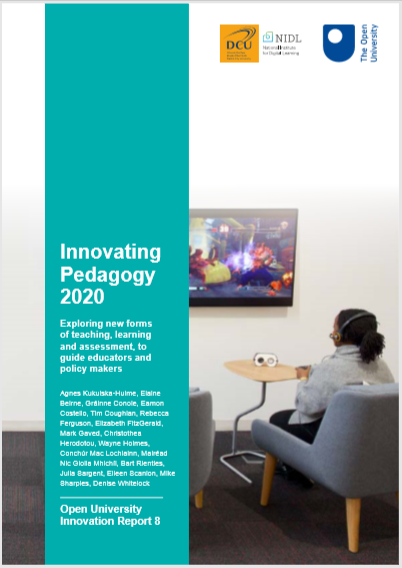
Innovating pedagogy 2020 - time for sustainable education?

CC BY-NC Some rights reserved by The Open University
The UK's Open University, in collaboration with the National Institute for Digital Learning (NIDL), Dublin City University, Ireland, has published its annual review of innovations in teaching and learning in higher education, Innovating pedagogy 2020. This the eighth report in a row and has common features with the much hyped NMC Horizon reports, such as predictions about the potential impact and timescales of each innovative practice described. These criteria are notoriously inaccurate (especially in the Horizon reports) and should not be taken too seriously but the descriptions, conclusions and references are interesting as indications on the present wind directions in the use of technology in higher education.

The ten areas examined by the report are:
  • Artificial intelligence in education. This means learning for, about and with AI. It is also vital that educators are involved in the implementation of AI and make sure it is used to benefit teaching and learning.
    ... what is clear is that the topic of AI in education is too important to be left to engineers and entrepreneurs. Instead, it is critical that educators, learning scientists and other stakeholders engage, to ensure that the AI applied in educational contexts best supports the learners, the teachers and the learning.
  • Posthumanist perspectives. This concerns the blurring of boundaries between humans and machines and the potential of this interaction for the benefit of education.
  • Learning through open data. Public organisations all over the world produce enormous amounts of open data that should be used in universities to enable students to use authentic data for research purposes.
  • Engaging with ethics. The (un)ethical use of personal data has been in the headlines for the last couple of years with the rise of what is often termed as surveillance capitalism. It is vital that students learn to learn how their data is used and misused and to gain a mature and informed attitude to the platforms and tools they use.
    Teachers and other education practitioners can actively engage their students with ethics by presenting authentic case-studies and giving opportunities for active discussion, ideally with people from different cultural settings and backgrounds. Only by engaging with ethics can we learn that our own mindset might not necessarily be shared by others.
  • Social justice pedagogy. Developing the ability to see issues from different perspectives, especially in terms of power structures, prejudice, roles, accessibility issues etc.
    For individuals, the process of thinking about how they came to know what they know, and what they think about what they know, can be very challenging. Specific teacher education may be required, to encourage and prepare teachers to adopt a social justice pedagogy and to deal with how the approach may play out in class.
  • Esports. The world of online gaming shows the power of learning and problem-solving in a community. These lessons are now being applied to create immersive learning communities.
  • Learning from animations. Animations are being increasingly used to show processes, procedures and movement.
  • Multisensory learning. Smell,taste and touch can be used more in learning activities.
  • Offline networked learning. Millions of people have limited or no internet access but can still benefit from digital resources in local networks run on battery or solar powered servers.
  • Online laboratories. Access to realistic virtual online labs give authentic laboratory experience to students who would otherwise never have access to such physical facilities.
The report is in general positive about the future as long as we can learn to harness the dangers of big data and artificial intelligence. Our attitudes to technology have changed and we need to be much more critical and cautious of the global tech giants.

The theme that interests me most is that of offline networked learning. Using battery powered mini servers and a wireless network, students in remote areas can work together with digital resources in a closed offline network (see also my post, Online learning - unplugged). This solution is also being used for education in prisons where internet access is not appropriate. However it is not only a solution for remote regions, there are arguments for closed networks even in developed regions. The report mentions the concept of  slow learning:

Networked offline learning brings people together in meaningful collaboration and sharing activities that can create opportunities for a slower, more deliberate learning experience than is typical on the Internet. 

Maybe we need to experiment with working in such distraction-free digital spaces to relearn how to focus. I don't mean that we go completely offline but a future skill will be learning to go offline in order to focus without losing the advantages of digital collaboration.

However, the biggest issue of all today is how education intends to face the greatest challenge of all today - the climate crisis. This is mentioned only briefly in the report but none of the innovations discussed will be of any relevance if the climate issue is not addressed immediately. Unless radical and uncomfortable changes take place on a global scale in the next ten years the future looks extremely dark. The educational sector must push harder for these changes, through further research but more importantly by integrating the message of United Nations sustainable development goals 2030 in every course and classroom. As I have previously written, we must develop sustainable ways to meet and collaborate, primarily through digital meetings and conferences. The carbon footprint of the higher education sector is extremely high through countless international projects and conferences (read more in this article in University World News, Time to cut international education’s carbon footprint). We cannot stop this completely but we could surely half the level if we develop better digital arenas for collaboration and learn how to use them effectively. As with all other aspects of the climate crisis, we know the dangers and we have solutions but entrenched attitudes and habits are the hardest things to change. My top trend for 2020 would be rethinking academic culture and focusing on sustainable education.

Reference
Kukulska-Hulme, A., Beirne, E., Conole, G., Costello, E., Coughlan, T., Ferguson, R., FitzGerald, E., Gaved, M., Herodotou, C., Holmes, W., Mac Lochlainn, C., Nic Giolla Mhichíl, M., Rienties, B., Sargent, J., Scanlon, E., Sharples, M. and Whitelock, D. (2020). Innovating Pedagogy 2020: Open University Innovation Report 8. Milton Keynes: The Open University.

Monday, January 6, 2020

A decade of broken dreams and big business


I strongly urge you to read Audrey Watters' review of the past decade in educational technology, The 100 Worst Ed-Tech Debacles of the Decade. It's a catalogue of the buzzwords, hypes, deceptions and snake-oil solutions that have made the educational technology headlines in recent years. Even if the focus is on the US edtech industry, most of the solutions will be familiar to educators everywhere. I have long admired Watters' courage over the years, daring to criticise the hypocrisy and cynicism of the tech industry when most of us were singing its praises and falling for the alluring tales of disruption and free education for all. The past decade has been a journey of broken dreams.

Number one in Watters' list of debacles is anti-school shooter software, the result of the USA's insane attitude to guns and mass shootings. School shootings are now so commonplace that an entire industry has developed to "protect" schools, identify shooters and alert the police. This involves increasingly sophisticated surveillance technology with enormous amounts of student data being gathered by corporations. This industry is hardly visible anywhere else in the world but is a desperately sad indictment of modern society.

Many of the phenomena described in the article fall under the following loose categories (though they are all of course interrelated):

Surveillance
Data is indeed the new oil and corporations are now able to refine the raw data of clicks, location tracking, preferences and interaction into business opportunities. Edtech software including learning management systems gather enormous amounts of student data and this can now be monetised. The prospect of using, for example, Amazon's voice assistant Alexa at school should set off alarm bells. Learning analytics seems to be largely focused on tracking and surveillance and all that data has a high commercial value. Instructure's proposed sale to equity firm Thoma Bravo for $2 billion would seem to confirm the potential value of student data. Plagiarism detection tool Turnitin has amassed a vast pool of student assignments that they can sell. The list goes on. Despite attempts, at least in Europe, to tighten laws on the exploitation of personal data we still happily accept those pesky terms and conditions when the pop up on our screens.

Educational mythology 
The Silicon Valley narrative that the traditional education system is inadequate to educate students for the 21st century has been very persuasive. As a result, we hear that the students (so-called digital natives) are driving the change and are already using technology to "hack" the system and learn on their own terms (some may be doing this but claims are highly exaggerated). This disruption narrative claims that edtech is the way forward to meeting the demands of this new generation of students who will be working in jobs that do not exist today (this has always been true - parents in the early 20th century could never have guessed that their children would become car designers, pilots or astronauts). The industry has capitalised on the FOMA (fear of missing out) factor among educational leaders with claims that MOOCs are the future of higher education and that companies like Udacity will become the Uber of education. Many institutions have been easily persuaded to make enormous investments to ensure they are seen as embracing the opportunities of the digital revolution. Sadly there have been unscrupulous actors running a whole industry of fake online universites and fake degrees. Watters' list is full of examples of this narrative and the reckless claims to disrupt education that didn't quite deliver.

Many of the leading names in the tech industry have of course invested in philanthropic initiatives that Watters calls venture philanthropy. There are surely benefits in this but inevitably there is a business case even for philanthropy:

These philanthropists’ visions for the future of education and education technology mirror their own businesses: the child will be the customer. The child’s data will be mined. The child’s education will be personalized.

Free
If it's free there's a catch, though even if you pay for it there's still generally a catch. Your data is the price you pay.

...if you’re using a piece of technology that’s free, it’s likely that your personal data is being sold to advertisers or at the very least hoarded as a potential asset (and used, for example, to develop some sort of feature or algorithm).

Free tools are used very successfully by millions of teachers to enhance their teaching, but there is always the danger that the company goes bust or gets bought by a larger company who then try to monetise it. One example of this was the social network platform Ning that was extremely popular among educators in the first half of the decade but was then bought and put behind a paywall.

Miracle cures
There have been so many headlines about how a particular device or method will disrupt/revolutionise education. From MOOCs to clickers to smartboards to virtual reality. They all have merits when applied well but the inflated expectations and sensational headlines have lead to many extremely expensive investments (and nice profits for some) and many shattered dreams.

In addition there are examples of more bizarre methods to monitor students in the form of skin response bracelets, brainwave headbands and the compulsory use of  fitness trackers for campus students (providing of course lots of useful personal data!). These are often based on quasi-scientific theories and rolled out with convincing optimism.

Flops
The list is full of ambitious and hyped solutions that belly-flopped: for example One laptop per child, Google Glass (and many other Google services that have died during the decade) and Amazon Inspire. Flops will always happen in an innovative market so there is now real surprise here but maybe the point is how the hype takes over the narrative and we all get swept along with it.

So where are we heading as we move into the twenties? I can't see the commercialisation of education going away any time soon, rather an intensification of the process from both industry and politics. Free and open education is still possible but the educators must own the platforms and the users must give informed consent to their data being stored and know that they can always demand their data back (a cornerstone of the European GDPR legislation). Maybe it's time to move to open source solutions and revive the idea behind platforms like Wikiuniversity and Wikieducator - they may have been clunky but they were open and non-commercial. Above all we need to be much more aware of media hype and attractive but misleading generalisations. Question everything and learn how and when to switch off.


Saturday, November 2, 2019

Attention seekers - taking innovation from project to mainstream


There is no shortage of innovative and exciting projects in education full of enthusiasts investigating new ways to enhance learning or widen the horizons of current educational practice. However the challenge of moving from project to mainstream often proves too great and few innovations get a chance to make a real impact on the institution's core activities.This is a source of frustration for all of us who have been working with educational technology but it's worthwhile stepping back a bit and looking at all the other important issues that are competing for the attention of policy makers and management: internationalisation, accessibility, diversity, sustainability, pedagogical development, quality assurance etc. Educational institutions must deliver what is asked of them by their government authorities or owners and if these requirements do not include specific objectives for the issues mentioned above, then those issues will naturally be of secondary importance to the management. If your cause is not on that priority list then your chances of getting noticed are low.

In recent years in Sweden there has been little coherent strategy from the top on the use of educational technology and as a result development has largely been fragmented and responsibility delegated to each institution. Things are changing now with the issue once again on the agenda of the government authorities but for many years it was hard to see real progress. There have been many projects and initiatives but almost always bottom-up and dependent on short-term financing. If bottom-up is not met half way by top-down strategies, commitment and incentives then all that energy just evaporates into thin air.

The struggle to catch the eye of the decision makers was nicely captured in a lecture I attended the other week by Melissa de Wilde from Gent University in Belgium. She is a researcher in educational innovation and described her efforts to promote virtual exchange at her university. Her story was familiar to everyone who has tried to introduce new concepts and perspectives. The challenge of simply getting people's attention is probably the greatest and demands resilience and stubborn persistence to make any kind of headway. Decision makers are the hardest to influence unless your issue can help them tick at least one of the boxes on their to-do list. Teachers can often be interested in your cause, but simply don't have the time or energy to get involved, especially since your cause is just one of many admirable but non-essential ones vying for the attention. Key success factors according to Melissa are simply getting your foot in the door and not withdrawing, getting help from a high status staff member or an external expert (deus ex machina), providing support to those who do engage, making sure to document, measure and analyse the process, creating  opportunities to share experiences and success stories and simply making yourself and your colleagues hard to ignore (creating a buzz).

However, no matter how hard you try, nothing helps your cause more than it becoming national policy and part of the institution's mission, so you need to address the policy makers as well as the grassroots. If we can join forces with other causes vying for attention and show that you can tick several boxes in one go then the chances of mainstream adoption must be high. Digitalisation can for example help to build sustainability (reduced air travel, paper use), promote internationalisation (virtual exchange, online collaboration), widen access to education (online courses), enhance inclusion (digital tools for text-speech-text, translation, sub-titles) and pedagogical development (open pedagogy, online courses, collaborative learning, best practice dissemination). If we have to compete for attention we will not get very far. Joining forces must be the answer.

Saturday, September 21, 2019

Digital by default - who is excluded?


I like to think that I am fairly comfortable with digital tools and platforms, but I feel a backlash growing inside me when the digital option is pushed into my face. Here in Sweden for example, cash has become almost obsolete, there's an app for everything and shops are becoming increasingly self-service. When a shop forces you to use those awful self-service checkouts, or you can only pay for parking by downloading the special app (that I as a visitor to the town will probably never use again), or when you arrive in a new city and are faced with the challenge of negotiating the often complex automatic ticket machines (offering you a myriad of options but never the one you are looking for). The hours I have wasted on such frustrating processes that an old-fashioned human contact would have solved in seconds.

I sometimes feel I'm the only one who feels like this, but received welcome support from a post by James Clay, Digital should be a choice… The new digital solution may be welcomed by many but we also need to consider who we are excluding by installing even more self-service machines or apps. Offer us a choice and we can maybe accept the change in time, but if there is no choice people will suffer.

We often forget that sometimes people don’t like innovation and innovation doesn’t automatically always mean better. Actually most of the time innovation for a lot of people is rarely better. Sometimes its worse than what was before, most of the time it’s just different.

I simply don't want to install new apps every week that clog up my mobile's limited capacity and that I only use a handful of times a year at most. Most buses are now cashless and if you don't use the app or have a prepaid card you are punished by paying a high price for a single ticket from A to B. In many self-service shops there is a forest of machines and one manual checkout with a long queue (curious isn't it?). At one railway station with only self-service ticket machines I saw several members of staff who spent all their time helping bewildered travellers to use the machines!

James Clay applies this to education where an increasing amount of services on campus are being migrated to kiosks or chatbots. What about students or staff who for some reason can't or don't wish to go digital in this way. Is there any real person I can ask? What do I do if I don't have a mobile that supports the latest app? Some tech companies have rationalised all traces of personal contact from their customer service, replacing it with vast FAQ pages and self-help discussion forums. Sometimes I have a problem that isn't covered there or I'm not prepared to spend the next two hours combing through the site to find an answer. I just want a quick answer. Of course I can check in myself at a hotel and do everything by app but I do like to meet a person who smiles and can answer my questions (no, I don't want a humanoid robot at the desk either, no matter how polite they may be).

Digital by default means making the first option digital, but there needs to be a second option, one that may require the use of people to deliver the service.

Whenever we innovate we need to consider whether we are excluding anyone and ensure that we have an option for them. 

Sunday, May 26, 2019

New models for higher education in rural areas

UHI Inverness campus. CC BY-SA Alastair Creelman
I am currently working in a Swedish project (Nya vägar - information in Swedish) that is investigating new paths to higher education for all who live in rural and sparsely populated areas. The problem today is that people move away from rural areas to study and very seldom return. This means that local businesses find it increasingly hard to find qualified staff and the local authorities also have difficulties finding teachers and health care staff. Even if there are many online courses and degree programmes available from Swedish universities, the range is nowhere near as wide as that offered on campus and so the brain drain continues. Some larger local authorities have set up local campuses or learning centres that try to match the needs of the local private and public sector with the courses and programmes offered by the higher education institutions. They also offer a meeting place as well as support and guidance to students and this has proved crucial to the completion rates of degree programmes. For many small local authorities the ability to access higher education without having to move from home is a simple matter of survival. Without this the population will dwindle and it will be difficult to maintain services. Our project aims to answer the following questions:
  • How can we provide higher education to all, wherever they live? 
  • How can we collaborate to optimize and assure the quality of the individual’s study situation? 
  • What can municipalities and other key actors do to create a local context that favors access to higher education? 
  • What is the role of industry and the public sector (employers)? 
  • What is required from the HE sector to increase access to HE for individuals and groups far from university sites? 
  • How can all actors collaborate to strengthen skills supply and life-long learning throughout the country?
UHI Inverness campus
One university that seems to have come a long way to answering these questions is the University of the Highlands and Islands (UHI) in Scotland and this week we paid them a visit to learn more about their unique approach to offering higher and further education to students spread over a large and sparsely populated region. Their development has been impressive and rapid; established in 1992, becoming a higher education institution in 2001 and a full university in 2011. Previously all universities in Scotland were concentrated in a central corridor between Glasgow and Aberdeen with nothing to the north and west; well over half of the country's area. UHI identifies strongly with its region aiming to be “locally based, regional in structure and have national and international reach.” They do this in an original way since the university's physical presence is in the form of a network of 13 colleges and 70 learning centres spread all over a region considerably larger than Belgium. Each college is an autonomous organisation with bilateral agreements with UHI, what they call a collegiate federal model. The teachers and researchers are based at the colleges, each of which has its own specialities and local focus, but the students can study most programmes from their nearest college or even learning centre and all have a personal academic tutor. The university faculties and support units operate horizontally in a matrix organisation. Then there are over 70 learning centres in villages, community centres, supported directly by UHI but fully rooted in the local communities. UHI is also a bilingual university with all information and support available in both English and Gaelic though this does not cover the education provided and although there are many courses in Gaelic, the vast majority of the education provided is in English.

What is particularly interesting about UHI is the fact that so many of its courses are accessible whether you study at college, a learning centre or from home and this enables people to access higher education wherever they live and don't need to leave their community. They proudly claim that students have access to about 30 degree programmes within a 30 mile radius of home (distance to nearest learning centre or partner college). Not all courses are available everywhere but as many as possible. Students work from home and come to their learning centre and local college when necessary. All students have a personal academic tutor, usually based at their nearest college. Most courses have students who study from different locations and the boundaries between campus and distance (whatever that means) seem to have been erased.

The same applies for the teachers who can be based at a college or run their courses from small remote learning centres. We met one such teacher who teaches music and even runs week-long virtual music residencies from her base on the tiny island of Benbecula. The use of digital media is of course central to everything that UHI does. A Cisco video-conferencing system links all nodes in the network and UHI is biggest user of video conferencing in Europe. It is therefore essential for all staff to be proficient in using digital media.

Inverness
For me the most interesting aspect of the university's work is its Learning and Teaching Academy (LTA) that supports the professional development of all teaching staff with a particular emphasis on the effective use of digital media. An integral part of their strategy is ALPINE (Accredited Learning, Professional development and Innovation in Education), a framework that offers professional development leading to official recognition in terms of fellowships of the UK Higher Education Academy (HEA). Staff are expected to first become associate fellows and then progress to full fellowships with the option of later becoming senior fellows. Qualification involves compiling a portfolio of learning resources, course plans and digital courseware with the amount and nature of evidence depending on the level of fellowship. Teachers are encouraged to create digital portfolios of their teaching material for recognition. The development of digital skills is integrated into all professional development but comes into focus in activities such as an annual Digital Education Week, mentorships and regular lunchtime webinars. In addition, there are seminar days involving student representatives and teaching staff to discuss for example implementation of learning analytics, course design, curriculum development etc.

Effective use of the learning management system (at present moving from Blackboard to Brightspace) is supported by their benchmarks for the use of technology in learning and teaching that maps teaching and learning criteria with functions in the LMS and offers best practice examples. This is done in terms of their 3E framework: enhance, extend and empower.

The benchmarks and associated guidance and exemplars defined and provided here are aligned with the university’s Learning and Teaching Enhancement Strategy, and will enable the embedding of the Learning and Teaching Enhancement Values in how we use the learning environment and other technologies to support learning, teaching and assessment.

Digital scholarship in terms of sharing scholarly practice and increasing research visibility is encouraged through schemes such as an annual fund to encourage research or study that must result in a paper submission to a journal as well as arranging a workshop or webinar. Three day writing retreats are arranged to help staff write their first scientific papers and this includes adjuncts and educational technologists.

Finally there is a clear strategy for openness, working towards a policy of open as default. A lot of course material is already open and they are planning to develop open textbooks and have joined the OERu partnership where they will offer open courses and validation of other partners' open courses.

I see a clear need for a model like this in Sweden, either by existing institutions in partnership or by a new institution. The key is that there is a university that focuses on providing inclusive and flexible higher education for all, no matter where they live, and sees "distance" as no object and the pedagogical use of digital media as default. The technology and methods already exist, what is often lacking is the will to change.

Finally my thanks to everyone at UHI for their hospitality and excellent discussions.

Sunday, April 28, 2019

Somewhere over the rainbow - the shifting perspectives of the Horizon Report


The full version of this year's Horizon Report is now available, published by Educause who rescued the publication from the threat of extinction last year. Each year a global panel of experts nominate trends in educational technology that will make an impact in the short, medium and long term and also identify key challenges facing higher education in the coming years. The report is often criticised since the same technologies seem to move backwards and forwards on the horizon and sometimes even disappear for a while before returning. This year's report is no exception with mobile learning predicted to go mainstream in the next couple of years, having been a feature of several reports in the past. Many other technology trends such as learning analytics, gaming, virtual reality and blended learning have been on the horizon for quite a while but somehow never really make the transition to mainstream practice.

Probably the most interesting feature of this year's report is a section, Fail or scale? (pages 33-39), that examines three trends that have featured in previous reports but have still not become an integral part of higher education practice: adaptive learning, virtual and augmented reality and gaming/gamification. Three experts present their analysis of why these phenomena haven't made the transition and all three analyses have some common ground. All of them have very sound cases for adoption but they all demand major changes to existing structures and models. Bryan Alexander's analysis of gaming in education makes a comment that could well be applied to many other technology trends featured in the Horizon Report over the years:

A new technology—especially one that requires significant research and training—needs to be able to work across the curriculum and in sufficient numbers to merit institutional investment. Faculty members can carry such a technology forward to some extent, but only if they are knowledgeable and engaged with it and if they can sufficiently support the hardware or software. Otherwise the technology will only appear at best in a small segment of a college or university.

Some technology applications have made the transition and become essential elements of the university's operations, such as the learning management system, lecture capture and anti-plagiarism software. It could be claimed that the reason that these applications have succeeded is that they have not challenged the traditional structures and models of higher education, they have simply added a digital version of what we do already (ie. lecture, work in defined classes and classrooms). The potential of many other technologies that so often feature in Horizon reports can only be realised by making radical changes to the way we teach and learn. As a result, they often get bogged down by all the other changes that have to take place before they can be fully implemented. Many new technologies require significant investment to realise their full potential, as outlined by Nicole Weber in her analysis of adaptive learning technologies:

With so much potential, why has adaptive learning not scaled quickly? One of the largest challenges is the investment (e.g., time, money, resources, and vision) needed to implement and scale these courseware products.

In the case of virtual and augmented reality (mixed reality), Kevin Ashford-Rowe highlights the barriers of the hardware required to implement the solutions successfully. In short, the inconvenience and expense of the VR visors make it impractical as a mainstream technology:

In his February 2018 article “3 Reasons Augmented Reality Hasn’t Achieved Widespread Adoption,” AJ Agrawal, argues that—in this order—it is due to a combination of ergonomics, basic utility, and corrective lenses. In short, no matter the benefits, “no one wants to wear a pair of goggles on their head during daily routine” (ergonomics); “even the most mind-blowing AR glasses won’t matter until they look ‘normal’ enough for everyday wear” (basic utility); and, given that three-quarters of the US population need corrective lenses, “it goes without saying that smart glasses need this option [corrective lenses].” He also points out an important distinction that should be made between VR and AR—AR possesses a natural advantage in that the information being displayed is integrated with what is in front of the user.

My conclusion here is that maybe we should not simply criticise reports like Horizon for changing their predictions and timescales but instead look at why it is so hard to change traditional educational structures. Tradition is the hardest barrier to break and it takes many years for any innovation to break through. The idea that we can see the impact of technological innovation in terms of such a short time scale as the next five years is probably flawed.

Read more on this in an article in Campus Technology, 3 Ed Tech Trends Stuck on the Horizon (and Why).

Monday, April 8, 2019

Destination Indonesia

I have just returned from an extremely interesting exchange visit to one of my university's partner institutions, State University of Malang (Universitas Negeri Malang), in eastern Java, Indonesia. My job there was to lecture and run workshops for staff and students on digital skills development and online collaboration as well as discussing aspects of technology in education with management, teachers and administrators. I must complement my hosts for excellent hospitality and a very warm welcome. It's always fascinating to discuss with colleagues in different countries and finding that although we have different cultures, history, languages and educational context we have so much in common. Higher education all over the world is in the midst of a digitalisation process that is forcing us all to revise our concepts of teaching and learning. This process is never simple nor straightforward, with frequent barriers and backlashes to overcome. Once we start talking, we recognise each other's difficulties and hopefully can learn from each other.

Malang State University (MU) was founded in 1954 and has today over 33,000 students based on three campuses around the city of Malang. The city itself, with a population of over 3.5 million in the urban area, is known as a city of education and is home to four public universities and 13 private institutions. The main campus is modern, tidy and very green with tree-lined avenues and parks. The most striking feature of campus life is that virtually all students have a motorbike (indeed the whole country is swarming with motorbikes) and all the parking areas are packed with bikes. There is no real distance education so all students live on campus and are all in the age group 18-23 since it is extremely difficult to apply for the state universities once you get older due to government regulations. The private universities accept older students but many of them are rather expensive. So here university is still seen in its traditional role as as something you do when you are young in order to get a good job. Professional development for alumni seems to be rather rare and when offered students are expected to attend campus classes.

The lifelong learning sector is covered by the Indonesian open university, Universitas Terbuka, with about 460,000 students. Like many other open universities around the world it offers a variety of study options with digital and printed course literature, broadcast TV and radio and a network of support centres in major cities around the country, often in association with other universities. I had no contact with any representatives of this university but in the world's fourth most populous nation (population over 260 million) there is surely room for more institutions in the lifelong learning sector.

MU is in the midst of the familiar transition from a fragmented digital learning environment run mostly by enthusiasts to an integrated part of the university's infrastructure.
The learning management system (LMS) is an adapted version of Moodle run by the IT department but still only optional for teachers and as a result the uptake is only partial. Those teachers who do use the LMS need more training to use the more interactive features and the next challenge is to build a structure for offering support and professional development. This in turn requires management commitment and a digitalisation strategy covering all of the university's activites. We discussed many options for development including the introduction of educational technologists to support faculty, digitally skilled teachers acting as mentors for colleagues and ways of rewarding those who use digital tools in their teaching. Recognition of those who promote digitalisation, support colleagues and are innovative in their course design is a crucial driver. These issues are under discussion and it will be interesting to follow developments there in the future.

Another topic of interest was how to use technology to build bridges between the university's three campuses which, although they are all in the same region, are far enough from each other to limit contacts. Video conferencing is of course an interesting option to build bridges and there was interest in developing this in the near future. Transport between locations (up to 80 km) is not so easy with heavy congestion meaning that journeys of even a few kilometres take up to an hour. As a result the three campuses are largely self-contained.

Finally I must add that these are simply my impressions from a one week visit and not an attempt to provide a any overview of Indonesian higher education.

Thursday, February 14, 2019

How would you change education if you could choose?


What would the education system look like if you had the power and resources to change it? We have all been discussing educational change for years at conferences, in publications, communities and blogs, pointing out shortcomings of the present system and proposing new strategies, teaching methods, organisation forms, platforms, devices and tools as possible solutions. But what do we actually want? What would our schools and colleges look like if you could choose? That was the basis of a panel discussion at this week's ICDE Lifelong learning summit 2019 in Lillehammer, Norway that I attended. So I decided to take up the challenge and try to briefly outline what sort of education system I would like to see. This is very much a first draft with some general principles but maybe the starting point for further discussion and reflection.

Schools and universities are part of society but also oases for reflection and perspective.
Education must become more integrated into the surrounding community with more opportunities for pupils and students to get involved in real community projects and work experience. This is already happening but must be further strengthened to let students apply their knowledge and skills in activities of real value and learn to work in a variety of different fields and with a wide range of people. Similarly companies and local authorities need to be more visible in the schools and colleges. At the same time it is also vital that educational institutions are also places where you are able to step back from the world around you; an oasis for reflection. We must not allow our education system to become simply training grounds for the labour market and there must be space for studies in philosophy and the arts to provide a healthy counter-balance. Sometimes we need an ivory tower to sit in for a while.

From bubbles to an ecosystem
Our education system is made up of a lot of bubbles. We divide schools rigidly into age-group bubbles as well as dividing the curriculum into subject bubbles, thus creating artificial barriers for the sake of administrative convenience. We need to find new ways to let age groups and subjects interact naturally, learning to use a range of knowledge and skills to solve problems together. This ties in with the increasing involvement of the community in education and of education in the community outlined above. Of course, this continues all through life and the concepts of school and college evaporate into a fluid education ecosystem for lifelong learning. Everyone in society is engaged in learning activities all through life and schools and colleges provide a framework for this. A classroom full of 12 year-olds will in this context become a rather absurd notion from the past.

Inclusion
Schools and colleges should be spaces that are open to all sections of society and where we have a chance to learn to live and work with each other. If we want to have a tolerant and cohesive society we need to foster this in our schools. Technology can help us here with tools that make learning more accessible to all and allow us to collaborate not only on-site but with colleagues from anywhere in the world. Concepts like virtual mobility allow our students to learn to work with students from many different cultures and circumstances. Technology can allow people with special needs to participate more fully than ever before in school and college work. In addition we have more teachers and other professionals who are trained in supporting people with special needs and can help to make our schools more inclusive.

Distance is no object
Today there is a vast range of online and distance learning opportunities in most countries in the world. This will continue to flourish but we need governments in particular to provide funding for  support structures to help disadvantaged people and people in remote areas to take advantage of opportunities like this. Combinations of online courses and local support are essential if we really want more inclusive education. Universities need incentives to open up their courses to the wider society and create new paths to higher education. Technically we can widen access to education but the educational systems are not quite ready for the challenges.

Technology is important but so is the absence of it
When I started thinking about this I realised that today I do not want to put technology in a headline role in my dreams of a future education system. Technology has a supporting role in all of the above but should complement and enhance human contacts. As technology becomes ubiquitous in society the need arises to find spaces where we learn to survive without it. Even if artificial intelligence will soon learn to write novels, compose music, solve complex problems, play chess, speak any language and drive our transport we will still want to be able to do these things ourselves as well. Schools of the future will need to create offline time where these skills can be learnt and practiced. Learning how to switch between plugged in and unplugged is a key literacy for the future.

All these ingredients are already present today to varying degrees around the world. I would just like us to work together to magnify them.

Update
After posting this I realised that I had forgotten to mention the theme of so many of my posts over the last couple of years - digital literacies and data security. Schools and colleges need to be able to make informed choices about the platforms and tools they use and ensure that students' data is protected from commercial interests. Similarly we need to help students make wise choices about how they use tools and services and be aware of the opportunities and limitations involved.

Sunday, April 29, 2018

Beyond the horizon

Educause,
Photo: CC BY Some rights reserved by Vancouver film school
The annual NMC Horizon reports on trends in educational technology have been eagerly awaited and intensively debated over the past decade or so. Last year New Media Consortium unexpectedly went out of business and it looked as if the reports would also disappear. However Educause were able to acquire the rights to the report and the back issues and have also succeeded in finalising this year's report, though understandably a few months behind normal schedule. They have just released a preview of the higher education report, NMC Horizon Report Preview 2018, with the full version promised by the summer.

As usual, the report has been written by about 70 experts from around the world and identifies key trends and challenges in educational technology in higher education from a short, medium and long-term perspective. This year, as before, contains few real surprises since all the technologies mentioned have been on the radar for some time and many of them never really become mainstream, despite all the predictions and innovative initiatives.

The full report will contain detailed analyses of the trends and valuable links to current initiatives in each area. Here are the trends in brief:
Driving educational technology adoption
  • Short-term: Growing focus on measuring learning, Redesigning learning spaces.
  • Medium-term: Proliferation of open educational resources, New forms of interdisciplinary studies.
  • Long-term: Advancing cultures of innovation, Cross-institution and cross-sector collaboration.
Challenges impeding technology adoption
  • Solvable: Authentic learning experiences, Improving digital literacy.
  • Difficult: Adapting organizational designs to the future of work, Advancing digital equity.
  • Wicked: Economic and political pressures, Rethinking the roles of educators.
Important developments in educational technology for higher education
  • Short-term: Analytics technologies, Makerspaces.
  • Medium-term: Adaptive learning technologies, Artificial intelligence.
  • Long-term: Mixed reality, Robotics.
For me the most intriguing category is the wicked challenges impeding technology adoption. Rethinking the role of the teacher doesn't seem to be so radical an idea, considering the wide adoption of collaborative learning, flipped classroom, project-based learning, peer assessment and so on. The transition from lecturer to facilitator is still controversial and even when the teachers are positive there are significant barriers in the form of regulations, efficiency demands and the most wicked of all - tradition. Unless the new role(s) of the teacher is accepted then the other trends may not play out as predicted.

The other wicked challenge only hints at what I see as the biggest threat to all these developments. Economic pressures on universities are growing and governments are increasingly focused on accountability, financial efficiency and simplistic league tables and rankings. However the last two years have shown us that changes in government can quickly reverse years of educational progress, especially when populist cries to return to the "good old days" become educational policy. Further personal data scandals could quickly undermine all trust in the companies who have driven the edtech movement. We have learnt that development is neither linear nor predictable and that just about anything can happen to upset the trajectory. That is probably the most wicked challenge.

Sunday, December 10, 2017

Innovating pedagogy - new report

CC BY Some rights reserved by Open University (Photo Chris Valentine)
In case you haven't already found it, I'd like to point you in the direction of the latest edition of the Open University's excellent report, Innovating pedagogy 2017. This is the sixth edition of the report and the aim is to provide a pedagogical balance to the annual NMC Horizon reports on trends in educational technology. Each year they identify and describe ten emerging pedagogies that are of course influenced by technology but are relevant to all forms of teaching and learning. Each trend is described with theoretical background and practical examples and, as in the NMC Horizon reports, there are numerous links to reports, articles and examples of these ideas in practice.

This year's report raises the following phenomena:
  • Spaced learning - dividing class time into short modules of input, recall and application with social activity breaks in between. 
  • Learners making science - citizen science activities gathering data and actively analysing.
  • Open textbooks - teachers, and even students, writing and continuously updating course literature openly on the net.
  • Navigating post-truth societies - strategies for dealing with false news, biased reporting and propaganda.
  • Intergroup empathy - methods for fostering inter-cultural understanding and diversity.
  • Immersive learning - using simulations, virtual and augmented reality in education to provide realistic practical experience of situations that are hard to replicate physically.
  • Student-led analytics - letting students access their own data to help them set objectives for and monitor their studies.
  • Big-data inquiry - learning to harness the power of big data and applying it to solve real problems.
  • Learning with internal values - greater freedom for learners to choose own focus areas within the wider curriculum, thus adding internal motivation.
  • Humanistic knowledge-building communities - combining the need for learner autonomy, creativity and self-direction with the the need to build the collective knowledge of the community.
What all of these have in common is developing a more rounded and holistic view of education and trying to integrate the sometimes conflicting perspectives of learning for employment, learning for personal development and learning to be an active citizen and part of a wider community. Today there is an increasing focus, especially from governments and industry, on learning for employment and many of the most popular uses of technology in education have been related to this. We use technology to monitor learner progress, test, set grades and facilitate knowledge transfer through recorded lectures and online resources.

The trends in this report offer a human balance to the the current obsession with tangible results and league tables. They stress participation, internal motivation, balance and active involvement. Instead of looking at how universities and schools can use big data and learning analytics to monitor students we should see how students can make use of this data to help them learn. We all need to learn how to harness the power of the data revolution instead of being passive victims. We need to learn to question and filter the information torrent in an informed and scientific way instead of feeling helpless and overwhelmed. Basically we all (teachers and students) need to relearn how to learn in today's new media landscape.

The report is fascinating reading but, like all such reports, is simply an indication of possible future developments. In a year's time things could look very different and who knows what new phenomenon can come out of the blue. What the last few years have taught us all is that predicting the future has never been so difficult. If you want to read more about this report have a look at these two: Martin Weller's blog post, Innovating Pedagogy 2017 and an article in 
Times Higher Education, Post-truth teaching: coming to a lecture theatre near you?

Reference
Ferguson, R., Barzilai, S., Ben-Zvi, D., Chinn, C.A., Herodotou, C., Hod, Y., Kali, Y., Kukulska-Hulme, A., Kupermintz, H., McAndrew, P., Rienties, B., Sagy, O., Scanlon, E., Sharples, M., Weller, M., & Whitelock, D. (2017). Innovating Pedagogy 2017: Open University Innovation Report 6. Milton Keynes: The Open University, UK.

Sunday, September 17, 2017

Students and educational technology - it's complicated


A recurring narrative in educational technology is that students are driving the change. They are using the creative and collaborative opportunities offered by today's social media and demanding that universities and faculty do the same. This is used as a powerful argument by edtech companies when selling their solutions. This narrative is strongly linked to the idea of students as digital natives and is often the reason for institutions rushing head first into hasty and largely unplanned technology projects. No one wants to appear out of touch with student demands and so major technology projects are launched without first discussing the pedagogical implications and how the technology can be used to enhance teaching and learning. Of course students are using digital tools and arenas in their learning but not as widely and proficiently as the edtech narrative claims.

But are students really demanding change? My own experience leads me to question this to a certain extent. Furthermore, digital literacy is not a simple generation issue but more about whether or not a person is interested in the use of technology. Many students are highly proficient at using digital devices and social media for socialising and entertainment but are unaware of how to use them for work and learning. It would be extremely dangerous to assume that all students are proficient at information retrieval, source criticism, collaborative learning and media skills and most institutions are now integrating these soft skills into all parts of the curriculum. However, this change is not due to student demand but due to teachers becoming aware that these skills are missing and taking action to remedy the gaps.

Sometimes students can be more conservative than faculty and this issue is raised in an article in EdSurge, What If Students Are the Biggest Barrier to Innovation? Even if many students have used a wide range of digital tools and learning spaces in their high school years, whenever they arrive on campus they are told that university is different. Students are generally very pragmatic; they want to get their grades and then a degree in the most efficient way possible. They will adapt to whatever the institution demands. They also have the traditional image of university in their heads and are disappointed if their experience doesn't match it.

... the “metaphor” of the old and wise professor pouring knowledge into students through class lectures is what many graduate students expect. When they don’t get that experience because they are forced to do group work and interact with peers (who they do not view as subject-matter experts), they don’t feel like they are learning.

“I have had students tell me. I am not paying to listen to my neighbor's thoughts, I am paying to hear you,” says Pickett.


This is reinforced by the vocabulary of higher education so if we call the teachers lecturers and the lessons are called lectures then a lecture is naturally what the students expect. Teachers who focus on student-centred learning and concepts such as collaborative learning, flipped classroom, problem-based learning and so on risk negative evaluations from students who expect to be fed with wisdom and knowledge. Expectations, tradition and attitudes are major barriers to change and cannot be overcome simply by logical argument, no matter how much research evidence is available.

I would say that the main drivers of change in terms of educational technology are teachers who are using the technology successfully, often due to a desire to widen their professional skills and a genuine interest in pedagogical innovation. The problem is, however, that many of these teachers have developed their digital skills on their own initiative, usually outside working hours. This ad hoc approach means that teachers' digital skills are not evenly distributed and there is often an alarming digital divide within the teaching staff of most institutions.

This inconsistency is a concern for many students as discussed in an article from JISC in the UK, It’s official - higher education students want staff to be better with digital, not to use more of it. Students in this national survey state clearly that they want all staff to be trained in using digital tools and demand more consistent use of technology rather than more variety.

Don’t allow academic staff to pick their own ways of using digital resources. At the moment each academic uses the virtual learning environment (VLE) in a different way, making it very time consuming to keep switching approaches. It’s also obvious that academic staff have not received adequate training in using these systems.

They are not demanding more technology but a more strategic approach to technology use and fewer bottom-up ad hoc initiatives. Interestingly the survey reveals a concern that online learning lacks a face-to-face element and a fear that more technology means less classroom contact with teachers.

However, when asked what their institution should do and not do, students requested a better use of digital systems, not more, fearing it could be used to replace face-to-face time with staff.

What seems to be missing here is a realisation that online collaboration is an essential skill in many companies and organisations today and that this skill must be developed at university and integrated into all programmes. Sadly online work is still seen as a substitute for "real" contact instead of a valuable skill in itself.

The conclusion is that technology can enhance teaching and learning but to succeed it needs to be explained and introduced gradually. Both teachers and students need to change their perspectives and this takes time. Above all the process requires skilled management and leadership and only when all these conditions are fulfilled will we see successful implementation and integration of technology in education.

Sunday, May 21, 2017

Tired tech narratives - disruption at a price


There are a number of recurring narratives in this business that we all enjoy telling and hearing to the extent that repetition leads to belief; feel-good stories about how technology is changing education and society for the better. Although these stories have elements of truth they tend to accentuate the positive and in some cases become dangerous myths. Here are two such narratives that simply won't go away.

Firstly there is the old chestnut of digital natives and a naive belief that the kids/students will work everything out for themselves. Students are using all sorts of innovative digital tools to learn for themselves and this is pushing institutions to respond. Of course there are elements of truth here. There are numerous anecdotes of teenagers creating impressive tech start-ups and the often retold tales of toddlers trying to swipe a printed book and being amazed it doesn't work like an iPad. I don't doubt these but they are more exceptions rather than the rule. Yes, most children and teenagers are completely comfortable with technology but it doesn't mean that they can work out how to search, filter, collaborate, work, study and create without any assistance. I'm not sure either that students are driving educational change as we often hear at conferences. In my experience, students are good at adapting to the institution's teaching methods and even if some may well find the teaching uninspiring they simply find ways to cope since they need the qualification and have taken on a substantial loan in order to get it. Some are using technology to enhance their studies but many only use the tools offered by the institution. Education is changing as a result of digitalisation but the main drivers in my opinion are innovative teachers and insightful leaders, urged on by the ed tech industry; for better or for worse, but that is another story.

The second popular narrative is that of the future workplace. I've seen plenty inspiring accounts of innovative work spaces at high tech companies like Google or Apple where employees have project meetings on giant beanbags, play basketball or take a yoga break whenever they need inspiration. It looks very attractive and they are undoubtedly inspiring places to work. In the same narrative we hear about the growth of the gig economy where everyone works as a consultant moving seamlessly from project to project with breaks for competence development from time to time. Success is built on being flexible, constantly developing your skills, being able to reinvent yourself and always searching for new challenges. The word disruption occurs frequently in this narrative. Technology is disrupting traditional practices and a new flexible and ever-changing society is emerging offering opportunities and growth for those who are able to adapt.

However this narrative also has a dark side. The creative and innovative workplaces we see in these conference presentations are for a well-educated elite with the financial resources to tide them over between projects. For the vast majority, however, the modern workplace has a very different narrative with long hours, stressful schedules, low pay, few if any benefits and seldom knowing whether or not you'll be needed next week. The stars of the digital economy tend not to employ very many people and many of those who do work there are involved in the less glamorous side of operations; in the warehouses or working from home on low wages. The flip side of this gig economy are the people who scramble for zero hours contract jobs with no security and never knowing whether they will get paid next week at all. The digital revolution is not so attractive for those on the wrong side. See more on this in a BBC article, Why "cool" offices don't always make for a happier workforce.

So how about companies taking some social responsibility for all the job losses and problems their disruptive innovation causes? This issue is raised by András Baneth in a recent TEDx talk (see below). He takes examples like Uber, Airbnb and Facebook as companies that have come under hard criticism for the results of their operations and offers advice on how companies should take responsibility and enhance their reputation. This involves at a basic level at least admitting that your business has created some serious issues in society instead of simply denying any responsibility. Then the company can try to help tackle those issues, for example by finding ways to prevent the spread of hate and fake news or funding retraining initiatives for those whose businesses suffer due to their operations.


Disruption is generally viewed positively today and the narrative of bold innovative young entrepreneurs "taking on the establishment" and overturning the system nearly always goes down well at conferences. However disruption also has consequences. A deregulated market can make some people very rich but can also cast many more into unemployment, poverty or insecurity. Social media let everyone have their say but also make it easy to spread hate and prejudice. It may not be completely the fault of the messenger (such as Facebook) but they have certainly a major role and need to recognise this.