Showing posts with label photo. Show all posts

Sunday, May 5, 2019

Don't believe your eyes - this person does not exist

In a world full of fake news it's time to embrace the concept of fake people. An artificial intelligence system called StyleGAN developed by Nvidia is used on a site called thispersondoesnotexist.com to generate an infinite number of portrait photos of people who do not exist (watch the video below to see how it works). Just go to the site and simply reload the page to generate a new portrait. Some are extremely convincing though sometimes there are flaws that make you suspicious, such as strange skin features or ears that don't quite fit. However, I don't think we are meant to study the faces for any length of time, we will probably just see them as a gallery of "satisfied customers" in an advert or concerned citizens in political propaganda.

The phenomenon is described in an article from CNN, These people do not exist. Why websites are churning out fake images of people (and cats). Of course if you can generate fake people you can also generate fake cats, fake home interiors, fake cars and much more. There are many valid uses for a tool like this.

GANs-produced fakery can be fun — if you know what you're looking at — and potentially big business. A startup called Tangent, for example, says it is using GANs to modify faces of real-life models so online retailers can quickly (and realistically) tailor catalog images to shoppers in different countries rather than using different models or Photoshop. A video game company could use GANs to help come up with new characters, or iterate on existing ones.

There are also, of course, lots of less honest applications of this technology and that's what makes it scary. At least by letting us see these applications they make us aware that this technology exists and can be more careful in the future but once it is perfected how will we ever be able to tell the difference between reality and fiction? I also wonder how you can decide the copyright for these images since they are mashups of a vast number of photos of real people. Maybe it's time to stop saying things like "I'll believe it when I see it."

Saturday, August 13, 2016

Giving it all away

Photo: Samuel Zeller CC0
I found a nice testimony to the power of sharing in a post by a Swiss photographer called Samuel Zeller, Giving my images for free. He shares many of his best photos on a site called Unsplash and makes them freely available for copying and reusing under a Creative Commons CC0 license (public domain, author waives all rights). This may seem insane to many people when he could try to sell these images but his post makes a very strong case for the power of sharing. By sharing his work in this way he has increased his visibility as a photographer to a staggering level - 184 images have been viewed 63 million times and downloaded 613,000 times. His free photos have been used by major companies and he hasn't received a cent for this. However the free images link to his main portfolio and this leads to clients asking for special commissions and this is where he makes his money.

Why should I need to sell images if I have clients paying me to shoot specific images ? To me working for a client face to face is rewarding, way more than making money on digital sales to people I will never interact with.

It's not a case of giving everything away for free but sharing an impressive sample of your material that will attract attention and lead to more serious business later. It's basically the same the freemium model that many online tools and services offer; letting you use a basic version of the service for free in the hope that you will want to upgrade to the commercial version later.

I have benefitted enormously by sharing my lectures, blog posts, slideshows, articles etc. since they have lead to all sorts of people contacting me and asking if I can speak at their conference, write something for their journal or website or joining a project they are planning. Many of us work for smaller projects as volunteers in our free time, not only because it's interesting and fun but also because that volutary work usually pays off in the end through reputation building or commissioned work.

Of course not everyone has the luxury of being able to share everything they do. Bills have to be paid and those who share normally have a secure employment. The skill is realising that a certain level of sharing has more benefits than drawbacks. If you don't share anything and hope that people will pay to discover your work you will not get far today. Free sharing is your shop window. As Zeller concludes:

There’s no point in being talented if nobody can see what you do.


Monday, February 2, 2015

Giving credit

pelotón de fusilamiento by kinojam, on Flickr
Creative Commons Creative Commons Attribution-Noncommercial-No Derivative Works 2.0 Generic License  by kinojam on Flickr

We live in the age of ubiquitous photography. I remember the days when I wondered if I should take one or two film rolls with me on holiday and the cost of developing 50 photos was considerable. Today I just snap everything I see and come home with hundreds of photos, some of which are quite good. An astounding amount of photos are stored and publicly shared in various cloud repositories like Flickr or Picasa and once there they can then be shared and reused by thousands. Once your photos are out there they develop a life of their own and you no longer control your creations.

In a world full of mashups and remixes we borrow from a wide range of sources and create new works. However it is seldom you see the original creators getting any credit and although the practice doesn't result in a copyright lawsuit it would be only fair to give credit to those who have inspired you. Professional photographers are generally good at protecting their work and being explicit about rights but the hordes of good but not professional photographers are often less careful and their work is then reused without credit. Putting a Creative Commons license on your work makes it clear how you would like your work to be used and always demands that reusers clearly credit the owner of the work and link back to the original. The problem is that people need help to give credit in the right way and that's where new tools are needed.

A new service called Elog.io is hoping to help people acknowledge their sources. Elog.io has been started by a Swedish guy called Jonas Öberg, who describes himself as "a technologist, teacher, software developer, project manager, non-profit serial entrepreneur, husband and father."The service that allows you to search for the source of any photo you find on the net and generates a ready format for acknowledging that source. The aim is to encourage a sharing culture where credit is freely given to people who are willing to share their work. This should be common practice in schools and universities where citing text sources is obligatory academic practice but where photos are often used without credit, especially in PowerPoint presentations. But it's not just about giving credit. Elog.io hopes to help build a community of photographers and offer a community service where everyone contributes and benefits. Since it's an open source solution the field is open for new add-ons and developments.

This isn't limited to photographs: knowing who authored something is essential to be able to give credit to that person. In school, we've come to learn and appreciate the need to cite our sources, to give reference and credit to the authors whose work we use. When others cite you and give credit to you, they help you build your reputation, something that's vital if you are to succeed with your ambitions, whether you're a budding writer, journalist, photographer or scientist.


At present the Elog.io app is available for Chrome and Firefox. The service is still in its early stages and although the present volume of photos covered by Elog.io is considerable it needs money to keep expanding. That's why they have started as a crowd-funding project so you're welcome to donate to the cause. Here's the introduction film to give you an idea of what Elog-io has to offer.

Sunday, April 28, 2013

Just because you can

OK Go - Singing Over the Crowd by Cycrolu, on Flickr
Creative Commons Attribution-Noncommercial-No Derivative Works 2.0 Generic License  by Cycrolu

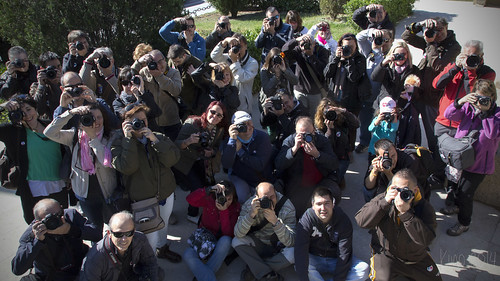
When I went on holiday 15 years ago or more I thought a couple of 36 photo film rolls were easily enough to capture those important moments. The cost of developing those photos meant that every camera click was carefully considered. Today I take hundreds of photos, not because I have to but mostly because I can. I delete the worst ones but I keep about 90% of them even if I know that very few people in the world, if any, are likely to want to see them. We all sit on vast collections of photos and video footage that are hardly ever viewed. Since digital storage is free or inexpensive it's easy to save everything, just in case.

Maybe we spend so much time filming and taking photos that we actually forget to simply enjoy the real experience. Whenever you go to a major tourist attraction the place is swarming with people all taking thousands of very similar photos of the same place, from much the same angles. I'm in there with the best of them but I sometimes wonder why. I suppose it's the need to prove that you were actually there and in recent years to prove that to all your friends on Facebook. I do often enjoy seeing friends' photos on Facebook, especially if they've been somewhere interesting. Sharing memories and experiences is what drives social media and fulfills the need to create bonds and common reference points. However maybe we have to step back now and then and wonder if we really need to take all these photos and films and whether we are sometimes more focused on that than actually enjoying the experience.

An article on CNN, At concerts, put that cell phone down, complains of the forest of mobiles held up at concerts with everyone taking blurred photos and recording poor quality films of the performance. YouTube is full of dreadful concert video clips that no one ever watches and the author wonders why we do it.

"It's difficult to explain just why we do it -- why having a very basic camera in our pocket compels us to shoot photos and videos of live music that, deep down, we know we'll never look at.
Part of it might be the delusional notion of preserving a memory, but it's probably more about showing everyone in social media that you're actually out of your house doing something culturally important. As opposed to staying in and slathering your body with ranch dressing."


The article cites a recent example of the rock group the Yeah Yeah Yeahs who put up signs at a recent concert appealing to fans to keep their mobiles out of sight. Let the people behind you see the show. The chances of you getting any decent footage are slim and it's simply an unnecessary irritant.

"Of course, if you have a quality camera and can get up close, there's definitely an art in concert photography. And people certainly appreciate that.
But for everyone else, let's all agree to give it a rest. Do it for you. Just experience the music, take it in, and we'll talk about our favorite moments over late-night food."


Friday, March 11, 2011

The genie in the laptop

This week's web discovery for me is a very attractive search tool called Qwiki. I've found myself searching images almost as much as text recently and there are many very attractive apps for finding high quality photos. The idea behind Qwiki, however, is unique as far as I know. You search for a town, person, restaurant, activity or whatever and Qwiki presents you with a photo montage about your search, reads an introductory text with the vital facts and presents lots of relevant links for more information. It is a fine example of a mashup featuring material from sources like Wikipedia, Google, YouTube, Fotopedia and others.

One slightly eerie thing about Qwiki is that the computer voice that presents the information has a soft female neutral American accent which reminds me strongly of the soft-spoken tones of the computer HAL in the film 2001 - A space odyssey. I can just hear her saying "I don't think that is a good idea Alastair."

The following film is from the product launch last year and features using Qwiki as your wake-up call telling you what today's weather will be like as well as what meetings you have in your diary. The genie speaks.


Qwiki at TechCrunch Disrupt from Qwiki on Vimeo.

Tuesday, May 4, 2010

What's a zettabyte?

There's a certain fascination in extremely large numbers. Children often invent their own vocabulary for numbers higher than a billion; I remember using zillion for example. The world of computing is teaching us to use all sorts of new prefixes to describe the vast amount of information in the world today. I remember when a megabyte of information was considered a lot but now we talk more in terms of gigabytes and terabytes.

So I enjoyed reading an article in the Guardian, Goodbye petabytes, hello zettabytes, stating that the total amount of digital information in the world today is fast approaching the zettabyte level and is set to reach 1.2 ZB by the end of the year. In case you wondered, a zettabyte is a million million gigabytes or the equivalent of 75 billion iPads. Once you get up to these levels you lose track of how many zeroes there are. If you enjoy mind-numbing number crunching have a look at a couple of entries in Wikipedia: the biggest number of all, the Googolplex and the names of large numbers

The trouble is that this vast amount of information is largely unstructured and impossible to retrieve despite the growth of Google. Our texts, photos, films and music are stored on servers, own computers, CDs, DVDs and memory sticks and most of us hardly even bother to label them. Just imagine a famous tourist attraction like the Eiffel Tower. How many photos of it are taken per day every day, every year? Just watch the camera flashes in the crowd at say the opening ceremony of the Olympic games and imagine that each member of the 80,000 crowd took at least 100 photos per person. Where are we going to store all this in the future and more importantly should we even try to store it all? Who decides what to save? There must be plenty scope for some serious spring cleaning on the web. How many identical photos of the Eiffel Tower does the world need?

Photo: by Anne Helmond on Flickr, CC-BY-NC-ND

Monday, February 8, 2010

Credit where credit's due

I try to be careful about using other people's material in my presentations and blogs. I often use my own photos and if I use something from the net I go to sites with stock photos with CC licenses and try to link to and acknowledge the source. I may have failed to do this properly sometimes but I try. The trouble is that it's seldom clear exactly what should be written under a photo or a film so that it is correctly used. I'd love to find a ready line to paste in that gives due credit and links to the original. I've spent a long time on various sites trying to find the right way to credit and in the end was forced to guess. Maybe it's blindingly obvious to many of you but I'm afraid I haven't found the magic formula.

I read with great interest two good blog posts on the confusing area of using digital material in education; one by James Clay entitled Are you stealing stuff? and the other by Simon Finch entitled Proper tea is theft. Both posts of course resulted in lengthy discussions. The main point for me from these excellent posts is that since we're all putting so much material on the net we should simply show a bit more respect for each other when we borrow. If you use someone else's material just say so and give credit. Some might argue that it's a battle between us poor ordinary people in the street and the faceless might of big business and its protectionist laws. However, in the world of the social web most of the creative work is coming from just those ordinary people in the street - us! As Simon Finch writes:

"Web 2.0, and the rest, is making us a world of creators and publishers. We’re uploading pictures, music, videos, Flash activities, personal writing, presentations, teaching resources and more – and so are our learners. That image that you’ve found, is just the thing to add value and impact to the learning activity for that needy class of yours. But that image doesn’t belong to an international image company – no, it belongs to someone like you.."

So the moral is to give credit where credit is due, not terribly difficult really. Isn't embedding a photo similar to quoting from a book or article? There are established formulae for text references that we teach carefully to all students so why not photo or film references? A standard format for media references would be very handy. On Creative Commons sites I would like the attribution to automatically follow when I embed a photo or a film. Make it easy and most people will follow.

Tuesday, November 10, 2009

Going public

If you say something controversial at a meeting, in class or even at a party there's an ever-increasing likelihood that your comment will be broadcast to the world almost instantly. Someone in the audience will have a smartphone and can inform all their contacts via Facebook or Twitter almost before you've finished your sentence. Someone may even be filming you.

This can have positive effects of course and can extend the reach of a conference or class but in many cases this sort of social reporting can have damaging effects. It just needs someone to misunderstand a comment or willfully misrepresent what was said to start all sorts of malicious rumours. I read a while ago that many celebrity parties ban cellphones because people can't relax if there's the risk that anything they do or say may be out on the net within seconds.

These themes are discussed in a new BBC article called Social media challenge social rules. The writer, Bill Thompson, admits to tweeting and sending photos during a recent conference but wonders where we should draw the line on this. Gossip has never travelled faster or further than today and maybe we need to develop a new sense of respect for what may or may not be communicated.

We have the ability to communicate with the world and suddenly all of us have to consider issues previously only considered by newspaper editors. When we send a tweet or make a blog post we are publishing in the public domain and have to consider the consequences. Remarks that you can make to a close friend in private may not be appropriate to broadcast. A vital part of the digital competence that needs to be taught in schools and colleges is a sense of appropriacy and respect or other's feelings. You never know who may read your text or see your photo. Maybe we need to learn to be more critical of what we publish.

Thursday, October 22, 2009

How free is free?

We all assume that everything on the net is free and that somehow advertising pays for all the services we use. As a result we upload tons of content to servers somewhere out there and believe they're safe there. But what happens when the company providing that service has financial problems and decides to charge for the service or, worse still, decides simply to pull out the plug?

There's a critical article on this theme in Times Higher Education by Tara Brabazon, Beware writers bearing promises of a free internet. In particular Chris Anderson's book "Free" comes under fire as it shows the "freemium" movement to be ultimately highly commercial rather than the philanthropic movement it is sometimes presented as.

"His (Anderson's) “free” is corporatised. The cost of free is permanence, reliability and stability. The old cliché is correct. We get what we pay for: when the price is free, then the “service” can be removed without questions or reprisal."

Brabazon used a web service for storing her audio files that suddenly disappeared because the owners decided that the service wasn't being used enough. Since it was "free" they had no obligation to communicate with the users. In addition, the cost of using many free services is the irritation of having sometimes highly inappropriate ads next to your content; especially sensitive if you're using it for teaching.

We trust companies like Google and Ning but if times get tough who knows what may happen. Our information is at their mercy. Terms can be changed at the drop of a hat and it's important we are aware of this and not place unlimited trust in companies that, after all, are there to make money. The free services are, of course, mostly there as bait to get you into the premium services. I admit the irony of writing this on a free blog tool!

The article does however point us in the direction of a genuine non-profit archive for digital material, the Internet Archive. This is a massive library of films, photos, audio, texts and an archive of 150 billion web pages from 1996 to the present day. The archive “is free and open for everyone to use ..... to encourage widespread use of texts in new contexts by people who might not have used them before." This is possibly the real meaning of "free".

Saturday, September 12, 2009

Fotopedia

Sharing photos is one of the most popular social activities on the net and you might wonder if there is a need for another photo sharing site, but I can't help recommending a relatively recent arrival on the scene; Fotopedia. The idea is to create a photo equivalent of Wikipedia allowing photographers to share, tag and collaborate. Superb layout and some breathtaking photos.

The principle is that youcan upload photos and create your own albums or you can add your photos to existing albums on a particular subject. Photos can even be uploaded from Flickr or Picasa and then be linked to Wikipedia articles and Google Maps. The crowdsourcing principle rules here by allowing users to vote on the best and most relevant photos. The more votes a photo collects the further up the hierarchy it climbs.

“After traveling the world, I wanted to share my photos with others. Flickr and other photo sites give you exposure for only a brief window in time, and adding photos to wikipedia proved too complicated for the average user. This sparked the idea for a ‘wikipedia of photos’ – that combines the permanence and community collaboration of wikipedia with the ease of use of consumer desktop applications.” Jean-Marie Hullot, one of the founders of Fotopedia.