Wednesday, May 12, 2010
Speaker-free conference


Academic conferences follow a time-honoured tradition with a very predictable format and few radical innovations. Keynote speakers, break-out sessions, panel discussions and debates are the order of the day and even if we now add in Twitter feeds and other social networking tools there's often the feeling at the end that the best part of it all were the coffee breaks and the evening mingle.
I wonder if we can organise speaker-free conferences or at least 50% speaker-free. Think of those giant LAN-gatherings where kids gather in their thousands to play collaborative games; what concentrated and dynamic commitment! My dream is an academic conference that manages to generate some of that power and commitment. All the participants at academic conferences are experts in their own area and have a lot to say. How can we get everyone involved and make it a valuable and stimulating experience? How can we integrate the online participants?
The concept of unconferencing already exists and there are plenty of methods available to activate dynamic discussion groups with or without technology. The virtual world of Second Life is also used for conferences with varying degrees of success but is often confined to participants who are already comfortable with the virtual environment.
The problem is that mainstream conferences seldom consider any radical departures from the traditional format. Presenting a paper is of course an academic merit and the conference is a showcase for researchers. However I feel that many conferences try too hard to cram in as many presentations as possible, often allowing only 15-20 minutes per speaker with the result that most delegates feel punch-drunk at the end of the day. I've been involved in conference organisation myself and know how difficult it is to step out of the comfort zone.
Let's have more free discussion sessions without demands for someone to summarize in front of the whole class afterwards (often a rather dull ritual to show that we've all been working hard). Let's find more ways of involving the online community in the conference proceedings with new ways of using technology constructively - for collective brainstorming for example. Imagine delegates leaving the conference exhausted but elated after having really contributed to a meaningful dialogue like the kids after a LAN.
I know that many are already doing this but let's try and make it mainstream. I don't mean we should sweep away the best points of an academic conference, just that we question some of the traditions and try new ways of getting people really involved.


Tuesday, May 11, 2010
Wikipedia again
As a follow-up to previous posts on Wikipedia I'd like to recommend an article by Matthew Shapiro on Education Week called Embracing Wikipedia. He is also concerned about teachers banning the use of Wikipedia as a reference and refers to a recent study (Internet encyclopedias go head to head, Nature) showing that for every four errors found on Wikipedia you can find three errors in Encyclopedia Britannica.
That will no doubt come as a shock to many Wikipedia opponents but it's worth thinking about how reliable the traditional reference works actually are. Another point is that the Wikipedia errors get corrected, often very quickly, whereas the errors in the print encyclopedia don't get corrected till the next edition. This doesn't mean that Wikipedia is completely trustworthy, just that it should simply be brushed aside. It is one of many sources and since it is the sixth most accessed resource on the web it should not be ignored.
That will no doubt come as a shock to many Wikipedia opponents but it's worth thinking about how reliable the traditional reference works actually are. Another point is that the Wikipedia errors get corrected, often very quickly, whereas the errors in the print encyclopedia don't get corrected till the next edition. This doesn't mean that Wikipedia is completely trustworthy, just that it should simply be brushed aside. It is one of many sources and since it is the sixth most accessed resource on the web it should not be ignored.
Monday, May 10, 2010
"Net generation" not so open
You read a lot these days about how young people are using social media recklessly and revealing their entire private lives to the world. I'm not sure and although I can't link to any conclusive research in this area I suspect that this problem is as relevant for the over 30s, if not more so. In fact I would claim that teenagers actually prefer relatively "closed" social networks to wide open ones and that their parents are the ones who share with everyone. Texting, Skype and MSN are the dominant means of communication and there you only communicate with friends. Many are wary of open apps like Facebook and Twitter since you don't know who will be reading (often parents and teachers!).
Contrary to popular belief, social networking appeals to all age groups. 64% of all Twitter users and 61% of Facebook users are 35 or older (Study: ages of social network users). It's a similar story in many other apps normally associated with the so-called net-generation. Most users are no doubt relatively unaware of their own security settings and that in many cases the default setting is that everything is public. You have to take the initiative if you want to restrict access. There's been a lot of public debate about how much information Facebook in particular owns about each one of us and what that information may be used for in the future. Read, for example, a recent blogpost Top ten reasons you should quit Facebook.
An article in the New York Times, The tell-all generation learns to keep things offline takes up the growing privacy concerns of many young people and confirms my suspicion that they are more concerned than their parents' generation:
"In the Pew study, to be released shortly, researchers interviewed 2,253 adults late last summer and found that people ages 18 to 29 were more apt to monitor privacy settings than older adults are, and they more often delete comments or remove their names from photos so they cannot be identified."
Basically you have to assume that whatever you publish will be seen by more people than you might wish and therefore be careful what you publish unless you're sure of the security settings. Maybe it's time to move some activities away from Facebook and suchlike and on to more secure or more relevant networks. Many people mix work and play on, say, Facebook, resulting in unfortunate consequences. Decide what you want to do on each network and who you want to communicate with and be consistent. Use different identities or even different networks (eg Facebook for private and LinkedIn for work) to avoid work contacts learning all about your family life and vice versa. This is nothing new really, it's just that we have new and exciting settings for interaction today and we have to relearn a few common sense principles.
Contrary to popular belief, social networking appeals to all age groups. 64% of all Twitter users and 61% of Facebook users are 35 or older (Study: ages of social network users). It's a similar story in many other apps normally associated with the so-called net-generation. Most users are no doubt relatively unaware of their own security settings and that in many cases the default setting is that everything is public. You have to take the initiative if you want to restrict access. There's been a lot of public debate about how much information Facebook in particular owns about each one of us and what that information may be used for in the future. Read, for example, a recent blogpost Top ten reasons you should quit Facebook.
An article in the New York Times, The tell-all generation learns to keep things offline takes up the growing privacy concerns of many young people and confirms my suspicion that they are more concerned than their parents' generation:
"In the Pew study, to be released shortly, researchers interviewed 2,253 adults late last summer and found that people ages 18 to 29 were more apt to monitor privacy settings than older adults are, and they more often delete comments or remove their names from photos so they cannot be identified."
Basically you have to assume that whatever you publish will be seen by more people than you might wish and therefore be careful what you publish unless you're sure of the security settings. Maybe it's time to move some activities away from Facebook and suchlike and on to more secure or more relevant networks. Many people mix work and play on, say, Facebook, resulting in unfortunate consequences. Decide what you want to do on each network and who you want to communicate with and be consistent. Use different identities or even different networks (eg Facebook for private and LinkedIn for work) to avoid work contacts learning all about your family life and vice versa. This is nothing new really, it's just that we have new and exciting settings for interaction today and we have to relearn a few common sense principles.
Thursday, May 6, 2010
Unintentional marketing pays off
The President of Macalester College in Minnesota, Brian Rosenberg, was not particularly aware of social media until he agreed to take part in a light-hearted video aimed at college alumni and recorded as part of President's Day at the college. The video was then released on YouTube and became an instant hit with 39,000 views in the first month and the college president suddenly had a cult following on the net. The video made the college known to a vast number of people (writing this post adds to that number!) who would never otherwise have shown any interest in the place. Furthermore the video became an unintentional fund-raising tool with donations spiking in the period after the video's release.
More on this story can be found in an article in The Chronicle of Higher Education, What I learned from YouTube. The main lesson to be learned here is the power of social media in that you can reach audiences you wouldn't reach by more conventional marketing methods. The cost of this video was very low compared to its impact and reach. Not all such initiatives pay off of course but Rosenberg draws the conclusion that you have to be innovative to get noticed. Breaking the traditional, well-polished academic mould now and again can have a liberating effect.
"Yet it is precisely that meticulous cultivation of image that can make the occasional moment of self-parody so powerful and so liberating for both the community and the president. While our primary audience was alumni, I have been moved by the number of faculty and staff members who have expressed pride in working at an institution that was willing to risk, even in this seemingly casual way, being both authentic and distinctive."
More on this story can be found in an article in The Chronicle of Higher Education, What I learned from YouTube. The main lesson to be learned here is the power of social media in that you can reach audiences you wouldn't reach by more conventional marketing methods. The cost of this video was very low compared to its impact and reach. Not all such initiatives pay off of course but Rosenberg draws the conclusion that you have to be innovative to get noticed. Breaking the traditional, well-polished academic mould now and again can have a liberating effect.
"Yet it is precisely that meticulous cultivation of image that can make the occasional moment of self-parody so powerful and so liberating for both the community and the president. While our primary audience was alumni, I have been moved by the number of faculty and staff members who have expressed pride in working at an institution that was willing to risk, even in this seemingly casual way, being both authentic and distinctive."
Tuesday, May 4, 2010
What's a zettabyte?

So I enjoyed reading an article in the Guardian, Goodbye petabytes, hello zettabytes, stating that the total amount of digital information in the world today is fast approaching the zettabyte level and is set to reach 1.2 ZB by the end of the year. In case you wondered, a zettabyte is a million million gigabytes or the equivalent of 75 billion iPads. Once you get up to these levels you lose track of how many zeroes there are. If you enjoy mind-numbing number crunching have a look at a couple of entries in Wikipedia: the biggest number of all, the Googolplex and the names of large numbers
The trouble is that this vast amount of information is largely unstructured and impossible to retrieve despite the growth of Google. Our texts, photos, films and music are stored on servers, own computers, CDs, DVDs and memory sticks and most of us hardly even bother to label them. Just imagine a famous tourist attraction like the Eiffel Tower. How many photos of it are taken per day every day, every year? Just watch the camera flashes in the crowd at say the opening ceremony of the Olympic games and imagine that each member of the 80,000 crowd took at least 100 photos per person. Where are we going to store all this in the future and more importantly should we even try to store it all? Who decides what to save? There must be plenty scope for some serious spring cleaning on the web. How many identical photos of the Eiffel Tower does the world need?
Photo: by Anne Helmond on Flickr, CC-BY-NC-ND
Saturday, April 24, 2010
Farmville

I've just read an article on Farmville by A. J. Patrick Liszkiewicz called Cultivated play: Farmville. Seemingly the main attraction of the game is the simple fact that everyone else is playing it. It's a bit like the Tupperware concept: it's very hard not to buy when your best friend or neighbour is the salesperson. You get invited into Farmville and you're hooked. There's not a lot of skill involved, nothing much happens and you don't get a lot out of it. It's just there and demands attention. There's a lot of debate about whether or not people will be willing to pay for news content from the major newspapers on the net but people have no trouble paying real money to improve their virtual farms.
"The secret to Farmville’s popularity is neither gameplay nor aesthetics. Farmville is popular because in entangles users in a web of social obligations. When users log into Facebook, they are reminded that their neighbors have sent them gifts, posted bonuses on their walls, and helped with each others’ farms. In turn, they are obligated to return the courtesies. As the French sociologist Marcel Mauss tells us, gifts are never free: they bind the giver and receiver in a loop of reciprocity. It is rude to refuse a gift, and ruder still to not return the kindness. We play Farmville, then, because we are trying to be good to one another. We play Farmville because we are polite, cultivated people."
It's very similar to the Tamagotchi phenomenon of 10 years ago where you had to care for an electronic pet who got angry or depressed if it didn't get attention regularly. If you didn't keep it fed and cared for it died. Similarly your farm demands regular work and will quickly suffer if you are not a good farmer. We have enough duties and bad conscience in the real world without playing games that add to that. But against all logic such games flourish.
It may not be exciting, immersive, engaging or impressive but Farmville does something that may more impressive games fail to do. It makes money, and lots of it. Evidently Zynga the company behind Farmville and several other similar social games is tipped to earn $300 million this year, mostly on in-game micro-payments. Underestimate trivia at your peril.
Friday, April 23, 2010
Always on
Social media can be addictive. Once you start networking and communicating it's very hard to stop. If you do stop for a while you soon get messages from friends wondering what's wrong with you. If you don't update your profile, add a blog post, comment on Twitter or log into Messenger or Skype you simply disappear off the social radar. It's fun, stimulating, rewarding but also stressful and demanding. Without even noticing it many of us are quite simply hooked.
A recent experiment at the University of Maryland, Students addicted to social media, asked 200 students to take part in 24 hours of unplugged media abstinence and then write about the experience. Most of them had problems. Interestingly very few missed accessing traditional mass media simply because they don't use them anyway. Very few watched broadcast TV, radio or read newspapers. Very few even read the online editions of recognized newspapers preferring to get their new via social media like Facebook, Twitter, blogs or through text contact with friends.
What worried them most was not being in touch with their networks of friends. Mobile devices let us keep in touch with all our friends all day, no matter where they are and this creates a sort of comforting cocoon to our lives; constantly updated status reports, comments, mood statements and chat. This coccon follows us everywhere. Our friends are always with us just as we are always with them and this comforting background noise becomes a sort of digital oxygen. Add to that the constant soundtrack we have to our lives as we listen to music almost everywhere and the comfort cocoon is complete. The unplugged students expressed considerable anxiety about being disconnected:.
"Texting and IM-ing my friends gives me a constant feeling of comfort," wrote one student. "When I did not have those two luxuries, I felt quite alone and secluded from my life. Although I go to a school with thousands of students, the fact that I was not able to communicate with anyone via technology was almost unbearable."
All this communication shows that we are part of a community and are accepted and valued by others. Nothing new there, it's just more pronounced than ever. The equivalent for those of us who remember life before the web would be not getting any phone calls or no letters in the postbox. Being left out of the conversation has never been pleasant. The Maryland students just felt the social isolation more intensely because today's social interaction is so much more intense.
Read the study blog A day without media.
A recent experiment at the University of Maryland, Students addicted to social media, asked 200 students to take part in 24 hours of unplugged media abstinence and then write about the experience. Most of them had problems. Interestingly very few missed accessing traditional mass media simply because they don't use them anyway. Very few watched broadcast TV, radio or read newspapers. Very few even read the online editions of recognized newspapers preferring to get their new via social media like Facebook, Twitter, blogs or through text contact with friends.
What worried them most was not being in touch with their networks of friends. Mobile devices let us keep in touch with all our friends all day, no matter where they are and this creates a sort of comforting cocoon to our lives; constantly updated status reports, comments, mood statements and chat. This coccon follows us everywhere. Our friends are always with us just as we are always with them and this comforting background noise becomes a sort of digital oxygen. Add to that the constant soundtrack we have to our lives as we listen to music almost everywhere and the comfort cocoon is complete. The unplugged students expressed considerable anxiety about being disconnected:.
"Texting and IM-ing my friends gives me a constant feeling of comfort," wrote one student. "When I did not have those two luxuries, I felt quite alone and secluded from my life. Although I go to a school with thousands of students, the fact that I was not able to communicate with anyone via technology was almost unbearable."
All this communication shows that we are part of a community and are accepted and valued by others. Nothing new there, it's just more pronounced than ever. The equivalent for those of us who remember life before the web would be not getting any phone calls or no letters in the postbox. Being left out of the conversation has never been pleasant. The Maryland students just felt the social isolation more intensely because today's social interaction is so much more intense.
Read the study blog A day without media.
Wednesday, April 21, 2010
Informal learning
Still on the theme of open educational resources (OER) I enjoyed an excellent summary of current issues in a New York Times article, An Open mind. Hundreds of universities now offer lectures and course material freely on the net as a recruitment and market strategy and it seems to be working. Open University, for example, claim to have recruited 10,500 students at least partly as a result of its OpenLearn initiative and by making lectures available on iTunes U (see ALT Newsletter 18, Jan 2010).
As more universities offer open resources the whole concept, unthinkable 10 years ago, suddenly seems logical. The university is not the content it produces but the learning process that takes place and the context provided by teacher-student interaction.
"If the mission of the university is the creation of knowledge (via research) and the dissemination of knowledge (via teaching and publishing), then it stands to reason that giving that knowledge away fits neatly with that mission."
However the most interesting part of this trend is how it affects informal learning. According to the article 43% of those who use MIT's Open Course Ware and 69% of those using Open Yale are independant students, studying without formal structure and for personal development.
"M.I.T. officials like to tell about an unsolicited comment they received one day about the online course “Introduction to Solid State Chemistry. “I learned a from these lectures and the other course material,” the comment said. “Thank you for having it online.” The officials did a double take. It was from Bill Gates."
There's nothing new about informal learning. People have always read books and journals in their spare time out of pure interest. The difference today is the medium and that the universities are making formerly exclusive material freely available. Today you can listen to top professors as you sit on the train to work in the morning. The question is whether we can find ways of validating such study. Once you've gone through the OER material on a certain subject area you may be interested in submitting a paper for assessment by a university or other accredited organisation. Many would be willing to pay for this. It wouldn't be the equivalent of the full campus experience but for people with jobs and families it may well be good enough.Will universities be interested in providing this service or will it be seen as undermining the "core business?"
Another essential 21st century skill for schools and universities to encourage is the ability to select and learn from the best resources and how to build personal learning networks. If no teacher is available you can still learn a lot by working collaboratively. You can't always attend a formal course when you need to learn something and the ability to link up with others interested in the same subject and studying together will be invaluable in the future.
As more universities offer open resources the whole concept, unthinkable 10 years ago, suddenly seems logical. The university is not the content it produces but the learning process that takes place and the context provided by teacher-student interaction.
"If the mission of the university is the creation of knowledge (via research) and the dissemination of knowledge (via teaching and publishing), then it stands to reason that giving that knowledge away fits neatly with that mission."
However the most interesting part of this trend is how it affects informal learning. According to the article 43% of those who use MIT's Open Course Ware and 69% of those using Open Yale are independant students, studying without formal structure and for personal development.
"M.I.T. officials like to tell about an unsolicited comment they received one day about the online course “Introduction to Solid State Chemistry. “I learned a from these lectures and the other course material,” the comment said. “Thank you for having it online.” The officials did a double take. It was from Bill Gates."
There's nothing new about informal learning. People have always read books and journals in their spare time out of pure interest. The difference today is the medium and that the universities are making formerly exclusive material freely available. Today you can listen to top professors as you sit on the train to work in the morning. The question is whether we can find ways of validating such study. Once you've gone through the OER material on a certain subject area you may be interested in submitting a paper for assessment by a university or other accredited organisation. Many would be willing to pay for this. It wouldn't be the equivalent of the full campus experience but for people with jobs and families it may well be good enough.Will universities be interested in providing this service or will it be seen as undermining the "core business?"
Another essential 21st century skill for schools and universities to encourage is the ability to select and learn from the best resources and how to build personal learning networks. If no teacher is available you can still learn a lot by working collaboratively. You can't always attend a formal course when you need to learn something and the ability to link up with others interested in the same subject and studying together will be invaluable in the future.
Tuesday, April 20, 2010
TED talks on new media in education
TED is a fantastic resource for inspiring talks on all aspects of life and I would just like to recommend a special TED event that took place in New York 6 March 2010, TEDxNYED (click here for access to all material). The idea was to invite leading figures in educational technology to present their ideas on the changes taking place in education today; "examining the role of new media and technology in shaping the future of education."
The line up at TEDxNYED was impressive with for example George Siemens, Henry Jenkins, Lawrence Lessig, Mike Wesch, Amy Bruckman, Gina Bianchini and Jay Rosen among the speakers. Since I'm particluarly interested in open learning resources at present and am part of a Swedish national project in that field I was particularly inspired by David Wiley's talk Open Education and the Future and embed it here as a taster from the meeting.
I particularly liked the idea that education is inherently about openness and sharing and that without sharing there is no education. Why then are so many people dedicated to locking it away and protecting it? According to Wiley we have a situation where we have unprecedented capacity to share knowledge and ideas as well as a massive interest in doing so but this movement is in conflict with "outdated thinking reinforced by law." So far we have used new technology to reinforce a closed system locking knowledge away behind password-protected gateways.
The talks in this series provide some glimpses into what the future may hold.
The line up at TEDxNYED was impressive with for example George Siemens, Henry Jenkins, Lawrence Lessig, Mike Wesch, Amy Bruckman, Gina Bianchini and Jay Rosen among the speakers. Since I'm particluarly interested in open learning resources at present and am part of a Swedish national project in that field I was particularly inspired by David Wiley's talk Open Education and the Future and embed it here as a taster from the meeting.
I particularly liked the idea that education is inherently about openness and sharing and that without sharing there is no education. Why then are so many people dedicated to locking it away and protecting it? According to Wiley we have a situation where we have unprecedented capacity to share knowledge and ideas as well as a massive interest in doing so but this movement is in conflict with "outdated thinking reinforced by law." So far we have used new technology to reinforce a closed system locking knowledge away behind password-protected gateways.
The talks in this series provide some glimpses into what the future may hold.
Sunday, April 18, 2010
Ning dumps free
The big news this week has been a major policy switch on the social networking site Ning. They have decided to jetison the free service which enabled you to set up your own social network free of charge as long as you accepted limited advertising on your site. Ning has rapidly become the choice social networking app for educators around the world and there must be an impressive number of educational Ning sites in operation. Those will now close unless they can afford to upgrade to a premium subscription and of course a large number of them will not be able to do that.
It's not really so surprising really that Ning want to concentrate on their paying customers. The free model attracted enormous interest but now that they've got a customer base it's time to monetize that. Ning claim they will offer attractive solutions to educators who want to stay with them but I suspect that many network will simply die or move elsewhere.
Is this the failure of he freemium model? I don't think so; it's simply the next stage. If you're a company you want to make money and the initial free offer is mostly to attract attention. Will Twitter or Facebook start charging if things get tough? Are people willing to pay for such services? They are in some cases as Second Life or World of Warcraft clearly show. People happily pay money for virtual products or for magic powers. Maybe the moral is not to assume that today's free services will always remain so. There's always a risk that either you will be forced to upgrade your account or the company will simply go bust.
If you want things free then you should look at open source solutions. They may not be so attractive or user-friendly but the driving force is global collaboration without the need to show a profit. A list of alternative social networking solutions to Ning is available in an article on Electronic Papyrus, Ning - where to go when the public square charges an entrance fee.
Read also a good summary of all this on Mashable, Ning: failures, lessons amdsix alternatives.
It's not really so surprising really that Ning want to concentrate on their paying customers. The free model attracted enormous interest but now that they've got a customer base it's time to monetize that. Ning claim they will offer attractive solutions to educators who want to stay with them but I suspect that many network will simply die or move elsewhere.
Is this the failure of he freemium model? I don't think so; it's simply the next stage. If you're a company you want to make money and the initial free offer is mostly to attract attention. Will Twitter or Facebook start charging if things get tough? Are people willing to pay for such services? They are in some cases as Second Life or World of Warcraft clearly show. People happily pay money for virtual products or for magic powers. Maybe the moral is not to assume that today's free services will always remain so. There's always a risk that either you will be forced to upgrade your account or the company will simply go bust.
If you want things free then you should look at open source solutions. They may not be so attractive or user-friendly but the driving force is global collaboration without the need to show a profit. A list of alternative social networking solutions to Ning is available in an article on Electronic Papyrus, Ning - where to go when the public square charges an entrance fee.
Read also a good summary of all this on Mashable, Ning: failures, lessons amdsix alternatives.
Friday, April 16, 2010
Knowledge management
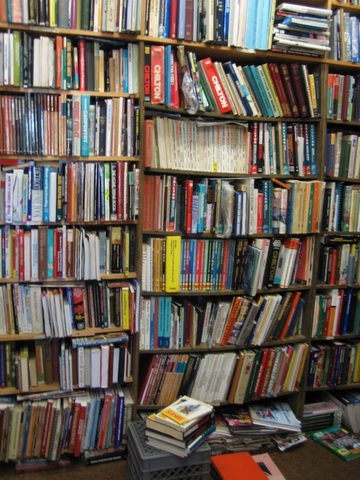
It's much the same with knowledge. In the past we had a limited number of books to read on a certain subject and they had all been approved by publishers. At school we usually had one book which we read our way through each year. Since that book was part of a national curriculum we all assumed that it contained the truth and nothing but the truth.We seldom had access to books which presented alternative interpretations. History was always presented with a strong national bias and our own country was seldom if ever presented as being "on the wrong side" in a war. If you read school history books from different countries describing the same conflict you wonder if you're reading about the same events. Take a look at encyclopedia entries from different countries and you'll see how villians become heroes depending on the nationality of the authors. Yet in the absence of any alternatives we all accepted our textbooks as the truth.
Today it's much more complicated. On the net we have access to an almost infinite variety of sources when researching; from all countries and from all political viewpoints. Who's telling the truth? Who's biased? Is anyone, even the most eminent professor, objective? When we had a limited choice of sources it all seemed so easy. Today we can see the complexity of most issues and reach the conclusion that there are many truths and no one solution to a problem.
The vast range of information on the net is of course bewildering and the fact that everyone and anyone can contribute is disturbing for many. Clearly there is no real "truth" and that only by reading a variety of accounts can we reach some kind of balanced interpretation. We should treat everything as one writer's contribution to a discussion. Everything is a blog post and you always have the write to comment. Instead of consuming knowledge by accepting what we read we should be entering the discussion and contributing to the development of knowledge. Maybe that is one of the key 21st century skills for schools to focus on.
Photo: Used books by babblingdweeb on Flickr, Creative Commons BY-ND-NC
Saturday, April 10, 2010
Outsourced grading
In a world where just about everything seems to have been outsourced it was no surprise to read in the Chronicle of Higher Education that a university in the US is sending student papers to India to be graded (Some papers are uploaded to Bangalore to be graded). Courses with hundreds of students make it impossible for the teachers to do all the grading and so there's now a company that will take strain by sending papers to Indian graduates to grade. The argument in favour of this is that it provides neutral assessment and allows the teachers more time for teaching and discussion with students. Another argument against teachers grading their own students is the risk of subjectivity and favoritism.
In reply to the Chronicle article is a blog post by Dean Dad on Inside Higher Ed, Outsourcing grading, claiming that this type of outsourcing is far from new. Larger universities have always used graduate students to grade undergraduate papers and whether these graduates are on campus or in Bangalore shouldn't really matter much. Neither should we claim that such outsourcing will lead to poorer quality in grading:
"I don't buy the 'quality' argument against it, either. If radiologists in India can read images, and programmers in India can work on developing and fixing incredibly sophisticated software, then surely some smart folks in India can handle some freshman comp papers. Seriously. Other information-based industries have endured outsourcing without the quality of the work suffering. Given the inarguable indifference with which our large universities have handled undergraduate teaching for so long, to suddenly get huffy and puffy about standards is disingenuous at best."
When education resembles industrial mass production as in classes of hundreds it is probably inevitable that industrial methods are used. The academic ideal is a low teacher student ratio but there is seldom the money to finance it. Curiously the smaller (and often less prestigious) institutions are the ones who can often offer closer student teacher contacts.
In reply to the Chronicle article is a blog post by Dean Dad on Inside Higher Ed, Outsourcing grading, claiming that this type of outsourcing is far from new. Larger universities have always used graduate students to grade undergraduate papers and whether these graduates are on campus or in Bangalore shouldn't really matter much. Neither should we claim that such outsourcing will lead to poorer quality in grading:
"I don't buy the 'quality' argument against it, either. If radiologists in India can read images, and programmers in India can work on developing and fixing incredibly sophisticated software, then surely some smart folks in India can handle some freshman comp papers. Seriously. Other information-based industries have endured outsourcing without the quality of the work suffering. Given the inarguable indifference with which our large universities have handled undergraduate teaching for so long, to suddenly get huffy and puffy about standards is disingenuous at best."
When education resembles industrial mass production as in classes of hundreds it is probably inevitable that industrial methods are used. The academic ideal is a low teacher student ratio but there is seldom the money to finance it. Curiously the smaller (and often less prestigious) institutions are the ones who can often offer closer student teacher contacts.
Tuesday, April 6, 2010
Goodbye cellphone

However the role of the cellphone has already changed radically. It is no longer primarily a device for voice communication. We still use terms like cellphone and mobile phone but will soon have to change our vocabulary. According to an article from The Guardian, A new first in mobile, mobile devices are now used more for data than for voice. We're using them to check websites, socialising on Facebook and Twitter, watching videos, taking and sharing photos and films and so on. The telephone function has officially been relegated to accessory. We can see this trend most clearly amongst teenagers where phone calls are few and far between and texting and instant messaging dominate. As George Siemens comments on his blog elearnspace:
"I would rather give up the call functionality of my phone than data/app functionality. My voice time is rather limited – I spend my time looking at my phone, rather than talking into it."
The moral of all this for education? It's time to revise our views on the use of mobile devices in school. It's time to take them out of quarantine and see them as the students' device of choice for net access. Instead of saying "take out your books and turn to page 54" we should be saying "switch on your mobiles and check this link."
Tuesday, March 30, 2010
Embracing Wikipedia
I wrote last week (Wikipedia goes undercover) about the increasing clandestine use of Wikipedia by students in spite of teachers' warnings that it isn't always academically reliable. The moral of the story for me is that if faculty don't completely trust sites like Wikipedia why not get involved to improve the shortcomings.
This is what is happening already at some universities and in particular the University of Denver according to an article in eCampus News, Journalism students turn to Wikipedia to publish stories. Journalism students there are given assignments to write new entries in Wikipedia that have to be thoroughly researched and referenced. As one student says about the assignment:
“I never considered how much research and knowledge actually has to go into a Wikipedia article to make them good sources. It was actually very tough researching the subject and turning it into a coherent entry for Wikipedia.”
Indeed if you are writing for a site that gets around 68 million visitors per month you can be sure that if you make a mistake someone out there will comment. One of the Denver teachers involved in this initiative comments on faculty suspicion of Wikipedia:
“One of the reasons I wanted to assign [writing Wikipedia entries] is to combat that view. I tell students to use it as an information portal … and you can see what information has been sourced and see that they’re reliable sources. Wikipedia can be a great resource.”
I don't think anyone is suggesting that Wikipedia can replace academic journals and reference works but it is definitely a great place to start if you want a good overview of a subject and links to further study.
This is what is happening already at some universities and in particular the University of Denver according to an article in eCampus News, Journalism students turn to Wikipedia to publish stories. Journalism students there are given assignments to write new entries in Wikipedia that have to be thoroughly researched and referenced. As one student says about the assignment:
“I never considered how much research and knowledge actually has to go into a Wikipedia article to make them good sources. It was actually very tough researching the subject and turning it into a coherent entry for Wikipedia.”
Indeed if you are writing for a site that gets around 68 million visitors per month you can be sure that if you make a mistake someone out there will comment. One of the Denver teachers involved in this initiative comments on faculty suspicion of Wikipedia:
“One of the reasons I wanted to assign [writing Wikipedia entries] is to combat that view. I tell students to use it as an information portal … and you can see what information has been sourced and see that they’re reliable sources. Wikipedia can be a great resource.”
I don't think anyone is suggesting that Wikipedia can replace academic journals and reference works but it is definitely a great place to start if you want a good overview of a subject and links to further study.
Thursday, March 25, 2010
Have we ever really paid for content?

I've just read a fascinating article by Mark McLaughlin in the Huffington Post called Audiences don't pay for content that has certainly made me think again. Here he claims that we've never really paid for content but we certainly pay for the distribution. Once we've paid the TV licence or cable fee we can watch as much TV as we want. We pay for the fact that a newspaper has been put together and sent to us but the content has been paid for by the advertisers (in some cases, like the small ads, that's us too). Radio is even more generous, being free or bundled into the TV licence, and we can listen to whatever we want. We happily pay for the equipment but not really the actual content.
Internet is, of course, far from free. We pay sometimes quite hefty fees for our broadband access, landline and cellular, as well as the cost of all of our computers, gaming consoles and mobile devices. Should we then face further charges for all the net content we access? It's a bit like buying a TV, paying the licence and cable company charges and then being asked to pay extra for every programme we watch.
Can advertising bear the costs of all this content? Can solutions like iTunes or Kindle provide attractive distribution solutions that we would be prepared to pay for? Can some of the internet access costs be used to finance some of the content too? No clear answers are available but I can't see the pay wall tactics of some newspapers having any effect as long as someone else is providing the news "for free". We'll just stop quoting these sources. There's no point sending a link to an article that your friends can't read.
McLaughlin doesn't have any clear solution either but it's an article that stimulates discussion. There's also the question of how all this effects education and the debate between advocates of open educational resources and those who want the university's material and research safely locked away behind passwords and journal subscriptions. The future is open but probably not free.
Photo by rhondda.p on Flickr CC BY NC
Subscribe to:
Posts (Atom)